
Results
-
 £73.60
West of the Mississippi - Dean Jones
There's always a sense of adventure about America that makes it a really exciting topic to write about. The 3 States that sprang to mind in bringing a piece of music together were: California, Hawaii and Texas.We start out our American journey on the West Coast....California has provided much in the way of film and music for over 100 years. Combining this sense of free expression with the 'Surfing' culture, this initial section of the piece has an easy-going, fun feel in a pop idiom. Maybe wearing some shades might be quite a good look for this section!We move even further West now to the island of Hawaii where the free and easy goes onto a new level! The use of chromatics is a feature of Hawaiian melodies and has a feel a 'sliding' between notes that somehow sums up this feel of living on a tropical island! Have some fun with this section and have a Hawaiian garland to wear!Back into the USA mainland, and the fabulous state of Texas! Here we have the concept of the old fashioned rodeo and the 'Wild West'. Even today, the culture of horses, cowboys and tales of adventure are celebrated in places such as Fort Worth. The music captures some of these themes and has a fun and enjoyment...some get your Cowboy hats at the ready and enjoy the finale!
Estimated dispatch 5-14 working days
-
 £60.99
Latin Dance Party - William Vean
In 'Latin Dance Party' William Vean takes us along to sunny, seemingly care-free places. Happy faces, catchy music, delicious drinks are images that come to mind when listening to this 'feel good' music which will either get you in a dreamy mood or make you want to step out onto the dance floor. To start we hear the first dance of Cuban origin 'Cha Cha Cha', cheerful, romantic, playful dance . The Cha Cha Cha is probably the most popular dance. Then we have the slower 'Bossa Nova' (new wave), a dance developed from the Samba rhythms with strong syncopation. We end with the 'Samba'. Samba is party. The samba is a mix of polka, Cuban habanera and Africanrhythms, born around 1910 in the slums of Rio de Janeiro, and every year the leading dance during the exuberant carnival.
Estimated dispatch 5-14 working days
-
 £56.90
Balkan Gipsies - Paul Voet
Gipsies are wizards with the fiddle. Eastern European folk musicians and gipsies are using a lot of brass in their music. Their brass ensembles are very impressive, so the link to brassbands is quickly made. Based on the folk theme of Manea Tsigailor all cornets join the theme in an up tempo 7/8 bar. Gathered around a campfire gipsies are telling stories and making music. When the lower brass is telling their story all others clap hands. All of a sudden a cornet soloist appears. When we return to the basic theme the story ends with some dazzling bars.
Estimated dispatch 5-14 working days
-
 £110.99
The Four Noble Truths - Philip Sparke
The Four Noble Truths are the most basic expression of the teaching of Buddha and therefore still form the guidelines for Buddhists to this day. The four truths are Dukkha, which describes times of major stress in our lives - birth, aging, desire and death; Samudaya which describes those parts of our life that induce stress, feeling, craving, desire; Nirodha which tells us how to eliminate those aspects of our lives which induce stress and Magga which describes the eight didciplines which can help us eliminate the origins of stress from our lives. It can be seen from these over-simplified definitions, that the Four Noble Truths fall into two pairs, the first two describingthe origins of stress and the second two describing how we can reduce stress. To reflect this, the four movements of this work are also combined into two pairs - two quick movements and two slow movements. A fascinating work from this great English composer.
Estimated dispatch 5-14 working days
-
 £109.99
The Power of the Megatsunami - Carl Wittrock
The word 'tsunami' is of Japanese origin. When you look it up in a dictionary, you will find that it means 'a great sea wave produced by submarine earth movement or volcanic eruption'. A megatsunami is the superlative of this awesome expressionof power that nature can create, and has catastrophic consequences. When Carl Wittrock completed this composition not many such big earth movements had occurred, but since then we have become all too familiar with the disastrousconsequences which a tsunami may have. On the 26th of December 2004 a heavy seaquake took place near the Indonesian island of Sumatra. Tidal waves 10 meters in height ravaged the coastal regions of many countries for miles around. The tsunamitook the lives of thousands of people and destroyed many villages and towns. There are more areas which run the risk of being struck by a tsunami, such as the island of La Palma, one of the Canary Islands. This island is based on oceaniccrust at a fracture zone and as such is one of nature's time bombs. The consequences of a natural calamity like a megatsunami are immense. In the case of La Palma, the tidal wave will move in the direction of South America, where it may reach 50km inland, destroying everything on its way. In his composition Wittrock describes an ordinary day which will have an unexpected ending. Right from the beginning there seems to be something in the air, the music creating an oppressiveatmosphere of impending disaster. Themes are interrupted, broken off suddenly, followed by silence, suggesting the calm before the storm. Suddenly a short climax (glissandi in the trombone part) indicates the seaquake, and the megatsunami isa fact. Hereafter follows a turbulent passage symbolising the huge rolling waves. After nature's force has spent itself, resignation sets in and the composition ends with a majestic ode to nature.
Estimated dispatch 5-14 working days
-
£84.99
Creamy and Crispy - Marc Cunningham
This composition of Marc Cunningham has four parts, and takes place on a sunny day in a picturesque town. 1. Promenade Many people walk through the city. The band passes through the streets. People are strolling along the avenues and amorous couples are sitting on a park bench. 2. Lovey Dovey One of these couples is knee-deep in love. 3. Crispy and Creamy Here the contrasts between a crisp staccato section in two-four time signature and a smooth legato section in three-four time signature are depicted. Is Crispy the boy and Creamy the girl? 4. Farewell In the last particle the couple says goodbye. We still think back tothe walk through the city. It sounds a little less happy now. Not everyone is good at saying goodbye, sometimes a tear flows.
Estimated dispatch 5-14 working days
-
 £115.60
Run Away - Hans Offerdal
This piece is about running away. First there is restlessness, then the escape begins. But what are we running away from? That is for you to find out!Playing time: appx. 4:30 To the conductor:There are challenges in the use of dynamics and rhythm. It is important that energy and pace is upheld all the way up until the next to last page. Dissonances are present several places, but the voice leading is diatonic within the given scale.The whole piece is based on one single scale: F melodic minor with lowered second degree. It is notated as a concert F major scale with two accidentals. Feel free to use it during warm-ups!
Estimated dispatch 5-14 working days
-
 £109.99
Fincastle Overture - Jan Bosveld
Fort Fincastle was built in 1793 by royal governor 'Lord Dunmore at an unusual location: Nassau, the capital of the Bahamas. The name of the fort: Fort Fincastle' comes from Dunmore's second title of Viscount Fincastle '( Earl of Fincastle). He gave the fort a particular shape, a circular building with a sharp expansion in the form of a bow or bow of ship. In order to deceive enemy ships. The sounds of the first bars show the contours of a looming majestic stronghold, after a heroic theme follows. Soon we hear the threat of hostile elements. Work on the fort means much waiting and lonely, but you should always alert and vigilant for the ever lurking attack. After the turn of yet another attack there is a feeling of satisfaction and pride, we see the fort are on the hill towering above Nassau.
Estimated dispatch 5-14 working days
-
 £56.50
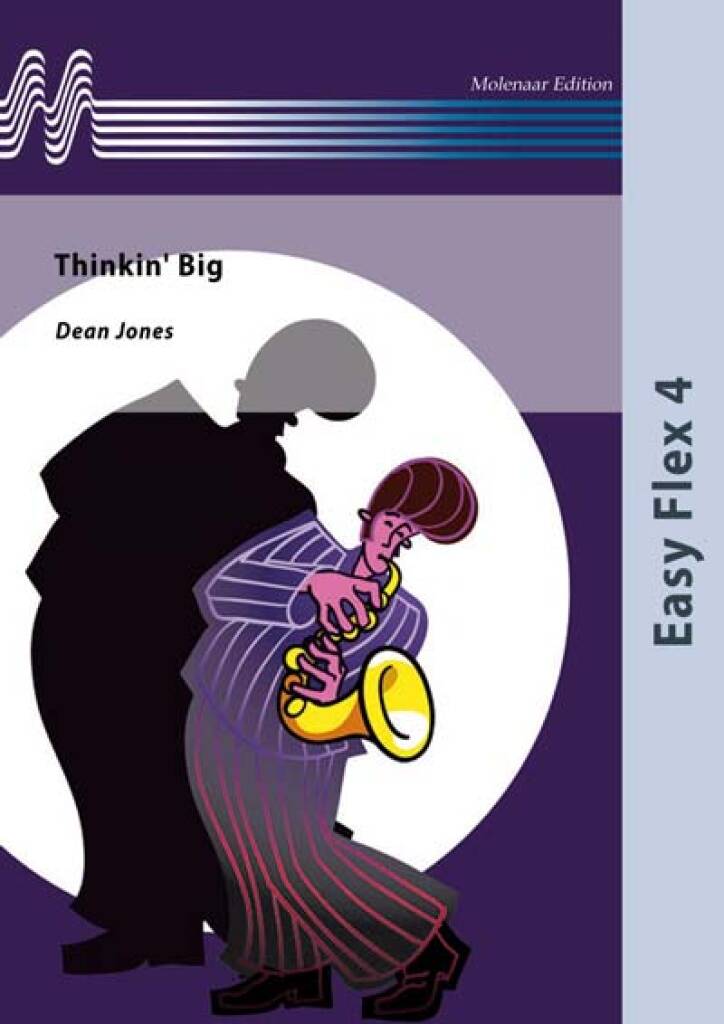
Thinkin' Big - Dean Jones
This is a piece for the bold and young dreamer! Growing up, we all have our wild ideas about what we can become as adults...and here are 3 such hero-like figures portrayed in this piece. The first is that of a 'Rock n roll star' in something of a 60s throwback idiom. The middle movement is gentle in approach and depicts the life of a Ballerina. Finally, the music reaches its conclusion with a trip to the 'Big Screen' with a few touches of Hollywood and the Red Carpet!
Estimated dispatch 5-14 working days
-
 £76.99
On the Movieset - John Emerson Blackstone
Glitter and glamour, good-looking people, a lot of Bling Bling and fast cars images like these will cross our minds when we think of the movie world. However, reality proves to be different : as a rule, a tremendous amount of work will have been done on the set before a film is ready to be shown on the big screen. A visit to an actual movie set inspired John Emerson Blackstone to write a composition bearing the same name. He had both seen a number of characteristic attributes and heard the typical phrases used in film making, and he incorporated them into 'On the Movie Set' . In the first part, 'The Clapboard', a 'director's assistant' is supposed to shout "Quieton the set'" and "Action!", as is done before a real scene is shot. Subsequently, in order to create the right atmosphere, the clacking of a 'Clapboard' should be heard. During a romantic scene we should be transported to another world by means of sweet sounds in the background, so romantic music is of course heard in the next part, 'Love Scene'. At the end of a long working day 'It's a wrap' is called on the set to inform everyone that the filming on that day is completed. Now there is only one more thing left to dream of : an Oscar..... Perf. Note: The use of the right props will add to the performance and appreciation of 'On the Movie Set'. A red carpet and a glamorous reception should give your audience the feeling they are attending a real 'opening night'!
Estimated dispatch 5-14 working days
 View Music