
Results
-
 £19.95
Danny Boy (Brass Quartet - Score and Parts)
Danny Boy or Londonderry Air is probably the most famous of all Ireland's folk songs. It is unclear when or who wrote the melody line but the words most commonly sung to the tune were penned by Englishman Frederick Weatherly in Somerset around the turn of the 20th Century.The true meanings of the lyrics are unclear and Weatherly never divulged their significance but it is most commonly believed that it is a message from a parent to a son traveling to war.The song has been covered in a wide variety of styles including recordings by Glenn Miller, Judy Garland, Johnny Cash, Cher, Eric Clapton and Charlotte Church to name but a few.This simple but effective arrangement will bring a touch of Ireland to any audience.
Estimated dispatch 7-14 working days
-
 £29.95
Judd: Anthem Of The Free
Prior to becoming a Salvation Army officer, Dean Goffin was the first Salvationist composer to gain a degree in music composition. This march was originally written for the 4th Brigade Band of the New Zealand Armed Forces (which Goffin conducted during World War Two) and called Bel Hamid before being adapted for Salvation Army use. The march contains the gospel song Ring the bells of heaven (...pealing forth the anthem of the free).
Estimated dispatch 7-14 working days
-
 £29.95
Judd: Lifestream
This march is modelled on the well-known American quick march called Midwest by J.J. Richards. The melody of the second subject is by the Danish hymn-writer, Sophie Hedvig Dedakam and is associated with words by Major Clara Vint who helped to establish En Evant, the French War Cry. The title of the march is derived from the text of the song.
Estimated dispatch 7-14 working days
-
£29.95
ANTHEM OF THE FREE (Brass Band Set) - Dean Goffin
Prior to becoming a Salvation Army officer, Dean Goffin was the first Salvationist composer to gain a degree in music composition. This march was originally written for the 4th Brigade Band of the New Zealand Armed Forces (which Goffin conducted during World War Two) and called Bel Hamid before being adapted for Salvation Army use. The march contains the gospel song Ring the bells of heaven (...pealing forth the anthem of the free).
Estimated dispatch 7-14 working days
-
£34.95
LIFESTREAM (Brass Band Set) - Ralph Pearce
This march is modelled on the well-known American quick march called Midwest by J.J. Richards. The melody of the second subject is by the Danish hymn-writer, Sophie Hedvig Dedakam and is associated with words by Major Clara Vint who helped to establish En Evant, the French War Cry. The title of the march is derived from the text of the song.
Estimated dispatch 7-14 working days
-
 £94.95
An Age of Kings (Mezzo-Soprano Solo with Brass Band and optional choir - Score and Parts) - Gregson, Edward
The origins of this work date back to 1988, when I was commissioned by the Royal Shakespeare Company to write the music for The Plantagenets trilogy, directed by Adrian Noble in Stratford-upon-Avon. These plays take us from the death of Henry V to the death of Richard III. Later, in 1991, I wrote the music for Henry IV parts 1 and 2, again in Stratford. All of these plays are concerned with the struggle for the throne, and they portray one of the most turbulent periods in the history of the British monarchy.Much of the music used in these productions was adapted into two large symphonic suites for wind band - The Sword and the Crown (1991) and The Kings Go Forth (1996). An Age of Kings is a new version for brass band incorporating music from both the symphonic suites for wind band. It was specially composed for a recording made by the Black Dyke Band, conducted by Nicholas Childs, in 2004.An Age of Kings is music on a large-scale canvas, scored for augmented brass band, with the addition of harp, piano, mezzo-soprano solo, male chorus, as well as two off-stage trumpets. The music is also organized on a large-scale structure, in three movements, which play without a break - "Church and State", "At the Welsh Court", and "Battle Music and Hymn of Thanksgiving".The first movement, "Church and State", opens with a brief fanfare for two antiphonal trumpets (off-stage), but this only acts as a preface to a Requiem aeternam (the death of Henry V) before changing mood to the English army on the march to France; this subsides into a French victory march, but with the English army music returning in counterpoint. A brief reminder of the Requiem music leads to the triumphal music for Richard Plantagenet, Duke of York, father of Edward IV and Richard III (the opening fanfare transformed). However, the mood changes dramatically once again, with the horrors of war being portrayed in the darkly-drawn Dies Irae and Dance of Death, leading to the final section of the first movement, a funeral march for Henry VI.The second movement, "At the Welsh Court", takes music from the Welsh Court in Henry IV part 1 with a simple Welsh folk tune sung by mezzo-soprano to the inevitable accompaniment of a harp. This love song is interrupted by distant fanfares, forewarning of battles to come. However, the folk song returns with variation in the musical fabric. The movement ends as it began with off-stage horn and gentle percussion.The final movement, "Battle Music and Hymn of Thanksgiving", starts with two sets of antiphonally placed timpani, drums and tam-tam, portraying the 'war machine' and savagery of battle. Trumpet fanfares and horn calls herald an heroic battle theme which, by the end of the movement, transforms itself into a triumphant hymn for Henry IV's defeat of the rebellious forces.- Edward GregsonDuration - 22'00"Optional TTBB available separately.
Estimated dispatch 7-14 working days
-
 £28.00
IT'S A LONG WAY TO TIPPERARY (Brass Band) - Kerwin, Simon
A great concert piece. "It's a Long Way to Tipperary" is a British music hall song written by Jack Judge and co-credited to, but not co-written by, Henry James "Harry" Williams. It was allegedly written for a 5 shilling bet in Stalybridge on 30 January 1912 and performed the next night at the local music hall. Judge's parents were Irish, and his grandparents came from Tipperary. It became popular among soldiers in the First World War and is remembered as a song of that war.
Estimated dispatch 7-14 working days
-
 £110.00
Diversions after Benjamin Britten (Brass Band - Score and Parts)
Suite by Lucy Pankhurst, Simon Dobson, Paul McGhee and Gavin HigginsHaving devised a collective centenary tribute for Michael Tippett at the 2006 RNCM Festival of Brass (Variations on a Theme of Michael Tippett by five eminent composers of brass band music, PHM002), I commissioned this companion piece as a Benjamin Britten tribute for the 2013 festival. In the late 1970s, while researching a book about the English composer, and Britten's first teacher, Frank Bridge (1879 - 1941), I came across a copy of the printed score of Benjamin Britten's Variations on a Theme of Frank Bridge (Op.10) for string orchestra, in which Britten had written descriptive titles for each of the variations suggesting appropriate character traits of his much loved mentor and guide. The character variations are cast in march, song and dance forms.Taking inspiration from Britten's youthful tribute, I invited four award-winning composers, who have all made significant contributions to the brass band medium, to create their own personal reflections on four aspects of Britten's character and music, designed to form a suite of Diversions after Benjamin Britten, but which can also be played separately.Lucy Pankhurst's hauntingly lyrical Prelude: His Depth refers to the emotional and symbolic subtexts that underpin Britten's operas, taking its musical cue from Britten's many arrangements of folk songs. The flugel horn takes a prominent role throughout.Simon Dobson's breathless Scherzo: His Vitality reminds us with its rapid passage work and leaping bass 'groove' that Britten loved tennis and fast cars in his younger days.Paul McGhee's evocative interpretation of the March: His Sympathy represents Benjamin Britten's pacifism, as the composer writes: 'We view the music through the eyes of a pacifist. Whilst war and violence surround us, we do not engage in it and though it continues to happen around us. With the use of muted effects in most of the band throughout the piece, the flugel horn is the lone voice of reason, standing firm against the mechanical and destructive society in which it is forced to live. As the machine of war continues around the lone voice, the voice is gradually dismissed and mocked as the war machine rumbles on into the distance.'In an extended finale, entitled Toccata: His Skill, Gavin Higgins celebrates Benjamin Britten's consummate creativity. For the RNCM Festival of Brass premiere, the four contrasting movements were framed and connected by Britten's Fanfare for St. Edmundsbury for three trumpets, with the trumpet soloists spaced round the hall. I am grateful to the Britten Estate and publishers Boosey & Hawkes for giving permission for the elements of Britten's fanfare to be incorporated in the collective work.- Paul HindmarshDuration: 19.30
Estimated dispatch 7-14 working days
-
£45.00
Diversions after Benjamin Britten (Brass Band - Score only)
Suite by Lucy Pankhurst, Simon Dobson, Paul McGhee and Gavin HigginsHaving devised a collective centenary tribute for Michael Tippett at the 2006 RNCM Festival of Brass (Variations on a Theme of Michael Tippett by five eminent composers of brass band music, PHM002), I commissioned this companion piece as a Benjamin Britten tribute for the 2013 festival. In the late 1970s, while researching a book about the English composer, and Britten's first teacher, Frank Bridge (1879 - 1941), I came across a copy of the printed score of Benjamin Britten's Variations on a Theme of Frank Bridge (Op.10) for string orchestra, in which Britten had written descriptive titles for each of the variations suggesting appropriate character traits of his much loved mentor and guide. The character variations are cast in march, song and dance forms.Taking inspiration from Britten's youthful tribute, I invited four award-winning composers, who have all made significant contributions to the brass band medium, to create their own personal reflections on four aspects of Britten's character and music, designed to form a suite of Diversions after Benjamin Britten, but which can also be played separately.Lucy Pankhurst's hauntingly lyrical Prelude: His Depth refers to the emotional and symbolic subtexts that underpin Britten's operas, taking its musical cue from Britten's many arrangements of folk songs. The flugel horn takes a prominent role throughout.Simon Dobson's breathless Scherzo: His Vitality reminds us with its rapid passage work and leaping bass 'groove' that Britten loved tennis and fast cars in his younger days.Paul McGhee's evocative interpretation of the March: His Sympathy represents Benjamin Britten's pacifism, as the composer writes: 'We view the music through the eyes of a pacifist. Whilst war and violence surround us, we do not engage in it and though it continues to happen around us. With the use of muted effects in most of the band throughout the piece, the flugel horn is the lone voice of reason, standing firm against the mechanical and destructive society in which it is forced to live. As the machine of war continues around the lone voice, the voice is gradually dismissed and mocked as the war machine rumbles on into the distance.'In an extended finale, entitled Toccata: His Skill, Gavin Higgins celebrates Benjamin Britten's consummate creativity. For the RNCM Festival of Brass premiere, the four contrasting movements were framed and connected by Britten's Fanfare for St. Edmundsbury for three trumpets, with the trumpet soloists spaced round the hall. I am grateful to the Britten Estate and publishers Boosey & Hawkes for giving permission for the elements of Britten's fanfare to be incorporated in the collective work.- Paul HindmarshDuration: 19.30
Estimated dispatch 7-14 working days
-
 £54.99
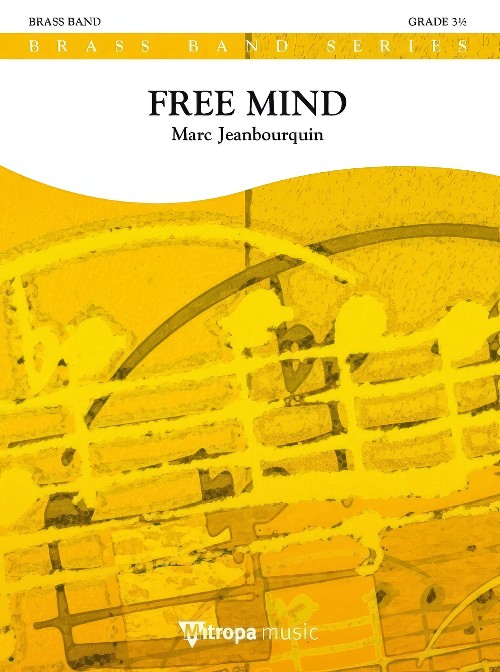
Free Mind (Brass Band - Score and Parts) - Jeanbourquin, Marc
For Free Mind, a light and dynamic piece, Marc Jeanbourquin drew inspiration from a gospel song, namely "Oh, Freedom", a post-Civil War African-American freedom song. In these times of crisis, the composer wanted to retain a positive and energetic spirit to symbolise the hope for better days. The four notes of the theme "Oh, Freedom" occur throughout the work and are brightened up by lively percussions, giving Free Mind a sparkling character that will lift the opening of a concert with enthusiasm. Duration: 3.00
Estimated dispatch 7-14 working days
 View Music