
Results
-
 £45.00
Diversions after Benjamin Britten (Brass Band - Score only)
Suite by Lucy Pankhurst, Simon Dobson, Paul McGhee and Gavin HigginsHaving devised a collective centenary tribute for Michael Tippett at the 2006 RNCM Festival of Brass (Variations on a Theme of Michael Tippett by five eminent composers of brass band music, PHM002), I commissioned this companion piece as a Benjamin Britten tribute for the 2013 festival. In the late 1970s, while researching a book about the English composer, and Britten's first teacher, Frank Bridge (1879 - 1941), I came across a copy of the printed score of Benjamin Britten's Variations on a Theme of Frank Bridge (Op.10) for string orchestra, in which Britten had written descriptive titles for each of the variations suggesting appropriate character traits of his much loved mentor and guide. The character variations are cast in march, song and dance forms.Taking inspiration from Britten's youthful tribute, I invited four award-winning composers, who have all made significant contributions to the brass band medium, to create their own personal reflections on four aspects of Britten's character and music, designed to form a suite of Diversions after Benjamin Britten, but which can also be played separately.Lucy Pankhurst's hauntingly lyrical Prelude: His Depth refers to the emotional and symbolic subtexts that underpin Britten's operas, taking its musical cue from Britten's many arrangements of folk songs. The flugel horn takes a prominent role throughout.Simon Dobson's breathless Scherzo: His Vitality reminds us with its rapid passage work and leaping bass 'groove' that Britten loved tennis and fast cars in his younger days.Paul McGhee's evocative interpretation of the March: His Sympathy represents Benjamin Britten's pacifism, as the composer writes: 'We view the music through the eyes of a pacifist. Whilst war and violence surround us, we do not engage in it and though it continues to happen around us. With the use of muted effects in most of the band throughout the piece, the flugel horn is the lone voice of reason, standing firm against the mechanical and destructive society in which it is forced to live. As the machine of war continues around the lone voice, the voice is gradually dismissed and mocked as the war machine rumbles on into the distance.'In an extended finale, entitled Toccata: His Skill, Gavin Higgins celebrates Benjamin Britten's consummate creativity. For the RNCM Festival of Brass premiere, the four contrasting movements were framed and connected by Britten's Fanfare for St. Edmundsbury for three trumpets, with the trumpet soloists spaced round the hall. I am grateful to the Britten Estate and publishers Boosey & Hawkes for giving permission for the elements of Britten's fanfare to be incorporated in the collective work.- Paul HindmarshDuration: 19.30
Estimated dispatch 7-14 working days
-
 £119.99
Bellum et Pax (Brass Band - Score and Parts) - Roels, Stijn
Bellum et Pax is a composition describing the two ancient concepts of 'war' and 'peace.' While this piece appears to be one single movement, it consists of four sections that flow into one another. Mysterious and threatening tones lead the way into an epic battle between the chaos of war and enlightenment of peace. Peace triumphs, but menacing bass notes at the end symbolise the constant presence and threat of war and violence in the world.Duration: 11:45
Estimated dispatch 7-14 working days
-
 £44.95
Reflections (Flugel and Tenor Horn Duet with Brass Band - Score and Parts) - Graham, Peter
Duet for Flugel and Tenor Horn or Two Bb Cornets from War of the Worlds SuiteEach movement of War of the Worlds is available separately allowing for a variety of "mini-suite" combinations eg: Movements 1,2 and 5 or 3,4 and 5 etc. For movements 1, 4 and 5 see the BB Concert Music tab. Complete suite also available.Reflections is the second movement of the suite War of the Worlds which was commissioned by the Senzoku Gakuen College of Music Saxophone Orchestra and first performed by them in the Maeda Hall, Japan on June 29 2012, the composer conducting. The music is dedicated to Professor Shin-ichi Iwamoto. The transcription for brass band was first performed by the Brighouse & Rastrick Band, conductor David King, in the Bridgewater Hall Manchester on September 8 2012.The suite takes inspiration from the 1953 film script adaptation of the famous HG Wells novel and key scenes from the film are set as individual movements: Reflections - here mankind contemplates a life forever changed as the invaders progress their colonisation of Planet Earth.
Estimated dispatch 7-14 working days
-
 £124.95
Diary of a Madman (Twenty-Fourth February) (Brass Band - Score and Parts) - Clarke, Nigel
From the beginning of history, warlords, emperors and dictators have risen up, some benign but many of them a scourge on humanity. Names that resonate to this day include Julius Caesar, Caligula, Genghis Khan, Ivan IV (The Terrible), Attila the Hun, Vlad IV (The Impaler), Hitler, Stalin, Mao Zedong, Pol Pot, all of whom were responsible for wanton destruction and the torture and death of millions of victims, either citizens of invaded countries and territories and or indeed, their own peoples.Diary of a Madman starts with a light-hearted march that gives the impression of toy tin soldiers parading in a brightly-coloured ceremonial pageant from a fairy tale, conveying peace and innocence. This spectacle is abruptly interrupted by a 'shock and awe' fanfare-like march, symbolising aggression and war. This theme grinds slowly to a halt, and an atmosphere of introspection, sadness and despair takes over. Rising above the smoky theatre of war, we then hear a distant cornet give a rendition of the Ukrainian Nation Anthem (The glory and freedom of Ukraine has not yet perished. Luck will still smile on us brother-Ukrainians). The solo cornet soon enters a fragile duet with a second cornet accompanied by dark undertones. One by one, we hear short shards of aggressive fanfare-like figures from various instruments in the band. The mood breaks - we hear strident fortissimo whole-tone scales representing pealing church bells, warning of danger. In contrast, we also hear pianissimo whole-tone scales announcing that the enemy's troops are falling back. A counter-offensive soon takes centre stage, and battles and skirmishes are heard, with short quotations from Mussorgsky's `Great Gates of Kyiv' symbolising the defenders' heroic struggle.All sides are victims of the Dictator's ambition! The slow central section offer us moments of melancholic beauty and utilises Henry Purcell's `When I am laid in earth' (`Dido's Lament' from Dido and Aeneas 1688). This music represents the loss of homes, dignity and loved ones. There are occasional hints at better times as the theme of the parading toy tin soldiers is heard from afar, like a distant memory.To announce the final push, we hear a church bell strike and an air raid siren signalling a ferocious musical counter-attack. After one final rendition of the Purcell theme, Diary of a Madman closes with a mood of triumph over tyranny.- Nigel Clarke
Estimated dispatch 7-14 working days
-
£57.95
Diary of a Madman (Twenty-Fourth February) (Brass Band - Score only) - Clarke, Nigel
From the beginning of history, warlords, emperors and dictators have risen up, some benign but many of them a scourge on humanity. Names that resonate to this day include Julius Caesar, Caligula, Genghis Khan, Ivan IV (The Terrible), Attila the Hun, Vlad IV (The Impaler), Hitler, Stalin, Mao Zedong, Pol Pot, all of whom were responsible for wanton destruction and the torture and death of millions of victims, either citizens of invaded countries and territories and or indeed, their own peoples.Diary of a Madman starts with a light-hearted march that gives the impression of toy tin soldiers parading in a brightly-coloured ceremonial pageant from a fairy tale, conveying peace and innocence. This spectacle is abruptly interrupted by a 'shock and awe' fanfare-like march, symbolising aggression and war. This theme grinds slowly to a halt, and an atmosphere of introspection, sadness and despair takes over. Rising above the smoky theatre of war, we then hear a distant cornet give a rendition of the Ukrainian Nation Anthem (The glory and freedom of Ukraine has not yet perished. Luck will still smile on us brother-Ukrainians). The solo cornet soon enters a fragile duet with a second cornet accompanied by dark undertones. One by one, we hear short shards of aggressive fanfare-like figures from various instruments in the band. The mood breaks - we hear strident fortissimo whole-tone scales representing pealing church bells, warning of danger. In contrast, we also hear pianissimo whole-tone scales announcing that the enemy's troops are falling back. A counter-offensive soon takes centre stage, and battles and skirmishes are heard, with short quotations from Mussorgsky's `Great Gates of Kyiv' symbolising the defenders' heroic struggle.All sides are victims of the Dictator's ambition! The slow central section offer us moments of melancholic beauty and utilises Henry Purcell's `When I am laid in earth' (`Dido's Lament' from Dido and Aeneas 1688). This music represents the loss of homes, dignity and loved ones. There are occasional hints at better times as the theme of the parading toy tin soldiers is heard from afar, like a distant memory.To announce the final push, we hear a church bell strike and an air raid siren signalling a ferocious musical counter-attack. After one final rendition of the Purcell theme, Diary of a Madman closes with a mood of triumph over tyranny.- Nigel Clarke
Estimated dispatch 7-14 working days
-
 £79.95
The Lost Village of Imber (Brass Band - Score and Parts) - Bond, Christopher
The Lost Village of Imber was commissioned by Bratton Silver Band in 2019 in celebration of 160 years of the band; 1859-2019. Structured in three movements, the complete work was premiered by Cory Band at Wiltshire Music Centre in February 2020.The village of Imber on Salisbury Plain had been inhabited for over one thousand years when it was evacuated in 1943 to make way for military training in the Second World War. At the time, with preparations for the Allied invasion of Europe underway, most villagers put up no resistance, despite being upset, with the belief that they'd return once the war had concluded. To this day, Imber and its surrounding land remain a military training ground. The villagers never returned, and just the shell of what was once a community remains.Structured in three movements, it is on this very real story that the work is based, setting out the series of events of 1943 in chronological order.The first movement, On Imber Downe, portrays a sense of jollity and cohesiveness, a community of individuals living and working together before news of the evacuation had broken. Sounds of the village are heard throughout, not least in a series of percussive effects, the anvil of the blacksmith; the cowbell of the cattle and the bells of the church.The second movement, The Church of St. Giles, begins mysteriously and this sonorous, atmospheric opening depicts Imber in its desolate state and the apprehension of residents as they learn they have to leave their homes. Amidst this is the Church, a symbol of hope for villagers who one day wish to return, portrayed with a sweeping melodic passage before the music returns to the apprehension of villagers facing eviction around their sadness at losing their rural way of life.In complete contrast, the third movement, Imemerie Aeternum, portrays the arrival of the military, complete with the sounds of the ammunition, firing and tanks, sounds which were all too familiar to those living in the surround areas. To close, the Church of St. Giles theme returns in a triumphant style, representing the idea that the church has always been, even to this day, a beacon of hope for the villagers and local community, both the centrepiece and pinnacle of a very real story.Duration: 13.30
Estimated dispatch 7-14 working days
-
 £144.99
No Man's Land (Brass Band - Score and Parts) - Deleruyelle, Thierry
No Man's Land was commissioned by the Noordlimburgse Brass Band. Thierry Deleruyelle has written this work in 2018, 100 years after the end of World War I. This work is related to his first work written for brass band, Fraternity, which tells the story about the mining accident in Courieres, France. Eight years later, World War I broke out. Instead of helping each other, no man's land arose.Duration: 19.30
Estimated dispatch 7-14 working days
-
 £94.95
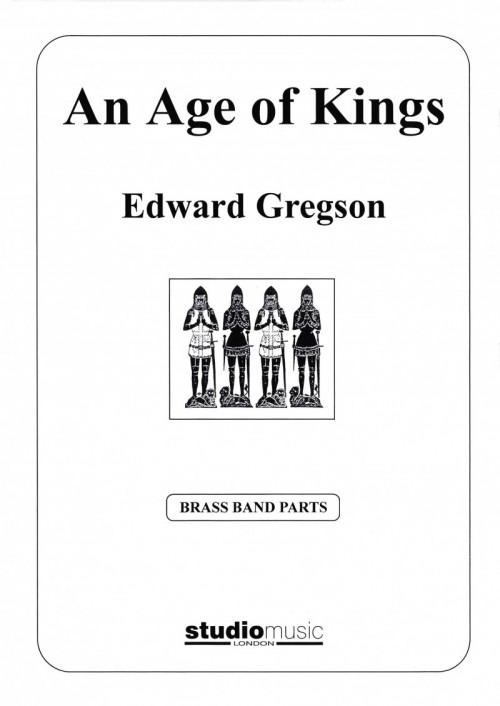
An Age of Kings (Mezzo-Soprano Solo with Brass Band and optional choir - Score and Parts) - Gregson, Edward
The origins of this work date back to 1988, when I was commissioned by the Royal Shakespeare Company to write the music for The Plantagenets trilogy, directed by Adrian Noble in Stratford-upon-Avon. These plays take us from the death of Henry V to the death of Richard III. Later, in 1991, I wrote the music for Henry IV parts 1 and 2, again in Stratford. All of these plays are concerned with the struggle for the throne, and they portray one of the most turbulent periods in the history of the British monarchy.Much of the music used in these productions was adapted into two large symphonic suites for wind band - The Sword and the Crown (1991) and The Kings Go Forth (1996). An Age of Kings is a new version for brass band incorporating music from both the symphonic suites for wind band. It was specially composed for a recording made by the Black Dyke Band, conducted by Nicholas Childs, in 2004.An Age of Kings is music on a large-scale canvas, scored for augmented brass band, with the addition of harp, piano, mezzo-soprano solo, male chorus, as well as two off-stage trumpets. The music is also organized on a large-scale structure, in three movements, which play without a break - "Church and State", "At the Welsh Court", and "Battle Music and Hymn of Thanksgiving".The first movement, "Church and State", opens with a brief fanfare for two antiphonal trumpets (off-stage), but this only acts as a preface to a Requiem aeternam (the death of Henry V) before changing mood to the English army on the march to France; this subsides into a French victory march, but with the English army music returning in counterpoint. A brief reminder of the Requiem music leads to the triumphal music for Richard Plantagenet, Duke of York, father of Edward IV and Richard III (the opening fanfare transformed). However, the mood changes dramatically once again, with the horrors of war being portrayed in the darkly-drawn Dies Irae and Dance of Death, leading to the final section of the first movement, a funeral march for Henry VI.The second movement, "At the Welsh Court", takes music from the Welsh Court in Henry IV part 1 with a simple Welsh folk tune sung by mezzo-soprano to the inevitable accompaniment of a harp. This love song is interrupted by distant fanfares, forewarning of battles to come. However, the folk song returns with variation in the musical fabric. The movement ends as it began with off-stage horn and gentle percussion.The final movement, "Battle Music and Hymn of Thanksgiving", starts with two sets of antiphonally placed timpani, drums and tam-tam, portraying the 'war machine' and savagery of battle. Trumpet fanfares and horn calls herald an heroic battle theme which, by the end of the movement, transforms itself into a triumphant hymn for Henry IV's defeat of the rebellious forces.- Edward GregsonDuration - 22'00"Optional TTBB available separately.
Estimated dispatch 7-14 working days
-
 £76.99
Suite from Miss Saigon (Brass Band - Score and Parts) - Schonberg, Claude-Michel - Waignein, Andre
The musical Miss Saigon was a massive hit in London, Broadway and throughout the world. Based on Puccini's opera, Madame Butterfly, this epic production centres on the romance between a strong-willed Vietnamese woman and an American soldier during the Vietnam War. The story tells of two young lovers torn apart by war yet still held together by a burning passion. This medley features three of the best songs from the musical and mixes desperate love with optimism and joy. Relive the hit show with this catchy medley.Duration: 10:30
Estimated dispatch 7-14 working days
-
 £60.99
Song of Liberation (Brass Band - Score and Parts) - De Haan, Jacob
A composition with the liberation from the Second World War as its theme. After a solemn introduction one hears the melody of the hymn Abide with you, which was sung a lot during the war. Following there are variations on the theme, finally leading to the magisterial conclusion that represents the ultimate liberation. The work may be interpreted as popular music (with the part for drumset), but a more serious version without drums is possible and, indeed, preferable.Duration: 4:45
Estimated dispatch 7-14 working days
 View Music