
Results
-
 £50.00
Overture for Brass - Franzetti
Carlos Franzetti was born in 1948, in Buenos Aires, Argentina. He worked along with Paquito D'Rivera, Joe Farrell, and among other talented artists, composing the soundtracks for Beat Street, Misunderstood, and theMambo Kings and arranging for the Boston Pops Orchestra, Carnegie Hall Jazz Band, and the American Symphony Orchestra. This sheet music, arranged by Mark Freeh, includes a full instrumentation: Full score Soprano Cornet in Eb Solo Cornets in Bb Repiano Cornet in Bb 2nd and 3rd Cornets in Bb Flugelhorn Solo Horn 1st and 2nd Horn inEb1st and 2nd Baritone in Bb 1st and 2nd Trombone in Bb Bass Trombone Euphoniums in Bb Bass in Eb and Bb Timpani Percussion World Parts Includes : Horn in F 1st and 2nd Baritone 1st and 2nd Trombone Bass Trombone Euphoniums Bass in Eb and Bb
Estimated dispatch 5-14 working days
-
 £127.30
Love? Magic With a Capital M - Frode Rydland
Imagine an extravagant magic show at Caesar's Palace in Las Vegas. All shows like this feature great superstars as guest artists. For instance, it can be Celine Dion and Josh Groban who enters the stage for a duet...Love... Magic with a capital M is a ballad for an imaginary magic show where the great stars are flugelhorn and trombone.A bit different stage setup, a bit of choreography, a bit of singing and a lot of sweet music!The Choir parts are intended to be sung by the band. But if your concert features a choir, you may add the choir to this performance.This music was written for Norwegian band Eikanger-Bjorsvik Musikklag for their winning program "MAGIC!", performed at the Norwegian equivalent to Brass in Concert, Siddis Brass in 2019.
Estimated dispatch 5-14 working days
-
 £70.00
Tango - Gavin Higgins
Tango for Trumpet and Trombone solos with Brass Band accompaniment was written for Ian Porthouse and Brett Baker in 2008. The first performance was given by the Black Dyke Bandconducted by Nicholas Childs, at the Black Dyke Brass Arts Festival. Brass Band Grade 5: 1st Section Duration: 9 minutes
Estimated dispatch 5-14 working days
-
 £39.95
Harlem Nocturne
While an arranger with the Ray Noble Orchestra in 1939, Earle Hagen composed the unforgettably sultry "Harlem Nocturne" which has lived on and on through various guises and performers. Here is published a version by that well know British trombonist and arranger, Bill Geldard, for solo tenor trombone and brass band.
Estimated dispatch 5-14 working days
-
 £44.50
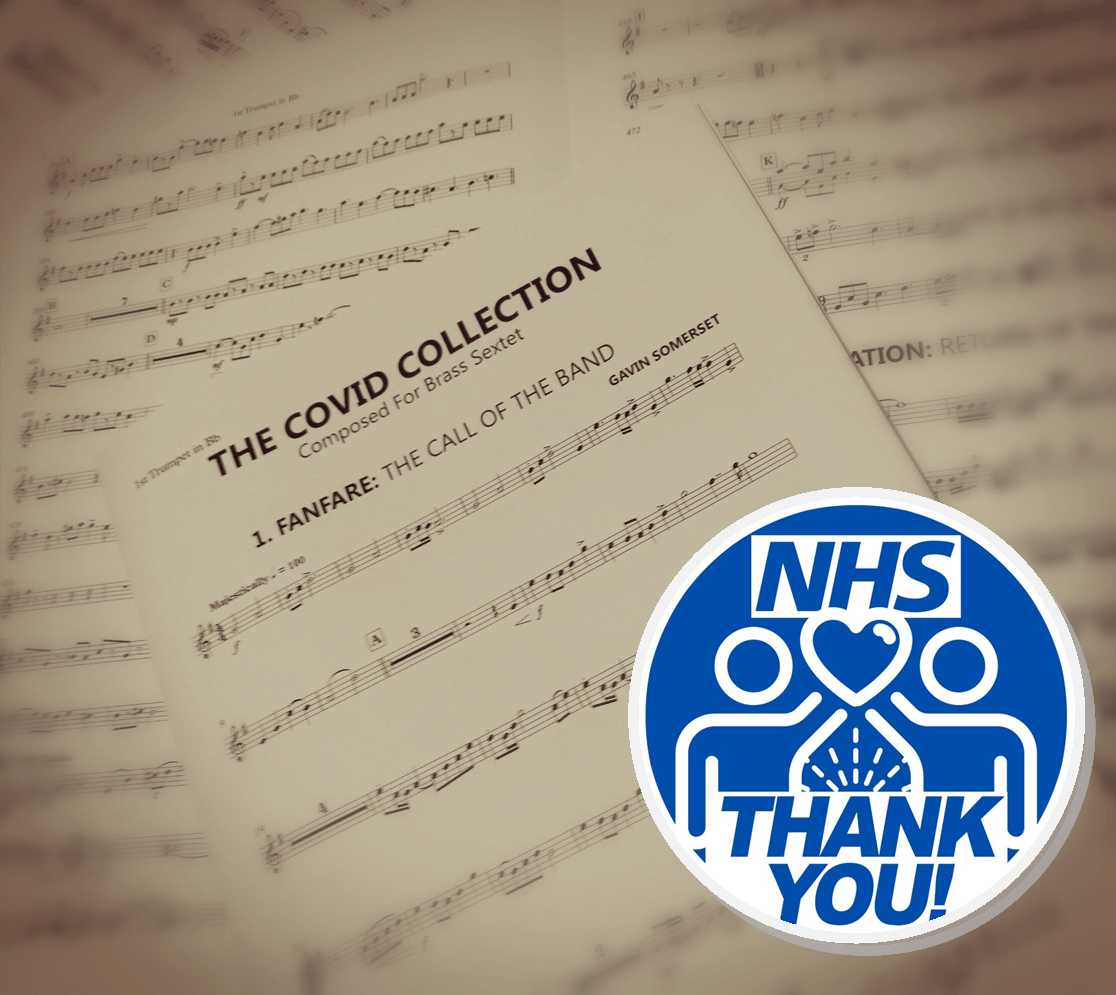
The Covid Collection - Gavin Somerset
This exciting new 22-minute concert suite for Brass Sextet has been composed during the months of lockdown charting the feelings of a nation, with seven movements playable by 6 (or more) players. The music was composed with the intention for players to perform either together live in a small group, in isolation by way of a virtual performance (downloadable backing tracks are available to play along to) and ultimately, to give players something to enjoy as we all miss our brass band families. This concert suite is the perfect addition to all bands' libraries at a time when rehearsals are limited. Several of the movements are already in preparation for a full band edition to be released at a later date: (also available as a digital download worldwide - purchase now & print to play). Bands purchasing this sextet edition will be eligible for a discount on the upcoming full brass band edition of the concert suite. ------------------------------------------------------------------------------------- Movement 1: FANFARE: The Call of the Band - CLICK HERE TO DOWNLOAD PLAYBACK TRACK This opening fanfare gives way to a full of life and energy. With catchy melodies and harmonies, it is an effective opening to any concert programme and the perfect way to begin the Suite. Movement 2: March of the Antibodies - CLICK HERE TO DOWNLOAD PLAYBACK TRACK A cheeky little number that keeps on fighting though. Whilst not a March in the traditional brass band sense, players should aim to give a 'happy' performance of this movement ensuring smiles all around for both performers and the audience.Movement 3: Solidarity - CLICK HERE TO DOWNLOAD PLAYBACK TRACK The first slow movement of the concert suite aims to reflect on the isolation many of us felt during the time of lockdown. However, during these times, walks out with loved ones allowed many to connect and enjoy downtime, not often afforded to many. Movement 4: Lazy Days - CLICK HERE TO DOWNLOAD PLAYBACK TRACK A movement whose title really does say it all. A laid back swing number that should be played in an as relaxed manner, as possible!Movement 5: Hymn for Carers (Dedicated to the NHS & Care Workers) - CLICK HERE TO DOWNLOAD PLAYBACK TRACK Dedicated to the NHS & Care Workers, this hymn tune is filled with emotional highs and lows, felt by many of the hospital and care staff who worked tirelessly to keep our people safe, with a timely nod at the end to Vera Lynn & our missed VE day commemorations. Movement 6: Army of the Keyworkers - CLICK HERE TO DOWNLOAD PLAYBACK TRACK A stirring work in 12/8 which rightfully, depicts our heroes who kept the country moving through the most difficult of times. An heroic number for players to enjoy.Movement 7: CELEBRATION: Return of the Band - CLICK HERE TO DOWNLOAD PLAYBACK TRACK Little needs to be said about this movement, as at this time of release, we cannot yet celebrate the return of all players to the band rooms across the country. However, when that time comes, this movement is to be played with the joy of normality we shall all feel. CLICK HERE TO DOWNLOAD THE FULL SUITE BACKING TRACK ------------------------------------------------------------------------------------- Each movement can be performed as a standalone item, or form part of the full 22-minute concert suite. Sextet scored for: x1 Cornet I in Bbx1 Cornet 2 in Bb1x Flugelhorn1x Tenor Horn in Eb1x Euphonium/Baritone in Bb1x Eb Bass*extra parts included are, Cornet parts in Eb & C, Horn in F, Euphonium/Baritone in BC, Trombone (TC and BC), BBb Bass in TC & Tuba in BC.
In Stock: Estimated dispatch 1-3 working days
-
 £29.50
Bravo Bones! - John Barber
This fresh new Trombone trio is the perfect way to liven up any concert or contest programme. Composed with a swing feel throughout, John Barber's work brings a modern feel to the brass band repertoire and will allow trombone sections of most abilities the chance to shine. The music is lively throughout and will have your audiences feet tapping along in a work that belongs in every band's library.
In Stock: Estimated dispatch 1-3 working days
-
 £33.20
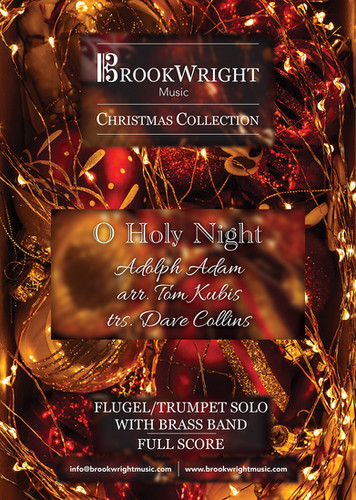
O Holy Night (Flugel/Trumpet Solo with Band) arr. Tom Kubis trs. Dave Collins
This stunning arrangement of O Holy Night, showcases the lyrical and expressive potential of the Flugel Horn or Trumpet, arranged by acclaimed jazz composer Tom Kubis and transcribed by Dave Collins. Originally made famous by the legendary Wayne Bergeron with the Tom Kubis Big Band, this arrangement has since become a favourite among brass soloists worldwide. It received its concert premiere with the North York Temple Band (Canada) under Bandmaster Glenn Barlow, featuring the virtuosic talents of Marcus and Harrington Venables. The piece was later recorded by the International Staff Band, conducted by Dr. Stephen Cobb, on their 2016 album Celebrate the Season. The featured soloist on that recording was the world-renowned Philip Cobb. This arrangement offers flexible performance options - it can be presented as a solo feature or as a duet for Flugel Horn and Soprano Cornet (cued into the parts), making it ideal for both concert settings and festive performances. To view a video of Philip Cobb performing the solo with the International Staff Band, please visit www.youtube.com/watch?v=1x_hjZyDjrA&list=RD1x_hjZyDjrA&start_radio=1 Duration: approx. 3.45 minutes Difficulty Level: 3rd Section + PDF download includes parts and score. Sheet music available at www.brassband.co.uk (UK) or https://satradecentral.org (USA) Instrumentation: Flugel Horn/Trumpet Soloist Bb Soprano Cornet Eb Solo Cornet Bb Repiano Cornet Bb 2nd Cornet Bb 3rd Cornet Bb Flugel Horn Bb Solo Horn Eb 1st Horn Eb 2nd Horn Eb 1st Baritone Bb 2nd Baritone Bb 1st Trombone Bb 2nd Trombone Bb Bass Trombone Euphonium Bb Bass Eb Bass Bb Bass Drum Percussion 1-3
In Stock: Estimated dispatch 1-3 working days
-
 £15.00
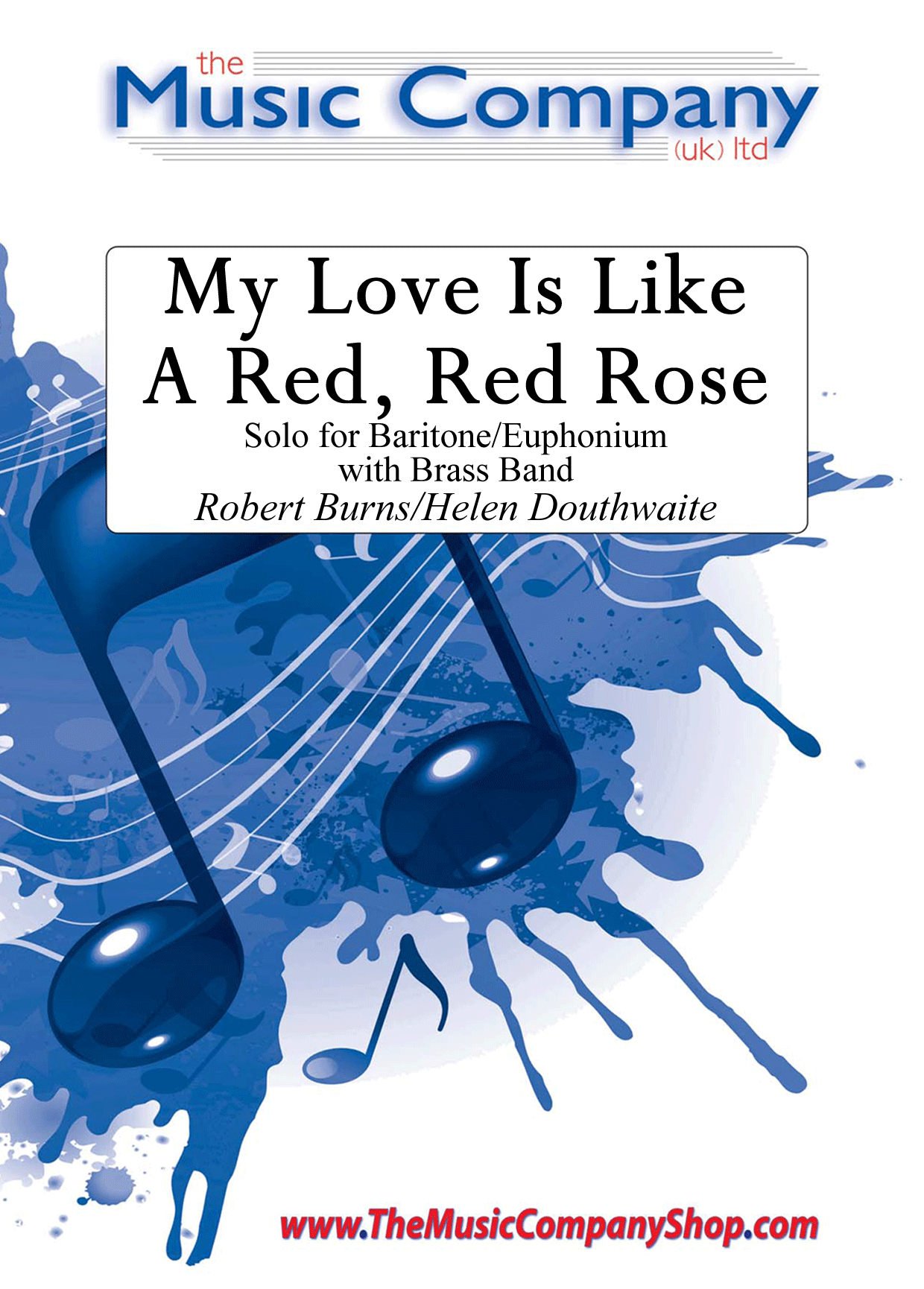
My Love is Like a Red, Red Rose - Helen Douthwaite
Robert Burns' beautiful melody is brought to life as a euphonium solo with brass band accompaniment in this simple, yet highly effective, arrangement by Helen Douthwaite.Originally arranged by Helen for the Kirkintilloch Youth Band, the piece not only features the soloist with a carefully crafted, accessible solo line, but also enables the rest of the band to shine through the tutti elements.Set includes score and parts for:Solo CornetRepiano Cornet2nd Cornet3rd CornetFlugelhornSolo Eb Tenor Horn1st Eb Tenor Horn2nd Eb Tenor Horn1st Baritone2nd Baritone1st Trombone2nd TromboneBass TromboneEuphoniumEb BassBb Bass (optional)GlockenspielPercussionAdditional world parts also provided include F Horn 1/2/3, Baritone 1/2 in bass clef, Trombone 1/2 in bass clef, Euphonium in bass clef, Tuba.
In Stock: Estimated dispatch 3-5 working days
-
 £30.00
That Moaning Trombone - Carl D Bethel, Sandy Coffin
Comic March One-StepCommissioned by John Wallace, this arrangement of That Moaning Trombone has been crafted by Sandy Coffin through close listening of the available recordings of the Harlem Hellfighters Band. Sandy had been heavily involved with the Historic Brass Society symposium 2017 held in New York and assisted John with his research on this fascinating band and the style of music it generated.Eye-witness accounts refer to the 369th band 'dancing' rather than 'marching'. Above all, in modern performance, finding a 'dancing beat' is crucial to a successful performance of this Ragtime march in order to do justice to the great pioneering work of James Reese Europe.Note the the reckless abandon with which glissando, at that time a novel effect, is used!Look and Listen (courtesy of the Tullis Russell Mills Band):Background to the Harlem HellfightersThe US Army 369th Regiment, made up largely of African-Americans from New York, became known as the Harlem Hellfighters because of the heroic reputation which accrued to them during the actions they engaged in during the First World War in Europe.James Reese Europe was one of the most active African-American composer/musical directors in the pre-war American music scene. The legendary Harlem Hellfighters Band, which he assembled in 1917 from African-American and Puerto Rican musicians, came at an important transitional point in musical history. A new form of music called jazz was emerging from Ragtime and the performing style of Europe's band was immersed in the flow of this new direction.Europe's Harlem Hellfighters influenced and inspired everyone who heard them, including the welcoming crowd when they disembarked in France, bowled over by their swinging rendition of La Marseillaise. Reese Europe became a war hero, commanding a machine-gun unit as well as the band.On return from War in 1919 the band led a ticker-tape parade along Fifth Avenue in New York and soon made about 30 shellac recordings. These recordings display some of the fingerprints of their performing style: ragging, improvising, muting, wailing, smearing (their word for glissando) - and from the evidence of their recordings they took the printed page as a blueprint for individuality.In May 1919 during the Hellfighters' triumphant coast-to-coast tour after their return, James Reese Europe was tragically murdered, bringing to premature close, at the age of 39, the work of a great musical innovator.
In Stock: Estimated dispatch 3-5 working days
-
 £39.99
Amid the Cold Of Winter- The Rose ("Es ist ein Ros entsprungen")
ABOUT THIS PIECE: Introduce a touch of elegance to your Christmas programme with Amid the Cold of Winter - The Rose, a beautiful arrangement of the traditional carol Es ist ein Ros entsprungen (Lo, How a Rose E'er Blooming). This cherished melody dates back to the late 16th century and has been celebrated for its gentle beauty and profound sense of reverence. Its origins in German sacred music have made it a favourite across centuries, embodying the spirit of hope and renewal. This arrangement, crafted for quartet with brass band accompaniment, enhances the carol's delicate charm while providing a fresh, rhythmic and gentle take on the accompaniment and overall feel. Perfect for seasonal concerts, or gentle and reflective moments in your programme, this piece allows a quartet of soloists to shine. ENSEMBLE: Quartet (soprano cornet, repiano cornet, solo tenor horn & solo baritone) with Standard British Brass Band. For information: As only two solo cornets are required, it is suggested that remaining cornet player play additional percussion. Soprano part available in Bb to be played by Bb cornet. Solo Horn part available in Bb to be played by trombone (trombone part available in Eb to be played by tenor horn in this scenario). WHEN YOU BUY THIS PRODUCT, YOU GET: High-quality printed score and parts LEVEL: 1 LISTEN: DURATION: c. 4-minutes EXAMPLE SCORE: Click here LEVEL GUIDE: Level 1- Accessible to all Level 2 - c. UK third section and higher Level 3 - c. UK second section and higher Level 4 - c. UK first section and higher Level 5 - c. UK championship section level
Estimated dispatch 5-7 working days
 View Music