
Results
-
£105.00
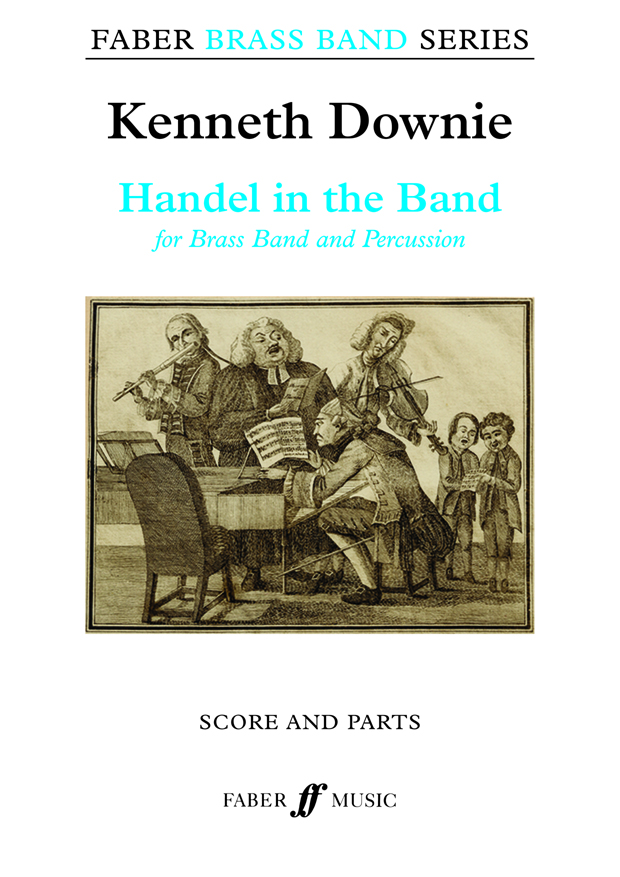
Handel in the Band - Kenneth Downie
Handel in the Band is a virtuoso set of symphonic variations on one of Handel's best known keyboard dances, the Sarabande from his Suite in D minor, HWV 437, based on the Spanish traditional dance La Folia. Kenneth Downie's work was commissioned by Brass Band Treize Etoiles, for performance at the 2013 Swiss National Brass Band Championships, where it was conducted by James Gourlay. The title is a reference to Percy Grainger's popular Handel in the Strand, and is indicative of the witty and theatrical nature of the music, which is more playful than conventional competition pieces and as such offers different challenges to brass bands as well as being thoroughly entertaining for audiences. Kenneth Downie is one of the most respected and experienced brass band composers. His music has been widely performed and published throughout the brass band world since the 1960s. Handel in the Band has been selected as the set work for the Championship Section final of this year's National Brass Band Championships of Great Britain, which takes place at the Royal Albert Hall, London, on 6th October 2018.
In Stock: Estimated dispatch 1-3 working days
-
 £42.00
Prisms (Score only) - Peter Graham
Dating from 1986 Prisms (Symphonic Study No. 2 for Brass band) was extensively revised in 1988 to form the preent work. Though not programmatic as such, the work has its roots in traditional brass band music, being strongly melodic and adopting a broad ternary form. The main themes call all be traced to the fourth-based first subject, these offshoots drawing a parallel with light refraction - Prisms. As well as the lyrical sections, much of the music is highly rhythmic, with a busy percussion section, and accesible and enjoyable to all. Duration: 13:00
Estimated dispatch 7-9 working days
-
 £52.00
Prisms (Parts only) - Peter Graham
Dating from 1986 Prisms (Symphonic Study No. 2 for Brass band) was extensively revised in 1988 to form the preent work. Though not programmatic as such, the work has its roots in traditional brass band music, being strongly melodic and adopting a broad ternary form. The main themes call all be traced to the fourth-based first subject, these offshoots drawing a parallel with light refraction - Prisms. As well as the lyrical sections, much of the music is highly rhythmic, with a busy percussion section, and accesible and enjoyable to all. Duration: 13:00
Estimated dispatch 7-9 working days
-
 £14.76
Jingle Boogie-Woogie Bells (Brass Band - Ukraine Charity Release) Ovcharenko
This piece was arranged by Halyna Ovcharenko, a Ukrainian composer who was born in Lugansk, a Ukrainian city that is currently under occupation by the Russian Federation. All the proceeds from this sale will go towards the 'A family for every orphan' appeal, which is providing emergency relief services to thousands of children and families in Ukraine. For more information about the charity please visit https://afamilyforeveryorphan.org/ukraine/ Halyna Ovcharenko has been composing music since she was 11. Many of her compositions of various genres have received international awards, but she discovered the world of brass band music with its specific timbre and huge range of musical colors only recently, in 2022, while composing her Vyshyvanka for Grimethorpe Colliery Band. Halyna comments: "I enjoyed my experience. Since then I have had an appetite to write more for brass bands, and here we are - an arrangement of a traditional English Christmas song which I have done especially to raise money for Ukrainian orphans. Their heroic parents stood for my Lugansk, for our Ukraine and for the whole World. I hope that the World will make these children feel that they are not left alone, giving them love, care and joy." The picture on the front cover was drawn by Victoria Lebed, a Ukrainian girl. This PDF download includes parts and score. Sheet music available from www.brassband.co.uk Instrumentation: Soprano Cornet Eb Solo Cornet Bb Repiano Cornet Bb 2nd Cornet Bb 3rd Cornet Bb Flugel Horn Bb Solo Horn Eb 1st Horn Eb 2nd Horn Eb 1st Baritone Bb 2nd Baritone Bb 1st Trombone Bb 2nd Trombone Bb Bass Trombone Euphonium Bb Bass Eb Bass Bb Percussion 1-2
In Stock: Estimated dispatch 1-3 working days
-
 £33.20
Pachelbel for Brass (Canon in D) - Brass Band (Pachelbel arr. William Himes)
VIEW SCORE PDF Canon in D is certainly the most popular and enduring work of Johann Pachelbel (1653-1674). With its repetitive and foundational bass line and the lyrical imitative themes that follow, this music has proven to be especially well suited as a wedding processional, with the flexibility to reduce or lengthen the music as needed for the occasion. Here it has been arranged by William Himes for brass band with flexible scoring, meaning it is playable by as few as 12 players but works equally well with a traditional size band. There is an optional cut reducing the total length of the piece by around 1.30 minutes if required. PDF download includes score and full set of parts. Sheet music available from: UK - www.brassband.co.uk USA - www.solidbrassmusic.com Difficulty Level: 4th Section + Instrumentation: Soprano Cornet Eb (optional) 1st Cornet Bb (2 players) 2nd Cornet Bb Flugel Horn Bb (optional) 1st Horn Eb 2nd Horn Eb Baritone Bb 1st Trombone Bb 2nd Trombone Bb Bass Trombone Euphonium Bb (2nd player optional) Bass Eb Bass Bb Timpani (optional) Percussion (optional)
In Stock: Estimated dispatch 1-3 working days
-
 £25.00
Zephyrus. March for Brass Band
Recommended - Suitable for all bands The Big Blow, was a formal record attempt to create the largest brass band in the world. It took place at Butlin's Resort, Skegness on 20 January 2007, and it's main goal was to raise money in support of the work of Brass Band Aid, and specifically to provide long-term sponsorship for two children in the village of Adet in Ethiopia. The Music Company (UK) Ltd were one of the Official Partners of The Big Blow, providing the performance piece for the record attempt. Andrew Duncan wrote 'Zephyrus' to mark the occasion. The title takes its name from the Greek God of the West Winds - Zephyrus. Zephyrus is a traditional British brass band march with an interesting African-feel lilt to the trio. This is enhanced by optional percussion instruments including djembi and bongos, which can alternatively be covered by standard drum kit. The Music Company are pleased to continue their support of Brass Band Aid by offering a donation to this worthy charity for every set of this music sold. Includes score & parts
-
 £79.95
Grieg Variations - Jonathan Bates
DURATION: 12'30". DIFFICULTY: 2nd+. . 'Grieg Variations' is a through-composed work in the traditional style of a 'theme & variations'. The work opens with the main melodic fragment featured throughout Grieg Variations which comes from Grieg's Peer Gynt Suite No.2; the final movement - 'Solveig's Song'. . This theme is followed by a set of 9 variations, each taking inspiration from various melodies and styles found within the Peer Gynt Suite. The first variation, a light-footed scherzo based upon the tonal line of Solveig's Song is followed by an 'Alla marcia' variation - in which the music is inspired by the 2nd movement - 'Arab Dance' - of the original suite. The 3rd variation takes a far darker and more aggressive turn in a variation set around the music of the 1st movement of the Peer Gynt Suite before a relaxation into a solemne revisiting of the original theme. Opening with a sombre and longing solo for Flugel horn, the focal point of this 4th variation is an extended solo for the Solo Euphonium, marked 'molto espressivo'. The new material here is used as a theme throughout this variation, being reprised by the full band immediately after as the music builds to a climax point at the top of the musical line. . Following this, there are 2 cadenzas for the Solo Horn and Solo Cornet respectively; the former inspired by the thematic material of Solveig's Song, and the latter from the Oboe cadenza at the beginning of Grieg's '2 Lyric Pieces, Op.68'. These cadenzas lead swiftly into the 7th variation, a bustling rhyhm-driven movement set in complex time. The 3rd movement of the Peer Gynt Suite No.2 - 'Peer Gynt's Homecoming' - makes it's first appearance in variation 8 in a triumphant battle-like setting before a combination of both this material and the Solveig's Song combine to bring Grieg Variations to it's close -not without a little nod to potentially Grieg's most famous work - In The Hall of the Mountain King. . .
In Stock: Estimated dispatch 1-3 working days
-
 £35.00
Ascension - Lucy Pankhurst
A major work written for the RNCM Brass Festival Competition 2005, and inspired by the nature of Ascension - creating a Musical depiction of the spiritual journey towards enlightenment, sanctuary and ultimate inner peace.As aninitial muse for this work, the 'Tibetan Singing Bowl' is utilised with the Brass Band in order to represent this path to Serenity, together withBaoding Balls(Chinese Health Balls) to mark the point of Final Ascension.Programme notes from the composer, Lucy Pankhurst:Ascension is a Musical depiction of the Spiritual Journey towards enlightenment, sanctuary and ultimate inner peace.As my initial muse for this work, the Singing Bowl is utilised with the Brass Band in order to represent this path to Serenity. "Tibetan" Singing Bowls date back to the 8th Century A.D., originating in the pre-Buddhist shamanic Bon Po culture in the Himalayas and are still used in modern Monasteries. The original purpose of them still remains a mystery, with accounts stating that it is forbidden to disclose the true function of the Bowls, as the "secrets of sound" yield so much Power, that they must be kept hidden.Listening to the tones created by the Singing Bowl effectively silences the internal dialogue of the listener, making it an excellent tool for Meditation, Centering and entering trance-like states. In Buddhism, as with many cultures, sound is an important part of Spiritual Practice. There are 9 methods to reach Enlightenment in the Buddhist Doctrine ; the seventh is SOUND.These Bowls are used by Healers in a similar way to help balance the body's residual energies. The Bowls are usually made from seven different sacred metals, intended to correlate directly to the seven sacred "Planets" : GOLD (Sun), SILVER (Moon), MERCURY (Mercury), COPPER (Venus), IRON (Mars), TIN (Jupiter), ANTIMONY (Saturn). Any one Bowl can create up to seven different frequencies (tones) simultaneously. In Healing, the Singing Bowl is played whilst balanced on the palm of the hand, struck three times to stabilise the surrounding energies, before rotating the wooden "beater" around the outer circumference of the Bowl to create the "singing" effect.I have included an optional Vibraphone part (to be played with a Double Bass Bow) with Tubular Bells, to be used only in performances where a Singing Bowl cannot be acquired. However, a traditional Bowl should be used whenever possible, to create this specific and unique sound.Baoding Balls or Chinese Health Balls are also utilised in this work. Their appearance in the Music here, however, is to mark the point of Final Ascension, where the music reaches its ultimate goal. These delicate cloisonne iron Balls are said to stimulate the acupressure points on the hand, thus improving the Chi and Energy Paths (Life Force) throughout the entire body. The delicate "tinkle" produced by these spheres is hypnotic and captivating. For this reason, where no Baoding Balls are obtainable for performance, only delicate metallic percussion should be used in replacement (i.e. Crotales, Antique Cymbals or (liberal) single strikes on a Triangle etc.). Bell Trees, Wind Chimes and Cow Bells should not be used.As in many cultures, the number three is important in Ascension, as it represents not only the purification from the Singing Bowl, but also it is a number of confirmation, reiterated throughout the music in the metallic percussion in addition to the Brass, re-affirming the correct path to Enlightenment.
In Stock: Estimated dispatch 3-5 working days
-
 £25.00
Zephyrus - Andrew Duncan
The Big Blow', was a formal record attempt to create the largest brass band in the world. It took place at Butlin's Resort, Skegness on 20 January 27 and in addition to the fun generated by the event itself, it's main goal was to raise money in support of the work of Brass Band Aid, and specifically to provide long-term sponsorship for two children in the village of Adet, Ethiopia.The Music Company (UK) Ltd were one of the Official Partners of The Big Blow, providing the performance piece for the record attempt. As Editorial Director of the company, Andrew Duncan wrote 'Zephyrus' to mark the occasion.Originally presented at the event as 'March - The Big Blow', the published re-titling of 'Zephyrus' provides a more subtle alternative, taking its name from the Greek God of the West Winds.'Zephyrus' is a traditional British brass band march with an interesting African-feel lilt to the trio. This is enhanced by optional percussion instruments including djembi and bongos, which can also be covered by standard drum kit. A positive, upbeat concert march to reflect the sentiment behind 'The Big Blow' record attempt.There were 443 participants in total, including:Soprano Cornets x 12Cornets x 152Flugels x 19Tenor Horns x 68Baritones x 32Euphoniums x 32Trombones x 55Eb Basses x 35Bb Basses x 17Percussionists x 21The Music Company are pleased to continue their support of Brass Band Aid by offering a donation to this worthy charity for every set of this music sold.
In Stock: Estimated dispatch 3-5 working days
-
 £33.20
Polka from 'The Bartered Bride' (Brass Band) Smetana arr. Rob Bushnell
Considered a major contribution to the develop of Czech music, The Bartered Bride by Bedrich Smetana is a comic opera in three acts that premiered, in its final version, in 1870; having not been a great success when the original two-act version premiered at the Provisional Theatre, Prague on 30 May 1866. The opera was part of Smetana's aim to create a native Czech music after the conductor Johann von Herbeck commented that Czechs were incapable of making music of their own. Whilst he avoided the direct use of folksongs, Smetana did use numerous traditional Bohemian dance forms, such as the furiant and the polka, leading to music that was Czech in spirit. 'Sold Bride', a more accurate translation of the original Czech title (Prodana nevesta), tells the story of two lovers (Marenka and Jenik) who want to marry despite Marenka's father's obligations for his daughter to marry the son of a wealthy landowner, Micha. Scheming, condition proposals and secret identities leads to a happy ending. The polka was not in the original 1866 version. A revision in October 1866 saw the addition of a gypsy dance near the start of act 2. But by the next performance in January 1869, this had been replaced by a polka. In June 1869, a new polka replaced the January version's (as well as being moved to the end of act 1) and this is the one that we know and love today. This arrangement is for British-style brass band, with *alternative parts for horns in F and bass-clef lower brass. Instrumentation: Soprano Cornet Eb Solo Cornet Bb Repiano Cornet Bb 2nd Cornet Bb 3rd Cornet Bb Flugel Horn Bb Solo Horn Eb* 1st Horn Eb* 2nd Horn Eb* 1st Baritone Bb* 2nd Baritone Bb* 1st Trombone Bb* 2nd Trombone Bb* Bass Trombone Euphonium Bb* Bass Eb* Bass Bb* Timpani Percussion (Triangle, Cymbal(s) & Bass Drum)
In Stock: Estimated dispatch 1-3 working days
 Watch video