
Results
-
£44.95Bravura (A Fantasy on British Folk Songs) (Euphonium Solo with Brass Band - Score and Parts) - Graham, Peter
Bravura is a companion piece to the composer's earlier euphonium display piece Brillante, utilising the same traditional 19th century "fantasy variation" structure, familiar to generations of brass soloists. Folk songs from the four corners of Great Britain are featured; Oranges and Lemons, (England), The Blue Bells of Scotland, The Minstrel Boy (Ireland) and the famous Welsh anthem Men of Harlech.The solo is a conflation of the original version, written for the 2002 Royal Albert Hall Gala Concert, which followed the National Brass Band Championships of Great Britain. On that occasion the combined talents of virtuosi David Childs, Derick Kane, Steven Mead and David Thornton (with guests Robert and Nicholas Childs) were on display, each personalising the cadenza section towards the end. This version incorporates a published cadenza, though soloists should feel free to improvise their own material at this point.
Estimated dispatch 7-14 working days
-
£65.00Second Suite in F - Brass Band Sheet Music Full Score & Parts - LM602 - Gustav Holst
COMPOSER: Gustav HolstTRANSCRIBED : Daniel S. AugustineA brand transcription from Holst's manuscript score for brass band.A very authentic version from the original for Military Band.Can be used as a testpiece in your next own choice contestSuitable for Section 3 bands upwardsSecond Suite in FOp. 28, No. 2 (1922)1. MarchThe "March" of the Second Suite begins with a simple five note motif between the low and high instruments of the band. The first folk tune is heard in the form of a traditional British brass band march using the morris-dance tune "Glorishears". After a brief climax, the second strain begins with a euphonium solo playing the second folk tune in the suite "Swansea Town". The theme is repeated by the full band before the trio. For the trio, Holst modulates to the unconventional subdominant minor of Bb minor and changes the time signature to 6/8, thereby changing the meter. Usually one would modulate to subdominant major in traditional march form. While Sousa, reputably the "king of marches", would sometimes change time signatures for the trio (most notably in "El Capitan"), it was not commonplace. The third theme, called "Claudy Banks",[2] is heard in a low woodwind soli, as is standard march orchestration. Then the first two tunes are repeated da capo.2. Song without Words "I'll Love My Love"Holst places the fourth folk song, "I'll Love My Love" in stark contrast to the first movement. The movement begins with a chord and moves into a solo over a flowing accompaniment. The solo is then repeated, forming an arc of intensity. The climax of the piece is a fermata, followed by a cornet pick-up into the final measures of the piece.3. Song of the BlacksmithAgain, Holst contrasts the slow second movement to the rather upbeat third movement which features the folk song "A Blacksmith Courted Me". There are many time signature changes (4/4 to 3/4) making the movement increasingly difficult because the accompaniment has a pick up on the up-beats of each measure. The band joins in on the melody around the body of the piece and are accompanied with the sound of a blacksmith forging metal with an anvil called for in the score. The final major chord has a glorious, heavenly sound, which opens way to the final movement.This chord works so effectively perhaps because it is unexpected.4. Fantasia on the "Dargason"This movement is not based on any folk songs, but rather has two tunes from Playford's Dancing Master of 1651. The finale of the suite opens with a solo based on the folk tune "Dargason", a 16th-century English dance tune included in the first edition of The Dancing Master. The fantasia continues through several variations encompassing the full capabilities of the band. The final folk tune, "Greensleeves", is cleverly woven into the fantasia by the use of hemiolas, with Dargason being in 6/8 and Greensleeves being in 3/4. At the climax of the movement, the two competing themes are placed in competing sections.As the movement dies down, a duet forms a call back to the beginning of the suite with the competition of low and high registers.The name 'dargason' may perhaps come from an Irish legend that tells of a monster resembling a large bear (although much of the description of the creature has been lost over time), the Dargason tormented the Irish countryside. During the Irish uprising of the late 18th century, the dargason is supposed to have attacked a British camp killing many soldiers. This tale aside, 'dargason' is more likely derived from an Old English word for dwarf or fairy, and the tune has been considered English (or Welsh) since at least the 16th century. It is also known as 'Sedony' (or Sedany) or 'Welsh Sedony'.
In Stock: Estimated dispatch 3-5 working days
-
£32.97Spanish Dance - Brass Band (Traditional arr. Andrew Wainwright)
Based on the traditional Spanish carol 'Riu Riu Chiu', this exciting foot-tapping item was premiered at Butlins Mineworkers Championships in 2010. Recorded on Virtuosi GUS Band's CD 'Christmas Fantasia - The Music of Andrew Wainwright', it has since proved to be a popular concert item. "Spanish Dance winds up to a whirlwind climax with a respectful nod in the direction of Morley Calvert's 'Canadian Folk Song Suite' - very clever." Paul Hindmarsh, British Bandsman magazine For a follow-the-score video of this work please visit: https://www.youtube.com/watch?v=jjskWuOH_YU Includes score and full set of parts. Sheet music available exclusively from World of Brass - www.worldofbrass.com Difficulty Level: 1st Section + Instrumentation: Soprano Cornet Eb Solo Cornet Bb Repiano Cornet Bb 2nd Cornet Bb 3rd Cornet Bb Flugel Horn Bb Solo Horn Eb 1st Horn Eb 2nd Horn Eb 1st Baritone Bb 2nd Baritone Bb 1st Trombone Bb 2nd Trombone Bb Bass Trombone Euphonium Bb Bass Eb Bass Bb Timpani Percussion 1-2
In Stock: Estimated dispatch 1-3 working days
-
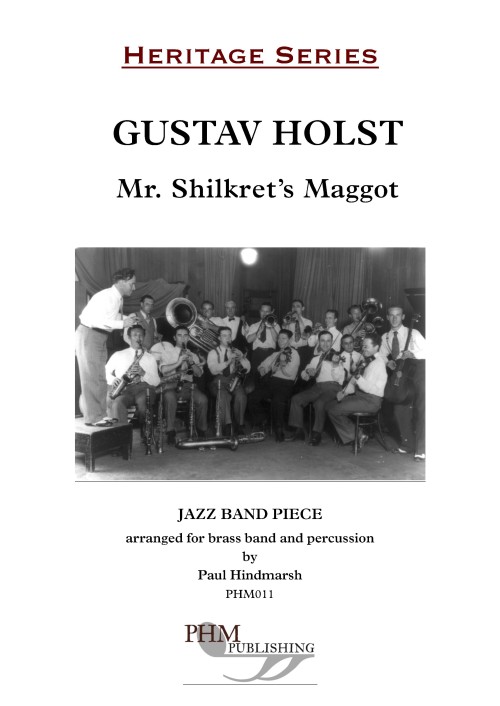
£55.00Mr Shilkret's Maggot (Brass Band - Score and Parts) - Holst, Gustav - Hindmarsh, Paul
This short piece was composed in 1932 during a visit Gustav Holst was making to the USA. He was invited by the band leader Nathaniel Shilkret to contribute to a series of piece for concert jazz band based on a folk song. Rather than using a traditional tune, Holst invented one of his own in folk song style and therefore the piece was not performed. Holst considered various titles for the piece including Mr. Shilkret's Dump, Folly and Maggot. On the manuscript he described it as a Jazz Band Piece. When the composer's daughter Imogen re-scored the piece for the English Chamber Orchestra to record under her direction in 1967, she changed decided to use the title Capriccio.Her re-orchestration involved removing the saxophone quartet, adding cor anglais and a second bassoon and changing cornet parts to trumpets. She retained the harp, extensive percussion, piano and celesta. My brass band version is based on the composer's manuscript, held at the British Library. It retains the composer's cornet parts, re-voices the woodwinds and strings, and places keyboards and harp onto glockenspiel, marimba, vibraphone and xylophone.I have selected the title Mr. Shilkret's Maggot for my scoring of Jazz Band Piece, which was first performed by The Cory Band, conducted by Philip Harper, at the Royal Northern College of Music Brass Band Festival, 29 January 2017.- Paul HindmarshDuration: 5.30
Estimated dispatch 7-14 working days
-
£55.00Mr Shilkret's Maggot (Brass Band - Score and Parts)
This short piece was composed in 1932 during a visit Gustav Holst was making to the USA. He was invited by the band leader Nathaniel Shilkret to contribute to a series of piece for concert jazz band based on a folk song. Rather than using a traditional tune, Holst invented one of his own in folk song style and therefore the piece was not performed. Holst considered various titles for the piece including Mr. Shilkret's Dump, Folly and Maggot. On the manuscript he described it as a Jazz Band Piece. When the composer's daughter Imogen re-scored the piece for the English Chamber Orchestra to record under her direction in 1967, she changed decided to use the title Capriccio.Her re-orchestration involved removing the saxophone quartet, adding cor anglais and a second bassoon and changing cornet parts to trumpets. She retained the harp, extensive percussion, piano and celesta. My brass band version is based on the composer's manuscript, held at the British Library. It retains the composer's cornet parts, re-voices the woodwinds and strings, and places keyboards and harp onto glockenspiel, marimba, vibraphone and xylophone.I have selected the title Mr. Shilkret's Maggot for my scoring of Jazz Band Piece, which was first performed by The Cory Band, conducted by Philip Harper, at the Royal Northern College of Music Brass Band Festival, 29 January 2017.- Paul HindmarshDuration: 5.30
Estimated dispatch 7-14 working days
