
Results
-
 £24.95
David Of The White Rock (Cornet Solo with Brass Band - Score and Parts) - Bowes, Ray
This melody is reputed to have originated in Caernarvonshire, North Wales. Tradition holds that a bard called David, lying on his deathbed, called for his harp and performed this plaintive tune, expressing a desire that it should be played at his funeral. Ever since the tune has been called by his name and that of his house 'Garagwen' ('Druid Stone' or 'White Rock'). The solo is not just a slow melody with brass band accompaniment but is a composite whole, the band needing as much sensitivity as the soloist in the presentation.
Estimated dispatch 7-14 working days
-
£12.50
David Of The White Rock (Cornet Solo with Brass Band - Score only) - Bowes, Ray
This melody is reputed to have originated in Caernarvonshire, North Wales. Tradition holds that a bard called David, lying on his deathbed, called for his harp and performed this plaintive tune, expressing a desire that it should be played at his funeral. Ever since the tune has been called by his name and that of his house 'Garagwen' ('Druid Stone' or 'White Rock'). The solo is not just a slow melody with brass band accompaniment but is a composite whole, the band needing as much sensitivity as the soloist in the presentation.
Estimated dispatch 7-14 working days
-
 £87.99
An English Christmas (Brass Band - Score and Parts) - Sparke, Philip
Christmas as celebrated in England is a relatively new tradition dating from the time of Queen Victoria. Her husband Prince Albert was from Germany and he brought many German Christmas traditions with him, including the Christmas tree and Christmas cards, and even carols such as Hark, the Herald Angels Sing. Philip Sparke has however used a varied selection of English melodies to arrange into his Festival of Carols.The choir parts are seperately available (order no. AMP 227-050 or AMP 227-250 for a single copy).Duration: 9:30
Estimated dispatch 7-14 working days
-
 £59.99
David of the White Rock (Brass Band - Score and Parts) - Sparke, Philip
This is an ancient Welsh air that was first published in Relics of the Welsh Bards in 1794. Dafydd (David) Owain was a famous Welsh bard who lived on a farm called Gareg Wen (The White Rock) in Eifionydd, Carnarnvonshire, North Wales. Tradition has it that on his deathbed he called for his harp and composed this lovely melody, requesting that it be played at his funeral. Accordingly, it was later played at the parish church of Ynys-Cynhaiarn. Lyrics were later added by Ceiriog Hughes, which describe the melody's inspiration. This version for brass band retains all the beauty and simplicity of the original.Duration: 2:45
Estimated dispatch 7-14 working days
-
 £54.99
Ding-a-Dong (Brass Band - Score and Parts) - Oud, Thijs
The group Teach-In, from the Netherlands, won the Eurovision Song Contest in 1975 with the song Ding-a-Dong. It was the fourth time that a Dutch entry had won the prestigious festival but since then no Dutch artist has even come near first place again. The original Ding-a-Dong was performed, in keeping with tradition, with the accompaniment of a large orchestra. This sparkling arrangement of the catchy song provides a cheerful note in every concert. The melody will certainly stay in the audience's memory long after the performance.Duration: 2:00
Estimated dispatch 7-14 working days
-
 £60.99
Fanfare in Iubilo (Brass Band - Score and Parts) - Doss, Thomas
The power of this bright fanfare reflects the optimism, joy and commitment to tradition that the people of the Italian town of Schlanders have deep within their souls. The golden trumpets from the valleys of South Tyrol echo across the mountains on both sides of the Austrian-Italian border and help to convey the composer's message: just as the sun shines on all parts of the world, music knows no boundaries. This message echoes throughout this brilliant fanfare.Duration: 4:30
Estimated dispatch 7-14 working days
-
 £69.99
Navigation Inn (Brass Band - Score and Parts) - Sparke, Philip
Navigation Inn was originally written to celebrate one of the most popular events in the brass band calendar - the Whit Friday marches. The Navigation Inn is a pub which is a popular meeting place for bandsmen and which celebrates the love of brass bands with mementos and historic photographs on the walls. This lively piece in the style of a traditional contest-style march will bring a great sense of tradition to any concert.Duration: 3.15
Estimated dispatch 7-14 working days
-
 £37.95
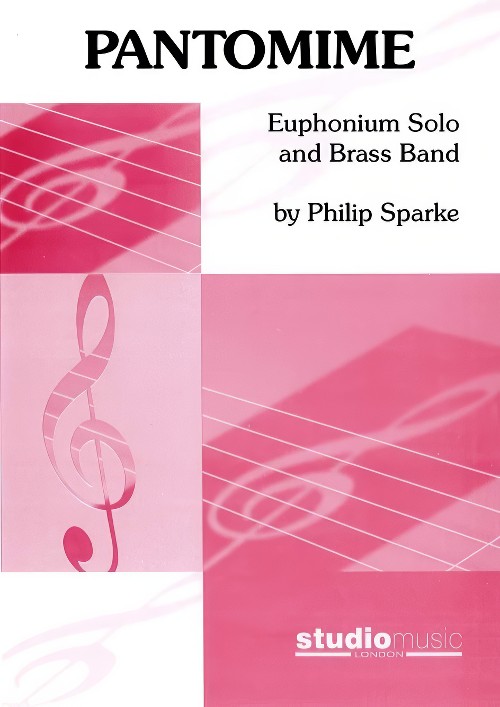
Pantomime (Euphonium Solo with Brass Band - Score and Parts) - Sparke, Philip
Pantomime was commissioned by euphonium virtuoso Nick Childs in 1986. Designed to show off both the lyrical and technical prowess of the instrument, the piece draws on the varied characters of the Italian Commedia dell'Arte tradition for its wide emotional range.Recorded on Polyphonic QPRL056D National Brass Band Championships of Great Britain and Gala Concert - 1992Recorded on Polyphonic QPRL045D Making Tracks
Estimated dispatch 7-14 working days
-
£154.99
Bulgarian Dances (Part II) (Brass Band - Score and Parts)
Bulgarian folk music has a long tradition and numerous typical characteristics, such as particular dissonances and complex, irregular rhythms. In Bulgarian Dances (Part II) (which can be performed together with the previously published title Bulgarian Dances) Franco Cesarini has preserved the original spirit of Bulgarian folk music, yet has imbued it with a symphonic character and brought it into the concert hall. The three different movements give us a meditative, moving folksong and a lively dance, before a distinctly symphonic part leads to a glittering finale.
Estimated dispatch 7-14 working days
-
£42.95
CU CHULLAIN (Brass Band) - Jenkins, Karl - Small, Tony
from Adiemus iv - The Eternal Knot. Adiemus is an extended choral-type series of works based on European classical tradition, but where the vocal sound is more akin to 'ethnic' or 'world' music. Karl Jenkins ingeniously invented the language used in the entire Adiemus project. Cu Chullain is a movement from ADIEMS iv - The Eternal Knot. Cu Chullain (pronounced 'Koo Kullan') is the foremost hero of the Ulster Cycle, a collection of prose and verse romances which forms one of the major cycles of Irish literature. The epitome of Celtic valour, Cu Chullain is portrayed as the ideal chieftain and defender of his tribe. Possessing extraoridinary powers which he uses solely for the benefit of his people, he forms a bridge between the world of the gods and that of humas. Duration: 4:20 approx
Estimated dispatch 7-14 working days
 View Music