
Results
-
 £14.95
Funk Engine (Score Only)
'Funk Engine' was commissioned by Brass Bands England for the 2016 National Youth Brass Band Championships of Great Britain. What Ryan says about the piece:"When I was commissioned to write a piece for the Championships I decided that I wanted to create something a bit different to standard brass band repertoire. I decided that the best way to do this was to go a bit out of my comfort zone and explore some styles of music that I have yet to experiment with. I have always been a great lover of jazz, funk and big band music and the sounds associated with them. In 'Funk Engine' I have tried to capture some of these sounds, however I am a brass-bander at heart and as such I've tried to create a fusion of styles that hopefully combines the best of brass band and jazz into one piece.'Funk Engine' runs continuously, but is divided into three broad sections - fast, slow, fast. The opening is in driving big band style, which segues into a smoother lyrical section; the pace then picks up into a jazz inspired scherzo. After a delicate transition from the basses and trombones the euphonium plays a soaring scale - bringing us into the central movement - which begins with a series of languid solos before descending into a darker interlude. A flugel solo lightens the mood and the music gains momentum leading into a brief cornet chorale before a euphonium solo leads into a percussive climactic passage for full band. As this section winds down to settle on an open fifth, the Hi-hat and Bass section punctuate the texture with the first notes of the final section."The final section of the piece is in similar big band style to the opening and develops material from the first two movements. The percussion feature heavily at this stage and the tension builds towards a final statement, with the piece concluding with a bang!"
Estimated dispatch 7-14 working days
-
 £12.00
Ave Maria
DescriptionJohann Sebastian Bach (1685 - 1750) was a German composer and musician of the Baroque period. Bach's compositions include the Brandenburg Concertos, the Goldberg Variations, the Mass in B minor, two Passions, and over three hundred cantatas of which approximately two hundred survive. His music is revered for its technical command, artistic beauty, and intellectual depth. Bach's abilities as an organist were highly respected during his lifetime, although he was not widely recognised as a great composer until a revival of interest in and performances of his music in the first half of the 19th century. He is now generally regarded as one of the greatest composers of all time.Charles-Francois Gounod (1818 - 1893) was a French composer, best known for his Grand Operas, most famously 'Faust', written in 1859 and his 'St Cecilia Mass' written in 1854. However possibly his most performed work is his arrangement of the latin text Ave Maria based on a work by Bach.You can listen to a computer realisation of the score while following the music below:
Estimated dispatch 7-14 working days
-
 £75.00
Cantata - Andrew Duncan
A major work composed for brass band by Andrew Duncan. The piece was commissioned by (and dedicated to) The Foden's Band, and selected as the set work at the 2014 Scottish Open Brass Band Championships, offering an exciting addition to the contesting repertoire.A challenging piece for the players, but one which reaps huge rewards through its rich scoring and imaginative development. A work of three movements, Cantata presents a new dynamic level of its composer's musical mastery.Listen In - Movement 1 (digital sound sample):https://www.themusiccompanyshop.com/wp-content/uploads/2015/12/Cantata-1st-Movement.mp3Listen In - Movement 2 (digital sound sample):https://www.themusiccompanyshop.com/wp-content/uploads/2015/12/Cantata-2nd-Movement.mp3Listen In - Movement 3 (digital sound sample):https://www.themusiccompanyshop.com/wp-content/uploads/2015/12/Cantata-3rd-Movement.mp3
In Stock: Estimated dispatch 3-5 working days
-
 £37.35
A Fugal Overture (Brass Band) Gustav Holst arr. Rob Bushnell
A Fugal Overture was written in 1922 by Gustav Holst. It was first performed at the Royal Opera House, Covent Garden on 14 May 1923 and was used as an opening work to Holst's one-act opera The Perfect Fool. It received its concert premiere on 11 October 1923 at one of Henry Wood's Queen's Hall Promenade Concerts. It is an early example of neoclassicism and was influenced by the counterpoint of J. S. Bach, despite its unconventional use of the fugal process. Holst began writing the piece in the summer of 1922, having hoped to develop it into a ballet. It is divided into three sections, the fugal subject with its distinct 3+3+2 pattern, a slower section with solos at the end, and a third section where the subject returns. Although reviews of the piece were mixed at the time of its premiere, the likes of Adrian Boult have said it was "an invigorating work that could effectively start any [...] concert". In more recent years, it has been compared to John Adam's A Short Ride in a Fast Machine. This arrangement is for the British-style brass band, with alternative parts for horns in F and bass-clef lower brass. A recording of the original composition can be found here: www.youtube.com/watch?v=a8xfwJyFq2E. Duration: Approx. 5.40 minutes Difficulty Level: 1st Section + PDF download includes parts and score. Sheet music available from www.brassband.co.uk Instrumentation: Soprano Cornet Eb Solo Cornet Bb Repiano Cornet Bb 2nd Cornet Bb 3rd Cornet Bb Flugel Horn Bb Solo Horn Eb 1st Horn Eb 2nd Horn Eb 1st Baritone Bb 2nd Baritone Bb 1st Trombone Bb 2nd Trombone Bb Bass Trombone Euphonium Bb Bass Eb Bass BbTimpani Percussion 1-2
In Stock: Estimated dispatch 1-3 working days
-
 £55.00
Triumph Series Brass Band Journal, Numbers 1383 - 1386, March 2026
1383: Festival March - Lead On! (Andrew Wainwright)A dynamic march, commissioned by Majors Paul and Dawn McFarland during their appointment as Area Commanders of The Salvation Army's Dallas-Fort Worth Area, premiered at the 2023 Thanksgiving service at the Dallas Adult Rehabilitation Centre. Featuring the classic hymns Storm the forts of darkness (S.A.S.B. 980) and Lead on, O King eternal (S.A.S.B. 964), the piece captures the drive, hope, and mission at the heart of The Salvation Army's work in North Texas.1384: Confession (Kenneth Downie)This arrangement is based on the tune Lord of all (T.B. 440), one of the welcome additions to the 2015 Salvation Army tune book. Introduced to the arranger by Andrew Blyth, whose appreciation for the melody highlighted its gentle charm, the piece is dedicated to Andrew and the Peterborough Citadel Band, where he served as Bandmaster and continues to play.The music pairs the tune with the reflective words of We have not known thee as we ought (S.A.S.B. 630), a hymn often used in worship as a moment of confession and heart-searching before God. Its inclusion encourages both performers and listeners to approach worship with humility and sincerity.Although labelled simply as "German traditional," the tune's graceful simplicity is immediately evident. This arrangement preserves that character while introducing subtle harmonic colour and developing the tune's rising fourth motif as a unifying musical thread. The gentle nature of the melody remains central throughout, with a slightly heightened energy in the fifth phrase carefully drawn out without disrupting the overall serenity. The sharing of thematic material between Cornets and Horns calls for smooth, unobtrusive ensemble playing, allowing the tune's beauty to speak naturally.1385: God in good (Stephen Hull) This arrangement brings together two much'loved melodies: Goodness of God, a favourite from the final years of the arranger's service as Divisional Music Director in the Wisconsin/Upper Michigan Division, and the simple, enduring chorus God is so good. Heard often at summer camps, the song's message stayed with him, eventually inspiring this thoughtful musical pairing that highlights God's unwavering goodness throughout our lives.1386: A march in time (Martin Cordner)Written to celebrate the 130th anniversary of Thetford Corps (UKI Territory), this lively march pays tribute to a legacy of faithful witness, joyful service, and a community moving forward in God's light. Premiered by Cambridge Citadel Band during the anniversary weekend, the piece weaves together three cherished songs: Marching on in the light of God (S.A.S.B. 968), Jesus, precious Saviour (S.A.S.B. 501), and Light up the sunshine in your heart.
Estimated dispatch 7-14 working days
-
 £95.00
Concertante (Piano Solo with Brass Band - Score and Parts)
This work was written in 1966, when I was a student at the Royal Academy of Music in London. It was the first major work to be written for this combination. The Concertante is unashamedly romantic in idiom and is cast in three movements: Prelude, Nocturne and Rondo.The Prelude is in sonata form with a contracted recapitulation. There are two main themes, the first announced after the opening flourish on piano. The second theme is lyrical in character and the interplay between these two themes forms the main focus of the movement.The pensive Nocturne opens with an introduction from the band which contains hints of the two main ideas to follow. The solo piano announces the main theme, which has a slightly 'blues' character in its flattened third and seventh notes of the scale. The band enters with the chorale theme already heard in the introduction. Eventually the first theme returns, this time from piano and band and building to a powerful climax before subsiding to a peaceful ending.The Rondo is full of energetic rhythms and changing time patterns. The main theme is 'giocoso' in character and in the first episode there is more than a hint of the tune 'Onward Christian Soldiers' in what amounts to a good humoured parody. Before the final coda there is a long piano cadenza underlying the virtuoso element of the work.The work had a number of public performances leading up to a memorable one in the Royal Albert Hall in 1989 as part of the Gala Concert that used to be held after the National Brass Band Championship in the Royal Albert Hall. That year, the 'centre band' in the massed bands concert were the GUS Band (then known for sponsorship reasons as 'Rigid Containers Group Band'!) conducted by my great friend and champion, Bramwell Tovey, with myself as the soloist.- Edward GregsonDuration: 18.00
Estimated dispatch 7-14 working days
-
 £50.00
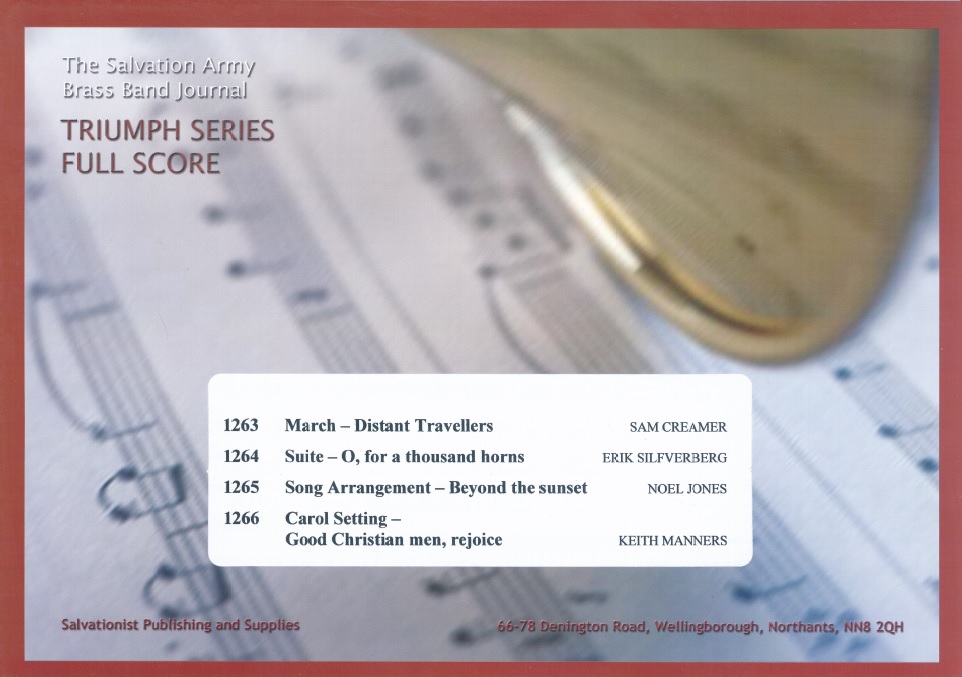
Triumph Series Band Journal July 2015 Numbers 1263 - 1266
No. 1263 March - Distant Travellers (Sam Creamer)With this Christmas march, we introduce a new contributor to our journals. Sam Creamer is a bandsman and songster at the Carindale Corps in Brisbane, Australia Eastern Territory. This march should prove a useful addition to the Christmas repertoire of many groups, as it features the well-known Christmas carols; When wise men come seeking (NCP 92) and While shepherds watched (NCP 93), as well as brief references to others.No. 1264 Suite - O, for a thousand horns (Erik Silfverberg)Bandmaster Erik Silfverberg OF has taken the song O for a thousand tongues by Charles Wesley, and has composed a suite in three movements with each of the movements exploring the sentiments of one of the verses. The tune Grimsby is heard in part throughout, but the majority of the musical material used is original.No. 1265 Song Arrangement - Beyond the sunset (Noel Jones)A three-verse setting of the song Beyond the sunset which speaks of the Christian's eternal home in Heaven.No. 1266 Carol Setting - Good Christian men, rejoice (Keith Manners)A bright setting of the well-known Christmas carol.
Estimated dispatch 7-14 working days
-
 £49.95
Bestowal of a Century - Christopher Bond
Bestowal of a Century (2014) was commissioned by Lowenna Taylor, and funded through her Harry Mortimer Trust award which she was presented with at the 2013 British Open Championship following the completion of her studies at the Royal Welsh College of Music in Cardiff. The 15-minute work received its world premiere at the Cornwall Youth Brass Band Christmas concert in 2014 with solosit, Lowenna, working alongside the band under the baton of Les Neish. The 'Bestowal' refers to the presentation of the Royal Trophy by the then Prince of Wales to the famous West of England Bandsman's Festival in Bugle in 1913. Over the years it has been won by some of the greatest names in brass banding, including Black Dyke and Munn & Feltons - although more recently it has become a wonderful open festival that includes sections for local bands as well as visitors from all over the banding globe. 2014 marked the one-hundredth anniversary of the presentation of the trophy, which is the only brass band trophy to have the official seal of royal patronage. The work, in three distinct sections, opens in a mysterious way, building progressively with interjections from the horn. The composer notes its as though one can imagine different part of the trophy being put together, piece by piece, until the trophy is complete and a climax is reached. Following this, a playful theme is presented which is developed throughout the first section and interacting between soloist and band. The second movement, in complete contrast, is a lyrical melody; heart-wrenching throughout, and sits well both as part of the concerto and also as a stand-alone solo item. The third movement is light-hearted and virtuosic, demonstrating the technical capabilities of the instrument with fast and virtuosic playing, and a cadenza towards the end of the work.
Estimated dispatch 10-14 working days
-
 £55.00
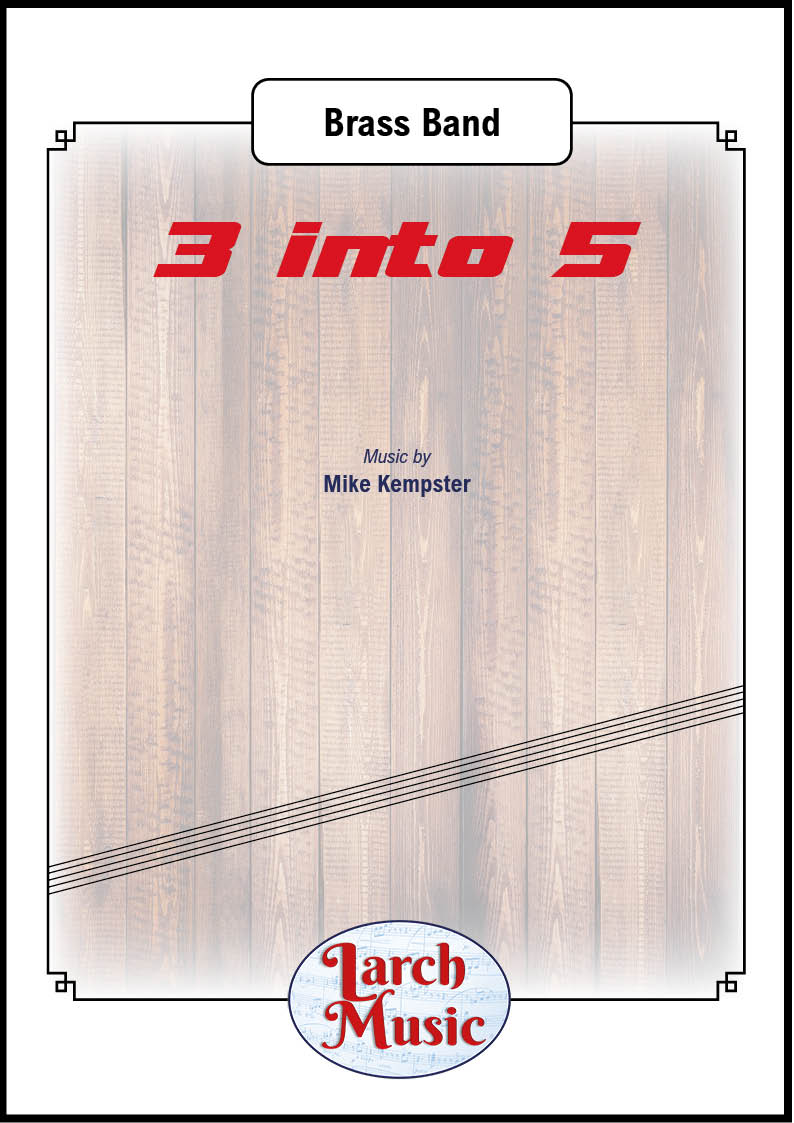
3 into 5 - Brass Band Sheet Music Full Score & Parts - LM920
COMPOSER: Mike KempsterA great new work in 5 movements from the pen of Mike Kempster.Originally written as 3 three movements but two were later added hence the title 3 into 5.A varied range of styles throughout the piece including swing, lyrical & ragtime.One certainly for your next concert.Playing time approx. 9 mins.LM920 - ISMN : 9790570009206
In Stock: Estimated dispatch 3-5 working days
-
 £30.00
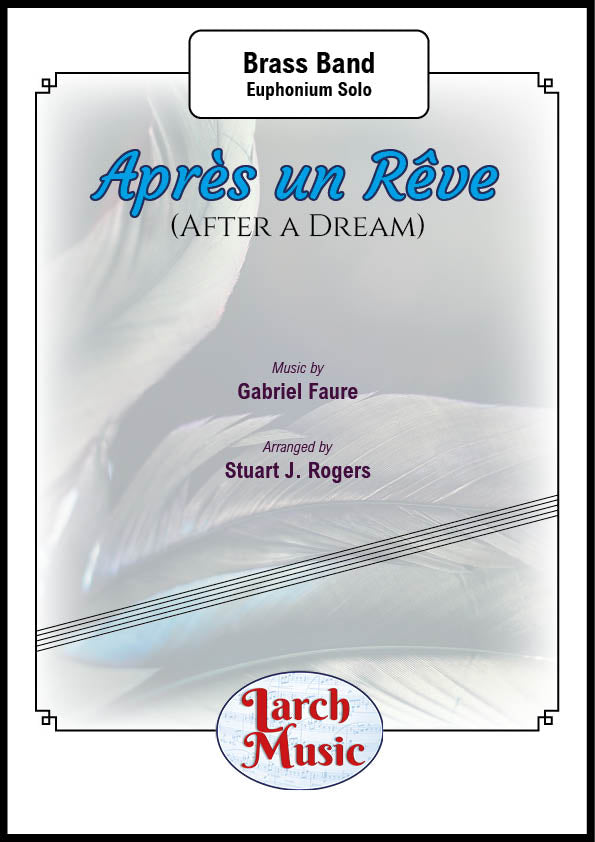
Apres un Reve - Euphonium & Brass Band Sheet Music Full Score & Parts - LM563
COMPOSER: Gabriel FaureARRANGER: Stuart J. RogersTrois melodiesis a set ofmelodiesfor solo voice and piano, byGabriel Faure.It consists of "Apres un reve" (Op. 7, No. 1), one of Faure's most popular vocal pieces,"Hymne" (Op. 7, No. 2), and "Barcarolle" (Op. 7, No. 3).The songs were written between 1870 and 1877, and published in 1878.They were not, however, originally conceived together as a set of three;theopus number7 was imposed on them retrospectively in the 1890s,almost 20 years after their first publications.In "Apres un Reve" (After a Dream),a dream of romantic flight with a lover,away from the earth and "towards the light", is described.However, upon awakening,the dreamer longs to return to the "mysterious night"and the ecstatic falsehood of his dream.LM563 - ISMN : 9790570005635
In Stock: Estimated dispatch 3-5 working days
