
Results
-
 £54.99
The Ketchup Song (Asereje) - Francisco Manuel Ruiz Gomez - Peter Kleine Schaars
The Ketchup Song was a big 2002 summer hit for the Munoz sisters. The band is made up of three sisters, Lol, Lucia and Pilar who are the daughters of a famous Spanish flamenco musician called Tomate (hence Ketchup!). This fabulous arrangement will bring a taste of summer on the Costa to any concert.
Estimated dispatch 5-14 working days
-
£118.99
Elegy I - Jacob de Haan
Elegy I 'Jealousy' has been named after John Donne's poem of the same name. This English poet (1572-1631) wrote an entire series of elegies, each with its own theme. Jealousy can trigger various emotions, ranging from disappointment, grief, or regret, to madness and anger. All these emotions have been incorporated into this composition. Jacob de Haan was inspired by three different works of art: a poem (the aforementioned poem by John Donne), a painting by the Norwegian painter Edvard Munch (Jealousy in the Garden) and an old French chanson about jealousy (Je ne l'ose dire) by the sixteenth-century French composer Pierre Certon. The music refers repeatedly to thischanson - sometimes through key notes from the melody that serve as the starting point for new, isolated themes and sometimes through quotations of the original version
Estimated dispatch 5-14 working days
-
 £76.99
Olympic Dream - Andreas Ludwig Schulte
The world's most important sports event inspired Schulte to compose a magnificent new concert piece. In three parts he successively describes the opening ceremony (musical entry of the athletes), the hymn for the winner (an alluring ballad), and the party following the closing ceremony (rock party) during which all tensions disappear. Enter the world of the Olympic Games and enjoy!
Estimated dispatch 5-14 working days
-
 £55.00
Shelter Island. - Nigel Hess
Shelter Island is a small island situated near the end of Long Island, a few hours drive east of New York. In the summer it becomes a crowded tourist trap but in the winter it is gloriously deserted, and bravely facesthe onslaught of the turbulent Atlantic, shrouded in sea mists and driving rain. This brass band transcription, by Phillip Littlemore, is of the first movement of East Coast Pictures, originally written for wind band, and wascommissioned in 1985 by the British Youth Wind Orchestra with funds from National Westminster Bank plc. These three short 'pictures' were inspired by several visits by the composer to a small part of theUSA'sEast Coast, an area that provides great extremes in the geography and the people.
Estimated dispatch 5-14 working days
-
 £22.00
The Catskills - Nigel Hess
In upstate New York lie the Catskill Mountains - an extraordinary combination of tranquillity and power, peace and majesty. Once seen they call you back again and again. This brass band transcription has been made by PhillipLittlemore and explores the sonorous and warm sounds of the brass band. The Catskills is the second movement of East Coast Pictures, originally written for wind band, and was commissioned in 1985 by the British Youth WindOrchestra with funds from National Westminster Bank plc. These three short 'pictures' were inspired by several visits by the composer to a small part of the USA's East Coast, an area that provides greatextremesin the geography and the people.
Estimated dispatch 5-14 working days
-
 £85.00
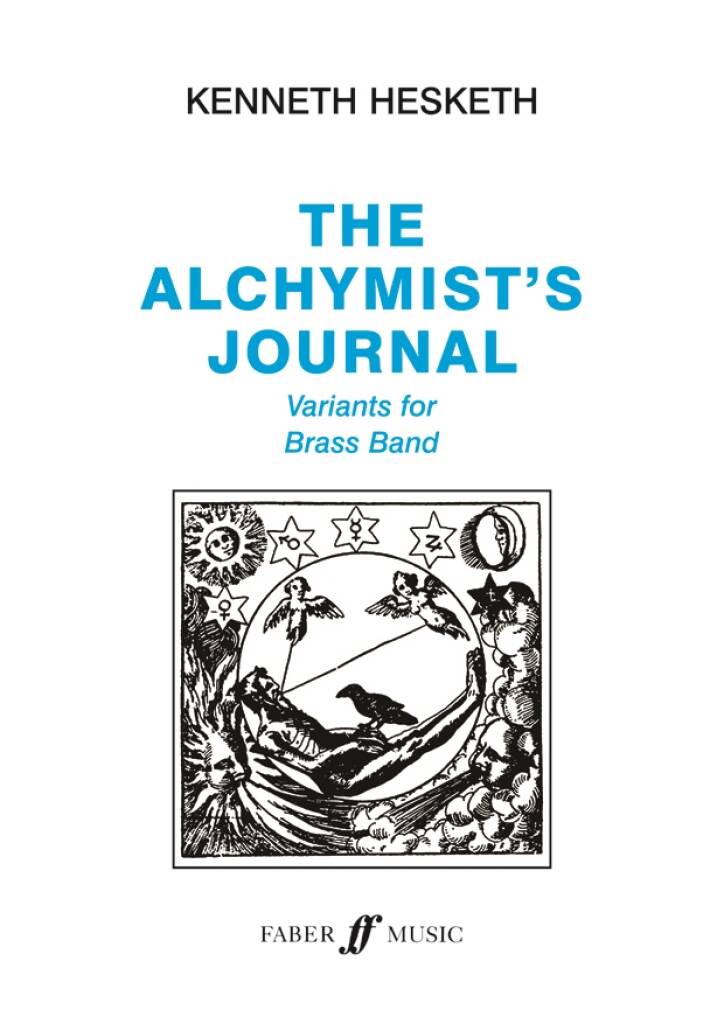
Alchymist's Journal. - Kenneth Hesketh
'The Alchymist's Journal' gets its title from the book of the same name by American author Evan S. Connell. The book fictionalises a number of famous Alchemist's writings, each one developing another's thoughts thuscontinuing one idea but changing it subtly to provide a new view point or way of thinking. This process is, in fact, alchemical as one idea transmutes into another. This idea is parallel to the processes at work within thesevariants. The whole work is constructed from 6 notes (C, A, B flat, E flat, F sharp, E) and is presented in nine different sections, each individual in mood but still based upon the original pitches. This is not a thematic setofvariations, as the themes are developed one at a time from small segments of the six notes. For example, the opening theme is the complete number of pitches, the second theme uses three notes transposed then repeated at theoriginal level, and so on. Harmonically, the six notes can be divided into two triads, A minor and E flat minor - each key beginning and ending the piece respectively. Whilst this is essentially abstract music with noprogramme there is an introduction, menacing scherzo, slow reflective section followed by a recap of the scherzo and final coda. 'The Alchymist's Journal' was commissioned by the Brass Band Heritage Trust at the suggestionof Paul Hindmarsh, to whom the work is dedicated.
Estimated dispatch 5-14 working days
-
 £80.00
Fanfares and Love Songs - Gavin Higgins
Fanfares and Love Songs was commissioned by the National Children's Brass Band of Great Britain for performance on 25th July 2009. Its three movements contrast the extrovert and lyrical qualities of thetraditional brass band. The fanfare with which the work opens involves the whole cornet section. The second movement is reflective in mood, beginning somewhat pensively on muted brass, and building to an emotional climax beforesubsiding back to a distant pianissimo chord. The finale is a fast dance, which with a final recapitulation of the opening fanfare drives on to a breathless close. Brass Band Grade 4: Advanced Youth and 3rdSectionDuration: 12 minutes
Estimated dispatch 5-14 working days
-
 £65.00
Frankly Speaking - Frank Sinatra
A suite of three songs of Sinatra arranged for Flugelhorn, Trombone and Cornet or Euphonium solos
Estimated dispatch 5-14 working days
-
 £54.99
Heavy Stuff - David Well
The drummer in the spotlight. A heavy piece with a fat heavy beat. In three sections. Great for the lower sections and youth bands.
Estimated dispatch 5-14 working days
-
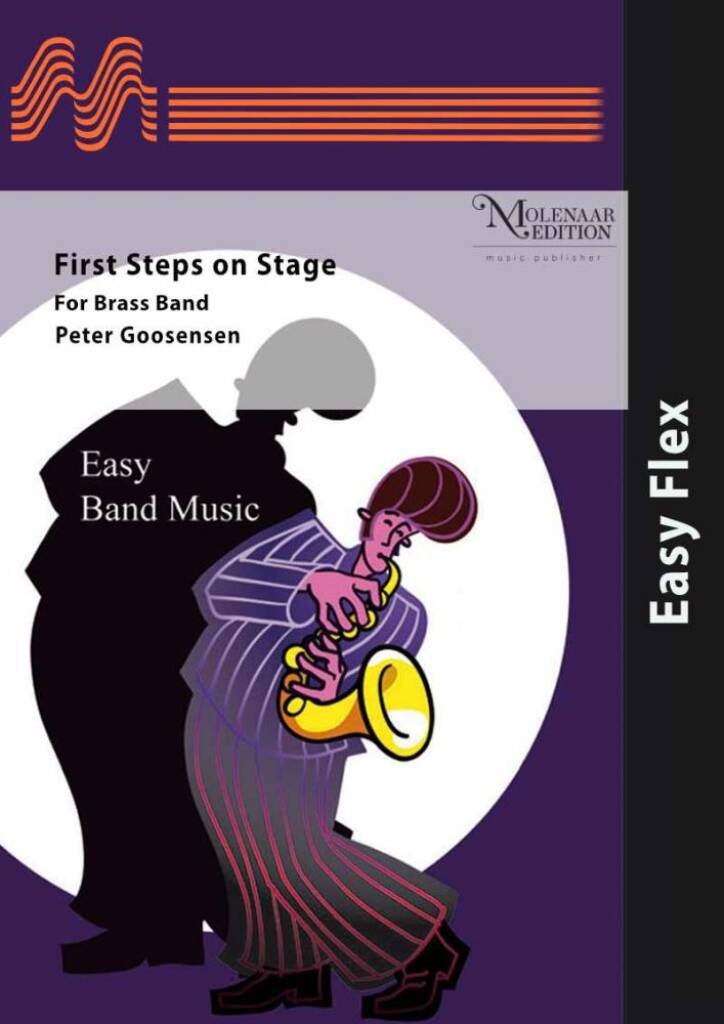 £69.00
First steps on stage - Peter Goosensen
First steps on stage' is especially intended for beginning wind orchestras. This piece can be used to playfully master music making in an orchestra or ensemble. The composition consists of three parts that together provide a varied and attractive composition.
Estimated dispatch 5-14 working days
 View Music