
Results
-
 £60.99
In Memoriam - Jacob de Haan
When someone departs this life, there is sadness, people seek comfort, and memories come to mind. Jacob de Haan has brought these three elements together in In Memoriam, which has been composed with the aim of honouring the deceased, and offering consolation to the bereaved.
Estimated dispatch 5-14 working days
-
 £76.99
Bliss - Jacob de Haan
Bliss: Impressions of a Village is a spectacular test piece by one of the most renowned brass band composers in Holland, Jacob de Haan. It contains three impressions of a village in the beautiful Brabant province in the Netherlands. The first movement is in a very classical style, which captures the village's history appropriately. The entire band joins in as the small river approaches an ancient castle. The third movement contains lots of interesting rhythms portraying the hustle and bustle of everyday life in the village.
Estimated dispatch 5-14 working days
-
 £55.00
New York. - Nigel Hess
'New York'... or to be more precise, Manhattan. For anyone who is familiar with this bizarre and wonderful city, this piece needs no explanation. This brass band transcription has been made by Phillip Littlemore and provides adriving and punchy 4 minute work for brass band. 'New York' is the third movement of 'East Coast Pictures', originally written for wind band, commissioned in 1985 by the British Youth Wind Orchestra with funds from NationalWestminster Bank plc. These three short 'pictures' were inspired by several visits by the composer to a small part of the USA's East Coast, an area that provides great extremes in the geography and thepeople.This work has recently been recorded on the CD 'East Coast Pictures' by the Leyland Band, conducted by Michael Fowles, and is available from this site (catalogue number: 0-571-52109-6).
Estimated dispatch 5-14 working days
-
 £45.00
The Nutcracker 'Sweet' - Pyotr Ilyich Tchaikovsky
Tchaikovskys ballet, The Nutcracker, is a fairy-ballet in two acts, three tableaux and was composed in 1891/2. It is based on The Nutcracker and the Mouse King, a story by E. T. A. Hoffmann (1816). Mark Freehhas arranged this Tchaikovsky classic for big band.Brass Band Grade 4: Advanced Youth and 3rd SectionDuration: 12 minutes
Estimated dispatch 5-14 working days
-
 £60.99
Bandstand Boogie - C. Albertine - Peter Wain
Charles Albertine played Tenor Saxophone with the Sammy Kaye band in the late 1940s, and was the lead arranger for the new Las Elgart band. He arranged most of the Three Suns later music. Most of his later career was spent in television. 'Bandstand Boogie' was adopted by Dick Clark as the theme song for his long-running series, 'American Bandstand.'
Estimated dispatch 5-14 working days
-
 £109.99
Fantasy for Brassband and Organ - Jan Bosveld
When I was approached to compose a work for brassband and church organ I already envisioned the concept I would use. It would indeed literally become a work for brassband and organ. Without the traditional solos, the organ would form an addition to the brassband orchestration as would the brassband provide an extra register for the organ. In short a homogeneous entity. The most important reason for doing this is quite simple. Since this work can only be performed in a church and because of the specific acoustics of the church, the brassband would sound in al its tone colour like an organ. By using certain registers of the organ and combining these with the brassband a wonderfulsound palette can be created. The use of complementary or contrasting tone quality is also possible. The primary theme of this composition is based on these three methods of "colouring". As far as structure is concerned this work consists of two parts. slow fast. It is built on a number of motifs in which some behave like a consecutive canon. In the fast movement the primary motif develops into a fugue-like section. The canon and fugato are techniques frequently used in classical and contemporary organ literature. The liberal use of structure and motif has lead to the title. "Fantasy for Brassband and Organ".
Estimated dispatch 5-14 working days
-
 £104.99
Scottish Dances - Peter Martin - Menno Haantjes
Scottish Dances is based on three Scottish traditionals: Cock of the North, The Bonnie Bank's O'Loch Lomond and Marie's Wedding. I. Cock of the North's name is used for multiple things or events. For example for a locomotive to a famous, it seems, delicious liqueur, and rallies to snowboard competitions. Furthermore is "Cock O' the North " a nickname of a famous Duke. (The 4th Duke of Gordon). In this composition Cock of the North (a Jig) is a traditional Scottish bagpipe tune, regularly played on tattoos by Pipe Bands. Not infrequently the drummers sing the text. Auntie Mary, had a canary, Up the leg of her trousers While she was sleeping Iwas peeping Up the leg of her trousers. II. " The Bonnie Bank's O'Loch Lomond " is about a sad story that took place during an revolt against the British. In 1745 Bonnie Prince Charlie had to retreat. Two of his men were captured. One was convicted and executed, while the other was released. The spirit of the executed soldier would arrive in Scotland via the 'low road' (underworld) before his companion, who had still a long way to go. You'll take the high road And I'll take the low road And I'll be in Scotland afore ye But me and my true love will never meet again On the Bonnie Bonnie Banks of Loch Lomond III. In a Scottish wedding, after the official ceremonies, there is often danced. This is called a ceilidh. For this we use traditional Scottish music such as "Marie's Wedding '. Mid dance we go back to the church, where a lovely song in honor of the couple sounds. Marie's Wedding has been recorded by Van Morrison (among many others). Step we gaely, on we go, heel for heel and toe for toe Arm and arm and on we go, all for Marie's wedding
Estimated dispatch 5-14 working days
-
 £84.99
Voyage with the VOC - William Vean
The Netherlands have been an important trading nation for a long time partly as a result of their geographical situation. One of the first multinationals in The Netherlands was the 'Verenigde Oostindische Compagnie' (VOC). The aim of the VOC was to send ships to Asia in order to buy pepper and spices, and to take over the Portuguese monopoly in this field. The Company was successful. An era of great prosperity resulted, in which the art of painting (Rembrandt van Rijn) as well as science (Constantijn Huygens) flourished alongside a thriving economy. 1. The Sails are set : There is a lot of hustle and bustle on the quay. The crew are preparing fordeparture. Goodbyes are said and once the sails have been hoisted the ship sets out to sea.2. A Visit to the Rajah of Yogyakarta: After a voyage of many months the place of destination is reached. A visit to the Radja, the king of the area around Yokyakarta, follows. The dishes and beverages and the native culture in general are very pleasant after having been on a diet of ship's biscuit and water for such a long time.3. The Holds have been loaded: The holds have been loaded to the brim, and the voyage home can be begin!4. Death sails along: Life at sea is rough. not seldom did a sailor die of a tropical disease or scurvy. After a memorial service, the Captain would speak the words 'One, two, three, in God's name ...' and the body, wrapped in canvas, would be committed to the sea.5. A joyful homecoming: After many months of hardship coming home is perhaps the best part of the entire voyage. The quay is filled with people eager to give the crew a warm welcome.
Estimated dispatch 5-14 working days
-
 £115.60
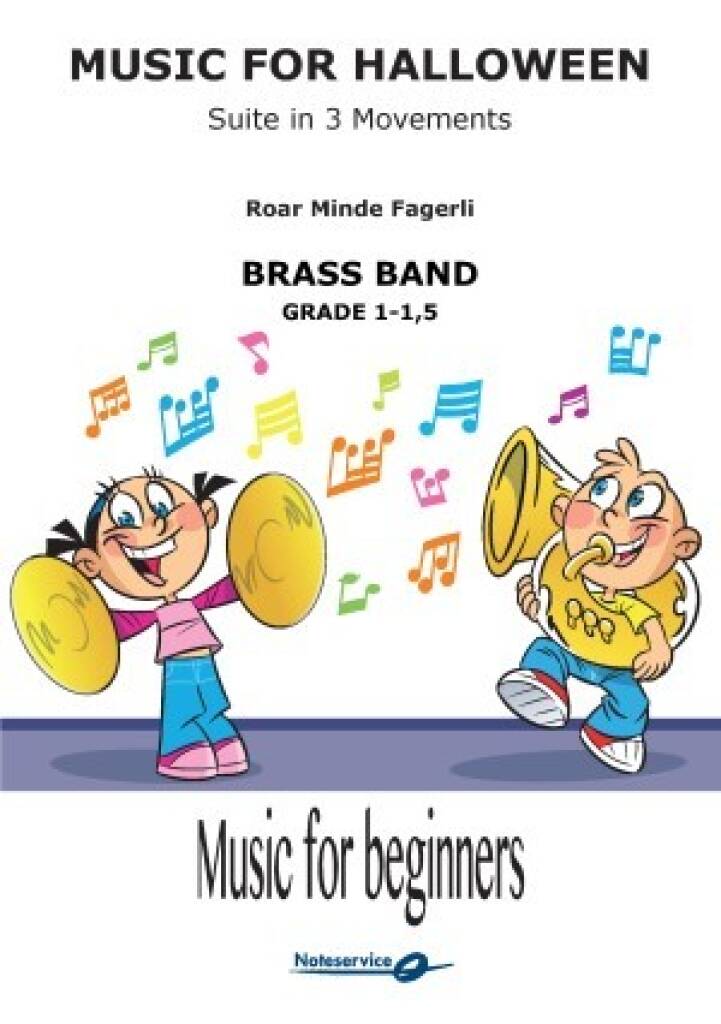
Music for Halloween - Roar Minde Fagerli
"Music for Halloween" is three simple pieces who describes spooky and scary moods we ALL know from halloween.The first movement describes The Grim Reaper, a scary character who represents death.The second movement describes the black magic of voodoo and its supernatural forces.The third movement describes a spooky ghost train who drives fast through the dark night.
Estimated dispatch 5-14 working days
-
 £59.95
Essay - Edward Gregson
This work was specially commissioned as the test piece for a new brass band competition in 1971, held at the Royal Albert Hall, London. It is in three movements, the titles of which all have literary connotations. The first movement, Dialoguetakes the form of 'conversations' between the instruments. The second movement, Soliloquy is dedicated to the memory of Gilbert Vinter - a composer who did so much in the 1960s to bring the brass band into the modern world. The final movement,Epigram, creates strong rhythmic contrasts and exploits the more virtuoso character of the brass band.
Estimated dispatch 5-14 working days
 View Music