
Results
-
 £59.99
Hava Nagila - Philip Sparke
Hava Nagila (the title means 'let us rejoice') is perhaps the best known example of a style of Jewish music called 'klezmer'. Klezmer music originated in the 'shtetl' (villages) and the ghettos of Eastern Europe, where itinerant Jewish troubadours, known as 'klezmorim', had performed at celebrations, particularly weddings, since the early Middle Ages.'Klezmer' is a Yiddish term combining the Hebrew words 'kley' (instrument) and 'zemer' (song) and the roots of the style are found in secular melodies, popular dances, Jewish 'hazanut' (cantorial music) and also the 'nigunim', the wordless melodies intoned by the 'Hasidim' (orthodox Jews).Since the 16th century, lyrics hadbeen added to klezmer music, due to the 'badkhn' (the master of ceremony at weddings), to the 'Purimshpil' (the play of Esther at Purim) and to traditions of the Yiddish theatre, but the term gradually became synonymous with instrumental music, particularly featuring the violin and clarinet. The melody of Hava Nagila was adapted from a folk dance from the Romanian district of Bucovina. The commonly used text is taken from Psalm 118 of the Hebrew bible.
Estimated dispatch 5-14 working days
-
 £59.99
Hava Nagila (Brass Band - Score and Parts) - Sparke, Philip
Hava Nagila (the title means 'let us rejoice') is perhaps the best known example of a style of Jewish music called 'klezmer'. Klezmer music originated in the 'shtetl' (villages) and the ghettos of Eastern Europe, where itinerant Jewish troubadours, known as 'klezmorim', had performed at celebrations, particularly weddings, since the early Middle Ages. 'Klezmer' is a Yiddish term combining the Hebrew words 'kley' (instrument) and 'zemer' (song) and the roots of the style are found in secular melodies, popular dances, Jewish 'hazanut' (cantorial music) and also the 'nigunim', the wordless melodies intoned by the 'Hasidim' (orthodox Jews).Since the 16th century, lyrics had been added to klezmer music, due to the 'badkhn' (the master of ceremony at weddings), to the 'Purimshpil' (the play of Esther at Purim) and to traditions of the Yiddish theatre, but the term gradually became synonymous with instrumental music, particularly featuring the violin and clarinet. The melody of Hava Nagila was adapted from a folk dance from the Romanian district of Bucovina. The commonly used text is taken from Psalm 118 of the Hebrew bible.Duration: 3:00
Estimated dispatch 7-14 working days
-
 £118.99
Euphonium Concerto - Edward Gregson
Commissioned by Euphonium Foundation UK. First performed by David Childs and British Brass conducted by Robert Childs at Senzoku Gakuen College of Music, Tokyo, Japan on 16 June 2018. UK premiere by David Childs and Tredegar Band conducted by Ian Porthouse at the Royal Northern College of Music Brass Band Festival, Manchester, on 29 January 2019. Premiere recording by David Childs (euphonium) with the Black Dyke Band, conducted by Nicholas Childs, on the Doyen label (DOYCD 414).
Estimated dispatch 5-14 working days
-
 £118.99
Albinus Variations - Etienne Crausaz
Johann Georg Albinus wrote a number of Lutheran hymns set to music by various composers. Johann Sebastian Bach reworked and inserted some of these hymns into his cantatas, particularly the chorale "Alle Menschen mussen sterben" in BWV 162. Albinus Variations opens with a solemn cadenza followed by five contrasted variations on this chorale. Both versions of the chorale, in major and minor keys, were used as a reference for this work.
Estimated dispatch 5-14 working days
-
 £118.99
Lions of Legends - Thierry Deleruyelle
This work was commissioned by Eurofestival. Ever since antiquity, mankind has been fascinated by the lion: symbolising courage, strength and temperance. Many have made use of the lion to represent themselves in symbols and emblems. In five movements the composer describes both the history of the lion throughout centuries, as well as the characteristics. A challenging idea to turn into music! The final movement 'King of Kings' is extremely spectacular. A great choice for thematic concerts or as a main piece in your concert or contest.
Estimated dispatch 5-14 working days
-
 £118.99
Introduction and Variations on "Dies Irae" - Jan de Haan
After the introduction, in which the landscape of Groningen with its beautiful wide views is presented, follows five variations based on the 13th-century Gregorian theme Dies Irae that is attributed to Thomas van Celano. Each variation can be seen as a stage or a scene in the rich history of the village of Grijpskerk, making this work a very exciting and expressive piece of music for a contest or a concert.
Estimated dispatch 5-14 working days
-
 £118.99
Abaddon - Kevin Houben
Abaddon was commissioned by the NLBB (Noord-Limburgse Brassband North Limburg Brass Band) from Belgium. Abaddon is the demon reigning over the underworld. In the New Testament in the Book of Revelation by John (9:11) he is calledthe angel of the bottomless pit. The work Abaddon lives up to its name. Technically and physically, it holds an enormous challenge for every band in the champions division. The composition has a traditional form structure (fast slow fast), and it consists of ornamentationsaround the letters IVAN, after Ivan Meylemans, the conductor who since 2001 has obtained great successes with the NLBB, and who in this case has also been essential in taming the demon in Abaddon.
Estimated dispatch 5-14 working days
-
£118.99
Elegy I - Jacob de Haan
Elegy I 'Jealousy' has been named after John Donne's poem of the same name. This English poet (1572-1631) wrote an entire series of elegies, each with its own theme. Jealousy can trigger various emotions, ranging from disappointment, grief, or regret, to madness and anger. All these emotions have been incorporated into this composition. Jacob de Haan was inspired by three different works of art: a poem (the aforementioned poem by John Donne), a painting by the Norwegian painter Edvard Munch (Jealousy in the Garden) and an old French chanson about jealousy (Je ne l'ose dire) by the sixteenth-century French composer Pierre Certon. The music refers repeatedly to thischanson - sometimes through key notes from the melody that serve as the starting point for new, isolated themes and sometimes through quotations of the original version
Estimated dispatch 5-14 working days
-
 £118.20
Marsj etter Erling Kjok - Svein H. Giske
Erling Kjok (1913-1999) was a Norwegian fiddler and a strong representative of the folk music from Nord-Gudbrandsdal.My arrangement was originally written for Concert band as a commission from The Staff Band of the Norwegian Armed Forces for the Norwegian Military Tatoo. It is partially inspired by a recording from the folk music group Kvarts.-Svein H. Giske-August 2022
Estimated dispatch 5-14 working days
-
 £118.20
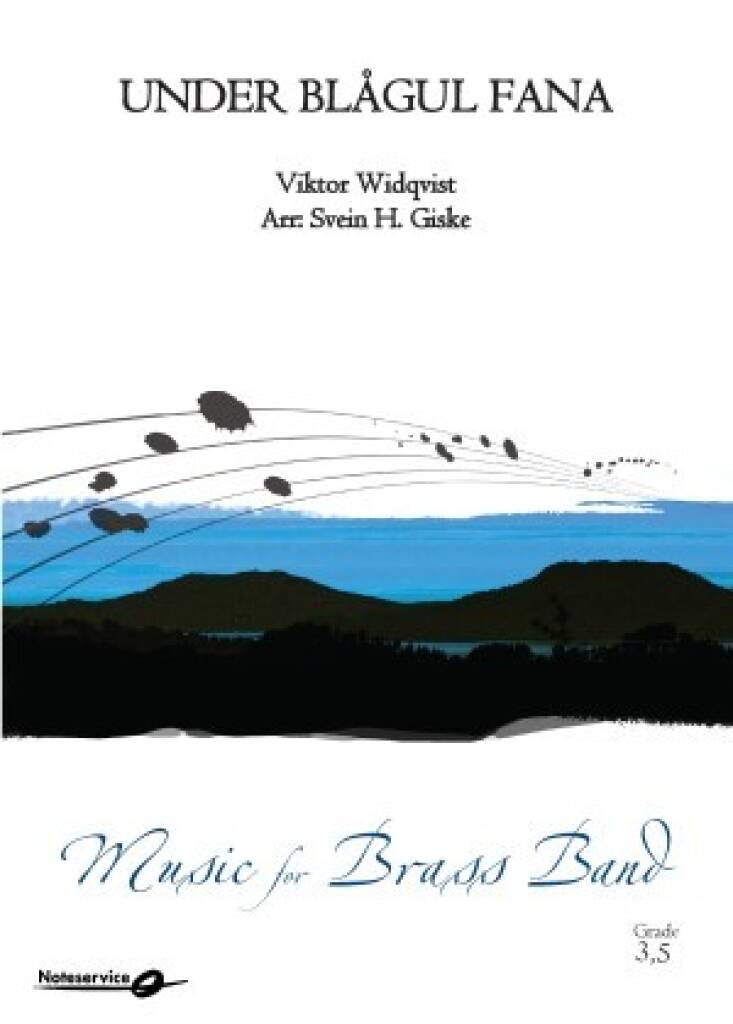
Under blaful fana - Viktor Widqvist - Svein H. Giske
This march composed in 1916 is arguably one of the finest and most famous marches from the Scandinavian countries.It's composer, and Swedish March King Viktor Widqvist's (1881-1952) most famous composition and it's the official march of all the armed forces in Sweden.The title reflects on the colours of the Swedish flag.-Svein H. Giske-August 2022
Estimated dispatch 5-14 working days
 View Music