
Results
-
 £154.99
Trance (Brass Band - Score and Parts) - Doss, Thomas
In this piece, the composer depicts a mother who hears her unborn baby cry for her. She is thrown into doubt as to whether she will keep the child, and passes this feeling onto the baby. Underlying this successful work is the Bach chorale Wie schn leuchtet der Morgenstern and has already proven itself as a winning piece in several renowned contests!Duration: 16:30
Estimated dispatch 7-14 working days
-
 £53.00
Last Night of the Proms Medley (Brass Band - Score and Parts) - Barton, Tom
A collection of the finest and most famous repertoire, performed at the most quintessential of English summer classical music concerts, "The Proms". Unravel your Union Jack flag in preparation for "Rule Britannia" (Thomas Arne), "The Saucy Arethusa" (Henry Wood), "The Sailor's Hornpipe" (Traditional), "Land of Hope and Glory" (Edward Elgar), "Jerusalem" (Hubert Parry) and "The Can-can" (Jacques Offenbach). Duration: 8.00. Suitable for 1st Section Bands and above.
Estimated dispatch 7-14 working days
-
 £34.95
Jesus Shall Conquer (Brass Band - Score and Parts) - Downie, Kenneth
This music was written for Salvation Brass. It is declamatory in style and would fit the role of an intrada. The words associated are by a former General of The Salvation Army, Albert Orsborn, and have a very optimistic tone, consistent with the Christian faith. The chorus reads: Jesus shall conquer, lift up the strain! Evil shall perish and righteousness shall reign.The tune used is Pilgrims (T.B. 548), by Henry Thomas Smart, the 19th Century English composer and organist, who also wrote another of my favourite hymn tunes, Regent Square. Keeping a steady tempo will help to preserve the dignity of the theme and also help to avoid the busier passages in the score from being rushed. As ever, articulation and dynamics require careful attention.
Estimated dispatch 7-14 working days
-
£17.50
Jesus Shall Conquer (Brass Band - Score only) - Downie, Kenneth
This music was written for Salvation Brass. It is declamatory in style and would fit the role of an intrada. The words associated are by a former General of The Salvation Army, Albert Orsborn, and have a very optimistic tone, consistent with the Christian faith. The chorus reads: Jesus shall conquer, lift up the strain! Evil shall perish and righteousness shall reign.The tune used is Pilgrims (T.B. 548), by Henry Thomas Smart, the 19th Century English composer and organist, who also wrote another of my favourite hymn tunes, Regent Square. Keeping a steady tempo will help to preserve the dignity of the theme and also help to avoid the busier passages in the score from being rushed. As ever, articulation and dynamics require careful attention.
Estimated dispatch 7-14 working days
-
 £29.50
REM-Scapes (Brass Band - Score only) - Doss, Thomas
Sweet echoes of Beethoven's Moonlight Sonata in the introduction bring a gentle slumber. Breathing is calm and sleep holds the promise of rest and relaxation. With the onset of the REM sleep phase, however, in which most dreams take place and where the day's events are worked through, we hear other sounds played. With distorted sounds, reminiscent of an old gramophone, the music pulls the listener inevitably ever deeper into the dreamscape, in a very realistic dangerous situation that comes to a dramatic head. It triggers a desperate struggle between the impulse to awaken and the exhausting urge to flee. For a short moment, it seems as if the wakeful urge has won out, before dream's powerful spell is again cast, and there's no escapeDuration: 17:00
Estimated dispatch 7-14 working days
-
 £154.99
REM-Scapes (Brass Band - Score and Parts) - Doss, Thomas
Sweet echoes of Beethoven's Moonlight Sonata in the introduction bring a gentle slumber. Breathing is calm and sleep holds the promise of rest and relaxation. With the onset of the REM sleep phase, however, in which most dreams take place and where the day's events are worked through, we hear other sounds played.With distorted sounds, reminiscent of an old gramophone, the music pulls the listener inevitably ever deeper into the dreamscape, in a very realistic dangerous situation that comes to a dramatic head. It triggers a desperate struggle between the impulse to awaken and the exhausting urge to flee. For a short moment, it seems as if the wakeful urge has won out, before dream's powerful spell is again cast, and there's no escape...Duration: 17:00
Estimated dispatch 7-14 working days
-
 £69.99
Sunset Serenade (Brass Band - Score and Parts) - Doss, Thomas - Woude, Klaas van der
Sunset Serenade is a tribute by the composer to a music colleague, whose life was unexpectedly cut short. In spite of the sad circumstances of its creation, the music reflects overwhelmingly happy memories and thoughts of gratitude for time spent together and shared experiences. The overall peaceful nature of this composition symbolises a reconciliation with, and acceptance of, the transient nature of man.Duration: 5:45
Estimated dispatch 7-14 working days
-
 £43.99
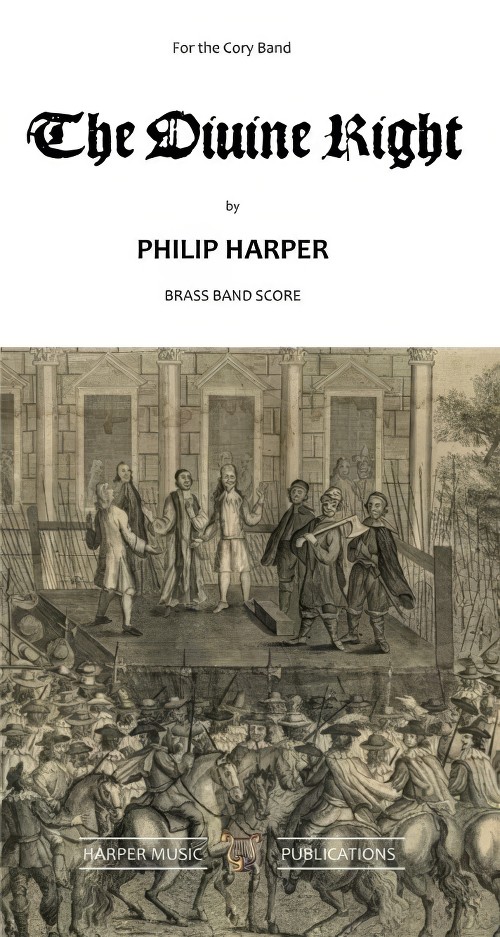
The Divine Right (Brass Band - Score only) - Harper, Philip
At the time of composing this piece, the Arab Spring was sweeping through the Middle East. It seemed that almost every week a new country's people had risen up against the regimes and dictatorships which had prevailed for generations, leaving many nations at a defining crossroads in their history. There were so many possible ways ahead: so many hopes, yet so many uncertainties.This music is a depiction of these revolutionary times, and several musical themes are in turn presented, discussed, considered, fought over, altered, rejected or accepted.Most nations have had, or probably will have, their own Arab Spring, including the United Kingdom. Events of 17th Century Britain provide the context for this piece, particularly those following the execution of the tyrant King Charles I on 30 January 1649. The regicide was in part due to Charless steadfast belief in the Divine Right of Kings, and led to a tumultuous interregnum, where England stood at its own defining crossroads. The music begins turbulently, before King Charles appears and is led to the gallows outside Banqueting House in central London where he is brutally decapitated. From the assembled crowd rose, according to one observer,a moan as I never heard before and desire I may never hear again.The music descends to emptiness.The musical argument which follows is not strictly programmatic, but a number of musical themes are all thrown into the melting pot, representing ideas such as: religion; military force; reasoned Parliamentary debate; and the chattering, irrepressible voice of the people. Additionally, there are some quotations from the music of royalist composer Thomas Tomkins (1572-1656), who was often in tune with the feeling of the times.This defining episode in England's history was brought to a close with the Restoration of the monarchy in 1660, and as the exiled King Charles II rode back into London the diarist John Evelyn wrote:Never was so joyful a day seen in this nation. I stood in the Strand and beheld it, and blessed God.At the end of the piece the bells ring out, and the musical appearance of the King has transformed from turbulent to triumphant.Duration: 17.00
Estimated dispatch 7-14 working days
-
£104.99
The Divine Right (Brass Band - Score and Parts) - Harper, Philip
At the time of composing this piece, the Arab Spring was sweeping through the Middle East. It seemed that almost every week a new country's people had risen up against the regimes and dictatorships which had prevailed for generations, leaving many nations at a defining crossroads in their history. There were so many possible ways ahead: so many hopes, yet so many uncertainties.This music is a depiction of these revolutionary times, and several musical themes are in turn presented, discussed, considered, fought over, altered, rejected or accepted.Most nations have had, or probably will have, their own Arab Spring, including the United Kingdom. Events of 17th Century Britain provide the context for this piece, particularly those following the execution of the tyrant King Charles I on 30 January 1649. The regicide was in part due to Charless steadfast belief in the Divine Right of Kings, and led to a tumultuous interregnum, where England stood at its own defining crossroads. The music begins turbulently, before King Charles appears and is led to the gallows outside Banqueting House in central London where he is brutally decapitated. From the assembled crowd rose, according to one observer,a moan as I never heard before and desire I may never hear again.The music descends to emptiness.The musical argument which follows is not strictly programmatic, but a number of musical themes are all thrown into the melting pot, representing ideas such as: religion; military force; reasoned Parliamentary debate; and the chattering, irrepressible voice of the people. Additionally, there are some quotations from the music of royalist composer Thomas Tomkins (1572-1656), who was often in tune with the feeling of the times.This defining episode in England's history was brought to a close with the Restoration of the monarchy in 1660, and as the exiled King Charles II rode back into London the diarist John Evelyn wrote:Never was so joyful a day seen in this nation. I stood in the Strand and beheld it, and blessed God.At the end of the piece the bells ring out, and the musical appearance of the King has transformed from turbulent to triumphant.Duration: 17.00
Estimated dispatch 7-14 working days
-
 £159.99
Time Machine (Brass Band - Score and Parts) - Doss, Thomas
Time Machine is a journey through time that begins in the Stone Age. Evolution and the coming of man take place. The journey takes us into the present, in which disorientation and chaos abound. We travel further into the future. An unfamiliar, quiet and surreal landscape lies before us and we wander through it, bewildered as we become aware of the destruction of the environment. Suddenly, and for no reason, memories from our childhood are awoken. Cultures have become completely mixed into one and the evolution of man has run its course. We realise that there is no "afterwards" as before us lies the Stone Age once again... The wheel of time spins blindly on and all is repeated.Duration: 13:30
Estimated dispatch 7-14 working days
 View Music