
Results
-
 £58.70
Into the Unknown - From Frozen II - Kristen Anderson-Lopez - Haakon Esplo
Composers Kristen Anderson-Lopez and Robert Lopez have once again written music for Disneys sequel film Frozen II after great success in 2013 with Frozen.Many will probably remember Let it Go which became a big hit from this movie.The new movie continue to follow the main character Elsa, who sings her amazing musical number "Into the Unknown" in Frozen II. The song describes Elsa's inner conflict of choice to leave Arendelle or trace the source of a mysterious voice she continues to hear.The song is originally sung by Idina Menzel and the Norwegian artist Aurora and has elements and motifs inspired by Scandinavian herding calls. As always, the music is both magnificent and captivating and will surely be a hit for many years to come.
Estimated dispatch 5-14 working days
-
 £57.50
Supernova - Thierry Deleruyelle
Supernova is an energetic piece in a pop style that inspires joy and good humour, its rhythm giving it an exceptionally lively and festive character. Its theme is renewal, rebirth and solidarity in the wake of the COVID-19 pandemic. The Confederation Musicale de France commissioned this work as part of the initiative "Concerts solidaires au profit de l'enfance en France et dans le monde" (Concerts in aid of children in France and worldwide).
Estimated dispatch 5-14 working days
-
 £131.00
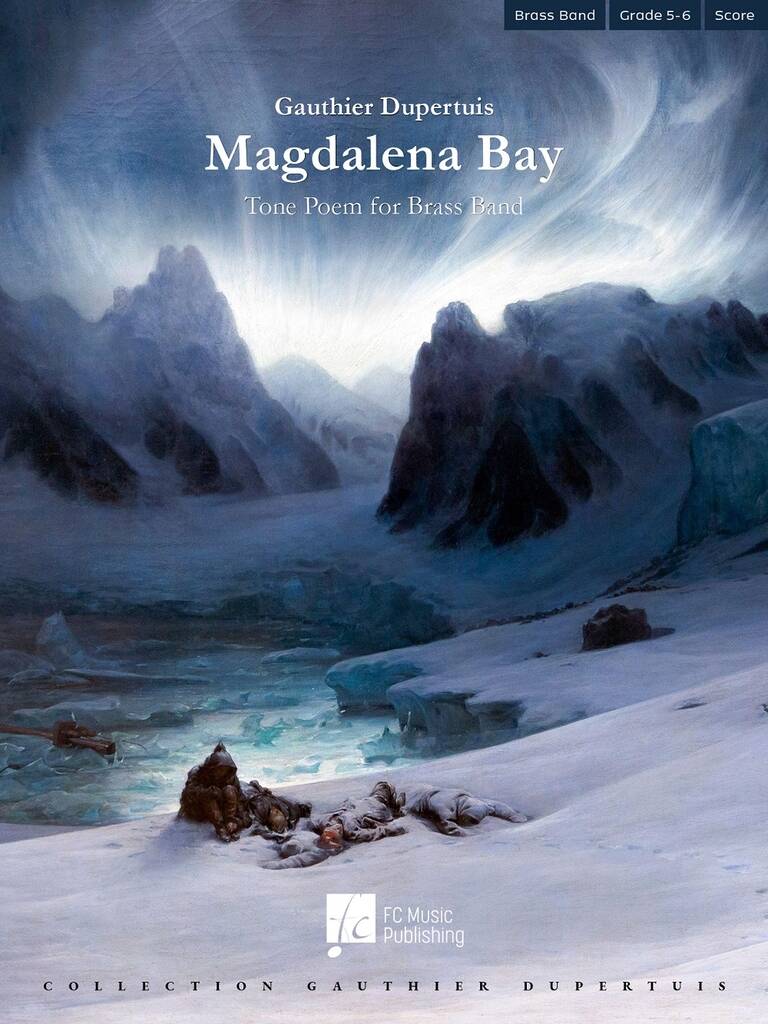
Magdalena Bay - Gauthier Dupertuis
While admiring many masterpieces at the Louvre Museum in Paris, Gauthier Dupertuis' attention was drawn to a less famous painting: Magdalena Bay, by French painter Francois-Auguste Biard (1799-1882).The work depicts a magnificent snowy landscape on the Norwegian island of Spitsbergen. However, in the foreground, the presence of the wreckage of a ship, bodies covered in snow and a visibly dying character make us understand that tragic events took place there. Thus, a strong contrast is formed between death and the sublime, between the desolation of the survivors of the shipwreck and the magnificence of the landscape. When we look in more detail at the painting, we notice that footprints have been made in the snow: so, could someone have gone to get help? This little glimmer of hope makes the picture even more touching. In this work, Gauthier Dupertuis tried to describe the different elements of the painting, using contrasting sections and dissonances (in particular, the conflict between the minor and the major) to convey the duality between death and the sublime. The work also attempts to highlight a wide palette of orchestral colors, from the most shimmering lines to the darkest low brass colours. In 2024, Magdalena Bay was awarded the first Prize as well as the band Prize at the 9th European Composition Competition for Brass Band, which was held in Palanga (LT). It was premiered on May 2, 2024 by The Cory Band, conducted by Philip Harper.
Estimated dispatch 5-14 working days
-
 £84.99
Pulse - Thomas Doss
Pulse is a solo work for euphonium and brass band. As the title suggests, this piece is very rhythmic in nature. Pulse represents life and vitality, which also characterises the work. The tempo remains virtually constant throughout the piece. Even during the cadenza, played by the euphonium, the pulse of the timpani continues to beat steadily. Even though the piece stays at a constant tempo, it can be performed at half speed.
Estimated dispatch 5-14 working days
-
 £105.20
Gabriellas Song - Dan Nilsson - Idar Torskangerpoll
"Gabriellas song" is a ballad song with music by Stefan Nilsson and lyrics by Py Backman. Recorded by Helen Sjoholm & Stefan Nilsson. The song became famous with the 2004 film "As It Is in Heaven." After this, Gabriellas Song has become a very popular scandinavian hymn-tune, used in all kinds of settings.
Estimated dispatch 5-14 working days
-
 £69.99
A Hymn to New England - John Williams
Written in 1987 as the accompaniment to New England Time Capsule, an Omnimax travelogue, and recently recorded by the Boston Pops, this three minute concert work adapts wonderfully for band. With true Williams craftmanship, it features brassy fanfares and a rich, sonorous hymn, all based on the same melodic intervals. John Williams' brilliant orchestration is successfully captured, making this a superb concert opener for brass bands.
Estimated dispatch 5-14 working days
-
 £85.80
Star Wars Episode VII: The Force Awakens - John Williams - Idar Torskangerpoll
The iconic soundtrack composed by John Williams continues with "The Force Awakens", the seventh Star Wars movie. This arrangement for Young Band tries to capture the rich timbre of the original orchestral music. It is very important to be aware ofthe balance in the band when performing this music. The horns should stand out dynamically when they plays the melody. Also make shure that the rhythmic are played as clear as possible, especially in the bass tubas and other low instruments. You maychoose whether to play the upper or lower octave in the cornet parts.
Estimated dispatch 5-14 working days
-
 £60.99
Into The Sky - Stephen Bulla
This music is a fanfare prelude that is designed to open concert programs with an impressive display of brass fireworks. It features every section of the band and reflects a modern spin on the style of the great Strauss fanfares for brass from the past.
Estimated dispatch 5-14 working days
-
£54.99
Joyful March - Bertrand Moren
As the title implies, this piece is all joy and cheerfulness. In Joyful March, the themes have been combined to make a spirited work that can give each concert an elated touch. From the opening vivid melody to the softer and colourful themes of the trio, Joyful March is full of joie de vivre. Its fairly simple structure makes it accessible to all brass bands.
Estimated dispatch 5-14 working days
-
 £119.99
Landscapes - Bertrand Moren
Landscapes is a work structured around two main ideas. On the one hand, the music freely paints some of the superb landscapes I've seen during several of my trips around the world. Listeners should, however, not be influenced by this programmatic framework and are encouraged to build their own 'mind pictures'.On the other hand, Landscapes constitutes a test piece for each section of the brass band. Indeed, each musical landscape highlights a particular register. A small group of soloists is given the opportunity to fully display its skills in dialogue with the rest of the band (the tutti), hence the name 'concerto grosso'. Landscapes also relies on the band's different soloistmusicians when it comes to express highly complex, musically and technically challenging passages.
Estimated dispatch 5-14 working days
 View Music