
Results
-
£44.95
LORD OF SEA AND SKY (Brass Band Set) - Martin Cordner
Daniel Schutte's well-known hymn, 'I, the Lord of sea and sky', provides the basis for this major four movement work by Martin Cordner. The use of a four-note motif emphasising the first line of the chorus, 'Here I am, Lord' is evident throughout the work.
Estimated dispatch 7-14 working days
-
 £30.00
Incoming ! - Jock McKenzie
I was delighted to accept this commission by the Footscray Yarraville City Band and their conductor (my friend & ex colleague) Louisa Lawless. I have made my response to the request to compose an upbeat opener and to adhere to the suggestion of something in the big band style.
-
 £30.00
No Other Option - Jock McKenzie
I seem to have taught a number of students in recent years who have either embarked on medical careers or are studying to do so. Whether it be our beleaguered NHS in general or the working conditions of Junior Doctors in particular, sentiments naturally run high. I was asked & inspired to write a piece for some of these 'medical musicians' to perform in situations of protest or industrial action; situations in which they felt there was "No OtherOption" than to make their feelings known through their chosen path of protest. There is a deliberate irony in the fact that this piece is written in the style of an upbeat and good-humoured folk reel.
-
 £15.00
Anvil Chorus from Il Trovatore - Verdi
Programme Notes from Andrew Duncan:Like many of the arrangements in the Flexi-Collection - Popular Classics Series I have simplified the rhythms and time signature, etc. I have also omitted trills for ease of playing.Dynamics form a very important aspect of this arrangement and it is important to observe these, especially the p markings. Every dynamic from p through to ff is used as well as some crescendos.The 1st Cornet/Trumpet part is perhaps more difficult than in some of the other arrangements in the series, but the other parts are fairly simple in comparison.The Percussion part (which is optional) is unusual in that it calls for two 'Anvils' to be played. However if these are not available then a good effect can be obtained by hitting two pieces of metal with metal hammers.The Flexi-Collection ApproachFlexible scoring tailored to your needs - A perfect solution for expanding the repertoire of training and junior brass bands. The Flexi-Collection currently offers two series - Popular Classics and World Tour. Based on four-part harmony, these collections provide groups with the advantage of complete flexibility when they may not be balanced. If players or instruments are missing, the show can still go on!The Flexi-Collection - Popular Classics Series, encapsulates all that is great about the wonderful range of musical styles produced by Holst, Elgar, Handel, Verdi, Tchaikovsky, Grieg, Bizet and Parry.The thoughtful scoring and arranging by Andrew Duncan now means that groups of all abilities have access to a truly flexible set of music for their needs. With world parts, rudimentary theory, terminology translations and large format typesetting, The Flexi-Collection ticks all the boxes when it comes to bringing interesting music to the training and junior band/brass group environment.Available for Brass Band - The Flexi-Collection offers flexibility in every sense of the word.(Available individually or as part of the money-saving Flexi-Collection Popular Classics Album)
In Stock: Estimated dispatch 3-5 working days
-
 £15.00
In the Hall of the Mountain King - Grieg
Performance Notes from Andrew Duncan:This arrangement is fairly difficult for inexperienced players and is without doubt one of the most difficult in the Flexi-Collection Popular Classics Series. But, as it is such a popular piece there is normally a great incentive from the players to learn the piece, despite the difficulties.The accelerando and gradual increases in tempo which are integral to this piece are in themselves very important musical ideas for new players to grasp, and these will be better understood as a result of playing and learning this arrangement.Other features found in this arrangement which may be new to some inexperienced players are the use of tin mutes in the 1st Cornet/Trumpet part, and the falling chromatic notes (accidentals) found in the melody line. Also, the wide range of dynamics, pp - ff , may be new to some players.I have deliberately not suggested any specific metronome markings as this is very much up to the conductor and is dependant on the players' abilities. However, as the arrangement becomes more familiar, the tempo could no doubt be speeded up adding to the excitement of future performances.The Flexi-Collection ApproachFlexible scoring tailored to your needs - A perfect solution for expanding the repertoire of training and junior brass bands. The Flexi-Collection currently offers two series - Popular Classics and World Tour. Based on four-part harmony, these collections provide groups with the advantage of complete flexibility when they may not be balanced. If players or instruments are missing, the show can still go on!The Flexi-Collection - Popular Classics Series, encapsulates all that is great about the wonderful range of musical styles produced by Holst, Elgar, Handel, Verdi, Tchaikovsky, Grieg, Bizet and Parry.The thoughtful scoring and arranging by Andrew Duncan now means that groups of all abilities have access to a truly flexible set of music for their needs. With world parts, rudimentary theory, terminology translations and large format typesetting, The Flexi-Collection ticks all the boxes when it comes to bringing interesting music to the training and junior band/brass group environment.Available individually or as part of the money-saving Flexi-Collection Popular ClassicsAlbum.Scored for Brass Band and supplied with additional Easy Bb, Easy Eb and world parts - The Flexi-Collection offers flexibility in every sense of the word.
In Stock: Estimated dispatch 3-5 working days
-
 £30.00
Merry-Go-Round - Tim Paton
I heard a recording of a fairground organ playing a fabulous concert waltz from the early 20th century. It struck me that this music was in the same league as another popular concert waltz, "Nights of Gladness". I aurally transcribed it, and set about creating an exciting piece for brass band, aiming to capture the 'fun of the fair'. The piece needs a good principal cornet, and an efficient glock player would not go amiss!
In Stock: Estimated dispatch 3-5 working days
-
 £77.00
General Series Brass Band Journal, Numbers 2265 - 2268, April 2026
2265: Holy God, we praise your name (Micael Dikantsa)This bolero introduces composer Micael Dikantsa of the Amriswil Corps, Switzerland, and is based on the hymn Holy God, We Praise Your Name (Grosser Gott, wir loben dich). Set in the traditional slow, dramatic bolero style, the work builds steadily from a distinctive percussion figure as the melody passes through different instrumental groups. With its growing intensity and rich scoring, this piece offers an engaging and atmospheric addition to concert programmes.2266: Tell the story (Barrie Gott)This work continues the Swing series that began nearly 40 years ago with Light'Walk. After a bold introduction, the melody unfolds through unison and close'harmony writing, leading to a Flugel Horn solo with scope for improvisation. The well'known hymn I Love to Tell the Story is heard in a New Orleans style before a modulation launches an energetic shout chorus and lively coda. Smooth, relaxed swing style is key throughout.2267: The old rugged cross (Erik Leidzn)This arrangement by Erik Leidzn is an early and lesser'known setting of a well'loved hymn, rediscovered during research into his work. Edited from a rare score found in the USA East Music Department archives, it demonstrates Leidzn's economical and effective style, creating a practical and expressive arrangement at a time when concise, serviceable hymn settings were greatly needed.2268: Heaven came down! (Michael Cooper)Inspired by William Booth's famous challenge to use contemporary styles for sacred purpose, this piece blends high'energy jazz'fusion big'band writing with a joyful gospel hymn. Driven by rhythm, syncopation and precision, the music proclaims its message of transformation and spiritual joy with vitality, clarity and infectious swing.
Estimated dispatch 7-14 working days
-
 £95.00
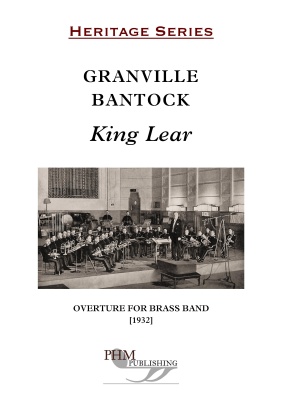
King Lear (Brass Band - Score and Parts)
Sir Granville Bantock (1868 - 1946) composed the second of his five major brass band work for Callender's Cableworks Band, completing the commission on 30 November 1932. Based in the Thames-side district of Belvedere near Erith, the band was active between 1898 and 1961. The works band of the Callender Cable & Construction Co. Ltd, it was at the peak of its popularity during the 1930s and was a frequent broadcaster on the radio. The band employed an in-house arranger and played saxophones in its lighter material. King Lear was one of the band's major commissions and was not published in Bantock's lifetime. The manuscript score and parts were thought to be lost for decades, but were found in the library of the Haydock Band (Lancashire), which had inherited part of Callender's library of manuscripts material and bespoke arrangements after it has been transferred to nearby Prescott Cables Band after Callender's Cable Works closed.King Lear is a substantial work, in essence a dramatic tone poem in the romantic Tchaikovskian manner, presenting a series of character portraits of the foolish old king and his three daughters, Goneril, Regan and Cordelia. The music is dramatic and lyrical by turns, with the most generous lyrical episode revealing perhaps the warm-hearted Cordelia. An expansive melody that flows from this is brought back towards the end as the main climax of the work.In 2001, Bantock's score was recorded by the University of Salford Brass Band, conducted by Dr. Roy Newsome. The original is serviceable, but in comparison with the orchestral version he made in 1936 (part of which was recorded on a Paxton 78 rpm) and later brass band scores, performing editions of which were prepared by others, it lacks colour and range typical of Bantock's orchestral work. Above all it lacks percussion, which can be heard on the recorded extract. With the kind permission of the Bantock Estate, I have prepared a performing edition for publication that incorporates percussion, derived from the orchestral recording and added editorially in similar manner elsewhere. I have revoiced some of the low- lying instrumental parts to present the material in more comfortable ranges. Editorial interventions more elaborate than revoicing the original text have been identified as cue notes.- Paul HindmarshDuration: 15.00
Estimated dispatch 7-14 working days
-
£40.00
King Lear (Brass Band - Score only)
Sir Granville Bantock (1868 - 1946) composed the second of his five major brass band work for Callender's Cableworks Band, completing the commission on 30 November 1932. Based in the Thames-side district of Belvedere near Erith, the band was active between 1898 and 1961. The works band of the Callender Cable & Construction Co. Ltd, it was at the peak of its popularity during the 1930s and was a frequent broadcaster on the radio. The band employed an in-house arranger and played saxophones in its lighter material. King Lear was one of the band's major commissions and was not published in Bantock's lifetime. The manuscript score and parts were thought to be lost for decades, but were found in the library of the Haydock Band (Lancashire), which had inherited part of Callender's library of manuscripts material and bespoke arrangements after it has been transferred to nearby Prescott Cables Band after Callender's Cable Works closed.King Lear is a substantial work, in essence a dramatic tone poem in the romantic Tchaikovskian manner, presenting a series of character portraits of the foolish old king and his three daughters, Goneril, Regan and Cordelia. The music is dramatic and lyrical by turns, with the most generous lyrical episode revealing perhaps the warm-hearted Cordelia. An expansive melody that flows from this is brought back towards the end as the main climax of the work.In 2001, Bantock's score was recorded by the University of Salford Brass Band, conducted by Dr. Roy Newsome. The original is serviceable, but in comparison with the orchestral version he made in 1936 (part of which was recorded on a Paxton 78 rpm) and later brass band scores, performing editions of which were prepared by others, it lacks colour and range typical of Bantock's orchestral work. Above all it lacks percussion, which can be heard on the recorded extract. With the kind permission of the Bantock Estate, I have prepared a performing edition for publication that incorporates percussion, derived from the orchestral recording and added editorially in similar manner elsewhere. I have revoiced some of the low- lying instrumental parts to present the material in more comfortable ranges. Editorial interventions more elaborate than revoicing the original text have been identified as cue notes.- Paul HindmarshDuration: 15.00
Estimated dispatch 7-14 working days
-
 £29.95
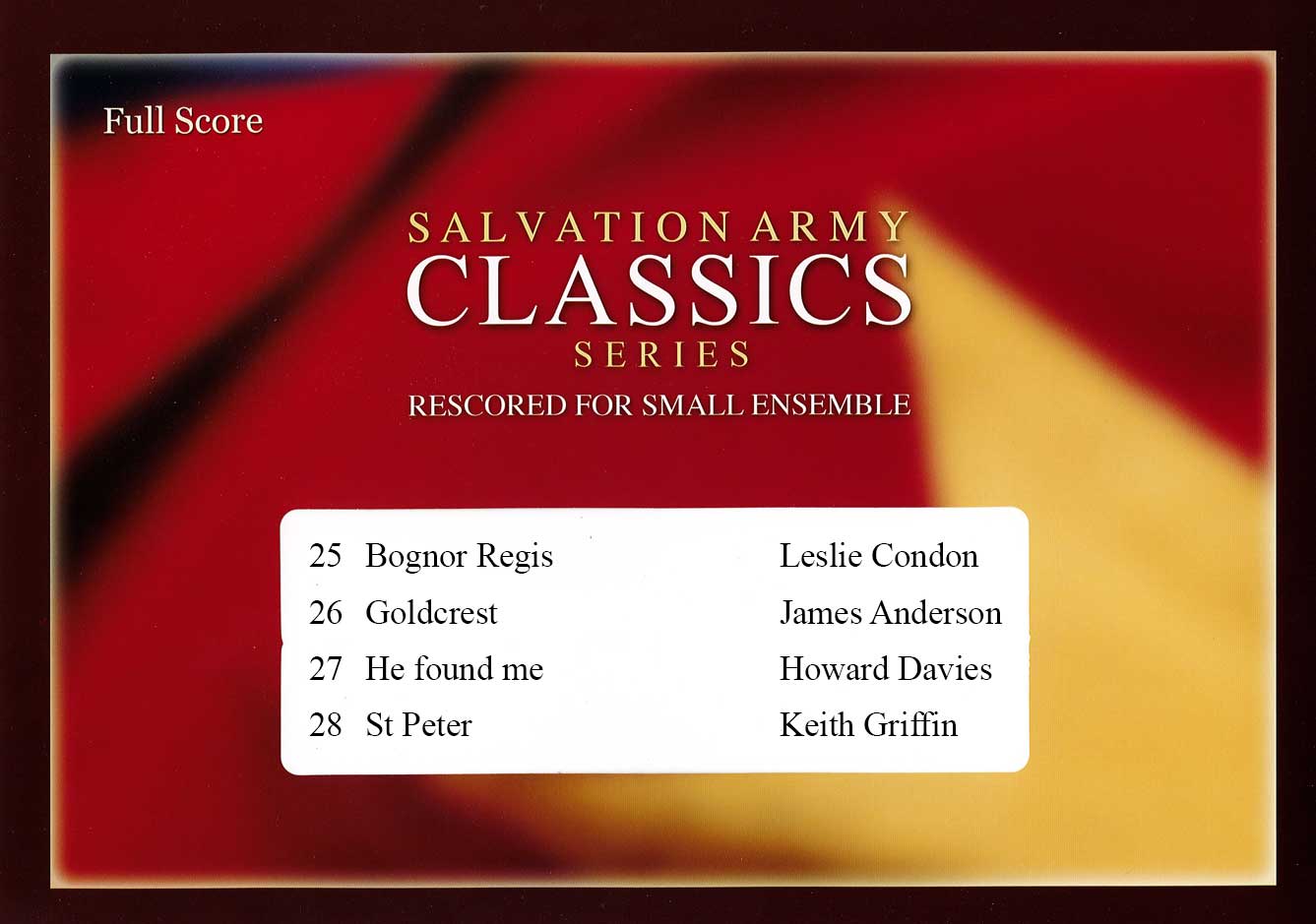
Salvation Army Classics 25-28 for Small Ensemble
Salvation Army Classics arranged for Flexible Brass Band Numbers 25-28Bognor Regis - Leslie CondonGoldcrest - James AndersonHe found me - Howard DaviesSt Peter - Keith Griffin This series features pieces that have been rescored for Unity Series (five-part) scoring.PART I 1st Cornet BbPART II 2nd Cornet Bb and 1st Horn EbPART III 2nd Horn Eb and Baritone or Trombone BbPART IV Euphonium BbPART V Bass Eb and Bass BbThese transcriptions have been carried out in such a way to facilitate the addition of any original parts that may be available.Where relevant, suggestions are made for a variation in tone colour (i.e. 2nd Cornet, Flugel, Baritone, Trombone) as well asthe occasional opportunity for rest.
Estimated dispatch 7-14 working days