
Results
-
 £69.99
Auld Lang Syne - Menno Haantjes
Whereas 'Auld Lang Syne' may be considered the best-known Scottish song ever, yet at the same time it is an obscure one, for there are but few people who know the complete text by heart. After the familiar 'Should auld acquaintance be forgot .....' many people take their refuge to lyrics like 'rum tee dum ta dee ..... lah, lah, lah ........... for auld lang syne'. Even in Scotland only a handful of persons know the entire text and are able to give a correct rendering of it. The current lyrics have been attributed to the Scottish poet Robert Burns. Burns, however, he did not write the whole poem : after he had heard an old man sing the centuries-old Scotchballad, he wrote it down and added a number of stanzas (1788). Historical research teaches us that the ballad served many purposes, both political and religious. Nowadays, 'Auld Lang Syne' is sung as a Christmas Carol and it is also sung on New Year's Eve at the turning of the year. Apart from that, though, the song is also sung on many other occasions sometimes with different lyrics, which usually have Love, Friendship and/or Parting as their themes, as these go well with the fascinating melody. In this arrangement a low-sounding solo instrument is central. The harmonization in the accompaniment fits in perfectly with the sentiments this song will evoke. Should auld acquaintance be forgot And never brought to mind? Should auld acquintance be forgot. And days of auld lang syne? For auld lang syne, my dear, For auld lang syne, We'll take a cup of kindness yet, For auld lang syne.
Estimated dispatch 5-14 working days
-
 £105.20
Our Last Summer - Benny Andersson - Bjørn Morten Kjærnes
An exciting arrangement where almost all players have a bit of the melody line. There are many opportunities to give individual musicians soloistic challenges. Any bandmember should find something interesting in this piece. It will be possible to add vocals to the arrangement. A lovely melody with great expressions.Our Last Summer" is a song by the Swedish pop group ABBA from their seventh studio album, "Super Trouper," released in 1980. The song is indeed featured in the musical "Mamma Mia!", a little bit shortened and with small changes in the lyrics. The musical premiered in London's West End in 1999 and is a duet performed by the characters Harry Bright and Donna Sheridan, reflecting on their past romance during a summer spent in Paris.The song is primarily sung by Bjorn Ulvaeus, with backing vocals provided by Agnetha Faltskog and Anni-Frid Lyngstad, the female members of ABBA. Their harmonies contribute to the song's nostalgic and wistful atmosphere. The lyrics vividly describe the memories of the summer spent together, including scenes of walking along the Seine River in Paris and listening to French songs. The song also touches on the passage of time and the realization that the summer romance has ended.While not released as an official single in most countries, "Our Last Summer" still received considerable airplay and became a fan favorite. It charted in some European countries and has remained popular among ABBA fans over the years.
Estimated dispatch 5-14 working days
-
 £94.99
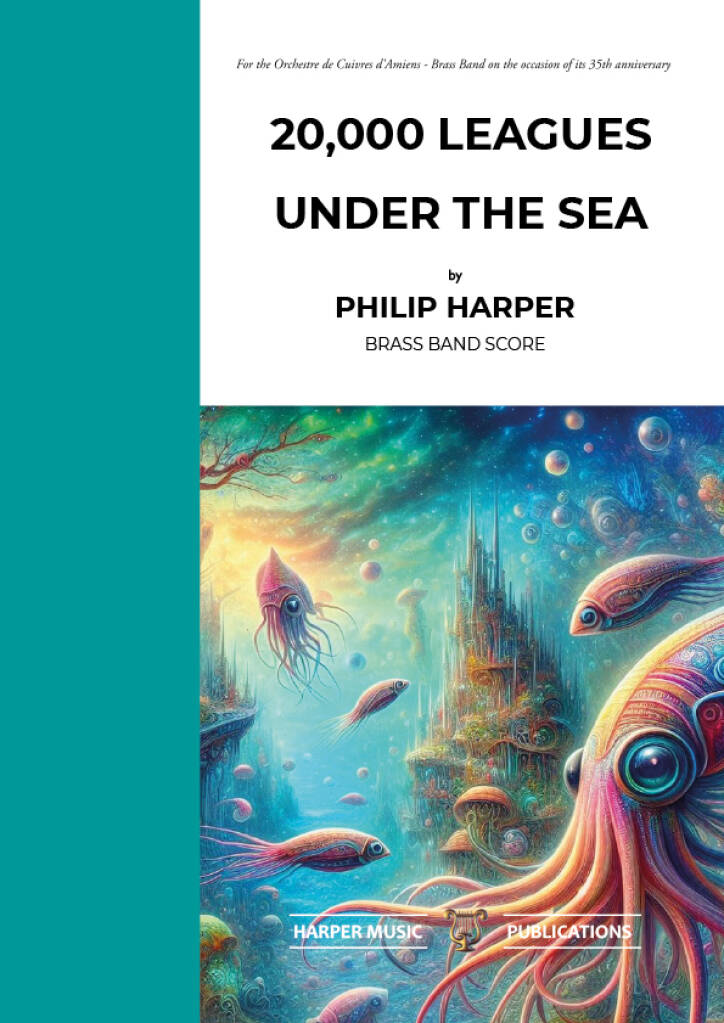
20,000 Leagues under the Sea - Philip Harper
Frenchman Jules Verne was a pioneer in science fiction during the late 19th Century, penning some classic stories such as Journey to the Centre of the Earth and Around the World in 80 Days - both of which have already been the subject of brass band test-pieces. It was therefore natural for me to choose Verne's 1869 watery magnum opus as the subject for this piece to which there are five sections, as well as an introduction and a finale.I. THE NAUTILUS. After a mysterious introduction we are introduced to The Nautilus - a fantastical submarine.II. THE CORAL KINGDOM. We visit awe-inspiring underwater coral formations.III. SQUID ATTACK. The Nautilus is attacked by a school of giant squid, or 'devilfish'.IV. CAPTAIN NEMO. Captain Nemo is a loner and an eccentric. Some say he is a madman. Soloists of the band help to uncover the character of this enigmatic but powerful figure.V. MAELSTROM. The Nautilus is dragged into the ocean's deadliest whirlpool but Captain Nemo lives to fight another day.
Estimated dispatch 5-14 working days
-
£119.99
Albion - Jan Van der Roost
Albion was commissioned by the Swiss Brass Band Federation as the test piece for the National Brass Band Championships of England, Belgium, The Netherlands, and Switzerland in 2001, and for Norway in 2002. The composition is dedicated to Markus Bach.Albion, along with Excalibur and Stonehenge, is the third major piece for brass band in which Jan Van der Roost took his inspiration from the British Middle Ages. Although the work is not based on an actual story there are unmistakable epic elements found in this symphonic poem. The piece paints a picture of the conquest of Albion (the earliest known name of the British Island), in which the listener is taken back to the timeof King Arthur and his legendary Knights of the Round Table.
Estimated dispatch 5-14 working days
-
 £54.99
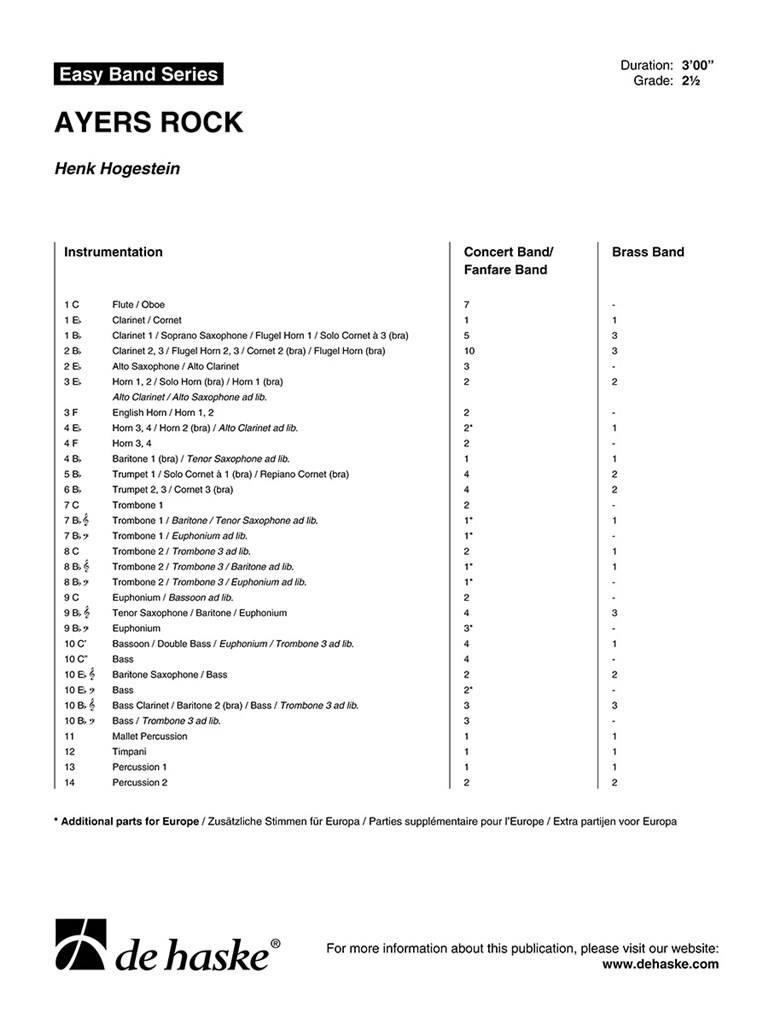
Ayers Rock - Henk Hogestein
The famous monolith Ayers Rock (also called Uluru) is the only true attraction in the Northern Territory of Australia. This colossal red rock lies in the middle of a desert plain. At dusk, a beautiful spectacle develops as the setting sun envelops the rock in rose-red hues. There are tourists who climb the rock, while this is a taboo according to the indigenous religion of the Aboriginals. Besides, the climb is very strenuous. A walk around the rock is also an unforgettable experience.During a journey through Australia, Henk Hogestein was inspired by this rock; he composed this robust rock number to cherish the memory of it.
Estimated dispatch 5-14 working days
-
 £139.99
Missa Brevis - Jacob de Haan
Missa Brevis is a major work for choir and brass band for performance in church or in the concert hall. For this mass, there are many performance possibilities depending on the musicians available. In addition to the standard orchestration of choir and band a brass quartet can also play the choral parts. For this it is desirable for the brass quartet to be positioned separately from the rest of the band (on a gallery, for example), so that the idea of two choirs is heard. It is also possible to perform the work with brass band and organ. A truly flexible religious masterpiece.
Estimated dispatch 5-14 working days
-
 £76.99
Let's Celebrate - Dagmar Kildevann
Is there something to be celebrated? Then let's play 'Let's Celebrate'! This four-part suite has been based on two birthday songs: the world-famous 'Happy Birthday to you' (which is also sung in many other languages), and the Dutch song 'Lang zal hij/zij leven'. The Fanfare opens in grand style with the motif of 'Lang zal hij leven' and is followed by a cheerful March in which the motifs of both songs can be heard. The third part, Song, forms a moment of contemplation, and the birthday presents are unwrapped by the percussion section in the fourth part, Surprise Party. The yell may be adapted to the occasion. (the sleigh bells caused the composer to note down this somewhat peculiar yell). Of course everybody is expected to join in.
Estimated dispatch 5-14 working days
-
 £115.60
God Natt Suite - Hilde Høyvik Dahl
Good Night Suite is written for beginning band and suitable for the youngest musicians. The level of difficulty is at lowest grade and the rhythms are equal in all wind parts. The register on each instrument is also customized to each part. Some easy solos appears in some sections and in Mvt. 4 there are different rhythm in the melody and bass parts. The level of difficulty is the same for all five movements. The movements may of course be played as single pieces. When all movements are mastered it's possible to play the suite as a kind of fairytale with simple dramaturgy or choreography. Maybe the whole band can be dressed in their pajamas?
Estimated dispatch 5-14 working days
-
 £104.99
Like a Child - Andreas Ludwig Schulte
The young have the future. This is the statement made at the beginning of 'Like a Child' by Andreas Ludwig Schulte. The opening radiates strength and ambition, but one is also made to wonder which direction will be chosen, which choices will have to be made.After the introduction the first steps on the path of life are taken, still somewhat unsteadily (the 3/4th time used illustrates this uncertainty). However, the child has now set off and will meet the future with an open mind, unafraid, even though experience will teach it how easily it can be hurt.Fortunately, it is sometimes allowed to be vulnerable and it discovers there will always be someone to offer shelter,support and love. (Adagio) The last part breathes a far greater independence. Youth is able to face the future, it can even take on the whole world!
Estimated dispatch 5-14 working days
-
 £115.60
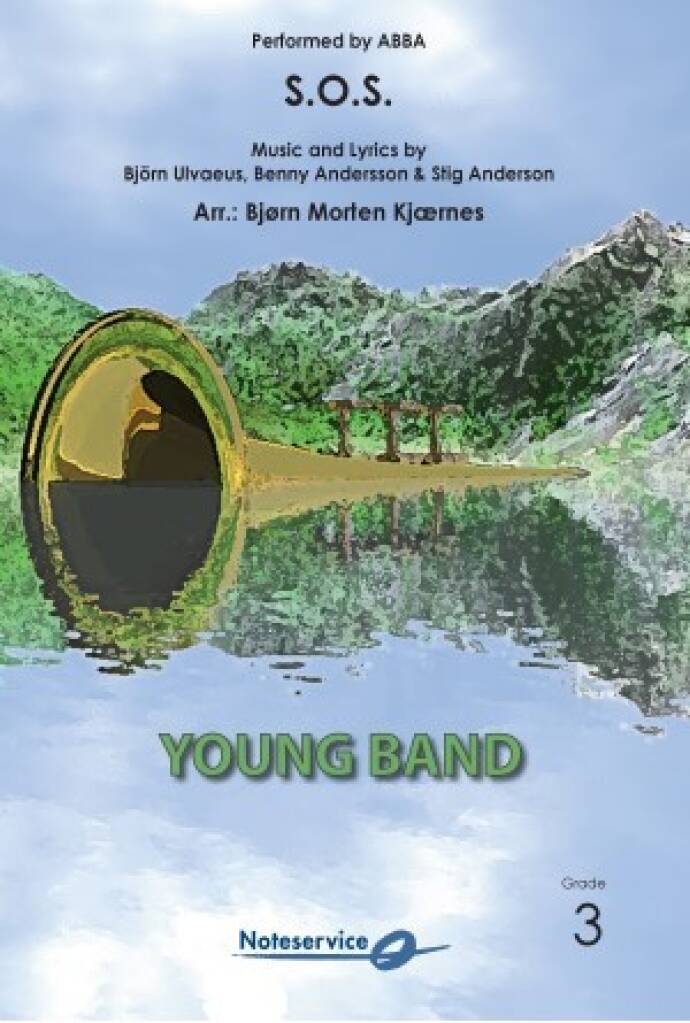
S.O.S. - Björn Ulvaeus - Bjørn Morten Kjærnes
When the publisher asked me to make an arrangement of an ABBA tune, S.O.S. was the first song I thought of. Its introduction and melody are well suited to play for Wind Band. Admittedly, the key had to be shifted to make it sound good for this instrumentation. To me, this is nostalgia, while for others, the Mamma Mia movie/show will be what they associate with this wonderful song. Apart from a few medleys, few of ABBA's songs are available to Wind Band. So, it was very fun to work on this classic.The arrangement is made quite simply to fit many sizes of Bands. Technically, it is also relatively simple both in range and rhythm. As you can see, there are many ways to adjust this arrangement to your own ensemble. Bring out melody lines and the bassline, and a lot is done. If needed, simplify to make it sound nice.Bjorn Morten Kjaernes
Estimated dispatch 5-14 working days
 View Music