Results
-
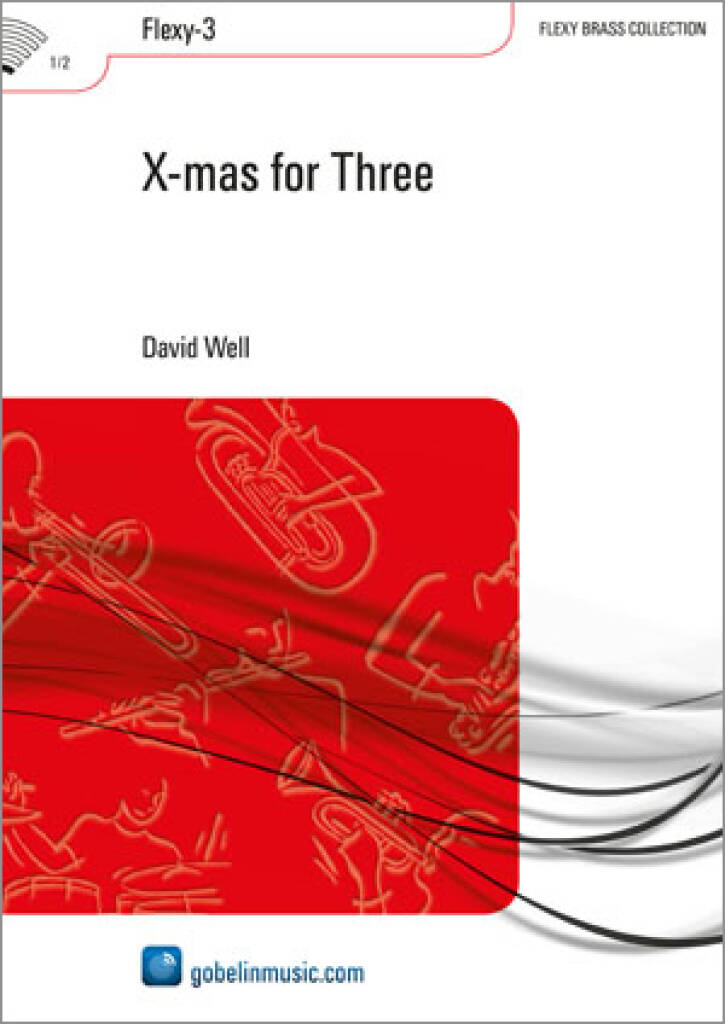
£54.99X-mas for Three - David Well
David Well composed 'X-mas for Three' for three young pupils of his, who wished to give a Christmas concert. He arranged six well-known Christmas songs for them, and their first performance was a great success. This was reason for the composer to adapt the piece for 'orchestra' by adding percussion. The title has stayed the same, and the work can still be played by as few as three musicians, but as the saying goes: "The more, the merrier"! 'X-mas for Three' consists of the following parts : 1. Oh du frohliche 2. Kling, Glockchen, kling 3. Gloria in excelsis deo 4. Joy to the world! 5. The first Noel 6. We wish you a MerryChristmas
Estimated dispatch 5-14 working days
-
£54.99Yo-ho, it's Christmas Time - David Well
Yo-ho, It's Christmas Time" could be just a cry from the mouth of Santa Claus. David Well used this as the title for this three-part composition. First the very familiar "Jingle Bells" in a relaxed style, followed by the sensitive Negro spiritual "Mary Had a Baby.". Finally hear "We Wish You a Merry Christmas."
Estimated dispatch 5-14 working days
-
£54.99Slavonic Rock March - David Well
According to his teachers, Pyotr Ilyich Tchaikovsky (1840-1893), was not particularly gifted. His special talents were acknowledged only in 1865 when he had been working for the Ministry of Finances for some years. In 1866 he was appointed teacher at the Conservatory and applied himself to composing. His oeuvre is fairly extensive and many of his compositions receive a high ranking on the international list of classical music, including his six symphonies, solo concertos (violin concerto and piano concertos), ballets (The Nut Cracker, Swan Lake), and his overtures (1812 and Romeo and Juliette). In 1893 Tchaikovsky died of Cholera after drinking a glass of infectedwater. His Slavonic March is a popular concert piece for symphonic orchestra that is still frequently performed in concert halls. David Well arranged the theme and created a contemporary march in rock style. Tchaikovsky once said to an unsatisfied teacher: 'I will be a great composer within 10 years time.'
Estimated dispatch 5-14 working days
-
£89.99Frida's Whiskers - David Well
David Well composed 'Frida's Whiskers' in commemoration of his own cat, who met an untimely end. Frida (whose real name was 'Godefrida van Coopersburg thoe Nieuwenhuys') was a lively creature, who led a playful and uncomplicated life. She used to sleep in her basket for hours, but when she woke up she upset the entire house and its furnishing. Curtains were inspected from top to bottom and flower pots fell from window-sills just like that! Outside, in the open air she was in her element. She used to frolic, bouncing into the air. After such playful moods she would return to her basket tired but satisfied where, being the cleanly cat that shewas, she subjected her entire body, whiskers included, to a thorough wash.
Estimated dispatch 5-14 working days
-
£54.99Eurock - David Well
Eurock is the gripping title of the five-part rock composition, written by David Well.
Estimated dispatch 5-14 working days
-
£74.82Blaenwern Diversions (Brass Band) Karl Whelan
Commissioned by Micah Dominic Parsons, Blaenwern Diversions is based on the well loved hymn, Love Divine. The composer writes: 'Originally intended to be a set of variations, I found myself wandering around the notes of the hymn tune at the piano and found that the variations almost took on a life of their own resulting in what we have here - diversions. There are 8 diversions in total; the introductory diversion; diversions 1 - 6; and the finale which are divided into three linked movements. Blaenwern Diversions represents my entry into the world of contest works, so even though the piece aims to test the band, it is important that the band enjoy the music within no matter how treacherous!' To view a follow-the-score video please visit www.youtube.com/watch?v=6X5gTMTHkfg PDF download includes score and parts. Sheet music available from: UK - www.brassband.co.uk USA - www.solidbrassmusic.com Difficulty Level: Championship Instrumentation: Soprano Cornet Eb Solo Cornet Bb Repiano Cornet Bb 2nd Cornet Bb 3rd Cornet Bb Flugel Horn Bb Solo Horn Eb 1st Horn Eb 2nd Horn Eb 1st Baritone Bb 2nd Baritone Bb 1st Trombone Bb 2nd Trombone Bb Bass Trombone Euphonium Bb Bass Eb Bass Bb Timpani Percussion 1-3
In Stock: Estimated dispatch 1-3 working days
-
£76.99A Western Suite - Andreas Ludwig Schulte - David Well
The atmosphere of the Wild West is caught in a striking and most imaginative way by young composer Andreas Schulte in this work. A caravan of gold- and fortuneseekers launch themselves into a big adventure and begin their rush westward. The first movement desciribes these first days of buoyancy and optimism in a crisp march. Near the campfire the pioneers rest themselves, and the music expresses feelings of romance, nostalgia for the past and hopes for the future. A wistful melody very characteristically communicates these feelings. Relaxation takes place in the third movement which is a musical characterization of a rodeo and its attendant festivities.It is obvious that sometimes something goes wrong and this aspect can also be heard. Nevertheless, the valiant rider wins in the end. With a flashback to the beginning, the journey is completed musically, thus giving the composition a dignified finale. Let the mystic Wild West entrance you. (Wagons ho ....!!) De sfeer van het Wilde Westen wordt door de jonge componist Andreas Ludwig Schulte op een uiterst treffende en beeldende wijze geschetst. Een karavaan van goud- en gelukzoekers stort zich in het grote avontuur en begint de grote reis naar het westen. Het eerste gedeelte beschrijft de eerste dagen van opgewektheid en optimisme in een vlotte mars. Bij het kampvuur komen de pioniers tot rust en worden gevoelens van romantiek, heimwee (verleden) en hoop (toekomst) muzikaal weergegeven. Een weemoedige melodie verwoordt die gevoelens op een zeer kenmerkende wijze. De ontspanning vindt plaats in het derde deel waarin een rodeofeest muzikaal wordt verklankt. Met een flashback van het begin wordt de tocht voltooid en de compositie waardig afgesloten. Raak in de ban van het wilde westen!
Estimated dispatch 5-14 working days
-
£44.95Princethorpe Variations (Brass Band - Score and Parts) - Downie, Kenneth
Colourful harmony, rhythmic flair and melodic invention are the hallmarks of this excellent set of variations by Kenneth Downie, based on the well known church tune, Princethorpe.This major work demonstrates the well-known characteristics of the composer: colourful harmony, rhythmic flair and melodic invention, all encapsulated in scoring which is engulfing both to players and listeners alike. Following a presentation of the theme there are five variations culminating in what can be described as either a finale or coda.Theme. The composer shows his originality in the harmonic sense of this introduction. Perhaps it could be suggested that over-indulgence of rubato may be a temptation to be avoided.Sections A to F. Relentless rhythmic drive is of paramount importance in this first variation. Conscientious observance of dynamics is of course an essential requirement in conveying the exciting quality of the music; there are moments of sudden contrast of which all will need to be aware. Moving between the time-signatures of 5/4 and 6/4 these sections are built from strong easily-identifiable fragments of the theme. These is a significant increase in temp at letter F which will further the exciting impact of the music.Sections G & H. In a pastorale style this short, gentle variation affords a contrast in style between the previous and succeeding ones. The gentle undulating character of the melodic lines is governed by the Allegretto grazioso directive.Sections I to M. Commencing two bars before letter I the music is now exuberant and the tempo and style is that of a march in compound time. In this exhilarating movement there are moments of contrast and indeed of delicacy which are a foil to the more energetic moments. Rhythmic control will be essential to maintain a consistent tempo. As elsewhere in the work, the percussion section will contribute much to the success of the performance there are bars where this section alone is heard and there are important entries for glockenspiel.Sections N & O. With emotional content this Adagio variation has the first two notes of the melody as its melodic impetus. Apart from just over two bars at O (where there is an interpolatory phrase from Cornets and Trombones), the melodic line is entrusted to the plaintive sounds of the horn section. Cornets and Trombones provide a change of tone colour at the beginning of section O. Under a poco rall, this very expressive variation is concluded; there is an important link supplied by Eb Bass.Sections P & Q. A lively march-tempo is launched immediately and these sections are in the nature of an introduction to the final variations. There is a quickening of pace at Q which assists the generation of excitement which should be an essential part of the performance. Solo Cornets introduce a melodic line at Q which anticipates the compound time of the following section.Sections R & S. The Solo Cornet theme of the previous section is now a contrapuntal line accompanying the theme tune. With an elongation of the notes in the melody, the conductor will need to call on the sustaining powers of the band and at no time should the interesting accompanying lines be allowed to detract from the sonorous presentation of the basic theme.Sections T, U & V. Following a poco rit, the finale begins at letter T with the directive, molto vivace. There is much detail to be rehearsed, not least being the dynamic contrasts which are encountered. As throughout the work, the listener should have no difficulty in identifying the thematic sources of the composer's music.
Estimated dispatch 7-14 working days
-
£22.50Princethorpe Variations (Brass Band - Score only) - Downie, Kenneth
Colourful harmony, rhythmic flair and melodic invention are the hallmarks of this excellent set of variations by Kenneth Downie, based on the well known church tune, Princethorpe.This major work demonstrates the well-known characteristics of the composer: colourful harmony, rhythmic flair and melodic invention, all encapsulated in scoring which is engulfing both to players and listeners alike. Following a presentation of the theme there are five variations culminating in what can be described as either a finale or coda.Theme. The composer shows his originality in the harmonic sense of this introduction. Perhaps it could be suggested that over-indulgence of rubato may be a temptation to be avoided.Sections A to F. Relentless rhythmic drive is of paramount importance in this first variation. Conscientious observance of dynamics is of course an essential requirement in conveying the exciting quality of the music; there are moments of sudden contrast of which all will need to be aware. Moving between the time-signatures of 5/4 and 6/4 these sections are built from strong easily-identifiable fragments of the theme. These is a significant increase in temp at letter F which will further the exciting impact of the music.Sections G & H. In a pastorale style this short, gentle variation affords a contrast in style between the previous and succeeding ones. The gentle undulating character of the melodic lines is governed by the Allegretto grazioso directive.Sections I to M. Commencing two bars before letter I the music is now exuberant and the tempo and style is that of a march in compound time. In this exhilarating movement there are moments of contrast and indeed of delicacy which are a foil to the more energetic moments. Rhythmic control will be essential to maintain a consistent tempo. As elsewhere in the work, the percussion section will contribute much to the success of the performance there are bars where this section alone is heard and there are important entries for glockenspiel.Sections N & O. With emotional content this Adagio variation has the first two notes of the melody as its melodic impetus. Apart from just over two bars at O (where there is an interpolatory phrase from Cornets and Trombones), the melodic line is entrusted to the plaintive sounds of the horn section. Cornets and Trombones provide a change of tone colour at the beginning of section O. Under a poco rall, this very expressive variation is concluded; there is an important link supplied by Eb Bass.Sections P & Q. A lively march-tempo is launched immediately and these sections are in the nature of an introduction to the final variations. There is a quickening of pace at Q which assists the generation of excitement which should be an essential part of the performance. Solo Cornets introduce a melodic line at Q which anticipates the compound time of the following section.Sections R & S. The Solo Cornet theme of the previous section is now a contrapuntal line accompanying the theme tune. With an elongation of the notes in the melody, the conductor will need to call on the sustaining powers of the band and at no time should the interesting accompanying lines be allowed to detract from the sonorous presentation of the basic theme.Sections T, U & V. Following a poco rit, the finale begins at letter T with the directive, molto vivace. There is much detail to be rehearsed, not least being the dynamic contrasts which are encountered. As throughout the work, the listener should have no difficulty in identifying the thematic sources of the composer's music.
Estimated dispatch 7-14 working days
-
£77.00General Series Brass Band Journal, Numbers 2230 - 2233, April 2023
2230: Prelude on 'Ascalon' (Geoffrey Nobes)This prelude was written for the Band of the Free Evangelical Church of Geisweid in Germany. The beautiful hymn tune Ascalon is heard in two complete statement, a free-flowing lyrical section followed by a contrasting section using the phrases of the melody to build to a full final working of the hymn.2231: Salt and light (Mark Feltwell)This original work follows the journey of someone who is finding their way through faith. Using inspiration from Shine, Jesus, Shine and Matthew 5:14, the journey ends with a triumphant fanfare.2232: Hymn Tune Arrangement - Esher (Dudley Bright)A two verse setting of the well know benediction, God be in my head.2233: Song Arrangement - The heart of worship (David Mills)The song The heart of worship (S.A.S.B. 635) speaks of the need to worship without any barriers or obstacles.
Estimated dispatch 7-14 working days