
Results
-
 £35.00
Welsh Echoes - Andrew Duncan
Commissioned by The Charles Church Camberley Band in 2007 as a gift to mark the 90th Birthday of their previous conductor, Gerallt Hughes. The piece has been well received, having been performed by Grimethorpe Colliery Band and by Brighouse & Rastrick Band on Listen To The Band.The striking Welsh folk tunes, Sospan Fach, David of the White Rock and Watching the Wheat are all woven into this delightful composition. There is a feature for the solo cornet in David of the White Rock, and some nice touches with a saucepan and wooden spoon in the Percussion to make Sospan Fach true to its name (Little Saucepan!).The contrasting styles this composition offers with the incorporation of the melodies make this piece an ideal concert work and has already proven popular with audiences of all nationalities!
In Stock: Estimated dispatch 3-5 working days
-
 £107.80
Myrsnipa - Vocal or Instrumental Solo - Jan Eggum - David Hveem
Jan Eggum released "Myrsnipa" on the album "Hjerteknuser", which was released in 2007. The text is a variant of the folk tale with the moral "everyone likes their own children best and has for many years been one of Eggum's regular encores at concerts.The arrangement is attempted to stay true to Eggum's version and has retained its somewhat delicate character in order to support the text as much as possible. Although the arrangement is written for vocal soloist, it also works great with a solo instrument instead, and you can also choose whether you want a guitar or not, to keep it even more true to the original recording.The arrangement requires good balance and intonation, but will be a nice part of the concert repertoire the audience is guaranteed to recognize.
Estimated dispatch 5-14 working days
-
 £104.99
Scottish Dances - Peter Martin - Menno Haantjes
Scottish Dances is based on three Scottish traditionals: Cock of the North, The Bonnie Bank's O'Loch Lomond and Marie's Wedding. I. Cock of the North's name is used for multiple things or events. For example for a locomotive to a famous, it seems, delicious liqueur, and rallies to snowboard competitions. Furthermore is "Cock O' the North " a nickname of a famous Duke. (The 4th Duke of Gordon). In this composition Cock of the North (a Jig) is a traditional Scottish bagpipe tune, regularly played on tattoos by Pipe Bands. Not infrequently the drummers sing the text. Auntie Mary, had a canary, Up the leg of her trousers While she was sleeping Iwas peeping Up the leg of her trousers. II. " The Bonnie Bank's O'Loch Lomond " is about a sad story that took place during an revolt against the British. In 1745 Bonnie Prince Charlie had to retreat. Two of his men were captured. One was convicted and executed, while the other was released. The spirit of the executed soldier would arrive in Scotland via the 'low road' (underworld) before his companion, who had still a long way to go. You'll take the high road And I'll take the low road And I'll be in Scotland afore ye But me and my true love will never meet again On the Bonnie Bonnie Banks of Loch Lomond III. In a Scottish wedding, after the official ceremonies, there is often danced. This is called a ceilidh. For this we use traditional Scottish music such as "Marie's Wedding '. Mid dance we go back to the church, where a lovely song in honor of the couple sounds. Marie's Wedding has been recorded by Van Morrison (among many others). Step we gaely, on we go, heel for heel and toe for toe Arm and arm and on we go, all for Marie's wedding
Estimated dispatch 5-14 working days
-
 £91.99
Hermitage - Jan de Haan
Jan de Haan drew inspiration for this work from five paintings exhibited in The Hermitage in Saint Petersburg, one of the largest and most versatile museums in the world. He used the melodious Andante cantabile from the String Quartet Op. 11 by the Russian composer Pyotr Ilyich Tchaikovsky as its starting point. Thus, he created his own musical painting, which is just as varied as the underlying canvases - from Cheerful Company by Dirck Hals to Dance II by Henri Matisse. A true work of art!
Estimated dispatch 5-14 working days
-
 £174.99
Tales & Legends - Etienne Crausaz
This three-movement work by the Swiss composer Etienne Crausaz reflects three true stories and fascinating legends from the Middle Ages. The first movement tells the dramatic story of the 'witch' Catherine 'Catillon' Repond (1662 1731). She was the last woman ever to be executed for sorcery. In the second movement, the famous court jester Girard Chalamala occupies centre stage. This jester, the last one at the castle of Count Greyerz, could make everyone laugh. The third movement tells the story of Count Michael. He went down in history as a spendthrift bon-vivant. His burden of debt became so high that he did a moonlight flit and never came back!
Estimated dispatch 5-14 working days
-
 £54.99
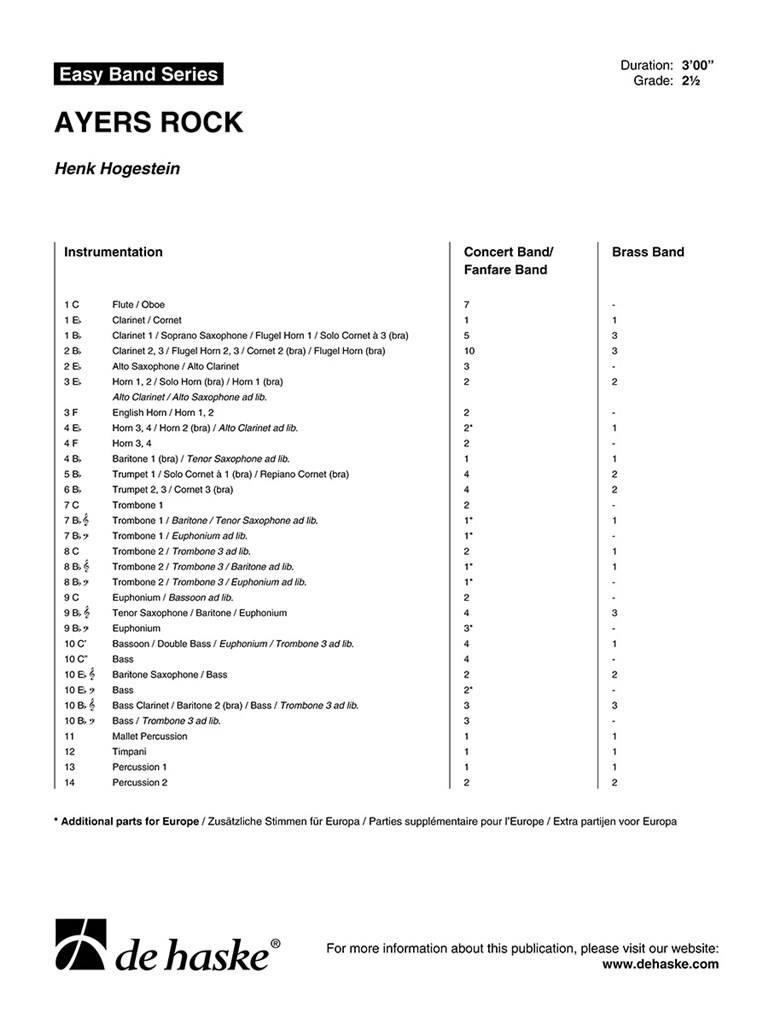
Ayers Rock - Henk Hogestein
The famous monolith Ayers Rock (also called Uluru) is the only true attraction in the Northern Territory of Australia. This colossal red rock lies in the middle of a desert plain. At dusk, a beautiful spectacle develops as the setting sun envelops the rock in rose-red hues. There are tourists who climb the rock, while this is a taboo according to the indigenous religion of the Aboriginals. Besides, the climb is very strenuous. A walk around the rock is also an unforgettable experience.During a journey through Australia, Henk Hogestein was inspired by this rock; he composed this robust rock number to cherish the memory of it.
Estimated dispatch 5-14 working days
-
 £140.80
Poem a la Carte - Manfred Schneider - Anton Weeren
As a French horn player, the successful German composer Manfred Schneider is familiar with brass instruments, so he took on the challenge of writing at a real Concerto for Trombone and Wind Band, which he called 'Poem a la carte'. The composition was commissioned by the JBK Sonthofen wind band. Though the 'misterioso' introduction already features some virtuoso passages for the soloist, the latter really takes off in the energetic allegro. Then comes a lyrical largo and the work ends with a sparkling allegro allowing the soloist to demonstrate true virtuosity.
Estimated dispatch 5-14 working days
-
 £59.99
A Klezmer Karnival - Philip Sparke
Klezmer music originated in the 'shtetl' (villages) and the ghettos of Eastern Europe, where itinerant Jewish troubadours, known as 'klezmorim', had performed at celebrations, particularly weddings, since the early Middle Ages. Since the 16th century, lyrics had been added to klezmer music, due to the 'badkhn' (the master of ceremony at weddings), to the 'Purimshpil' (the play of Esther at Purim) and to traditions of the Yiddish theatre, but the term gradually became synonymous with instrumental music, particularly featuring the violin and clarinet. In recent years it has again become very popular and in A Klezmer Karnival Philip Sparke has used three contrastingtraditional tunes to form a suite that will bring a true karnival atmosphere to any concert.
Estimated dispatch 5-14 working days
-
£54.99
Waterloo - Benny Andersson - Roland Kernen
The Swedish group ABBA had their decisive international breakthrough when the foursome won the Eurovision Song Contest on the 6th of April, 1974 with Waterloo. This cheerful song, with its driving beat and distinctive melody, has become a true pop classic, like many other ABBA hits. Roland Kernen has arranged Waterloo for brass band. It is an energetic piece that is a pleasure both to play and to listen to.
Estimated dispatch 5-14 working days
-
 £60.99
Gold - Gary Kemp - Thijs Oud
At the beginning of the eighties trendy English boy band, Spandau Ballet, made it big with hits like True and Gold. Millions of records were sold worldwide, and the group became one of the most successful bands of the eighties. Why not bring a little 80's pop magic to any concert with the zesty disco tempo and jazzy chords of this arrangement.
Estimated dispatch 5-14 working days
 View Music