
Results
-
 £88.99
Euphonium Concerto with Brass Band (Karl Whelan)
VIEW SCORE PDF Karl Whelan's Euphonium Concerto with Brass Band is written in three linked movements: I: Prelude II: Aria III: Scherzo The first movement, Prelude, is in a mirror image sonata form and with its menacing ostinato sets the tone for the entire concerto and also introduces material on which the concerto is based. During this movement, the soloist has the opportunity to display their technical ability as well as the extremes of the instruments range. A chord based on the notes of the ostinato signal the beginning of the second movement, Aria. Here, material from the first movement has been weaved together and moves through a multitude of keys, the soloist is able to show the expressive side of the instrument to create an almost yearning, operatic aria. A reiteration of the 1st subject takes us into an almost march like figure at the beginning of the third movement, Scherzo. This is then interrupted both times by dance-like scherzo which, as with the rest of the concerto navigates itself through different keys leading to the cadenza that even the temple blocks have the the chance of participating in! The concerto concludes with almost a battle between the band (playing fragments of the first and second subjects from the first movement), and soloist who is attempting to have the last word! To view a follow-the-score video of the work please visit: www.youtube.com/watch?v=aEnou67XHqA Sheet music available from: UK - www.brassband.co.uk USA - www.solidbrassmusic.com Instrumentation: Euphonium Soloist Bb Soprano Cornet Eb Solo Cornet Bb 2nd Cornet Bb 3rd Cornet Bb Flugel Horn Bb Solo Horn Eb 1st Horn Eb 2nd Horn Eb 1st Baritone Bb 2nd Baritone Bb 1st Trombone Bb 2nd Trombone Bb Bass Trombone Euphonium Bb Bass Eb Bass Bb Timpani Percussion 1-3
In Stock: Estimated dispatch 1-3 working days
-
£7.41
Euphonium Concerto with Brass Band (Karl Whelan) Soloist Copy
*Karl Whelan's Euphonium Concerto with Brass Band is written in three linked movements: I: Prelude II: Aria III: Scherzo The first movement, Prelude, is in a mirror image sonata form and with its menacing ostinato sets the tone for the entire concerto and also introduces material on which the concerto is based. During this movement, the soloist has the opportunity to display their technical ability as well as the extremes of the instruments range. A chord based on the notes of the ostinato signal the beginning of the second movement, Aria. Here, material from the first movement has been weaved together and moves through a multitude of keys, the soloist is able to show the expressive side of the instrument to create an almost yearning, operatic aria. A reiteration of the 1st subject takes us into an almost march like figure at the beginning of the third movement, Scherzo. This is then interrupted both times by dance-like scherzo which, as with the rest of the concerto navigates itself through different keys leading to the cadenza that even the temple blocks have the the chance of participating in! The concerto concludes with almost a battle between the band (playing fragments of the first and second subjects from the first movement), and soloist who is attempting to have the last word! To view a follow-the-score video of the work please visit: www.youtube.com/watch?v=aEnou67XHqA To purchase the full band set please visit www.brookwrightmusic.com/product-page/euphonium-concerto-with-brass-band-karl-whelan *Please note this download only includes the soloist copy. Sheet music available from: UK - www.brassband.co.uk USA - www.solidbrassmusic.com Instrumentation: Euphonium Soloist Bb Soprano Cornet Eb Solo Cornet Bb 2nd Cornet Bb 3rd Cornet Bb Flugel Horn Bb Solo Horn Eb 1st Horn Eb 2nd Horn Eb 1st Baritone Bb 2nd Baritone Bb 1st Trombone Bb 2nd Trombone Bb Bass Trombone Euphonium Bb Bass Eb Bass Bb Timpani Percussion 1-3
In Stock: Estimated dispatch 1-3 working days
-
 £37.08
Horn Concerto No.1 1st Movement (Tenor Horn Solo with Band) Haydn arr. Wilson
Franz Joseph Haydn's Horn Concerto No.1 in D major was composed in 1762, when he was new to the Esterhazy court. It is a virtuosic concerto that showcases the beauty and range of the horn. The concerto was originally scored for solo horn and orchestra, and is one of Haydn's most popular works. Here it has been arranged by Duncan Wilson for tenor horn with brass band. His arrangement of the concerto is a faithful and effective adaptation of the original work. The movement opens with a lively tutti introduction, followed by the entrance of the solo horn. The horn plays a series of melodies and passages that are both lyrical and virtuosic. The band provides accompaniment and contrast, and the two interact in a lively dialogue. The movement builds to a climax and then concludes with a triumphant coda. To view a follow-the-score video please visit https://www.youtube.com/watch?v=Uo2K5tge6Fs PDF download includes score and parts. Sheet music available from: UK - www.brassband.co.uk USA - www.solidbrassmusic.com Difficulty Level: 2nd Section + Instrumentation: Tenor Horn Soloist Eb Soprano Cornet Eb Solo Cornet Bb Repiano Cornet Bb 2nd Cornet Bb 3rd Cornet Bb Flugel Horn Bb 1st Horn Eb 2nd Horn Eb 1st Baritone Bb 2nd Baritone Bb 1st Trombone Bb 2nd Trombone Bb Bass Trombone Euphonium Bb Bass Eb Bass Bb Timpani
In Stock: Estimated dispatch 1-3 working days
-
 £10.00
Endurance
DescriptionMen wanted for hazardous journey. Small wages, bitter cold, long months of complete darkness, constant danger, safe return doubtful. Honour and recognition in case of success. - Ernest Shackleton, 4 Burlington StreetEndurance takes its title from the ship used by Sir Ernest Shackleton's Imperial Trans-Antarctic Expedition in 1914-15. After many months of fundraising (and reputedly running the above advert in The Times) the Endurance set sail from Plymouth on 6 August 1914. Whilst at sea news of the outbreak of war led Shackleton to put his ship and crew at the disposal of the Admiralty, but their services were not required and they were encouraged to continue. On October 26 1914 they left Grytviken on South Georgia for the Antarctic continent, hoping to find the pack ice shrinking in the Antarctic spring. Two days later, however, they encountered unseasonable ice which slowed their progress considerably. On 15 January 1915, when Endurance was only 200 miles from her intended landfall at Vahsel Bay, the ship became beset by ice which had been compressed against the land to the south by gale force winds. Trapped in the ice of the Weddell Sea, the ship spent the Antarctic winter driven by the weather further from her intended destination until, on 21 November 1915 Endurance broke up forcing the crew to abandon ship and set up camp on the ice at a site they named "Patience Camp".The crew spent several weeks on the ice. As the southern spring started to reduce the extent of the ice shelf they took to their three lifeboats, sailing across the open ocean to reach the desolate and uninhabited Elephant Island. There they used two of the boats to build a makeshift shelter while Shackleton and five others took the largest boat, an open lifeboat named the 'James Caird' and sailed it for 800 terrifyingly dangerous miles across the vast and lonely Southern Atlantic to South Georgia - a journey now widely regarded as one of the greatest and most heroic small-boat journeys ever undertaken. After landing on the wrong side of the island and having to climb over a mountain range in the dark with no map, Shackleton and his companions finally stumbled back into the Grytviken whaling station on 19 May 1916.After resting very briefly to recover his strength, Shackleton then began a relentless campaign to beg or borrow a ship to rescue the rest of his crew from Elephant Island; whaling ships were not strong enough to enter polar ice, but on 30 August 1916, over two years after their departure from Plymouth, Shackleton finally returned to Elephant Island aboard a steam tug borrowed from the Chilean government. Although some were in poor health, every member of the Endurance crew was rescued and returned home alive.Endurance is dedicated to the memory of my mum, who passed away in September 2017.Listen to a computer generated preview and follow the score below:
Estimated dispatch 7-14 working days
-
 £95.00
Tenor Horn Concerto 'Three Gods' (Tenor Horn Solo with Brass Band - Score and Parts)
Edward Gregson's Tenor Horn Concerto (Three Gods) was commissioned by the Belgian tenor horn soloist Tim de Maeseneer for a recording of commissioned works he made in 2024 with his own band, Brass Band Willebroek.The subtitle of 'Three Gods' refers to three mythological Greek Gods: Zeus, Hermes and Apollo. The idea for this came from Gregson's Viola Concerto, which he composed in 2023 and which was similarly subtitled 'Three Goddesses'. Indeed, the first movement of the horn concerto shares some common material with the viola concerto, although the other movements are newly composed.The concerto exploits the noble character of the horn, but the writing is also virtuosic in character as well as lyrical and melodic, demanding an extended playing range of nearly four octaves with a variety of colouration in its sonorities. The unifying motif of the whole concerto is the interval of a rising 5th, heard at the outset. The opening also has some other surprises (both seen and heard).The musical ideas, cast in three separate movements, take their starting point from the characters of the Three Gods in the title:Zeus, ruled as King of the Gods on Mount Olympus, and was the God of Thunder and Lightning and of War. His music is often threatening and violent, but also has a more tender side as portrayed in the lyrical second subject. However, the dominant mood is one of foreboding.Hermes was the great messenger to the Gods who could travel between realms on his winged sandals. Thus, his music is fast, fleet of foot, and mercurial - a dashing scherzo, but with lyrical and expressive moments.Apollo, the God of Music and Dance (and the Sun), symbolises virtue and beauty. This final movement, 'Hymn to Apollo', is mainly slow and hymn-like and cast in a continuous stream of melody passed between soloist and band. Brief fanfares herald a triumphant march, before the music returns to its quiet opening, gradually rising to a triumphant climax with glittering melodic percussion leading the way. The music ends in a blaze of glory!Duration: 17.00
Estimated dispatch 7-14 working days
-
 £95.00
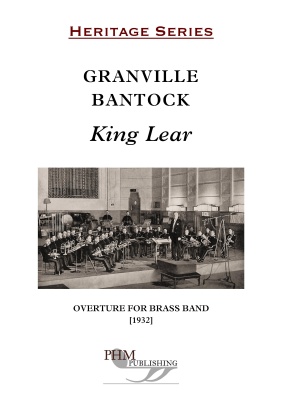
King Lear (Brass Band - Score and Parts)
Sir Granville Bantock (1868 - 1946) composed the second of his five major brass band work for Callender's Cableworks Band, completing the commission on 30 November 1932. Based in the Thames-side district of Belvedere near Erith, the band was active between 1898 and 1961. The works band of the Callender Cable & Construction Co. Ltd, it was at the peak of its popularity during the 1930s and was a frequent broadcaster on the radio. The band employed an in-house arranger and played saxophones in its lighter material. King Lear was one of the band's major commissions and was not published in Bantock's lifetime. The manuscript score and parts were thought to be lost for decades, but were found in the library of the Haydock Band (Lancashire), which had inherited part of Callender's library of manuscripts material and bespoke arrangements after it has been transferred to nearby Prescott Cables Band after Callender's Cable Works closed.King Lear is a substantial work, in essence a dramatic tone poem in the romantic Tchaikovskian manner, presenting a series of character portraits of the foolish old king and his three daughters, Goneril, Regan and Cordelia. The music is dramatic and lyrical by turns, with the most generous lyrical episode revealing perhaps the warm-hearted Cordelia. An expansive melody that flows from this is brought back towards the end as the main climax of the work.In 2001, Bantock's score was recorded by the University of Salford Brass Band, conducted by Dr. Roy Newsome. The original is serviceable, but in comparison with the orchestral version he made in 1936 (part of which was recorded on a Paxton 78 rpm) and later brass band scores, performing editions of which were prepared by others, it lacks colour and range typical of Bantock's orchestral work. Above all it lacks percussion, which can be heard on the recorded extract. With the kind permission of the Bantock Estate, I have prepared a performing edition for publication that incorporates percussion, derived from the orchestral recording and added editorially in similar manner elsewhere. I have revoiced some of the low- lying instrumental parts to present the material in more comfortable ranges. Editorial interventions more elaborate than revoicing the original text have been identified as cue notes.- Paul HindmarshDuration: 15.00
Estimated dispatch 7-14 working days
-
£40.00
King Lear (Brass Band - Score only)
Sir Granville Bantock (1868 - 1946) composed the second of his five major brass band work for Callender's Cableworks Band, completing the commission on 30 November 1932. Based in the Thames-side district of Belvedere near Erith, the band was active between 1898 and 1961. The works band of the Callender Cable & Construction Co. Ltd, it was at the peak of its popularity during the 1930s and was a frequent broadcaster on the radio. The band employed an in-house arranger and played saxophones in its lighter material. King Lear was one of the band's major commissions and was not published in Bantock's lifetime. The manuscript score and parts were thought to be lost for decades, but were found in the library of the Haydock Band (Lancashire), which had inherited part of Callender's library of manuscripts material and bespoke arrangements after it has been transferred to nearby Prescott Cables Band after Callender's Cable Works closed.King Lear is a substantial work, in essence a dramatic tone poem in the romantic Tchaikovskian manner, presenting a series of character portraits of the foolish old king and his three daughters, Goneril, Regan and Cordelia. The music is dramatic and lyrical by turns, with the most generous lyrical episode revealing perhaps the warm-hearted Cordelia. An expansive melody that flows from this is brought back towards the end as the main climax of the work.In 2001, Bantock's score was recorded by the University of Salford Brass Band, conducted by Dr. Roy Newsome. The original is serviceable, but in comparison with the orchestral version he made in 1936 (part of which was recorded on a Paxton 78 rpm) and later brass band scores, performing editions of which were prepared by others, it lacks colour and range typical of Bantock's orchestral work. Above all it lacks percussion, which can be heard on the recorded extract. With the kind permission of the Bantock Estate, I have prepared a performing edition for publication that incorporates percussion, derived from the orchestral recording and added editorially in similar manner elsewhere. I have revoiced some of the low- lying instrumental parts to present the material in more comfortable ranges. Editorial interventions more elaborate than revoicing the original text have been identified as cue notes.- Paul HindmarshDuration: 15.00
Estimated dispatch 7-14 working days
-
 £74.95
Radio City (Trombone Solo with Brass Band)
As youngsters growing up on the west coast of Scotland, my brother and I fell heir to an old valved radiogram which provided us with our first experiences of radio broadcasts. On the short wave signal, and through the static, we could pick up a whole range of programmes from across the Atlantic. I particularly recall the baseball games, the American accents of the announcers providing a window to a evocative world far removed from our small Ayrshire town. These memories form the basis of Radio City.The work is set in three movements, each introduced by a pastiche radio announcer narrative written by Philip Coutts. The first, City Noir, is a nod towards Raymond Chandler's eponymous private eye Philip Marlow and the dark cityscape of 1940s California.Movement two, Cafe Rouge, takes its title from the main restaurant in New York's famous Hotel Pennsylvania. Two of the most famous band leaders of the 1940s, trombonists Glenn Miller and Tommy Dorsey, broadcast live from the cafe on numerous occasions and the movement echoes with a collage of imagined sounds from the period.The finale, Two-Minute Mile, derives from an event dubbed in the USA as "the most exciting two minutes in sport", namely the Kentucky Derby. The virtuoso soloist figurations have their roots in Kentucky bluegrass fiddle music, with the galloping bluegrass clog-dancing rhythms providing the backdrop.- Peter Graham, Cheshire, January 2013
Estimated dispatch 7-14 working days
-
 £34.95
By Trevone Bay (Flugel Horn Solo with Brass Band - Score and Parts))
By Trevone Bay was composed for Flugel Soloist Zoe Hancock and the Black Dyke Band to celebrate both their Double Champion Victory at the British Open and National Championships 2014 and Zoe's unique achievement in winning the Best Soloist Award in both contests - an accomplishment never done before. The world premier was performed by Zoe and the band at Birmingham's Symphony Hall on February 8th 2015.By Trevone Bay is a lovely lyrical slow melody that utilises the full range and colour of the flugel horn. Starting with an atmospheric opening the soloist performs the main theme, which repeats with more colour in the accompanying parts and solo line. After introducing a second theme from the ensemble, the solo cornets perform the main melody with the soloist enjoying a lyrical counter melody. The piece develops with a tranquil middle section from the soloist that builds for the second theme to return, performed by the ensemble while the soloist soars over the top. Ending as it starts, the piece dies away to leave the soloist performing the opening melodic phrase to a tranquil close.As for the title: Trevone Bay is a beautiful tiny bay in Cornwall, close to Zoe's home town of Roche. Its tranquil waters lead out to the Celtic Sea and provide a picturesque landscape. The views there can be enjoyed all year round but they are particularly beautiful at sunset.
Estimated dispatch 7-14 working days
-
 £44.95
Metropolis 1927 (Brass Band - B4 Score only)
Fritz Lang's 1927 science fiction epic Metropolis is considered to be a masterpiece of cinematic vision and a high point of German Expressionist filmmaking. Set in a future dystopian world the film introduces the viewer to two contrasting communities living in the vast city of Metropolis. Those above ground live a life of privilege and pleasure serviced by the underground-dwelling drone workers whose role is to maintain and operate the banks of machines which provide the city's power.Lang's film, which can be considered a type of 20th century morality play, draws upon a range of themes and influences from Marxist ideals and social satire to overt religious symbolism.The music does not attempt to precis the plot, such as it is, but simply reflects my musical responses to Lang's noirish visual style and set designs - the brooding machine rooms, the decadent nightclubs, the gothic cathedral and so on - paradoxically a world of terrifying beauty.Metropolis 1927 was commissioned by Bramwell Tovey and The National Youth Brass Band of Great Britain with funds provided by The Arts Council of England. The first performances took place in the Winter Gardens, Weston-super-Mare on Saturday 19th April and in the Cheltenham Town Hall on Sunday 20th April 2014.This revised version was premiered by The Black Dyke Band, conductor Nicholas Childs, at the 38th European Brass Band Championships in the Konzerthaus Freiburg, Germany, on Saturday 2 May 2015.Peter Graham
Estimated dispatch 7-14 working days