
Results
-
 £34.95
Three Carols (Brass Band - Score and Parts)
Three Carols was commissioned by the New York Philharmonic as part of their Holiday Brass series and was premiered at Avery Fisher Hall by the New York Philharmonic Principal Brass and Canadian Brass. Originally for 10 players, soon after the premiere I decided to score the piece for brass band. The brass band version was first performed by the New York Staff Band.Through the years I have been intrigued by carious carols from different countries and the challenge of creating musical treatments that sound fresh and original. When commissioned to write these brass arrangements, I wanted to create contrasting movements that could be performed either as a set or individually and thought that three carols from different countries would allow the opportunity for that contrast. The featured carols are the traditional Polish carol Infant Holy (C.C. 41), What child is this? (C.C. 100) with lyrics by William Dix and set to the English folk song Greensleeves and the lesser-known Catalonian carol Cold December flies away.- Joseph Turrin
Estimated dispatch 7-14 working days
-
 £70.00
General Series Band Journal August 2016 Numbers 2158 - 2161
No. 2158 Prelude - My God and King! (Paul Sharman)Based on the hymn tune 'Luckington', this music is a paean of praise to the Lord of all creation.No. 2159 A Christmas overture (Kevin Larsson)An exciting collection of well-known Christmas carols, originally written as a concert opener.No. 2160 March - A voice from above (Eiliv Herikstad)This march refers to a number of Christmas carols. It starts with four bars of 'Hark! the herald angels sing' followed by fragments of 'Joy to the world!' before James R. Murray's 'Den himmelske lovsang' is presented in full. 'Come children, come quickly' requires legato playing from the lower band.No. 2161 In God we trust (Ralph Pearce)Although the title derives from the United States of America's much-neglected motto, the music is a journey through to total trust in God and our Lord Jesus Christ. The tunes featured are 'In thee, O Lord, do I put my trust' leading to 'Trust in God'. Increasingly calm music leads to the more recent song 'In Christ alone, I placed my trust'. The music ends with a brief reference to 'In Thee, O Lord, do I put my trust' now in a mood of calm assurance.
Estimated dispatch 7-14 working days
-
 £59.77
Variations on 'Sine Nomine' (Brass Band) Andrew Wainwright
This magnificent work was written in 2019 for the London Central Fellowship Band and Bandmaster David Rudd. It is based on the hymn tune by Ralph Vaughan Williams, which is also known as For all the Saints. Its release in the summer of 2022 marks the 150th anniversary of Vaughan Williams' birth. The work is set in four contrasting movements, which follow an opening statement of the hymn in its full form. Variation I (Leggiero) is based on the first few notes of the chorale and is lively and sprightly in nature, with regular time changes permeating throughout. There are regular statements of the hymn, with the movement closing with a full statement of the tune in its full glory. Variation II (Andante Espressivo) derives its material from the final strain of the verse. The music is generally calm and ethereal in nature before building to an impassioned fortissimo featuring the full band, and finally dying away. Variation III (Allegro Vivace) is in compound time and, like Variation I, is based on the first few notes of the hymn. The music is joyful and playful, epitomised by syncopated rhythms, and snippets of the tune are heard throughout. Variation IV (Allegro Giocoso) is in the form of a fugue which commences with the cornets, before the theme is handed to each section of the band at various points. After several statements of the theme, the music grows into the final strain of the chorale, which is given a grandiose setting. A frenzied Presto coda leads into organ-like chords, before a series of upward major scales bring the work to its final chord. To view a video of the Canadian Staff Band performing the work please visit https://www.youtube.com/watch?v=QZ1pYH0ftv0 Sheet music available from: UK - www.brassband.co.uk USA - www.solidbrassmusic.com Difficulty Level: Second Section + Instrumentation: Soprano Cornet Eb Solo Cornet Bb 1st Cornet Bb 2nd Cornet Bb Flugel Horn Bb Solo Horn Eb 1st Horn Eb 2nd Horn Eb 1st Baritone Bb 2nd Baritone Bb 1st Trombone Bb 2nd Trombone Bb Bass Trombone Euphonium Bb Bass Eb Bass Bb Timpani Percussion 1-2
In Stock: Estimated dispatch 1-3 working days
-
 £95.00
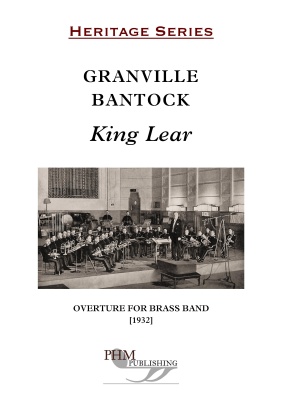
King Lear (Brass Band - Score and Parts)
Sir Granville Bantock (1868 - 1946) composed the second of his five major brass band work for Callender's Cableworks Band, completing the commission on 30 November 1932. Based in the Thames-side district of Belvedere near Erith, the band was active between 1898 and 1961. The works band of the Callender Cable & Construction Co. Ltd, it was at the peak of its popularity during the 1930s and was a frequent broadcaster on the radio. The band employed an in-house arranger and played saxophones in its lighter material. King Lear was one of the band's major commissions and was not published in Bantock's lifetime. The manuscript score and parts were thought to be lost for decades, but were found in the library of the Haydock Band (Lancashire), which had inherited part of Callender's library of manuscripts material and bespoke arrangements after it has been transferred to nearby Prescott Cables Band after Callender's Cable Works closed.King Lear is a substantial work, in essence a dramatic tone poem in the romantic Tchaikovskian manner, presenting a series of character portraits of the foolish old king and his three daughters, Goneril, Regan and Cordelia. The music is dramatic and lyrical by turns, with the most generous lyrical episode revealing perhaps the warm-hearted Cordelia. An expansive melody that flows from this is brought back towards the end as the main climax of the work.In 2001, Bantock's score was recorded by the University of Salford Brass Band, conducted by Dr. Roy Newsome. The original is serviceable, but in comparison with the orchestral version he made in 1936 (part of which was recorded on a Paxton 78 rpm) and later brass band scores, performing editions of which were prepared by others, it lacks colour and range typical of Bantock's orchestral work. Above all it lacks percussion, which can be heard on the recorded extract. With the kind permission of the Bantock Estate, I have prepared a performing edition for publication that incorporates percussion, derived from the orchestral recording and added editorially in similar manner elsewhere. I have revoiced some of the low- lying instrumental parts to present the material in more comfortable ranges. Editorial interventions more elaborate than revoicing the original text have been identified as cue notes.- Paul HindmarshDuration: 15.00
Estimated dispatch 7-14 working days
-
£40.00
King Lear (Brass Band - Score only)
Sir Granville Bantock (1868 - 1946) composed the second of his five major brass band work for Callender's Cableworks Band, completing the commission on 30 November 1932. Based in the Thames-side district of Belvedere near Erith, the band was active between 1898 and 1961. The works band of the Callender Cable & Construction Co. Ltd, it was at the peak of its popularity during the 1930s and was a frequent broadcaster on the radio. The band employed an in-house arranger and played saxophones in its lighter material. King Lear was one of the band's major commissions and was not published in Bantock's lifetime. The manuscript score and parts were thought to be lost for decades, but were found in the library of the Haydock Band (Lancashire), which had inherited part of Callender's library of manuscripts material and bespoke arrangements after it has been transferred to nearby Prescott Cables Band after Callender's Cable Works closed.King Lear is a substantial work, in essence a dramatic tone poem in the romantic Tchaikovskian manner, presenting a series of character portraits of the foolish old king and his three daughters, Goneril, Regan and Cordelia. The music is dramatic and lyrical by turns, with the most generous lyrical episode revealing perhaps the warm-hearted Cordelia. An expansive melody that flows from this is brought back towards the end as the main climax of the work.In 2001, Bantock's score was recorded by the University of Salford Brass Band, conducted by Dr. Roy Newsome. The original is serviceable, but in comparison with the orchestral version he made in 1936 (part of which was recorded on a Paxton 78 rpm) and later brass band scores, performing editions of which were prepared by others, it lacks colour and range typical of Bantock's orchestral work. Above all it lacks percussion, which can be heard on the recorded extract. With the kind permission of the Bantock Estate, I have prepared a performing edition for publication that incorporates percussion, derived from the orchestral recording and added editorially in similar manner elsewhere. I have revoiced some of the low- lying instrumental parts to present the material in more comfortable ranges. Editorial interventions more elaborate than revoicing the original text have been identified as cue notes.- Paul HindmarshDuration: 15.00
Estimated dispatch 7-14 working days
-
 £37.95
The Year of the Dragon (Score Only)
The highlight of Cory's centenary celebrations throughout 1984 was a concert held in St. David's Hall, Cardiff, in March. The band, with the aid of funds provided by the Welsh Arts Council, commissioned Philip Sparke to write a work for first performance at this concert. The result was "The Year of the Dragon" of which the composer writes:"At the time I wrote The Year of the Dragon, Cory had won two successive National Finals and I set out to write a virtuoso piece to display the talents of this remarkable band to the full."The work is in three movements:TOCCATA opens with an arresting side drum figure and snatches of themes from various sections of the band, which try to develop until a broad and powerful theme from the middle of the band asserts itself. A central dance-like section soon gives way to the return of this theme, which subsides until faint echoes of the opening material fade to a close.INTERLUDE takes the form of a sad and languid solo for trombone. A chorale for the whole band introduces a brief spell of optimism but the trombone solo returns to close the movement quietly.FINALE is a real tour-de-force for the band with a stream of rapid semi-quavers running throughout the movement. The main theme is heroic and march-like but this is interspersed with lighter, more playful episodes. A distant fanfare to the sound of bells is introduced and this eventually returns to bring the work to a stirring close.
Estimated dispatch 7-14 working days
-
 £29.95
The Strong Tower (Brass Band - Score and Parts)
Following the popularity of Turris Fortissima, I decided, albeit many years later, to revisit some of the material it contains and create a shorter piece, expanding on some of the ideas and motifs, allowing myself to follow those in different directions altogether. The result is this piece which I hope will also excite players and listeners alike.The music is marked at a quick tempo from the start, but despite several changes in meter, the tempo doesn't change until the small accelerando leads us into the presto section. In order to maintain the excitement and drama, it's important to set the pace and keep it consistent throughout.Section A introduces a few of the motifs that will be developed during the piece, including the main Turris Fortissima theme from bar 13 to 18.At section B, ensure the quavers are tight across the whole band with a strong attack, making an obvious difference in dynamic when fff is marked, in bars 23, 25 and 27. A more lyrical approach will be effective from the Horns in section C, with vigorous interruptions from the rest of the band breaking up their melody.Section D features long notes from muted 1st and 2nd Cornets and Trombones, with crescendos each time. These should be significant and sound as though they emerge from nowhere, completely cutting through the overall texture.Section D features long notes from muted 1st and 2nd Cornets and Trombones, with crescendos each time. These should be significant and sound as though they emerge from nowhere, completely cutting through the overall texture.Sections E and F are both passages of building intensity. Various contrasting motifs are layered, including a subtle reference to the hymn tune Ein' feste Burg (A mighty fortress is our God) from the Euphonium. The music becomes more busy and muddled, before reaching its climax at section G where the lyrical melody is heard again, this time from the Solo Cornets and Euphonium.In bars 141 to 145, there is a reference to Dean Goffin's My strength, my tower in the Basses, as used in Turris Fortissima. Allow this motif to dominate, keeping the notes full and grand-sounding. In bars 149 to 151 there is further use of the line from Ein' feste Burg in the Baritones, Trombones, Euphoniums and Basses leading into the final section.- Steven Ponsford
Estimated dispatch 7-14 working days
-
 £77.00
General Series Brass Band Journal, Numbers 2242 - 2245, April 2024
2242: Fanfare Prelude - Faithful in every way (Simon Gash)Lord, I come before your throne of grace (S.A.S.B. 378) has become a popular song for Sunday worship. These words of great assurance are married to a strong tune which, unlike many contemporary worship songs, suits the brass band idiom well. Although this piece will work without Percussion, the Snare Drum part, which underpins a lot of the piece, will help drive the music forward.2243: The wonders of thy grace (Norman Bearcroft)Herbert Booth's song Within my heart, O Lord, fulfil (S.A.S.B. 211) was the inspiration behind Lieut-Colonel Norman Bearcroft's three-verse setting of the hymn tune Wareham, with the title being taken from the lyrics of verse two.2244: Trombone Solo - I will wait (Andrew Mackereth)Major Leonard Ballantine has an astonishing gift for contemporary song writing. This song is a brilliant example of this, taking the idea of Jesus waiting patiently for us to accept the fullness of his offer of love.This arrangement was made at the request of Andrew Justice, former Principal Trombonist of The International Staff Band. For many years, Andrew has used this song with piano accompaniment. In making this arrangement, the composers aim was to capture the transparency you can create in piano playing.2245: The battle cry! (David Edmonds)Inspired by Lorne Barry's Trinity (F.S. 599), this piece would be well suited as a concert opener but would work in many settings as a contribution to worship. Its main feature is the driving rhythmic pattern in the Bass and Percussion sections. The music needs to be played with confidence and purpose. As the title suggests, it is a strong, inspiring battle cry, corralling the troops. This is a setting of the song by Stuart Townend and Keith Getty, O Church, arise (S.A.S.B. 819), which has become popular in recent years, not only within The Salvation Army, but also the wider Christian church.
Estimated dispatch 7-14 working days
-
 £29.95
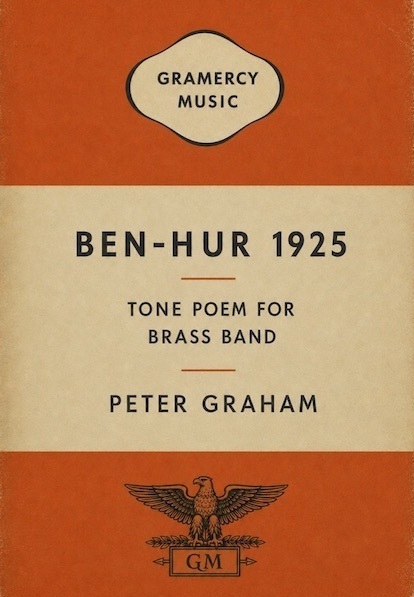
Ben-Hur 1925 (Brass Band - A4 Study Score)
Lew Wallace's Ben-Hur: A Tale of the Christ has inspired numerous adaptations for film, television and radio, each distilling the vast eight-part novel while preserving its enduring themes of compassion and forgiveness.Using the 1925 silent film as a starting point, I have reimagined the story as Ben-Hur, late in life, looks back on its defining moments, his memories coming alive before him.Part I: Ben-Hur's life unfolds in epic flashes: from Rome's splendour and tyranny to the haunting strains of Veni, Veni Emmanuel hinting at Christ's coming; a family betrayed, the galleys, heroic battles, and a chariot triumph--yet even victory offers no peace.Part II: Ben-Hur is torn by inner turmoil as he discovers his suffering family. In desperation he turns to Christ whose message of compassion and forgiveness transforms him, his thirst for vengeance giving way to healing and reconciliation.The work also acknowledges the profound influence of Eric Ball, whose biblical tone poems -- including King of Kings (1931) and Exodus (1937) -- helped shape the brass band repertoire of their time.The hymn Veni, Veni Emmanuel, symbolising the parallel narrative of Christ within this story, was likewise central to Ball's epic The Kingdom Triumphant.The work concludes with the well-known Dresden Amen, also heard in the closing bars of The Kingdom Triumphant.Ben-Hur 1925 was commissioned by The Whitburn Band, MD Nicholas Childs, and is dedicated to the memory of Derek Smith.
Estimated dispatch 7-14 working days
-
£44.95
Ben-Hur 1925 (Brass Band - B4 Score only)
Lew Wallace's Ben-Hur: A Tale of the Christ has inspired numerous adaptations for film, television and radio, each distilling the vast eight-part novel while preserving its enduring themes of compassion and forgiveness.Using the 1925 silent film as a starting point, I have reimagined the story as Ben-Hur, late in life, looks back on its defining moments, his memories coming alive before him.Part I: Ben-Hur's life unfolds in epic flashes: from Rome's splendour and tyranny to the haunting strains of Veni, Veni Emmanuel hinting at Christ's coming; a family betrayed, the galleys, heroic battles, and a chariot triumph--yet even victory offers no peace.Part II: Ben-Hur is torn by inner turmoil as he discovers his suffering family. In desperation he turns to Christ whose message of compassion and forgiveness transforms him, his thirst for vengeance giving way to healing and reconciliation.The work also acknowledges the profound influence of Eric Ball, whose biblical tone poems -- including King of Kings (1931) and Exodus (1937) -- helped shape the brass band repertoire of their time.The hymn Veni, Veni Emmanuel, symbolising the parallel narrative of Christ within this story, was likewise central to Ball's epic The Kingdom Triumphant.The work concludes with the well-known Dresden Amen, also heard in the closing bars of The Kingdom Triumphant.Ben-Hur 1925 was commissioned by The Whitburn Band, MD Nicholas Childs, and is dedicated to the memory of Derek Smith.
Estimated dispatch 7-14 working days
 Watch video