
Results
-
 £25.00
Meditation - John Stainer
Based on "God So Loved The World" from John Stainer's "Crucifixion".In the 19th century, the English composer John Stainer wrote an oratorio named "The Crucifixion". It contains a beautiful a capella setting of the Biblical text from John chapter 3 verses 16 & 17. Although I have added a few obligati and counter subjects, and a short fugal link, for the most part, I have not tried to add too much to a beautiful piece of traditional harmony. What I have done, is to try to emphasise the subtle changes of tone colour in the unique sound of the brass band. "Meditation" is on the latest CD from Weston Brass. Order from [email protected] price �6.95."..a beautiful concert item that reflects the title of the work perfectly." Robert Childs
In Stock: Estimated dispatch 3-5 working days
-
 £35.00
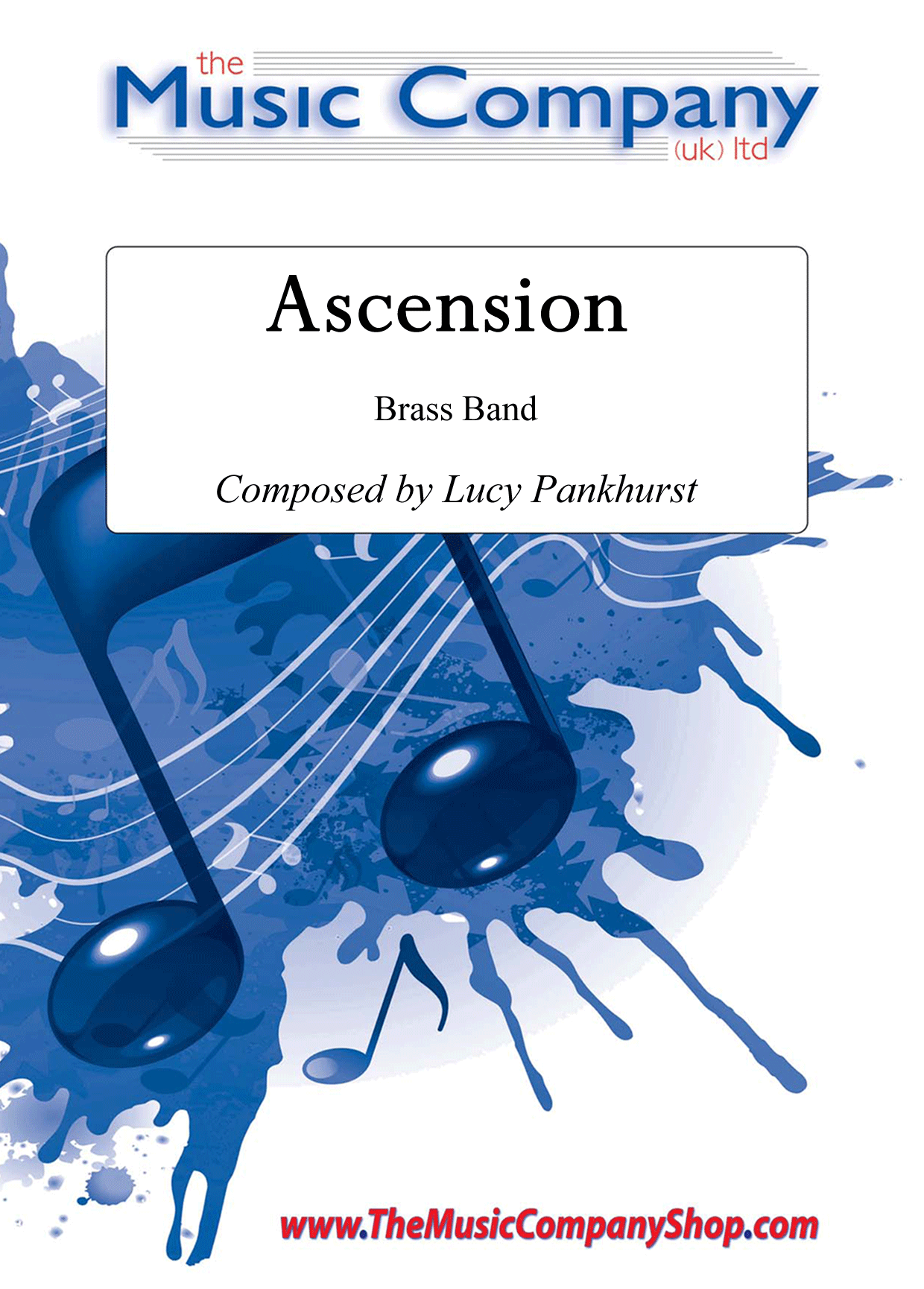
Ascension - Lucy Pankhurst
A major work written for the RNCM Brass Festival Competition 2005, and inspired by the nature of Ascension - creating a Musical depiction of the spiritual journey towards enlightenment, sanctuary and ultimate inner peace.As aninitial muse for this work, the 'Tibetan Singing Bowl' is utilised with the Brass Band in order to represent this path to Serenity, together withBaoding Balls(Chinese Health Balls) to mark the point of Final Ascension.Programme notes from the composer, Lucy Pankhurst:Ascension is a Musical depiction of the Spiritual Journey towards enlightenment, sanctuary and ultimate inner peace.As my initial muse for this work, the Singing Bowl is utilised with the Brass Band in order to represent this path to Serenity. "Tibetan" Singing Bowls date back to the 8th Century A.D., originating in the pre-Buddhist shamanic Bon Po culture in the Himalayas and are still used in modern Monasteries. The original purpose of them still remains a mystery, with accounts stating that it is forbidden to disclose the true function of the Bowls, as the "secrets of sound" yield so much Power, that they must be kept hidden.Listening to the tones created by the Singing Bowl effectively silences the internal dialogue of the listener, making it an excellent tool for Meditation, Centering and entering trance-like states. In Buddhism, as with many cultures, sound is an important part of Spiritual Practice. There are 9 methods to reach Enlightenment in the Buddhist Doctrine ; the seventh is SOUND.These Bowls are used by Healers in a similar way to help balance the body's residual energies. The Bowls are usually made from seven different sacred metals, intended to correlate directly to the seven sacred "Planets" : GOLD (Sun), SILVER (Moon), MERCURY (Mercury), COPPER (Venus), IRON (Mars), TIN (Jupiter), ANTIMONY (Saturn). Any one Bowl can create up to seven different frequencies (tones) simultaneously. In Healing, the Singing Bowl is played whilst balanced on the palm of the hand, struck three times to stabilise the surrounding energies, before rotating the wooden "beater" around the outer circumference of the Bowl to create the "singing" effect.I have included an optional Vibraphone part (to be played with a Double Bass Bow) with Tubular Bells, to be used only in performances where a Singing Bowl cannot be acquired. However, a traditional Bowl should be used whenever possible, to create this specific and unique sound.Baoding Balls or Chinese Health Balls are also utilised in this work. Their appearance in the Music here, however, is to mark the point of Final Ascension, where the music reaches its ultimate goal. These delicate cloisonne iron Balls are said to stimulate the acupressure points on the hand, thus improving the Chi and Energy Paths (Life Force) throughout the entire body. The delicate "tinkle" produced by these spheres is hypnotic and captivating. For this reason, where no Baoding Balls are obtainable for performance, only delicate metallic percussion should be used in replacement (i.e. Crotales, Antique Cymbals or (liberal) single strikes on a Triangle etc.). Bell Trees, Wind Chimes and Cow Bells should not be used.As in many cultures, the number three is important in Ascension, as it represents not only the purification from the Singing Bowl, but also it is a number of confirmation, reiterated throughout the music in the metallic percussion in addition to the Brass, re-affirming the correct path to Enlightenment.
In Stock: Estimated dispatch 3-5 working days
-
£30.00
Reach - S Club 7
When the group S Club 7, (an able bunch with a wide appeal to all ages), released the song Reach in the year 20, it soon became a hit with many people, and still is. My wife Julie and myself were at a large event recently, and saw the effect of this song on a mixed audience - it brought the house down! Besides more serious projects, I am a great believer in entertaining the brass band's largest audience, the general public, which is why I have been very happy to produce this arrangement of a song which is full of fun.
In Stock: Estimated dispatch 3-5 working days
-
£30.00
Presley In Mind
Includes: "Are You Lonesome Tonight?", "Can't Help Falling in Love", and "Wonder of You".Whether you like Elvis or not, audiences will love this medley. Three of his well known ballads, to which the audience can sing along.Talking of singing, the middle section of the band get their chance too! A very popular medley, which has also been included in 'entertainment contests'. The Parr Band won their section at Wychavon in 2004, judged by Goff Richards."Presley in Mind" is featured on Flixton Band's CD (order from [email protected] price �10).Robert Childs commented:"The brass writing is very accessible. The third tune in this triptych of Presley's pop songs requires the entire horn, baritone, trombone and euphonium sections to sing as well - all good fun I'm sure".
In Stock: Estimated dispatch 3-5 working days
-
 £72.00
I made it trough the rain - Manilow Barry - Hillary Nick
Estimated dispatch 7-14 working days
-
£79.00
I write the songs/Mandy - Manilow Barry - Hillary Nick
Estimated dispatch 7-14 working days
-
£57.00
Ich bete and die macht der liebe/I pray to the power of love - Dmitry Bortniansky - Luc Vertommen
Estimated dispatch 7-14 working days
-
 £98.00
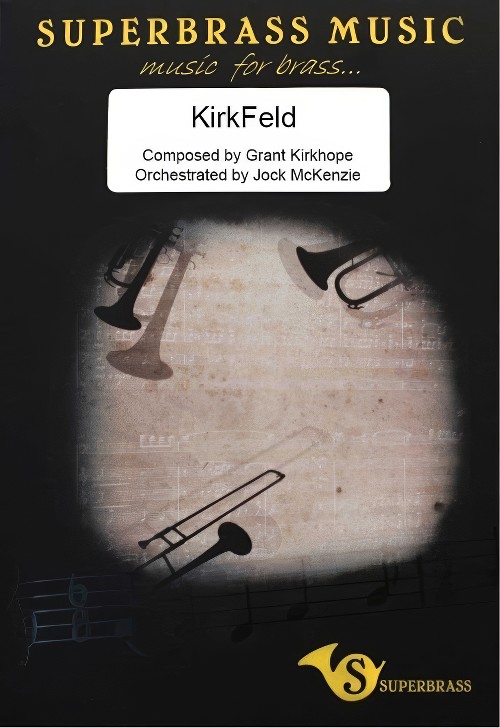
KirkFeld (Trombone Solo with Brass Band - Score and Parts) - Kirkhope, Grant - McKenzie, Jock
Written for Ian Bousfield and the International Trombone Festival 2017. Grant Kirkhope is a BAFTA nominated British composer who has created the soundtrack for video games that have sold in excess of 30 million copies. From "GoldenEye" to "Banjo-Kazooie", "Viva Pi?ata" to "Donkey Kong", "Kingdoms of Amalur: Reckoning" to "Civilization: Beyond Earth" and "Perfect Dark" to "Castle of Illusion starring Mickey Mouse". He has also recently scored the feature film "The King's Daughter" starring Pierce Brosnan and William Hurt and is currently working on "Yooka Laylee" and "Dropzone". Grant's score for "Viva Pi?ata" was nominated by BAFTA in the Original Score category in its 2007 awards. Grant is represented by the prestigious Gorfaine/Schwartz Agency by Cheryl Tiano and Kevin Korn. Grant has a degree in music from the Royal Northern College of Music, Manchester, where he majored in classical trumpet, is a green card holder and now lives in Agoura Hills, LA with his wife and two children. "Ian and I first met when we were around 15 years old. We both played in our county orchestra, the North Yorkshire Schools Symphony Orchestra (I was a trumpet player). I think we hit it off straight away, as we were definitely a couple of cheeky kids, if you know what I mean! We both ended up playing in Rowntree Mackintosh Brass Band for a while too which Ian's Dad, Trevor conducted. We bumped into each other again when we both went for the Shell/LSO Scholarship. I got to the area finals in Manchester so I was pretty pleased with myself but then I saw Ian and I knew it was all over! Of course Ian went on to win and the rest is history. I saw him again when I was attending the Royal Northern College of Music around 1983 by which time Ian had just got the principal chair at the Halle Orchestra. Then I guess 30 something years went by as we both went about our lives and lost touch. We re-kindled our friendship due to his wife really. She emailed me to say it was Ian's 50th birthday and she was collecting stories from all his friends over the years. After that we got back in touch and then one day on Facebook I got a message from him in typical dry Yorkshire fashion "now then Grant, I had a listen to your music and I think it's good, how about writing a piece for me ?" I was a little bit unsure at first but of course I loved Ian's playing and of course I said yes. Over a Skype call in 2016, he asked me what I thought I'd write. I said since I live in LA I'd like to write a "Hollywood" trombone piece. Imagine if John Williams had written a piece for solo trombone, that's what I'd like to write - well I'd certainly like to try" - Grant Kirkhope
Estimated dispatch 7-14 working days
-
 £80.00
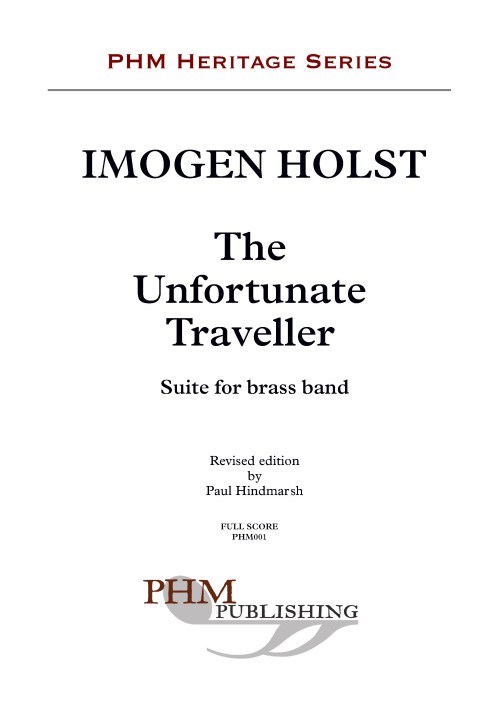
The Unfortunate Traveller (Brass Band - Score and Parts) - Holst, Imogen - Hindmarsh, Paul
Imogen Holst (1907-1984) submitted The Unfortunate Traveller (1929) as her final work as a student portfolio at the Royal College of Music, where her composition teacher was Gordon Jacob. The title was taken from Thomas Nashe's famous 1594 picaresque novel of the same title. The Suite was first performed on 12 February 1933 at her Majesty's Theatre, Carlisle, by the St. Stephen's Band, with the composer conducting. Te concert was given in memory of Holst's uncle, Dr. H.A. Lediard. Holst had been impressed with the band's performance of his A Moorside Suite at the 1928 National Brass Band Championships (The Crystal Palace, South London) and was keen to work with them. Writing in Imogen Holst, a life in music, Christopher Grogan indicates that it was Gustav Holst's suggestion to include his daughter's work in the programme, quoting Imogen Holst's remarks made in interview to The Daily Mail as follows: "....it is the first time, so far as I know, that a woman has conducted a brass band at a public concert....It has been a delight to rehearse the St. Stephen's Band. It was their performance at the Crystal Palace Festival that inspired me to write this Suite, which I have dedicated to them."Imogen Holst accompanied her father to the Crystal Palace in 1928 to hear the performances of A Moorside Suite, and was so excited by the played and, audibly, by her father's music that she decided to write a brass band piece for her final examination. Te result was The Unfortunate Traveller (1929). However, it was not possible for her to present a brass band work for examination. She arranged it for string orchestra so that it could be played before she left the RCM in July 1930. Following the premiere of the original in 1933, the manuscripts did not resurface until 1969 Imogen found them among her late mother's effects. Although she requested score and parts be destroyed, they ended up in the possession of Manchester composer John Golland, who marked up the score presumably with the intention of creating a new performing edition. The original scoring reveals a lack of experience with what can be a tricky medium.With the agreement of the Holst Foundation, a revised edition, with additional percussion, was prepared in 2011 since when the work has been fortunate to travel round the world as a concert and contest piece. The original includes drums in the March only. The title was taken from Tomas Nashe's famous 1594 picaresque novel of the same title. Several Morris Dance tunes are introduced during the course of the four short movements, including Bonnie Green Garters, Shepherd's Hey, The Rose and The Wind Blaws Cauld. Quirky twists and turns of harmony and spirited rhythms that remind us how much Imogen Holst loved tradition English dance music.In September 2025, I made a performing edition of the composer's arrangement for string orchestra. The manuscript lacks the final movement, which I arranged in a similar style, ie. without extending the upper ranges. Making this edition raised some issues regarding the accuracy of my band version and some of the solutions I used to smooth out the voicing. I have used the composer's second thoughts to refine my performing edition and to correct a textual errors.- Paul HindmarshDuration: 10.00
Estimated dispatch 7-14 working days
-
£40.00
The Unfortunate Traveller (Brass Band - Score only) - Holst, Imogen - Hindmarsh, Paul
Imogen Holst (1907-1984) submitted The Unfortunate Traveller (1929) as her final work as a student portfolio at the Royal College of Music, where her composition teacher was Gordon Jacob. The title was taken from Thomas Nashe's famous 1594 picaresque novel of the same title. The Suite was first performed on 12 February 1933 at her Majesty's Theatre, Carlisle, by the St. Stephen's Band, with the composer conducting. Te concert was given in memory of Holst's uncle, Dr. H.A. Lediard. Holst had been impressed with the band's performance of his A Moorside Suite at the 1928 National Brass Band Championships (The Crystal Palace, South London) and was keen to work with them. Writing in Imogen Holst, a life in music, Christopher Grogan indicates that it was Gustav Holst's suggestion to include his daughter's work in the programme, quoting Imogen Holst's remarks made in interview to The Daily Mail as follows: "....it is the first time, so far as I know, that a woman has conducted a brass band at a public concert....It has been a delight to rehearse the St. Stephen's Band. It was their performance at the Crystal Palace Festival that inspired me to write this Suite, which I have dedicated to them."Imogen Holst accompanied her father to the Crystal Palace in 1928 to hear the performances of A Moorside Suite, and was so excited by the played and, audibly, by her father's music that she decided to write a brass band piece for her final examination. Te result was The Unfortunate Traveller (1929). However, it was not possible for her to present a brass band work for examination. She arranged it for string orchestra so that it could be played before she left the RCM in July 1930. Following the premiere of the original in 1933, the manuscripts did not resurface until 1969 Imogen found them among her late mother's effects. Although she requested score and parts be destroyed, they ended up in the possession of Manchester composer John Golland, who marked up the score presumably with the intention of creating a new performing edition. The original scoring reveals a lack of experience with what can be a tricky medium.With the agreement of the Holst Foundation, a revised edition, with additional percussion, was prepared in 2011 since when the work has been fortunate to travel round the world as a concert and contest piece. The original includes drums in the March only. The title was taken from Tomas Nashe's famous 1594 picaresque novel of the same title. Several Morris Dance tunes are introduced during the course of the four short movements, including Bonnie Green Garters, Shepherd's Hey, The Rose and The Wind Blaws Cauld. Quirky twists and turns of harmony and spirited rhythms that remind us how much Imogen Holst loved tradition English dance music.In September 2025, I made a performing edition of the composer's arrangement for string orchestra. The manuscript lacks the final movement, which I arranged in a similar style, ie. without extending the upper ranges. Making this edition raised some issues regarding the accuracy of my band version and some of the solutions I used to smooth out the voicing. I have used the composer's second thoughts to refine my performing edition and to correct a textual errors.- Paul HindmarshDuration: 10.00
Estimated dispatch 7-14 working days
 View Music