
Results
-
 £25.00
First Attempt (brass band) - Tim Paton
This concert march, composed by Tim Paton for brass band, has taken inspiration from the inimitable style of the 'march king', Kenneth J Alford.It's an upbeat, cheerful march which has stood the test of time - it was premiered back in 1970 on the Rozel Bandstand by the Weston-Super-Mare Silver Band!Marches have always been a favourable choice in brass band concert programmes, so here's a great opportunity to bring a new offering to the table which helps lift spirits through its catchy pulse and creativity.Also available as a version for brass ensemble.
In Stock: Estimated dispatch 3-5 working days
-
 £104.99
High Flyers - Andrew R. Mackereth
From the composer: High Flyers are regarded as people with promise and potential.They are winners. This is music for winners.The title, as well as being a play-on-words, implies the nature of the work. It is a bright, optimistic, and upbeat piece attempting to depict an exhilarating ride on flying carpet. The opening rising chords immediately suggest the gentle elevation of the carpets' ascent towards unknown heights, leading to a hint of a first theme in the horns at Fig. B. The first four notes provide the thematic material for the whole work: C F G A.A perpetual sense of movement is achieved through accented quaver chords punctuating the melodicmaterial of the first main theme. Fig. E sees the music of the opening bars fully realised, with flourishes from the euphonium and baritones representing swirling clouds, shooting stars, or passing birds in flight.The same subject is developed into a lyrical second theme with a new lush harmonic treatment, evocative of gliding over an expanse of sparse countryside.This section ends with a note of serenity but is shattered by the urgent insistence of the percussion rhythms.The third section introduces a new idea with a slightly distorted fanfare in the cornets and trombones. This figure suggests for the first time that there may be trouble ahead. In fact, there is no need to fear and the journey can continue without aggravation. This fanfare returns near the end to signal a final note of triumph.A new rhythmic variant of the cell motif emerges as the third theme now transformed by the addition of a triplet figure. The music steadily gains momentum before moving inexorably towards the climactic return of the music and tonality of the opening bars of the piece.
Estimated dispatch 5-14 working days
-
 £72.99
Fanfare For A Friend - Bert Appermont
Fanfare for a Friend was originally composed as an introductory piece for the brass ensemble Musica Mosana and their conductor Mark Prils. The work begins with a brilliant brass fanfare that presents the main theme for the first time. This stately theme can be heard in counterpoints throughout the first 28 bars. This is followed by a contrasting and rapid part whereby a melodic theme can be heard against a more rhythmic accompaniment. A virtuoso and sweeping passage then leads to the grandioso in which both themes are played simultaneously in a grand finale.
Estimated dispatch 5-14 working days
-
 £54.99
Yo-ho, it's Christmas Time - David Well
Yo-ho, It's Christmas Time" could be just a cry from the mouth of Santa Claus. David Well used this as the title for this three-part composition. First the very familiar "Jingle Bells" in a relaxed style, followed by the sensitive Negro spiritual "Mary Had a Baby.". Finally hear "We Wish You a Merry Christmas."
Estimated dispatch 5-14 working days
-
 £95.00
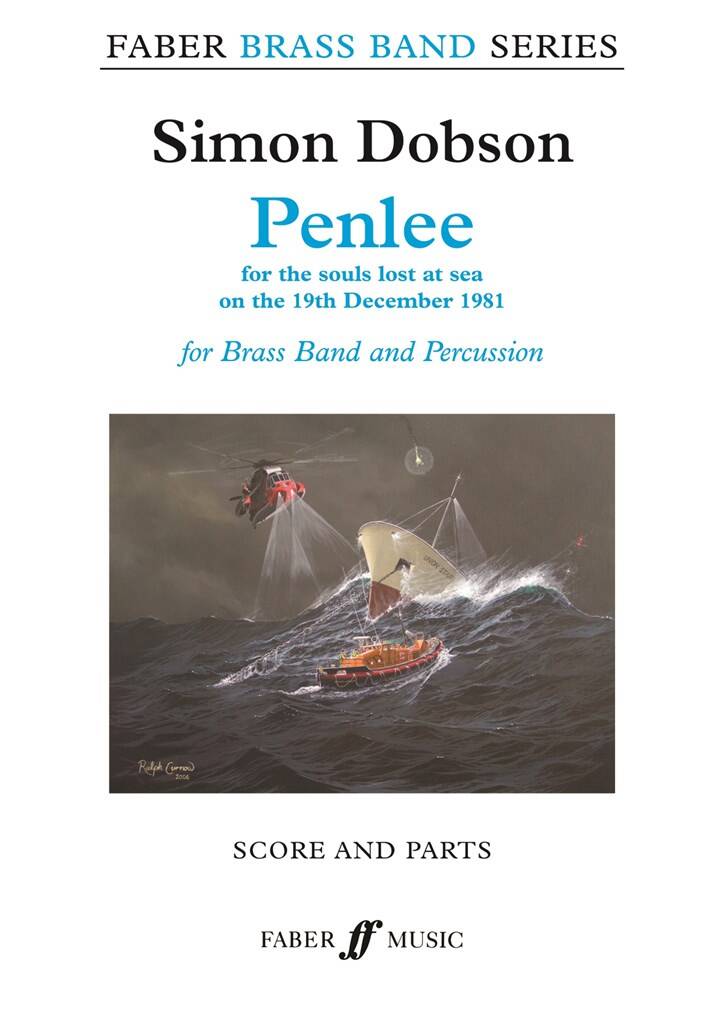
Penlee - Simon Dobson
To some, the tragic story of the Penlee lifeboat, Solomon Browne, would need no introduction, and to some the pain felt is still very much a reality. The composer, born just a few weeks before that fateful night on the19th December 1981, has created this work as a musical homage to the bravery of the souls who lost their lives and has dedicated it to their memory. Penlee was commissioned by the Cornwall Youth BrassBand using funds bequeathed by Michael Pickett. The first performance was given by the Cornish Youth Brass Band, conducted by Ian Porthouse, at St. Michael's Church, Newquay, on 30th December 2008.Penleehas been voted into the Classic FM Hall of Fame 2011 at No.106. Not only is it the first time a brass work has been featured in the Hall of Fame, but it was also thehighest new entry. The work has subsequently been recorded by the Leyland Band, conducted by Jason Katsikaris, on the CD entitled Penlee.Brass Band Grade 4: Advanced Youth and 3rd Section Duration: 13 minutes
Estimated dispatch 5-14 working days
-
 £109.99
Nordic Moods - Tom Brevik
The composer:1st movement: Reflections by the Fjord.Overlooking one of the mighty fjords of Norway, my mind and thoughts are with an old religious Norwegian folk-tune, with words by the famous parson Peter Dass.The majestic fanfare-likeopening reflects the power of God our Father, the choral itself heard for the first time on flugelhorn. The choral is repeated a few times, separated only by some short variations. The movement ends in thriumph, with fanfares and the choral broughttogether.2nd movement: Reflections in the Old Church.In this movement my associations of a summer day, finding myself alone in an old deserted stone church. From the old walls I hear folk songs, perhaps like the ones sung in the church bypoor fishermen and farmers in days gone by. Suddenly the light from the sun breakes through the small circular window above the altar, and a lovely melody is heard, before the original figures take us to the end of the movement.3rd movement:Festive Reflections.Any festive occasion can be reflected in this movement. from the bonfire at midsummer-night to the children celebrating the return of the sun in the northern part of Norway. from the traditional sleigh-riding at Christmas tothe Celebrations of the National Day on the 17th of May each year.
Estimated dispatch 5-14 working days
-
 £168.50
Music of the Spheres - Philip Sparke
Music of the Spheres was commissioned by the Yorkshire Building Society Band and first performed by them at the European Brass Band Championships in Glasgow, May 2004.The piece reflects the composers fascination with the origins of the universe and deep space in general. The title comes from a theory, formulated by Pythagoras, that the cosmos was ruled by the same laws he had discovered that govern the ratios of note frequencies of the musical scale. ('Harmonia' in Ancient Greek, which means scale or tuning rather than harmony - Greek music was monophonic). He also believed that these ratios corresponded to the distances of the sixknown planets from the sun and thatthe planets each produced a musical note which combined to weave a continuous heavenly melody (which, unfortunately, we humans cannot hear). In this work, these six notes form the basis of the sections Music of the Spheres and Harmonia.The pieces opens with a horn solo called t = 0, a name given by some scientists to the moment of the Big Bangwhen time and space were created, and this is followed by a depiction of the Big Bangitself, as the entire universe bursts out from a single point. A slower section follows called The Lonely Planet which is a meditation on the incredible and unlikely set of circumstances which led to the creation of the Earth as a planet that can support life, and the constant search for other civilizations elsewhere in the universe. Asteroids and Shooting Stars depicts both the benign and dangerous objects that are flying through space and which constantly threaten our planet, and the piece ends with The Unknown, leaving in question whether our continually expanding exploration of the universe will eventually lead to enlightenment or destruction.
Estimated dispatch 5-14 working days
-
£59.99
All Cried Out - Peter Kleine Schaars
At the beginning of the 1980s Alison Moyet was discovered by Vince Clarke, who - in search of greater independence - had left the successful band Depeche Mode. The soulful singing style of Moyet and the electronic, innovative pop that Clarke made melded well together in the group Yazoo with hits such as Only You and Don't Go. However, after a number of years Moyet went her own way and forged a solo career, during which she demonstrated a somewhat more traditional sound. She recorded several covers (such as The First Time I Ever Saw Your Face and That Ole Devil Called Love) but she also wrote fine songs herself, such as Love Resurrection and, of course, the expressive song AllCried Out. This arrangement by Peter Kleine Schaars does justice to the atmosphere of the original song.
Estimated dispatch 5-14 working days
-
 £115.60
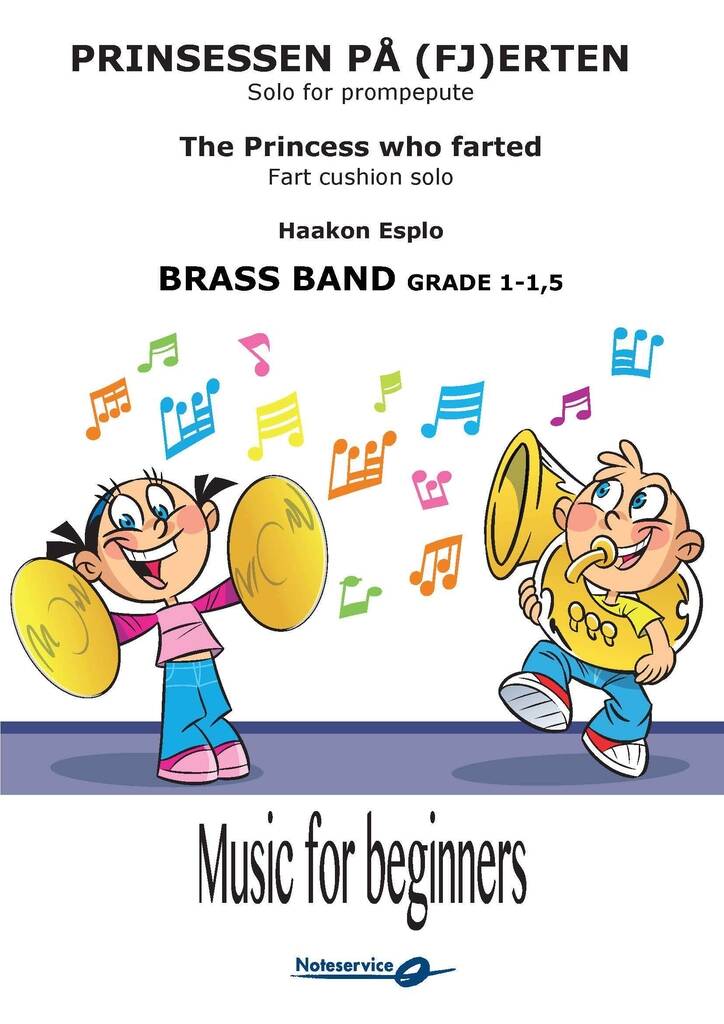
Prinsessen pa (fj)erten - Haakon Esplo
In this little suite in three movements, your young musicians really can be creative and have fun.Of course, a story must be written about the unfortunate princess who ate pea soup and got to let a small fart. Maybe one or more should dress up and play the princess and other roles? And who will be the lucky one who gets the honourable assignment to be a soloist on a fart cushion - probably for the first time in the history of your band? Maybe all the musicians should have one each?Think what a great finale at the last movement that could be.Good luck!
Estimated dispatch 5-14 working days
-
£54.99
Barcelona '92 - Horst Schelcke
The Olympic Games from the summer of 1992, officially known as theGames of the XXV Olympiad of the modern era, were held in the sunnySpanish city of Barcelona. This was the first time the Olympic Gameshad been held in Spain, and to celebrate this Horst Schelke composedthis rousing concert march with a typically Spanish feel. Relive theexcitement of this great event with this superb march.
Estimated dispatch 5-14 working days
 View Music