
Results
-
 £75.00
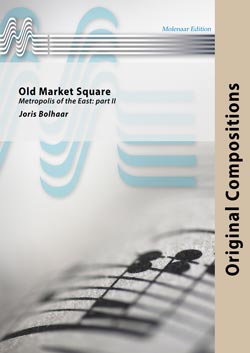
Old Market Square - Joris Bolhaar
In the second part of the two-piece work Metropolis of the East is the Old Market, the centre point of the city of Enschede in the Netherlands. Elements such as the Great Church, the monument to the city fire of 1862, and historical events such as the textile strike can be heard in this piece, as well as the sounds of the many al-fresco cafes, the theatre Concordia, and the many festivals. This piece is coupled with The Cotton Phoenix (Alex Poelman) but functions well as a stand-alone work.
Estimated dispatch 10-14 working days
-
 £35.00
Edward Gregson: Fanfare for a New Era (for Brass Band)
DescriptionComposer's NoteThe Fanfare has been designed to be partly antiphonal, with four separate brass 'choirs' initially playing their own music, and so some spatial separation is desirable. Soprano and solo cornets should be placed centrally, standing behind the rest of the band - or in some venues could even be placed off-stage in a side balcony, but still close to the band. If the Fanfare is played by a contesting size band, one of the solo cornets should play the 1st cornet part together with the usual player ie the number of players on the 1st, 2nd, and 3rd cornet parts should be equal. Otherwise the number of players in each of the two cornet 'choirs' is at the discretion of the conductor. The Tubular Bells accompanying the cornets 1-3 group should be placed close to that group. See inside back cover for suggested band formation.The style of playing should replicate that of symphonic brass, with a minimum of vibrato and with long notes being sustained without decaying.Programme NoteCommissioned in 2020 by Youth Brass 2000, Fanfare for a New Era was designed to be partly antiphonal - thus the separation of the band into four brass 'choirs', each with their own percussion accompaniment. First, soprano and solo cornets, rather like heraldic trumpeters, announce the main idea, majestic in character. Then horns, baritones, and euphoniums, with timpani, enter with stately figurations. Next, the heraldic trumpeters usher in trombones and tubas, to the accompaniment of tom-toms and snare drum, presenting a faster and rhythmic dance-like theme. Finally, the remaining cornets amplify the pealing of bells. All four elements then come together, surrounding the audience with a 'joyful noise' of festive brass and percussion.The original symphonic brass version of this fanfare can be purchased as part of a set of Three Fanfares HERE.For more information on Edward Gregson's music please visit the composer's website: www.edwardgregson.com
Estimated dispatch 7-14 working days
-
£72.00
Ave Maria - Vocal or Instrumental Solo - Bach-Gounod - Bjorn Mellemberg
This great piece is a result of two outstanding composers creative ability. The French composer Charles Gounod (1818-1893) used the Prelude No. 1 from "Das Wohltemperierte Klavier" by Johann Sebasian Bach (1685-1750) and added a beautiful melody to the original piece. The composition has the occurred in several versions both with and without lyrics and for many kinds of instrumentations.To the Conductor:It's important to take well care of the long phrases of the melody and it's warm and soft character.Make shure that the band balance the three elements of melody, harmony and the rhythmic (played by the clarinets) well. All these three is of equial importance and depend of each other.
Publisher Closed for Holidays. Est Delivery 13-14th Aug
-
£225.00
Prillar&Halling - for Solo Clarinet and Wind Band - Stig Nordhagen
"Prillar" has it's origin from Norwegian folklorist music. It's a way of calling and singing the cattle home from the fields. Halling is a wellknown folk dance from the valleys in the eastern part of Norway.In this work, the clarinet use the prillar to get the other musicians to join in.The melodic material in Prillar and Halling hasn't got all the sound of Norwegian folklore exclusively. You can also hear folkloric music from other nations. The idea is to show the similarities between these and also the small differences there are between folkloristic elements from a large area. The piece also contains the folk tune "Adam in paradise", from south of Norway. At the end, the tunes are stacked on top of each other, and the similarities of origin turns out.- Stig Nordhagen -
Publisher Closed for Holidays. Est Delivery 13-14th Aug
-
 £30.00
Django - Jock McKenzie
Django is inspired by the sounds of 'Hot Club Jazz'. The origins of this style also known as Gypsy Swing or Jazz Manouche were to be found in France in the 1930s. Indeed, the most famous group, based in Paris was the "Quintette du Hot Club de France" and featured in its ranks the legendary guitarist Django Reinhardt and violinist Stephane Grappelli. My composition Django seeks to provide a 'beginners guide' to some of the typical elements of this musical style: After a 'faux improvised' opening flourish, the main theme is in the characteristic minor key, including use of arpeggio figures to point the direction of the melodic line. The melodies throughout the piece are presented in a duet-like manner, spaced in intervals of 3rds and 6ths. The accompaniment based strongly around the minor 6th chords is designed to imitate the role of the rhythm section in a typical gypsy swing band.
-
 £40.00
Activate - Matthew Hall
ActivateTop to bottom in less than 2 minutes! Originally composed for Tredegar Town Band under the direction of Ian Porthouse, Activate is a fantastic way to start any programme in a concert or on the contest stage.The original conception of Activate occurred when Tredegar had 18 minutes of a 20 minute contest programme and couldn't find a piece to start the performance to fit in the time slot.With funky bass lines, percussion and melody lines as well as some devilish rhythmical elements in the inner parts, Activate is a sure fire way of getting the audience's feet tapping.The trombone solo in the middle section of the piece can be substituted on to any other Bb instrument should the need occur, and the piece can also be started with a drum kit rhythm rather than straight into the first bar.Activate
Estimated dispatch 5-7 working days
-
Game Of Thrones - Ramin Djawadi - Len Jenkins
"Game of Thrones" is an American fantasy drama television series based on George Martin's "A Song of Ice and Fire" and has received widespread acclaim by critics, although its use of nudity and violence has caused controversy. Filmed in Belfast and on location elsewhere in Northern Ireland, Malta, Croatia, Iceland, and Morocco, it premiered in 2011 and continues into a fourth season in 2014. The series interweaves several plot lines and through its morally ambiguous characters, explores the issues of social hierarchy, religion, loyalty, corruption, sexuality, civil war, crime, and punishment. It is set in a period that contains elements from the dark ages through to the medieval. The music for the series was composed by Ramin Djawadi and is noted for its popular main theme which is presented here as an arrangement for Brass Band. In keeping with the period depicted, the piece contains a significant contribution from the percussion section and care has been taken to achieve the desired effect with the normal resources of the average band.
-
Duet For Two Cats - G. Rossini - Len Jenkins
"Duet For Two Cats" is often performed as an encore to vocal recitals and operatic galas. It may be sung by two sopranos, male-female pairs, or even as a tomcat duet and can be accompanied by a piano or a full orchestra. The lyrics are simple; the single word 'Miaow', repeated with various styles of inflexion and attitude throughout the piece. Our arrangement is for a cornet and trombone. The piece is generally ascribed to Rossini, though there is some doubt as to its actual origins and whether it is an authentic work by that composer. It is believed that an English composer, Robert Lucas Pearsall under the pseudonym G. Berthold may have assembled the various elements from Rossini and perhaps other composers into the piece as we now know it. In order to achieve the correct balance between band and soloists, there is a need to mute most of the band instruments. Recognising that not all bands will have the larger mutes which are expensive and sometimes unwieldy, we suggest a form of muting made famous by a jazz trumpeter and which works well on most instruments. It consists of a circle of heat resistant padded table covering or felt, slightly larger than the bell diameter, with an elasticated edge like a 'mop-hat'. With 3 holes in it to let the sound out, the mute is then simply stretched over the bell to achieve the desired effect and folded up when not required.
-
 £42.00
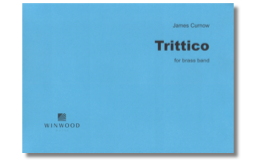
Trittico (Score only) - James Curnow
Trittico was commissioned by the Swiss Brass Band Association for their national championships in 1988. A trittico is a tripych or group of three paintings or musical compositions based on a common theme and presented or performed together. The present work is a set of three extended variations on the American shaped-note hymn Consolation. The work opens in grand style with motives based on intervals of the hymn tune. The opening motif, and smaller fragments of it reappear throughout the piece and serve as an underlying element alongside the theme itself. The first variation is essentially a scherzo which echoes the minor mood of the theme. The hemiolic opposition of compound and duple time is used to good effect and, again, the main motif is never far away. This is music with energy and forward movement. The second variation gives the soloists a chance to shine. The mood is tranquil, yet there is always some activity and the musical material pre-echoes the third variation. The third variation is another scherzo-like section, the main theme accompanied by a rhythmic ostinato. Toward the conclusion there is a short aeleatoric passage - a variation within a variation allowing half the band to make their own variaitions in a cachophony of sound. An energetic coda draws together several elements to round off a work brim full of drive, energy, and self-propelled enthusiasm. Duration: 13:30
Estimated dispatch 7-9 working days
-
 £52.00
Trittico (Parts only) - James Curnow
Trittico was commissioned by the Swiss Brass Band Association for their national championships in 1988. A trittico is a tripych or group of three paintings or musical compositions based on a common theme and presented or performed together. The present work is a set of three extended variations on the American shaped-note hymn Consolation. The work opens in grand style with motives based on intervals of the hymn tune. The opening motif, and smaller fragments of it reappear throughout the piece and serve as an underlying element alongside the theme itself. The first variation is essentially a scherzo which echoes the minor mood of the theme. The hemiolic opposition of compound and duple time is used to good effect and, again, the main motif is never far away. This is music with energy and forward movement. The second variation gives the soloists a chance to shine. The mood is tranquil, yet there is always some activity and the musical material pre-echoes the third variation. The third variation is another scherzo-like section, the main theme accompanied by a rhythmic ostinato. Toward the conclusion there is a short aeleatoric passage - a variation within a variation allowing half the band to make their own variaitions in a cachophony of sound. An energetic coda draws together several elements to round off a work brim full of drive, energy, and self-propelled enthusiasm. Duration: 13:30
Estimated dispatch 7-9 working days
 View Music