
Results
-
 £60.00
From the Shores of the Mighty Pacific (Cornet Solo with Brass Band - Score and Parts)
Cornet Solo with Brass BandHerbert L. Clarke (1867 - 1945) is regarded by many as one of the finest cornet players of all time, noted not only for his amazing technique but also for his warm, lyrical tone. He has left a multitude of cornet solos as well as collections of studies which are still very widely used. He was a member of The Sousa Band briefly in 1893 and then from 1898 to 1917 where he was not only the distinguished cornet soloist but also became assistant director.From The Shores Of The Mighty Pacific is an all-time favourite rondo-caprice cornet solo and was first published in 1912. A brass band arrangement was requested by Chris Lichtler, principal cornet of Brass Band of the Western Reserve, musical director Dr. Keith M. Wilkinson. Chris has performed it many times with BBWR and it was recorded by them on the CD, Without Reserve!.
Estimated dispatch 7-14 working days
-
 £30.00
The Sword and the Star
DescriptionThe Sword and the Star was written in 2006 for the Middleton Band at the request of their Musical Director, Carl Whiteoak. The inspiration for the work was the band's badge, which features a medieval archer. The town of Middeton's historical link with the symbol of the Archer came from the English victory at the Battle of Flodden in September 1513, where bowmen from Middleton and Heywood under the command of Sir Richard Assheton played a vital part in crushing the invading Scottish army. Sir Richard captured one of the Scottish commanders and presented the prisoner's sword to the St Leonard's church in Middleton in recognition of the town's contribution. As long time Lords of the Manor, the Assheton family crest was for centuries featured in the coat of arms of Middleton council, and when Middleton became part of the Metropolitan Borough of Rochdale the black star from the Assheton crest was used to represent Middleton in the new borough's coat of arms. Hence the title The Sword and the Star, for a piece which attempts to give an impression of the town as it was then and as it is now.The music is in three short sections - a fanfare, a lament and a bright scherzo - and simply aims to contrast the medieval hamlet of Middleton with the bustling urban centre it has now become. The central lament features a Scottish song called "The Flowers of the Forest", written to mourn the loss of so many of Scotland's young men on the field of Flodden; the song returns in a much more positive form at the end of the piece.
Estimated dispatch 7-14 working days
-
 £127.95
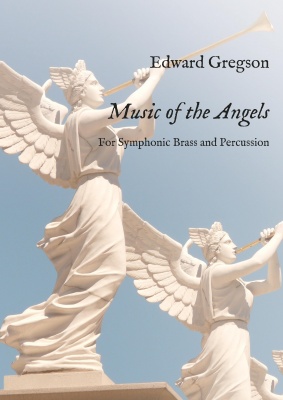
Music of the Angels (Symphonic Brass Ensemble - Score and Parts)
In 1998 Gregson was commissioned by conductor Martyn Brabbins to write a short concert opener with choir to mark his debut as Music Director of the Huddersfield Choral Society. Entitled ...and the seven trumpets... this ten minute flourish is founded on a verse from Chapter 8 of the Revelation To John (The Apocalypse), the last book in the Bible: 'and I saw the seven Angels which stood before God: and to them were given seven trumpets'. The performance employed the full power of the Huddersfield Town Hall organ and the brass section of the BBC Philharmonic, including seven trumpets and four horns placed strategically around hall.The following year, when Gregson received a commission from the Cheshire-based Foden's Brass Band (conducted at that time by Nicholas Childs) for a work to mark its centenary in 2000, he turned to the first portion of ...and the seven trumpets... as the basis for an ambitious celebratory work entitled The Trumpets of the Angels. "The opportunity to create an extended work which would break out of the brass band mould was an important milestone for me," the composer says. In 2015 he was asked by Nicholas Childs to create a new performing edition without organ for the Black Dyke Band. This received its first performance in April 2016 at the European Brass Band Festival in Lille. In 2018, Gregson revisited the music for a third time, returning the opening fanfares to orchestral brass and transforming substantial portions of the 'Black Dyke' version to create Music of the Angels, a dramatic canvas for symphonic brass and percussion.An array of bells and gongs offer an unmistakable key to the source of Gregson's inspiration. Inscribed In tribute to Olivier Messiaen, the work's principal material and its sound world, but crucially not the underlying musical processes, are influenced by Messiaen's masterpiece for wind and percussion, Et exspecto ressurectionem mortuorum (1964). Music of the Angels begins with braying of horns suggestive of the start of an ancient ritual. Six 'angel' trumpeters, set behind the ensemble, answer in sequence, with the evocative sound of tam-tams creating the Messiaen-like aura. Once the horns have reached the performing space, four of the trumpeters deliver highly contrasting fanfare cadenzas. At the climax of this episode, the individual fanfares are presented together, as if, perhaps, to reflect the Biblical writer's apocalyptic visions of hail, fire, seas of blood and the cataclysmic destruction of man and beast.This powerful vision of death and destruction gives way to a prayerful lament, re-imagining a sung Kyrie Eleison from the 'Black Dyke' edition, with flugel horn and euphonium obligati. The hushed atmosphere is broken by tenor and side drums, and trumpets five and six, which gallop away like the Horsemen of the Apocalypse. In the biblical account their steeds had 'heads like lions with fire and smoke and sulphur issuing from their mouths'.As the reverberation of a dramatic climax dies we hear the entry of the seventh trumpet, from 'on high', blazing forth with a version of the main that extends across the entire compass of the instrument - almost three octaves. Supported by a 'holy trinity' of gongs, an 'epic' final cadenza introduces new material which is further developed in a frenetic final section. This is announced by two sets of timpani, to the left and right. Braying brass (euphoniums and horns) once more adds an air of foreboding. As the music builds towards a magisterial conclusion, the Messiaen-inspired tritones of the principal motif are smoothed out into perfect 5ths and combined with the earlier material in a full-voiced chorale, over which the seventh trumpet blazes in triumph.- Programme note by Paul HindmarshScored for1 Trumpet in E flat (Trumpet 5)6 Trumpets in B flat (Trumpet 4 doubling Flugel Horn)4 Horns in F3 Tenor Trombones1 Bass TromboneEuphonium2 Tubas2 Timpani (Percussion 3 doubles Timpani 2)Percussion (3 players): 3 Tam-tams, 3 Suspended Cymbals, Bass Drum, Tenor Drum, Snare Drum, Tubular Bells.Duration: 16.00
Estimated dispatch 7-14 working days
-
£59.95
ELLACOMBE CHRONICLES, The (Brass Band Set) - James Curnow
This piece was commissioned by Brass Band of Columbus for the occasion of the band's 25th anniversary in 2009. It is dedicated to current and former members of the band and its founding Director, Dr Paul Droste. The hymns of Isaac Watts (1674 - 1748) have been a source of inspiration for musical thought and development by composers for over 200 years. His glorious hymn 'I sing the mighty power of God' has been coupled with the hymn tune 'Ellacombe' in many hymnals over these two centuries. This work was created and inspired by Isaac Watts's text and chronicles the three verses of the hymn through a set of diverse variations on the hymn tune 'Ellacombe'. The opening fanfare is intended to capture the joy and exuberance of the first phrase of the first verse, 'I sing the mighty power of God that made the mountains rise'. The developmental material following the fanfare gives a hint of the three large variations that are extracted from the tune.
Estimated dispatch 7-14 working days
-
 £45.00
The Thunderer (Brass Band - Score and Parts)
This march, one of Sousa's most popular compositions, was written in 1889 and was dedicated to the Knights Templar of Washington, D.C. Sousa had been knighted by that organization three years earlier. The origins of the name of the march are unclear and the march is noteworthy not only for Sousa's usual creative skills but also for the use, in two sections of the march, of military-style percussion and, in the last section, of featured fanfares.This arrangement was prepared for the 2009 Summer concerts of Brass Band of the Western Reserve, musical director Dr Keith M Wilkinson. The arrangement highlights the particular features mentioned above and performances will be enhanced by following the indicated staging directions.
Estimated dispatch 7-14 working days
-
 £88.00
Winter from the Four Season (Trombone Solo)
In 1723 Antonio Vivaldi (1678 - 1741) composed four concerti for violin and small orchestra entitled The Four Seasons. Winter is the fourth of these. Each concerto is comprised of three movements and paints sound pictures of the particular season. In this one we hear music describing harsh winter winds and icy snows, enough to make teeth chatter, in the first movement, a cosy scene by the fireside watching the falling rain (second movement) and the harsh winds, ice and snow return in movement 3.This arrangement was prepared at the request of Brett Baker and has been recorded by him accompanied by Brass Band Of The Western Reserve, musical director Dr Keith M Wilkinson, on the CD Slides Rule!
Estimated dispatch 7-14 working days
-
 £43.50
March (The Nutcracker Suite) (Brass Band - Score and Parts)
Tchaikovsky's extremely popular ballet, The Nutcracker, was first performed in December 1892. Earlier in the same year the composer extracted several movements from the ballet to form a concert suite. The first performance of the suite was conducted by the composer and the suite was immediately received with huge enthusiasm.This arrangement was originally made for the GUS Band while the arranger was its Music Director.
Estimated dispatch 7-14 working days
-
 £44.95
Meditation (from the Triumph of Time) (Flugel Horn and Baritone Duet with Brass Band)
Meditation is the central theme from The Triumph of Time, a work commissioned for The Black Dyke Band by Music Director Nicholas Childs. The original brief was for a piece which would showcase the talents of the band's many fine soloists, among them Zoe Hancock on Flugel horn and Baritone soloist Katrina Marzella. This extract brings both instruments together in an extended stand-alone arrangement.Although scored for Flugel and Baritone, a number of options can be explored at the discretion of the conductor (eg. Flugel/Cornet and Euphonium/Trombone; two Bb Cornets etc. in which case cued lines in the Solo Horn and Soprano cornet parts may be played).Duration: 05:00
Estimated dispatch 7-14 working days
-
 £44.00
The Liberty Bell (Brass Band - Score and Parts)
This march, written in 1893, was originally destined for inclusion in an operetta but after the composer had witnessed a spectacle called "America" in Chicago, which had as its backdrop a huge painting of the Liberty Bell, it was given the name by which it has become famous. Further recognition has come in more recent years by the adoption of the march as the signature tune for the popular TV programme, Monty Python.The arrangement includes several solos for a large unpitched bell which add aural (and visual) interest. It has been recorded by Brass Band of the Western Reserve, musical director Keith M Wilkinson, on the CD Slides Rule.
Estimated dispatch 7-14 working days
-
 £49.99
The Bandwagon (Brass Band - Score and Parts)
Band director and radio presenter Yutaka Nishida hails from Tokyo and is the Frank Renton of the Japanese brass band world. He presents a weekly two-hour music programme on the Japanese national radio station, Digital Radio Musicbird. The programme is called The Bandwagon and the station commissioned Philip Sparke to compose a march, which could be used as the theme tune. The result is this bright and breezy march in simple ABA form. A great lively item for any concert.
Estimated dispatch 7-14 working days