
Results
-
 £33.08
Margaret - Brass Band (Timothy Matthews arr.Kenneth Downie)
VIEW SCORE PDF The arranger, Kenneth Downie writes: 'This music was commissioned by Mike Griffiths, Music Director of Riviera Concert Brass, based in Torquay in Devon, England. It is developed around the hymn tune Margaret, and written in memory of the lady of that name who was a renowned supporter of, and generous donor to the band. The graceful melody was written by Timothy Matthews (1826-1910), and it is usually associated with the words of the hymn, the first verse of which says: Thou didst leave thy throne and thy kingly crown When thou camest to earth for me; But in Bethlehem's home was there found no room For thy holy nativity, O come to my heart, Lord Jesus; There is room in my heart for thee. I feel that there is a strong emotional core to this lovely tune and any performance should seek to bring out this quality, in a musical manner.' PDF download includes score and full set of parts. Sheet music available from: UK - www.brassband.co.uk USA - www.solidbrassmusic.com Difficulty Level: 4th Section + Instrumentation: Soprano Cornet Eb Solo Cornet Bb 1st Cornet Bb 2nd Cornet Bb Flugel Horn Bb Solo Horn Eb 1st Horn Eb 2nd Horn Eb 1st Baritone Bb 2nd Baritone Bb 1st Trombone Bb 2nd Trombone Bb Bass Trombone Euphonium Bb Bass Eb Bass Bb Timpani Glockenspiel Percussion
In Stock: Estimated dispatch 1-3 working days
-
 £34.95
Prelude on St. Clements - Jonathan Bates
DIFFICULTY: 3rd+. DURATION: 5'00". 'Prelude on St Clement's' was composed for the 2023 Royal Northern College of Music Brass Band Festival in memory of internationally renowned conductor and composer Bramwell Tovey. . Bramwell was the Artistic Director of the National Youth Brass Band of Great Britain throughout the composer's 7 years as a tenor horn player in the NYBBGB and the hymn tune 'St Clement's (no. 82 in the 120 Hymns for Brass Band book) was used by Bramwell to conclude every course. This setting of 3 verses of the hymn tune 'The Day Thou Gavest. was premiered by the RNCM Brass Band in January 2023.
In Stock: Estimated dispatch 1-3 working days
-
 £30.00
O.B.1. Fanfare - Tom Watson
Tom Watson was born into a musical family in Hertfordshire, England and showed a flare for playing the trumpet from the age of just 4. Taught by his father James Watson, the prolific international soloist, conductor, educator and session trumpeter, Tom studied at the Royal Academy of Music, where he gained a first class honours degree. Whilst still at college, Tom embarked on a varied professional freelance-playing career and was guest principal trumpet with the Mahler Chamber Orchestra performing under Claudio Abbado, Daniel Harding, and Sir Neville Marriner. Tom can be regularly found performing and recording with the London Symphony Orchestra, The BBC National Orchestra of Wales and many of the UK's finest orchestras. Commercially, Tom has played in sessions or concerts for artists such as Sir Elton John, Sir Paul McCartney, Sir Tom Jones, Dame Shirley Bassey, Ozzy Osbourne, Phil Collins, Eric Clapton, Joe Cocker, Jarvis Cocker, Pete Doherty, Nick Cave, Karl Jenkins and Victoria Wood. Some of his film session work has included recording the scores for Brave, Eragon and Stormbreaker. Tom also works as a musical director, arranging and conducting various projects such as Tony Christie's album Made in Sheffield and for renowned harpist Catrin Finch. Tom also runs his own independent recording and production company Pro Audio, part of Prozone Music, which Tom owns and runs alongside his brother William. The O.B.1. Fanfare was written for the Harper Ensemble, a brass ensemble comprising of Tom's contemporaries from his time at the Royal Academy of Music. It was written for the Leicester Square UK premiere of the film "Ali" starring Will Smith. Composed as a salute to Hollywood and the big screen, this fine pastiche of film scoring is an ideal fanfare and concert opener.
-
£33.00
Out of Africa - Barry, J - Barry, D
The great irony of John Barry's Academy Award-winning score for Out of Africa (which also took the Oscar as Best Picture) is that it almost never was - director Sydney Pollack had originally envisioned the film with native African music, going as far as laying the indigenous score down as he was editing. But the weight of John Barry's arguments held sway, and the composer delivered on his intent: a lush, romantic masterpiece for the ages. This romantic film is marked by its many breathtaking views of unspoiled African landscapes. John Barry's main title theme masterfully captures the moods and feels of the film. A terrific arrangement by his namesake!4th section +
In Stock: Estimated dispatch 1-3 working days
-
 £38.95
Unity Series Band Journal - Numbers 530 - 533, June 2024
530: Carol Arrangement - God rest you merry, gentlemen (Noel Jones)This swing arrangement of the traditional English carol also features references to O come, all ye faithful (C.C. 61) and Jingle Bells (C.C. 121). Play with imagination and a sense of style!531: Go, tell it on the mountain! (Nathanael Watchorn)Historically, the passion of enslaved people in America for singing about the Gospel of Jesus is well documented, but it was men of three generations, each named John Wesley Work, who enabled spirituals to become more widely known. John Wesley Work Sr, a church choir director in Nashville, Tennessee, wrote and arranged music for the pioneering Fisk Jubilee Singers whose early repertoire consisted largely of spirituals. This passion and knowledge of spirituals was passed down through the generations. John Work III travelled hundreds of miles to collect songs by attending church services in remote areas. In 1940, he published a collection of 230 songs which included a setting of Go, tell it on the mountain! that is still performed today.Nathanael Watchorn, a Bandsman at Regent Hall Corps in London, is a new contributor to the journals. He originally wrote this as a vocal arrangement for the group FourHymn, subsequently transcribing it for the corps' Young People's Band, while he was Band Leader.532: Carol Arrangement - They all were looking for a king (Stephen Hull)At the North American Composers Forum, Major Len Ballantine challenged participants to find an unfamiliar song in the Salvation Army Song Book and try to write an arrangement of the listed tune. Stephen Hull happened across They all were looking for a king (S.A.S.B. 128) and the tune Childhood (T.B. 421) which lead to this arrangement.533: March - Washed and healed (Eiliv Herikstad)The Christian experience of many people will have been positively impacted by the life of the late Bandmaster Eiliv Herikstad, either personally or through his musical leadership and compositions. This march is the second publication from this well-known Salvation Army composer since his Promotion to Glory last year. This march is more traditional in style that many of his compositions but contains a strong Christian message and demonstrates his compositional expertise.
Estimated dispatch 7-14 working days
-
 £50.00
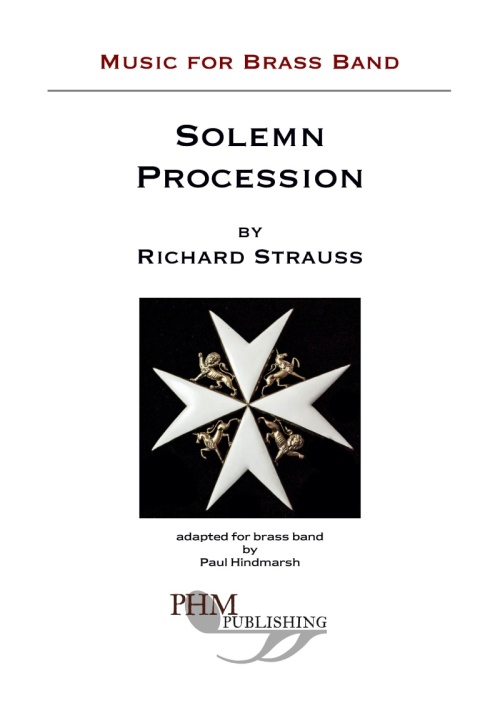
Solemn Procession (Brass Band - Score and Parts)
Richard Strauss (1864 - 1949) was a famous conductor and composer when he wrote Feierlicher Einzug der Ritter des Johanniter-Ordens (Solemn Entrance of the Knights of the Order of Saint John) in 1909. One of only a handful of his works written exclusively for winds, Strauss composed Feierlicher Einzug for the investiture ceremonies of the Order of St. John, a Christian military order that was founded in Jerusalem in 1023 to care for poor, sick, or injured pilgrims journeying to the Holy Land.Strauss scored Feierlicher Einzug (TrV 224) for a large ensemble of fifteen trumpets, four horns, four trombones, two tubas and timpani. He saw enough potential in its stately character and majestic conclusion to produce a version for symphony orchestra with organ and it has been arranged for a variety of brass ensembles with or without organ since then.This version for British style brass band was adapted from the original in 1990 by Paul Hindmarsh for the exclusive use of Besses o' th' Barn Band, of which he was then the musical director. Now that the music of Richard Strauss published in his lifetime is in the public domain, Solemn Procession, as it has been rendered in English, can be enjoyed by all brass bands and their audiences.- Paul HindmarshDuration: 6.00
Estimated dispatch 7-14 working days
-
 £50.00
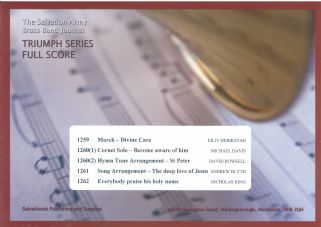
Triumph Series Band Journal March 2015 Numbers 1259 - 1262
No. 1259 March - Divine Care (Eiliv Herikstad)The message of this march is 'God will take care of you!' The introduction reflects the beginning of the song, God will take care of you (T.B.C.S. 124), which is presented in full at sections C and D.No. 1260 (1) Cornet Solo - Become aware of him (Michael Davis)A setting for Cornet and band of Colonel Robert Redhead's song, Become aware of him, which was originally published in The Musical Salvationist.No. 1260 (2) Hymn Tune Arrangement - St Peter (David Rowsell)An arrangement of the tune, St Peter, associated with the song, In Christ there is no east or west.No. 1261 Song Arrangement - The deep love of Jesus (Andrew Blyth)The strong hymn tune of Ebenezer (T.B. 433) was composed by Welshman, Thomas John Williams (1869-1944), who served as organist and choir director at various churches in and around Llanelli. This arrangement is more relaxed in style than the original and attempts to convey the freedom of the verses mostly associated witht he tune by Samuel T. Francis (1835-1925) O deep, deep love of Jesus, vast, unmeasured, boundless, free.No. 1262 Everybody praise his holy name (Nicholas King)A bright arrangement by Nicholas King of Remco Hakkert's song, Praise his holy name.
Estimated dispatch 7-14 working days
-
 £38.95
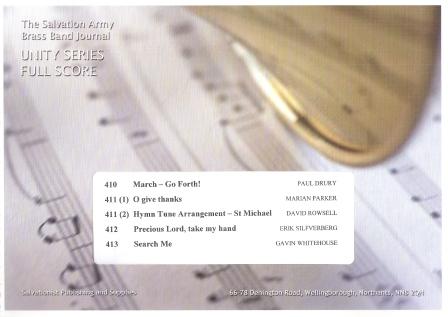
Unity Series Band Journal October 2013 Numbers 410 - 413
No. 410 March - Go Forth! (Paul Drury)This march was written as a tribute to Bandmaster Jack Spowart and the Bo'ness Salvation Army Band. The composer lives in the twon of Bo'ness and has had numerous opportunities to share with the band and the wider corps at various events. This march serves as recognition of the faithful service given in the Lord's name in the town by The Salvation Army for over 100 years. Two tunes are featured, both well-known and instantly recognisable, namely, Forward! be our watchword and We're marching on.No.411 (1) O give thanks (Marian Parker)The composer, Marian Parker, is a new contributor and is the Recruiting Sergeant at Leicester South Corps. This simple, yet rhythmic piece should not pose any technical problems for most bands and features the attractive arrangement of Joanne Pond's contemporary song, 'O give thanks'.No.411 (2) Hymn Tune Arrangement - St Michael (David Rowsell)The hymn tune 'St Michael' was composed in 1551 by French composer Louis Bourgeois and the composer provides a very useful arrangement of this historic hymn.No. 412 Precious Lord, take my hand (Erik Silfverberg O.F.)This well-known Gospel Song is a favourite of many. It has been recorded by many great artists, including Rosetta Tharpe, Elvis Presley and Aretha Franklin. The words were written by Reverend Thomas A. Dorsey, who is often known as the 'Father of Gospel song'.No. 413 Search Me (Gavin Whitehouse)The second new contributor to this journal is Gavin Whitehouse. gavin is the Assistant Music Director for the Greater New York Division and is also the USA Eastern Territorial Songster Leader. This piece combines two songs - one old and one new - which speak of a God who knows us intimately. 'Search me, O God and know my heart today' (associated with the beautiful Maori melody, 'Now is the hour') is woven with a contemporary setting of Psalm 139 by Rebecca St James, the first line of which says, 'You searchme, you know me'.
Estimated dispatch 7-14 working days
-
 £40.00
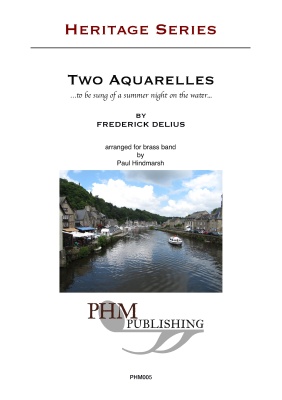
Two Aquarelles (Euphonium Feature with Brass Band - Score and Parts)
In the late spring of 1917, the Bradford born composer, Frederick Delius (1856 - 1934) composed two short part-songs at his home in Grez-sur-Loing. The river ran along the bottom of his garden and he called the two miniatures To be sung of a summer night on the water. The First World War was at its height, but one would never guess that from the languid and serene quality of these richly textured nocturnes. The songs were first heard in London on 28 June, sung by the Oriana Madrigal Society, conducted by Charles Kennedy Scott. In 1932 Delius's amanuensis, Eric Fenby, arranged them for string orchestra as Two Aquarelles. While I have taken Fenby's title, my arrangement is a note-for-note transcription of the choral original. It was prepared in early in 1993 for Besses o' th' Barn Band, of which I was Musical Director at the time. In the second song, the prominent tenor solo has been given to the solo euphonium, who should stand apart from the band in performance.- Paul HindmarshDuration: 5.00
Estimated dispatch 7-14 working days
-
 £39.00
El Capitan (Brass Band - Score and Parts)
El Capitan was originally an operetta which was first produced in Boston in 1896. It was initially very popular and there are occasional revivals even to this day. The march of the same title uses themes from the opera and was also published in 1896. One notable feature - resulting from the use of themes from the operetta - is the abrupt transition from 6/8 to 2/4 half way through the march.This arrangement was prepared for the 2013 Summer concerts of Brass Band of the Western Reserve, musical director Dr Keith M Wilkinson.
Estimated dispatch 7-14 working days
 Watch video
 View Music