
Results
-
 £33.62
For unto us a child is born from 'Messiah'(Brass Band) Handel arr. Kevin Norbury
Ever since the first performance in April 1742 in Dublin, Ireland, Messiah has been the iconic Christian oratorio. It is a work of genius with lyrics skillfully taken from the Bible by Charles Jennens and timeless music by G. F. Handel, and has been at the top of the Western musical canon for close to 300 years. For unto us a child is born comes roughly halfway through Part One of the oratorio and is one of its most popular choruses, being the prophecy of the birth of a Messiah (Jesus) found in Isaiah chapter nine. This excellent setting for brass band is by Kevin Norbury. To view a rolling score video of the work please visit https://www.youtube.com/watch?v=G63Tzi3L07U Duration: Approx. 4.00 minutes Difficulty Level: 2nd Section + PDF download includes parts and score. Sheet music available from www.brassband.co.uk Instrumentation: Soprano Cornet Eb Solo Cornet Bb Repiano Cornet Bb 2nd Cornet Bb 3rd Cornet Bb Flugel Horn Bb Solo Horn Eb 1st Horn Eb 2nd Horn Eb 1st Baritone Bb 2nd Baritone Bb 1st Trombone Bb 2nd Trombone Bb Bass Trombone Euphonium Bb Bass Eb Bass BbTimpani Snare Glockenspiel
In Stock: Estimated dispatch 1-3 working days
-
 £37.35
Great is Thy Faithfulness (Brass Band) Runyan arr. Dan Forrest trs. Wainwright
This marvelous setting by Dan Forrest of the classic hymn Great is thy Faithfulness has quickly become a popular item for choirs around the world. This setting for brass band by English composer Andrew Wainwright was commissioned by the Melbourne Staff Band to commemorate Bandmaster Ken Waterworth's final year as Bandmaster before his retirement. It begins with quiet assurance, a beautiful combination of strength and gentleness which continues to build to a dramatic final statement of truth. For bands looking to combine with a choir, this setting is in the same key and format as the original choral version. To view a rolling score video of Melbourne Staff Band performing the piece please visit www.youtube.com/watch?v=bPtXdxaEPHc Duration: Approx. 5.30 minutes Difficulty Level: 3rd Section + PDF download includes parts and score. Sheet music available from www.brassband.co.uk (UK) or https://satradecentral.org (USA) Instrumentation: Soprano Cornet Eb Solo Cornet Bb Repiano Cornet Bb 2nd Cornet Bb 3rd Cornet Bb Flugel Horn Bb Solo Horn Eb 1st Horn Eb 2nd Horn Eb 1st Baritone Bb 2nd Baritone Bb 1st Trombone Bb 2nd Trombone Bb Bass Trombone Euphonium Bb Bass Eb Bass BbTimpani Percussion 1-2
In Stock: Estimated dispatch 1-3 working days
-
 £33.62
Je te veux (Brass Band) Satie arr. Rob Bushnell
Je te veux, or I Want You, is a valse chantee (sung waltz) by the French composer Erik Satie, with lyrics by Henry Pacory. It was written for Paulette Darty, who first sang it in 1903 at La Scala, Paris, with Satie accompanying. There are various versions that Satie produced, the original for piano and voice, a version for brass 'orchestra', for full orchestra (where a trio section was added), and a version for solo piano (but including the new trio section). This arrangement is for the UK-style brass band, with alternative parts for horns in F and bass-clef lower brass, and is of the longer version (with the trio section). As a result, it lends itself to being performed in a various of ways, with the ensemble has the option of selecting the part of it compound ternary form to play: (A-B-A)(C-D-C)(A-B-A). A recording of the original composition can be found here: www.youtube.com/watch?v=FA3JJdmwJU8 Difficulty Level: 4th Section + Duration: 4 or 5 minutes (depending on tempo and without any cuts) PDF download includes parts and score. Sheet music available at www.brassband.co.uk (UK) or https://satradecentral.org (USA) Instrumentation: Soprano Cornet Eb Solo Cornet Bb Repiano Cornet Bb 2nd Cornet Bb 3rd Cornet Bb Flugel Horn Bb Solo Horn Eb 1st Horn Eb 2nd Horn Eb 1st Baritone Bb 2nd Baritone Bb 1st Trombone Bb 2nd Trombone Bb Bass Trombone Euphonium Bb Bass Eb Bass Bb Timpani Drum Kit Auxiliary Percussion (Glockenspiel, Cymbal & Triangle)
In Stock: Estimated dispatch 1-3 working days
-
 £14.94
Jingle Boogie-Woogie Bells (Brass Band - Ukraine Charity Release) Ovcharenko
This piece was arranged by Halyna Ovcharenko, a Ukrainian composer who was born in Lugansk, a Ukrainian city that is currently under occupation by the Russian Federation. All the proceeds from this sale will go towards the 'A family for every orphan' appeal, which is providing emergency relief services to thousands of children and families in Ukraine. For more information about the charity please visit https://afamilyforeveryorphan.org/ukraine/ Halyna Ovcharenko has been composing music since she was 11. Many of her compositions of various genres have received international awards, but she discovered the world of brass band music with its specific timbre and huge range of musical colors only recently, in 2022, while composing her Vyshyvanka for Grimethorpe Colliery Band. Halyna comments: "I enjoyed my experience. Since then I have had an appetite to write more for brass bands, and here we are - an arrangement of a traditional English Christmas song which I have done especially to raise money for Ukrainian orphans. Their heroic parents stood for my Lugansk, for our Ukraine and for the whole World. I hope that the World will make these children feel that they are not left alone, giving them love, care and joy." The picture on the front cover was drawn by Victoria Lebed, a Ukrainian girl. This PDF download includes parts and score. Sheet music available from www.brassband.co.uk Instrumentation: Soprano Cornet Eb Solo Cornet Bb Repiano Cornet Bb 2nd Cornet Bb 3rd Cornet Bb Flugel Horn Bb Solo Horn Eb 1st Horn Eb 2nd Horn Eb 1st Baritone Bb 2nd Baritone Bb 1st Trombone Bb 2nd Trombone Bb Bass Trombone Euphonium Bb Bass Eb Bass Bb Percussion 1-2
In Stock: Estimated dispatch 1-3 working days
-
 £29.88
March - His Royal Banner (Brass Band) Jonathan Mead
This upbeat, foot-tapping march by Welsh composer Jonathan Mead features the two well known Welsh tunes of Aberystwyth and God Bless The Prince of Wales. Aberystwyth is set as a big bold bass solo and careful attention will need to be paid to make sure that it sounds clean and together. God Bless The Prince of Wales first appears as a traditional hymn tune, before returning in a more vibrant, lively style, with florid scalic passages for the solo cornets and euphoniums. The march was written with St David's Day in mind, although will be an appropriate addition to concert programme throughout the year as either an opener or finisher. Difficulty Level: 3rd Section + Sheet music available from: UK - www.brassband.co.uk USA - www.solidbrassmusic.com Instrumentation: Soprano Cornet Eb Solo Cornet Bb Repiano Cornet Bb 2nd Cornet Bb 3rd Cornet Bb Flugel Horn Bb Solo Horn Eb 1st Horn Eb 2nd Horn Eb 1st Baritone Bb 2nd Baritone Bb 1st Trombone Bb 2nd Trombone Bb Bass Trombone Euphonium Bb Bass Eb Bass Bb Percussion Clash Cymbals Glockenspiel
In Stock: Estimated dispatch 1-3 working days
-
 £33.62
Men of Harlech (Brass Band) Welsh Traditional arr. Alex McGee
This contemporary take by Alex McGee on the Welsh folk song Men of Harlech will be an entertaining addition to concert programmes. The arranger writes: 'Men of Harlech is perhaps one of the most well known of all traditional Welsh folk songs, but not like this. This setting was inspired by a composer who I first encountered as a 14-year-old playing in his first regional brass band, Gareth Wood. Upon learning of the death of Gareth I felt compelled to honour his memory and his music in composition. I struck upon the idea to do what he had done to the tune Sosban Fach to Men of Harlech, to take the tune as the raw material and try to craft it into something new yet recognisable, modern yet accessible. The work attempts to highlight what for me are the underlying characteristics of we Welsh; prone to melancholy but quick to find joy, contradictory, inviting, welcoming and warm but capable of housing a fierce streak of nationalistic pride. I dedicate this work to Gareth Wood and thank him for his music.' To view a rolling score video of the work please visit: https://www.youtube.com/watch?v=YSoZnpnhEjQ Duration: 3.30 minutes Difficulty Level: 3rd Section + PDF download includes parts and score. Sheet music available from www.brassband.co.uk Instrumentation: Soprano Cornet Eb Solo Cornet Bb Repiano Cornet Bb 2nd Cornet Bb 3rd Cornet Bb Flugel Horn Bb Solo Horn Eb 1st Horn Eb 2nd Horn Eb 1st Baritone Bb 2nd Baritone Bb 1st Trombone Bb 2nd Trombone Bb Bass Trombone Euphonium Bb Bass Eb Bass BbTimpani Percussion 1-2
In Stock: Estimated dispatch 1-3 working days
-
 £33.62
Menuet (Brass Band) Ravel arr. Rob Bushnell
Le Tombeau de Couperin (The Grave of Couperin) was written by Maurice Ravel between 1914 and 1917, originally a suite of piece for solo piano. Based on what was considered a traditional Baroque suite, Ravel wanted to pay homage to Baroque French keyboard music, whilst retaining his 20th-century chromaticism, making the work neoclassicist. Each movement is dedicated to the memory of a friend of the composer who died fighting in World War I. Ravel produced an orchestral version in 1919, omitting two of the original six movements. The Menuet was written in memory of Jean Dreyfus; Ravel had recuperated at his home. This arrangement is for the British-style brass band, with alternative parts for horns in F and bass-clef lower brass. A recording of the original composition can be found here: www.youtube.com/watch?v=jnNwEcBTSmk. Duration: Approx. 4 minutes Difficulty Level: 2nd Section + Duration: 4 minutes (depending on tempo and without any cuts) PDF download includes parts and score. Sheet music available at www.brassband.co.uk (UK) or https://satradecentral.org (USA) Instrumentation: Soprano Cornet Eb Solo Cornet Bb Repiano Cornet Bb 2nd Cornet Bb 3rd Cornet Bb Flugel Horn Bb Solo Horn Eb 1st Horn Eb 2nd Horn Eb 1st Baritone Bb 2nd Baritone Bb 1st Trombone Bb 2nd Trombone Bb Bass Trombone Euphonium Bb Bass Eb Bass Bb Timpani Percussion - Vibraphone & Glockenspiel
In Stock: Estimated dispatch 1-3 working days
-
 £74.72
Mind Dances (Brass Band) Fendall Hill
This highly descriptive and personal work for brass band is autobiographical, and based on a seven-year period of the composer Fendall Hill's life. He comments: "...external events had severe personal consequences, and my previously self assured self woke in the early mornings, way before my body wanted. My mind would fret, regret, and attempt to fix things beyond my control or powers, carving out an anxiety-shaped hole in my soul. This piece is an exploration of the sheer range of thought processes I went through, the mind dances I would perform to either calm myself back to sleep, or somehow come to terms with my situation. So often I would get to the point of mental exhaustion after phases of semi-calm, imagined alternate realities, and sheer panic. Your mind knows there is no benefit to worrying, but that doesn't stop the flow of emotions, the fear, and the anxiety." To view a performance video of the work please visit www.youtube.com/watch?v=pUhy33KKCKY&t=3s PDF download includes score and parts. Sheet music available from: UK - www.brassband.co.uk USA - https://satradecentral.org Difficulty Level: First Section + Length: 15.00 minutes Instrumentation: Soprano Cornet Eb Solo Cornet Bb Repiano Cornet Bb 2nd Cornet Bb 3rd Cornet Bb Flugel Horn Bb Solo Horn Eb 1st Horn Eb 2nd Horn Eb 1st Baritone Bb 2nd Baritone Bb 1st Trombone Bb 2nd Trombone Bb Bass Trombone Euphonium Bb Bass Eb Bass Bb Timpani Percussion Vibraphone Marimba
In Stock: Estimated dispatch 1-3 working days
-
 £33.62
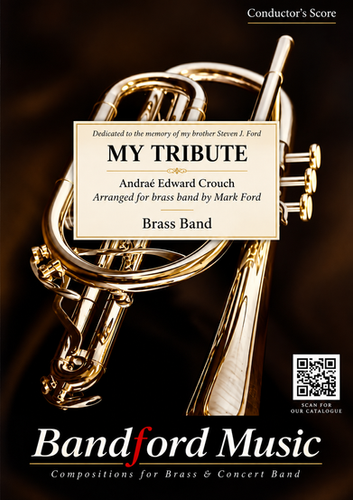
My Tribute (Euphonium Solo with Brass Band) Andrae Crouch arr. Mark Ford
My Tribute (To God Be The Glory) is a gospel song written by American gospel singer and songwriter Andrae Edward Crouch. He first recorded the song in 1972 on his album Keep on Singin'. The song is considered to be one of Crouch's most well-known songs. It is sometimes included in Christian children's song books. This arrangement for brass band from the pen of Mark Ford, features the euphonium as the soloist in a delightful setting sure to be popular with audiences. To view a performance video of the solo featuring Aaron Ford please visit https://youtu.be/6WGtAVgAsWc Duration: 1.30 minutes Difficulty Level: 3rd Section + This PDF download includes the full score and parts. Sheet music available at www.brassband.co.uk (UK) or https://satradecentral.org (USA) Instrumentation: Euphonium Soloist Bb Soprano Cornet Eb Solo Cornet Bb Repiano Cornet Bb 2nd Cornet Bb 3rd Cornet Bb Flugel Horn Bb Solo Horn Eb 1st Horn Eb 2nd Horn Eb 1st Baritone Bb 2nd Baritone Bb 1st Trombone Bb 2nd Trombone Bb Bass Trombone Euphonium Bb Bass Eb Bass Bb Drum Set Percussion
In Stock: Estimated dispatch 1-3 working days
-
 £33.62
Novus Vitae (Euphonium Solo with Brass Band) Darren Bartlett
Written for the dedication (Christening) of the composer's two young nephews (Jake and Oliver) to celebrate their birth, this beautiful euphonium solo gives thanks for their safe arrival. Darren Bartlett writes: 'A beautiful melody transpired out of the love we all feel for our families and those who have a faith in God... At the key change the listener needs to feel the excitement and anticipation of new life and long to be a part of the celebration.' To view a video of Anthony Smith performing the version with piano accompaniment version please visit www.youtube.com/watch?v=kM9bUys27OM Sheet music available from: UK - www.brassband.co.uk USA - www.solidbrassmusic.com Difficulty Level: Third Section + Instrumentation: Euphonium Soloist Bb Soprano Cornet Eb Solo Cornet Bb Repiano Cornet Bb 2nd Cornet Bb 3rd Cornet Bb Flugel Horn Bb Solo Horn Eb 1st Horn Eb 2nd Horn Eb 1st Baritone Bb 2nd Baritone Bb 1st Trombone Bb 2nd Trombone Bb Bass Trombone 2nd Euphonium Bb Bass Eb Bass Bb Timpani Drum Kit Tuned Percussion
In Stock: Estimated dispatch 1-3 working days
 Watch video