
Results
-
 £37.95
Connotations (Brass Band - Score only) - Gregson, Edward
Connotations was commissioned for the 1977 National Brass Band Championship finals, held in the Royal Albert Hall, London (the winner, incidentally, of that particular competition was the famous Black Dyke Mills Band).At the age of 32 Gregson was the youngest composer to have received the honour of such a commission. It came at the end of a productive five years writing for the brass band publisher R Smith. Some of those works - The Plantagenets, Essay and Patterns for example, with their direct and tuneful style, have remained popular with brass bands the world over.For Gregson, these were the means by which he sharpened the tools of his trade, preparing the ground, as it were, for his finest work to date - Connotations. He thought of calling the piece Variations on a Fourth, but with due deference to Gilbert Vinter perhaps (Variations on a Ninth), he chose a more appropriate one. As Gregson has written, 'Connotations suggests more than one way of looking at something, an idea, and this is exactly what the piece is about'.Writing a competition piece brought its own problems. 'It has to be technically difficult and yet musically satisfying. I didn't like being kept to an eleven-minute maximum. The inclusion of short cadenzas for less usual solo instruments seems to signify a certain test-piece mentality'.Gregson solved the problems admirably by adopting a symphonic approach to variation form: Introduction - fanfares, a call to attention, in effect Variation 1; Theme - a six-note motif, given a lyrical and restrained first statement; Variation 2 - a delicate toccata; Variation 3 - typically robust in melody and rhythm; Variation 4 - lyrical solos; Variation 5 - a scherzo; Variation 6 - cadenzas; Variations 7-9 - an introduction, fugato and resounding restatement of the theme.Duration: 10.30
Estimated dispatch 7-14 working days
-
£74.95
Connotations (Brass Band - Score and Parts) - Gregson, Edward
Connotations was commissioned for the 1977 National Brass Band Championship finals, held in the Royal Albert Hall, London (the winner, incidentally, of that particular competition was the famous Black Dyke Mills Band).At the age of 32 Gregson was the youngest composer to have received the honour of such a commission. It came at the end of a productive five years writing for the brass band publisher R Smith. Some of those works - The Plantagenets, Essay and Patterns for example, with their direct and tuneful style, have remained popular with brass bands the world over.For Gregson, these were the means by which he sharpened the tools of his trade, preparing the ground, as it were, for his finest work to date - Connotations. He thought of calling the piece Variations on a Fourth, but with due deference to Gilbert Vinter perhaps (Variations on a Ninth), he chose a more appropriate one. As Gregson has written, 'Connotations suggests more than one way of looking at something, an idea, and this is exactly what the piece is about'.Writing a competition piece brought its own problems. 'It has to be technically difficult and yet musically satisfying. I didn't like being kept to an eleven-minute maximum. The inclusion of short cadenzas for less usual solo instruments seems to signify a certain test-piece mentality'.Gregson solved the problems admirably by adopting a symphonic approach to variation form: Introduction - fanfares, a call to attention, in effect Variation 1; Theme - a six-note motif, given a lyrical and restrained first statement; Variation 2 - a delicate toccata; Variation 3 - typically robust in melody and rhythm; Variation 4 - lyrical solos; Variation 5 - a scherzo; Variation 6 - cadenzas; Variations 7-9 - an introduction, fugato and resounding restatement of the theme.Duration: 10.30
Estimated dispatch 7-14 working days
-
 £55.00
EPISODES FOR BRASS (Brass Band - Score and Parts) - Churcher, Gareth
Despite the title's inference, the work's form is not episodic, but more a depiction of various episodes in the life of the composer, who penned it for his wedding to capture the excitement and majesty of the day. The piece is in three movements: Fanfare and Bells of Celebration, Solenne (dedicated to the late Shaun Thomas), and Finale, which starts with a wake-up call, followed by a fanfare for cornets and trombones.
Estimated dispatch 7-14 working days
-
£25.00
EPISODES FOR BRASS (Brass Band - Score only) - Churcher, Gareth
Despite the title's inference, the work's form is not episodic, but more a depiction of various episodes in the life of the composer, who penned it for his wedding to capture the excitement and majesty of the day. The piece is in three movements: Fanfare and Bells of Celebration, Solenne (dedicated to the late Shaun Thomas), and Finale, which starts with a wake-up call, followed by a fanfare for cornets and trombones.
Estimated dispatch 7-14 working days
-
 £44.95
Whirlwind (Cornet Solo with Brass Band - Score and Parts) - Graham, Peter
An exciting cornet display piece, recorded by Roger Webster on Call of the Cossacks.
Estimated dispatch 7-14 working days
-
 £38.95
Unity Series Band Journal - Numbers 542 - 545, June 2025
542: Exalted (Daniel Elson)An up-beat arrangement of the worship chorus Hosanna in the highest (S.A.S.B. 366). The piece features a relaxed, flowing style with syncopated rhythms and dynamic contrasts.543: Angels Rock (Samuel Shelley) This rhythmic arrangement references Hark! the herald angels sing (C.C. 38) and provides an easily accessible, modern arrangement of a well-known carol.544: Carol Arrangement - Little Jesus, sweetly sleep (David Wright)A beautiful two-verse setting of The rocking carol, originally published in 1920, which is known for its gentle, understated style with an emphasis on balance and intonation.545: We shall come rejoicing (Andrew Mackereth) A straightforward medley of harvest favourites, featuring dynamic contrasts, call and response figures, and a nostalgic reference, with a focus on harmonic consistency.
Estimated dispatch 7-14 working days
-
 £29.95
Judd: Come and get Saved
This fantasia is based on the old Salvation Army song, 'Never can tell' which includes the words, 'You never can tell when the Lord will call you...Come and get saved and happy be'. The piece has many different and contrasting moods but is generally light-hearted and amiable like the straightforward message of the song and its genial melody.
Estimated dispatch 7-14 working days
-
 £14.95
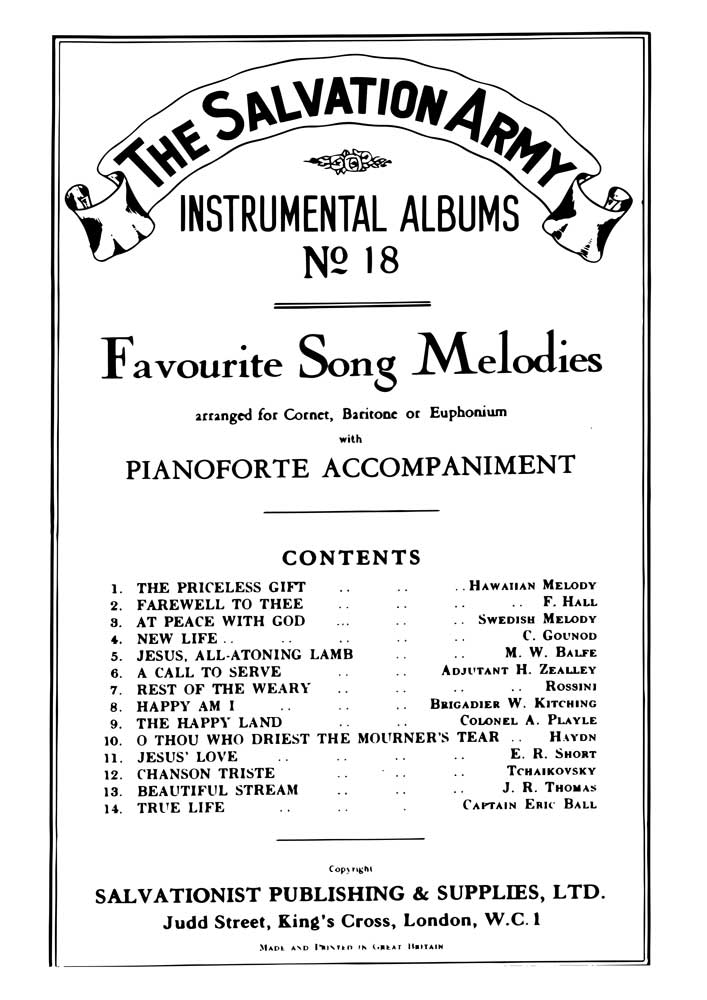
Instrumental Album No.18 - Favourite Song Melodies
Includes: The Priceless gift; Farewell to thee; At peace with God; New Life; Jesus, all-atoning lamb; A Call to serve; Rest of the weary; Happy am I; The Happy Land; O thou who driest the mourner's tear; Jesus' Love; Chanson Triste; Beautiful Stream; True LifeInstrumentation: Cornet, Baritone or Euphonium with Piano Accompaniment
Estimated dispatch 7-14 working days
-
 £39.95
Black and White Minstrel Medley No.2
Includes: Give My Regards to Broadway; If You Were the Only Girl in the World;When the Midnight Choo-Choo Leaves for Alabam; Le Me Call You Sweetheart; Everybody's Doing It Now; Moonlight Bay; California, Here I Come.
Estimated dispatch 7-14 working days
-
 £119.50
Me and Mrs. Jones - Kenneth Gamble - David Hveem
Me and Mrs. Jones was written by Kenny Gamble, Leon Huff and Cary Gilbert in 1972, and was first recorded by Billy Paul on the album 360 Degrees of Billy Paul. The song is about a man who has an affair with Mrs. Jones, and how the two secretly meet every day in the same cafe, even though they may know it's not quite right: "We got a thing going on/we both know that it's wrong/but it's much too strong/to let it go now." Paul has stated that he was sure the song was going to be a hit even before it was released, as "it's a song everyone can relate to", but already from the start the lyrics were considered somewhat controversial and the song were banned from several radio stations. Nevertheless, it became one of the best-selling singles of 1972 and Paul received a Grammy for Best Male R&B Vocal Performance.Well known is also Michael Buble's version of the song, released on the album Call Me Irresponsible in 2007. It is his version that has been the inspiration for this arrangement, which brings out even more of the jazz elements Buble has found in the song. The arrangement is quite demanding for the ensemble, and requires great rhythmic precision in particular.
Estimated dispatch 5-14 working days
 View Music