
Results
-
£132.00
Celebration for Band - John Brakstad
Many Norwegian bands have grown up around factories; but Norwegian factories are often located in the countrysides - by a fjord or lake, by a river or waterfall that provided power for the factory.The factory was the foundation for the existence of the community, but it was also essential for the community's cultural life; choirs, bands etc. (cp. British brass bands and mining)."Celebration for band" tries to give a picture of the environment and life around a band like this, with both factory noise and the natural world (Pastorale), as well as the challenges and development of the band itself.The composition is built up of five connected episodes:- Fanfare and Prologue (concludes with a feeling of the untamed power of the river) - Pastorale I: " At the river"- Intermezzo: " The Factory" (starts with the opening of water for the turbines: snare drum. Factory whistle and bell call to work, and the spinning and weaving machinery starts up.)- Pastorale II: " Summer evening on the fjord." - Finale: " Challenge and Progress"
Estimated dispatch 7-14 working days
-
Zat You, Santa Claus - Jack Fox - Len Jenkins
The Christmas song 'Zat You Santa Claus was written by Jack Fox and was first recorded and released by Louis Armstrong and The Commanders in 1953 by Decca Records. The studio orchestra was under the direction of Toots Camarata (who also made the big band arrangement) and Garth Brooks interpreted the song in the feature film "Nenn' mich einfach Nikolaus" (Just call me Nicholas) in 2001. More recently, the song was featured in the film Dr Seuss' "The Grinch" (2018) and sung by Buster Poindexter. This arrangement features the Bass Trombone.
-
 £44.95
COSSACK WEDDING DANCE - Peter Graham
The finale from Call of the Cossacks (see above).Available MultiMedia Files
Published Closed for Holidays. Est dispatch 13th Nov
-
£44.95
DOYLE'S LAMENT - Peter Graham
Solo for Flugel Horn (or Cornet Bb); 4th Movement from Call of theCossacks.
Published Closed for Holidays. Est dispatch 13th Nov
-
£44.95
WHIRLWIND - Peter Graham
An exciting cornet display piece, recorded by Roger Webster onCall of the Cossacks.
Published Closed for Holidays. Est dispatch 13th Nov
-
£37.50
Triumphalis - Ed Keeley
Triumphalis is a celebration that honours victory - a musical epitaph that reflects on the horrors and sacrifices of WWII. The BBC began prefixing its transmissions to the European Mainland with V for Victory in Morse Code (3 dots and a dash) in 1941, this motif corresponds to the famous opening of Beethoven's 5th Symphony on the timpani - becoming a symbol of resistance and hope. The music continues with a quasi bugle call, followed by a victory fanfare. Then, the music meanders through both major and minor keys symbolising victories and defeats, joy and sorrow, finally culminating in a joyous and flourishing celebration.
In Stock: Estimated dispatch 1-3 working days
-
 £37.50
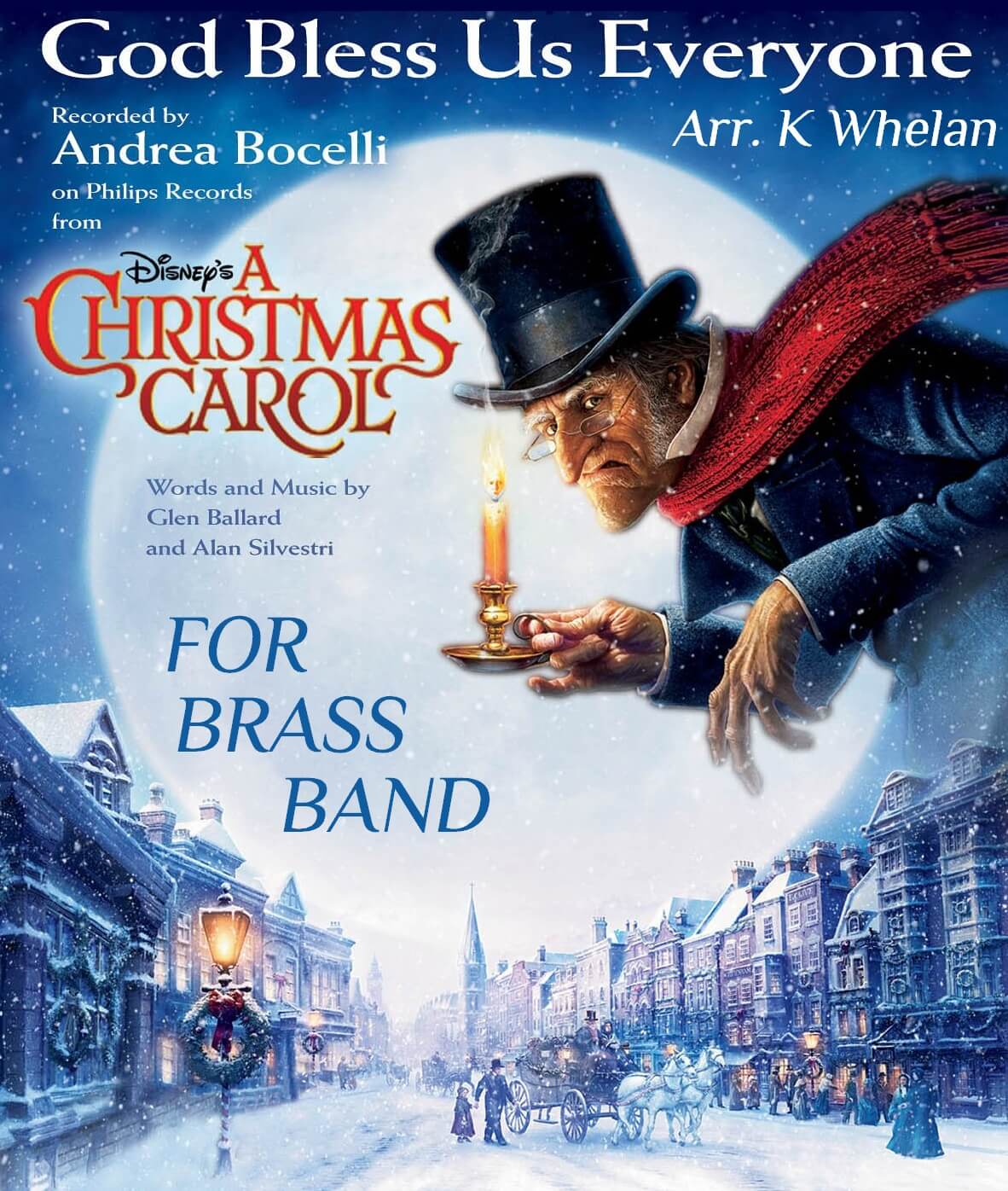
God Bless Us Everyone - Alan Silvestri - Karl Whelan
From Disney's hit movie A Christmas Carol comes the compelling theme song that will fill every heart with the holiday spirit. This inspiring message of peace and goodwill is a holiday call to kindness, and the festive orchestration is the icing on the cookies. Arranged by Karl Whelan, this new festive release is accessible to all bands and something familiar yet original for your Christmas concerts this year.
In Stock: Estimated dispatch 1-3 working days
-
 £42.95
Evening Hymn and Sunset (Brass Band - Score and Parts) - Wiffin, Rob
The bugle call Sunset has, over the years, been combined with a number of tunes but The Day Thou Gavest, Lord, is Ended is the most usual combination with it.The words of John Ellerton's hymn are associated with the tune St Clement - generally credited to the Reverend Clement Cotteril Scholefield.The band accompaniment to Sunset is generally associated with the band arrangement by one Captain Green (1888-1974), but the arranger has taken the opportunity to give a slightly new look at the accompaniment to the trumpet call.Duration: 3.15
Estimated dispatch 7-14 working days
-
 £95.00
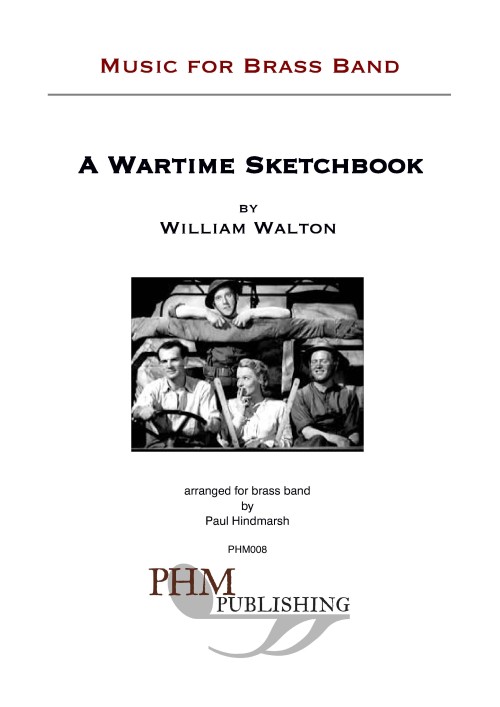
A Wartime Sketchbook (Brass Band - Score and Parts) - Walton, William - Hindmarsh, Paul
Early in 1941 William Walton, 39, received his call-up papers. He was by then one of the most eminent of British composers and was exempted from military service on condition that he provided music for films deemed to be of 'national importance'. Scoring Lawrence Olivier's Shakespeare epic Henry V in 1943 was the most substantial of these wartime projects. His role in patriotic films from 1941 and 42 like The Foreman went to France, Next of Kin, Went the day Well and The First of the Few was to provide appropriate title music and some underscoring at key moments. Walton extracted the most substantial portions of the latter as the popular Spitfire Prelude and Fugue for orchestra. The remaining music remained unpublished until 1990, when Christopher Palmer assembled the highlights into A Wartime Sketchbook. I was intrigued to hear these examples of Walton's wartime music and having discovered that they would fit naturally and idiomatically onto the brass band, I arranged six of the numbers into a suite for Besses o' th' Barn Band, which I was conducting at the time.In 1995 the brass band suite was recorded by the famous Black Dyke Mills Band as part of an all Walton album which I produced for the ASV label (ASV CD WHL 2093). This award- winning CD also included Walton's First Shoot, in the edition by Elgar Howarth, my transcription of movements from Music for Children and two substantial brass versions by Edward Watson of the suite from Henry V (with narrator) and the March and Siegfried Music from The Battle of Britain music.Prologue: This is the stirring title music from Went the day Well, a screen play by Graham Greene about a German airborne invasion of an English village. The main theme leads toBicycle Chase: Characteristic musical high-jinks for J.B.Priestley's The Foreman went to France.Refugees: From the same film, this is a poignant accompaniment to the long march of refugees. As Ernest Irving, the film's musical director, put it, "this really makes your feet sore and your knees sag."Young Siegfrieds: This lively movement comes from the music that Walton composed for The Battle of Britain in 1968, with the assistance of Malcolm Arnold, but which the film's producer rejected. It portrays first the Berliners, cheerfully ignoring the black-out and then, in the trio, the Young Siegfrieds of the Luftwaffe, courtesy of a parody of Siegfried's horn call from Wagner's opera.Romance: A soldier and a Dutch refugee snatch a few tender moments together in Next of Kin.Epilogue: At the end of The Foreman went to France, the French look forward with hope and optimism to eventual liberation.- Paul HindmarshDuration: 14.00
Estimated dispatch 7-14 working days
-
£40.00
A Wartime Sketchbook (Brass Band - Score only) - Walton, William - Hindmarsh, Paul
Early in 1941 William Walton, 39, received his call-up papers. He was by then one of the most eminent of British composers and was exempted from military service on condition that he provided music for films deemed to be of 'national importance'. Scoring Lawrence Olivier's Shakespeare epic Henry V in 1943 was the most substantial of these wartime projects. His role in patriotic films from 1941 and 42 like The Foreman went to France, Next of Kin, Went the day Well and The First of the Few was to provide appropriate title music and some underscoring at key moments. Walton extracted the most substantial portions of the latter as the popular Spitfire Prelude and Fugue for orchestra. The remaining music remained unpublished until 1990, when Christopher Palmer assembled the highlights into A Wartime Sketchbook. I was intrigued to hear these examples of Walton's wartime music and having discovered that they would fit naturally and idiomatically onto the brass band, I arranged six of the numbers into a suite for Besses o' th' Barn Band, which I was conducting at the time.In 1995 the brass band suite was recorded by the famous Black Dyke Mills Band as part of an all Walton album which I produced for the ASV label (ASV CD WHL 2093). This award- winning CD also included Walton's First Shoot, in the edition by Elgar Howarth, my transcription of movements from Music for Children and two substantial brass versions by Edward Watson of the suite from Henry V (with narrator) and the March and Siegfried Music from The Battle of Britain music.Prologue: This is the stirring title music from Went the day Well, a screen play by Graham Greene about a German airborne invasion of an English village. The main theme leads toBicycle Chase: Characteristic musical high-jinks for J.B.Priestley's The Foreman went to France.Refugees: From the same film, this is a poignant accompaniment to the long march of refugees. As Ernest Irving, the film's musical director, put it, "this really makes your feet sore and your knees sag."Young Siegfrieds: This lively movement comes from the music that Walton composed for The Battle of Britain in 1968, with the assistance of Malcolm Arnold, but which the film's producer rejected. It portrays first the Berliners, cheerfully ignoring the black-out and then, in the trio, the Young Siegfrieds of the Luftwaffe, courtesy of a parody of Siegfried's horn call from Wagner's opera.Romance: A soldier and a Dutch refugee snatch a few tender moments together in Next of Kin.Epilogue: At the end of The Foreman went to France, the French look forward with hope and optimism to eventual liberation.- Paul HindmarshDuration: 14.00
Estimated dispatch 7-14 working days
 View Music
 Listen to MP3