Results
-
 £34.95
Hallelujah, I Love Her So - Jonathan Bates
DIFFICULTY: 2nd+. DURATION: 2'30". 'Hallelujah, I Love her So' was originally a poplar hit by American singer and songwriter Ray Charles in 1975 on album of the ame name and was arranged for the Foden's Band at the 2023 Brass in Concert Championships, held at The Glasshouse, Gateshead.
In Stock: Estimated dispatch 1-3 working days
-
 £54.95
Road to Run - Concert piece - Paul Lovatt-Cooper
"Road to Run" was composed for the National Children's Brass Band of Great Britain 2014 and takes its influence from the great American Jazz Fusion style that was prominent in the 1970's and 80's made famous by bands such as 'Weather Report', 'Return to Forever' and 'Headhunters'.
Estimated dispatch 10-14 days
-
£70.00
Apophenia - Peter Meechan
aApophenia is the experience of seeing patterns or connections in random or meaningless data.aApophenia is a trumpet concerto in three movements written for American trumpet virtuoso Rex Richardson. Each of the three movements features a different instrument; Movement 1 is for the Bb trumpet, the second is for flugel horn and trumpet, and the third is for trumpet and piccolo trumpet.Each of the three movements of Apophenia relate to the phenomenon of viewing Dark Side of the Rainbow - a name used to refer to the act of listening to the 1973 Pink Floyd album The Dark Side of the Moon whilst watching the 1939 film The Wizard of Oz, where moments where the film and the album appear to correspond with each other.Movement 1 is a fast a furious movement. Solo and ensemble interact at high tempo, swapping and creating new ideas, leading each other in new directions. Aside from the trumpet soloist, the kit player also acts as a quasi soloist.The second movement takes its musical inspiration from the Pink Floyd song Us and Them. It is during this segment of the film that some of the most amazing moments of connection happen.The final movement is a dance - and a tour de force for the soloist who begins on the Bb trumpet, before switching to the piccolo trumpet (or Eb trumpet) for the fast and furious finale. Many of the coincidences from Dark Side of the Rainbow relate to dancing, however, as long as a piece of music is the same tempo as the original, and the time signature is a regular one, this could be the case across most films. So the composer chose to write a dance that wouldn't synchronise to too many existing dance scenes!The soloist is free to improvise their own cadenza.Apophenia is dedicated to Rex Richardson.
Estimated dispatch 12-14 working days
-
Game Of Thrones - Ramin Djawadi - Len Jenkins
"Game of Thrones" is an American fantasy drama television series based on George Martin's "A Song of Ice and Fire" and has received widespread acclaim by critics, although its use of nudity and violence has caused controversy. Filmed in Belfast and on location elsewhere in Northern Ireland, Malta, Croatia, Iceland, and Morocco, it premiered in 2011 and continues into a fourth season in 2014. The series interweaves several plot lines and through its morally ambiguous characters, explores the issues of social hierarchy, religion, loyalty, corruption, sexuality, civil war, crime, and punishment. It is set in a period that contains elements from the dark ages through to the medieval. The music for the series was composed by Ramin Djawadi and is noted for its popular main theme which is presented here as an arrangement for Brass Band. In keeping with the period depicted, the piece contains a significant contribution from the percussion section and care has been taken to achieve the desired effect with the normal resources of the average band.
-
 £29.88
Call (Brass Band) Zachary Docter
This short concert opener by American composer Zachary Docter is built around a trumpet-call motif, first heard in canon at the outset. The motif is gradually developed before a broader, more substantial theme emerges in the trombones. This new material is then explored and expanded, eventually combining with the original motif in a grand, climactic conclusion. Harmonically, the work draws on the perfect intervals of the opening call, creating a sound world that feels contemporary while remaining accessible. Energetic and effective, it makes an ideal concert opener without presenting excessive technical demands for most bands. To view a rolling score video of this piece please visit https://www.youtube.com/watch?v=YxCuFLMdh6c Duration: 1.40 minutes Difficulty Level: 4th Section + This PDF download includes the full score and parts. Sheet music available at www.brassband.co.uk (UK) or https://satradecentral.org (USA) Instrumentation: Soprano Cornet Eb Solo Cornet Bb Repiano Cornet Bb 2nd Cornet Bb 3rd Cornet Bb Flugel Horn Bb Solo Horn Eb 1st Horn Eb 2nd Horn Eb 1st Baritone Bb 2nd Baritone Bb 1st Trombone Bb 2nd Trombone Bb Bass Trombone Euphonium Bb Bass Eb Bass Bb Timpani Percussion 1-2
In Stock: Estimated dispatch 1-3 working days
-
 £33.62
Jingle Bells Forever (Brass Band) Pierpont/Sousa/Smith arr. Lythaby
Jingle Bells Forever is a setting of two American favourites that weaves the melodic line from Pierpont's Jingle Bells with Sousa's umistakable march style. Drawn from The Stars and Stripes Forever, Sousa's immortal march that has become the official national march of the United States of America, the familiar strains provide the perfect accompaniment for the most festive of Christmas melodies. Sousa's famous grandioso with the piccolo descant (here scored for soprano cornet) and trombone countermelody draw this festive standard to a rousing conclusion. PDF download includes score and parts. Sheet music available from: UK - www.brassband.co.uk USA - www.solidbrassmusic.com Difficulty Level: 4th Section + Instrumentation: Soprano Cornet Eb Solo Cornet Bb Repiano Cornet Bb 2nd Cornet Bb 3rd Cornet Bb Flugel Horn Bb Solo Horn Eb 1st Horn Eb 2nd Horn Eb 1st Baritone Bb 2nd Baritone Bb 1st Trombone Bb 2nd Trombone Bb Bass Trombone Euphonium Bb Bass Eb Bass Bb Timpani Drum Set Cymbals Sleigh Bells Glockenspiel
In Stock: Estimated dispatch 1-3 working days
-
 £33.62
My Tribute (Euphonium Solo with Brass Band) Andrae Crouch arr. Mark Ford
My Tribute (To God Be The Glory) is a gospel song written by American gospel singer and songwriter Andrae Edward Crouch. He first recorded the song in 1972 on his album Keep on Singin'. The song is considered to be one of Crouch's most well-known songs. It is sometimes included in Christian children's song books. This arrangement for brass band from the pen of Mark Ford, features the euphonium as the soloist in a delightful setting sure to be popular with audiences. To view a performance video of the solo featuring Aaron Ford please visit https://youtu.be/6WGtAVgAsWc Duration: 1.30 minutes Difficulty Level: 3rd Section + This PDF download includes the full score and parts. Sheet music available at www.brassband.co.uk (UK) or https://satradecentral.org (USA) Instrumentation: Euphonium Soloist Bb Soprano Cornet Eb Solo Cornet Bb Repiano Cornet Bb 2nd Cornet Bb 3rd Cornet Bb Flugel Horn Bb Solo Horn Eb 1st Horn Eb 2nd Horn Eb 1st Baritone Bb 2nd Baritone Bb 1st Trombone Bb 2nd Trombone Bb Bass Trombone Euphonium Bb Bass Eb Bass Bb Drum Set Percussion
In Stock: Estimated dispatch 1-3 working days
-
£55.00
A Touch of Mancini - Henry Mancini
A Touch of Mancini celebrates the music of Henry Mancini (1924-1994), the Academy Award winning American composer, conductor and arranger best remembered as a composer of film and television scores. This medley features The Pink Panther Theme, Moon River, Days of Wine and Roses and The Peter Gunn Theme (as featured in The Blues Brothers).Brass Band Grade 4: Advanced Youth and 3rd SectionDuration: 4 minutes
In Stock: Estimated dispatch 1-3 working days
-
 £154.99
A Road Less Travelled By - Philip Sparke
A Road Less Travelled By(Philip Sparke)Anglo Music | 16 minutesA Road Less Travelled Bywas commissioned byPalangos Orkestrasfor the Championship Section of the 2020 European Brass Band Championships held in Palanga, Lithuania.The composer writes:The title alludes to a poem by American author, Robert Frost, which appeared in his 1916 collection,Mountain Intervals. In common with most of my larger works, the piece is not programmatic, but purely abstract; there is no extra-musical story. The choice of title chimes with my view of how composers can often develop. There can be no 'destination' in a composer's career, but rather a continuing journey to an unknown place. From piece to piece a composer needs to decide his or her next steps, never really knowing where they might lead. As Frost so eloquently describes, these sorts of instinctive decisions guide all our lives.
In Stock: Estimated dispatch 3-5 working days
-
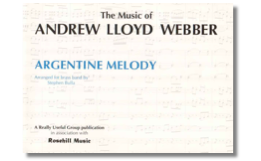 £39.95
Argentine Melody (Score and Parts) - Andrew Lloyd Webber arr. Stephen Bulla
The flavour of South American dance effectively translated to the brass band idiom by a master arranger.
Estimated dispatch 7-9 working days
 View Music
 Watch video