
Results
-
 £44.95
Symphony Of Thanksgiving (Brass Band - Score and Parts) - Goffin, Dean
Specially written for the Diamond Jubilee Celebration of The International Staff band in 1951 concluding with 'Praise my soul, the King of Heaven' and a phrase of 'Give to Jesus glory'.
Estimated dispatch 7-14 working days
-
£22.50
Symphony Of Thanksgiving (Brass Band - Score only) - Goffin, Dean
Specially written for the Diamond Jubilee Celebration of The International Staff band in 1951 concluding with 'Praise my soul, the King of Heaven' and a phrase of 'Give to Jesus glory'.
Estimated dispatch 7-14 working days
-
 £42.95
ANDANTE (from 6th Symphony) (Brass Band) - Barry, Darrol
This famous melody is adored around the world. It was also the basis for a very popular 'pop' song Story of a Starry Night.
Estimated dispatch 7-14 working days
-
£19.99
Elegy (Brass Band - Score and Parts) - Hesketh, Kenneth
Elegy is a consortium commission in celebration of the 75th birthday of the distinguished wind band conductor Timothy Reynish. The music derives from a youthful symphony written when Hesketh was 16, the same source as his popular Masque. Full of big tunes and bitter-sweet harmonies, Elegy is a heartfelt thank you to a conductor who has done more than most to widen the vision of the wind orchestra movement.Suitable for 1st Section Bands and aboveDuration: 7.00
Estimated dispatch 7-14 working days
-
£154.99
Spiriti (Brass Band - Score and Parts)
A Bach chorale stands at the centre of this work (F?r deinen Thron tret? ich hiermit).Anton Bruckner was one of Johann Sebastian Bach's great admirers. His work is full of the spirit of that musical genius. For Thomas Doss, it was Bruckner's spirit that always seemed to be with him while working on Spiriti. Bruckner's spirit is captured in this composition by a quote from the chorale of his Fifth Symphony at the end of the piece.The introduction, written in the style of a funeral march, already displays the first fragments of the chorale. Like splinters they are strewn throughout the first Allegro, combining and recombining in turbulent, powerful tutti passages. As the music becomes more rambunctious, the Bach-like fragments begin to swirl around each other, only to be scattered once more.The middle-section is of a more pensive nature. The Religioso character gives the audience time to reflect. The music is meditative and the quarter-note (or crotchet) elements mimic a soul that is yearning and crying out.The third part of the piece finally leads, by way of minimalist elements and the fragments mentioned earlier, to a magnificent presentation of the Bach chorale. As the church bells ring out, one can almost hear the great masters presiding at the organ. 17:00
Estimated dispatch 7-14 working days
-
 £40.00
Symphonic Dance No.3 (Brass Band - Score and Parts) - Rachmaninoff, Sergei - Littlemore, Phillip
Completed in 1940, the set of?Symphonic Dances?was Sergei Rachmaninov's last composition. The work is fully representative of the composer's late style with its curious, shifting harmonies, the almost Prokofiev-like grotesquerie of the outer movements and the focus on individual instrumental tone colours throughout.?Rachmaninov composed the Symphonic Dances four years after his Third Symphony, mostly at the Honeyman Estate, 'Orchard Point', in Centerport, New York, overlooking Long Island Sound. The three-movement work's original name was Fantastic Dances, with movement titles of 'Noon', 'Twilight' and 'Midnight'. When the composer wrote to the conductor Eugene Ormandy in late August, he said that the piece was finished and needed only to be orchestrated, but the manuscript for the full score actually bears completion dates of September and October 1940. It was premiered by Ormandy and the Philadelphia Orchestra, to whom it is dedicated, on 3rd January, 1941. This arrangement is of the last dance and is a kind of struggle between the?Dies Iraetheme, representing Death, and a quotation from Rachmaninov's own?Vespers?(also known as the All-night Vigil, 1915), representing Resurrection. The Resurrection theme proves victorious in the end as the composer actually wrote the word 'Hallelujah' at the relevant place the score (one bar after Fig. 16 in this arrangement).?Duration: 3:45
Estimated dispatch 7-14 working days
-
 £40.00
William Tell Overture, Finale from (Brass Band - Score and Parts) - Littlemore, Phillip
The overture to Rossini's opera?William Tell?is a fairly large scale work in four sections and lasting some twelve minutes. However, it is the finale of the overture which is one of ?the most iconic pieces of music. This 'March of the Swiss Soldiers' is a dynamic cavalry charge and galop often used in popular media to denote galloping horses, a race, or a hero riding to the rescue. Its most famous use in that respect is as the theme music for the radio and TV show?The Lone Ranger. It was also used to great comic effect by Spike Jones and his City Slickers and it also finds it's way into the first movement of Shostakovich's 15th Symphony! Duration: 3:20
Estimated dispatch 7-14 working days
-
 £84.99
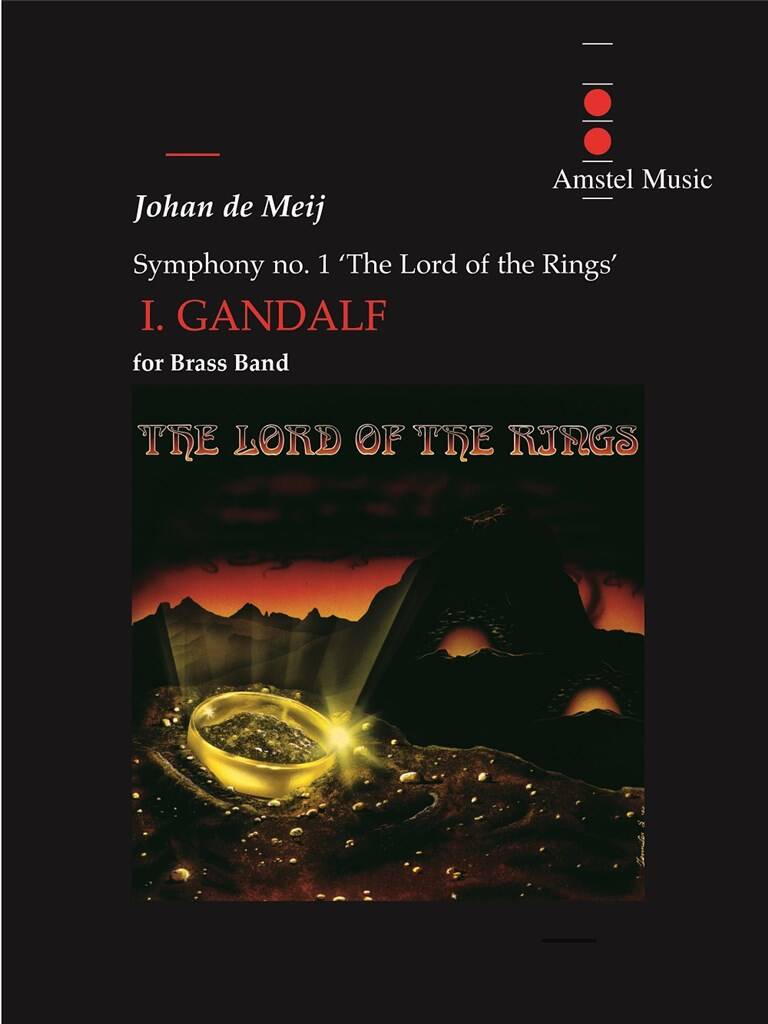
Gandalf the Wizard - Johan de Meij
Johan de Meij's first symphony The Lord of the Rings is based on the trilogy of that name by J.R.R. Tolkien. This book has fascinated many millions of readers since its publication in 1955. The symphony consists of five separate movements, each illustrating a personage or an important episode from the book. This transcription for brass band, arranged by the composer has the following movements: I. GANDALF (The Wizard), IV. JOURNEY IN THE DARK (The Mines of Moria and The Bridge of Khazad-D m), V. HOBBITS. The symphony was written in the period between March 1984 and December 1987, and had its premiere in Brussels on 15th March 1988, performed by the The Royal Band ofthe Belgian Guides under the baton of Norbert Nozy. In 1989, the symphony The Lord of the Rings was awarded a first prize in the Sudler International Wind Band Composition Competition in Chicago, and a year later, the symphony was awarded a grant by the Dutch Composers Fund. In 2001, the orchestral version was premiered by the Rotterdam Philharmonic Orchestra and recorded by the London Symphony Orchestra.
Estimated dispatch 5-14 working days
-
 £89.99
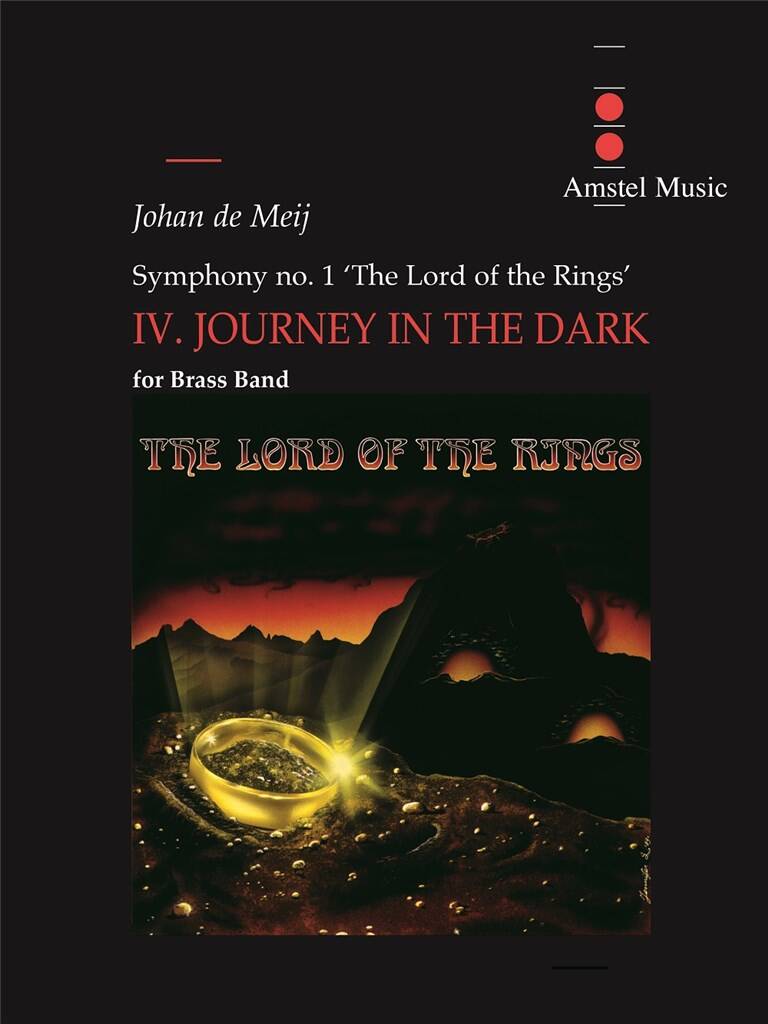
Journey in the Dark - Johan de Meij
Johan de Meij's first symphony The Lord of the Rings is based on the trilogy of that name by J.R.R. Tolkien. This book has fascinated many millions of readers since its publication in 1955. The symphony consists of five separate movements, each illustrating a personage or an important episode from the book. This transcription for brass band, arranged by the composer has the following movements: I. GANDALF (The Wizard), IV. JOURNEY IN THE DARK (The Mines of Moria and The Bridge of Khazad-D m), V. HOBBITS. The symphony was written in the period between March 1984 and December 1987, and had its premiere in Brussels on 15th March 1988, performed by the The Royal Band ofthe Belgian Guides under the baton of Norbert Nozy. In 1989, the symphony The Lord of the Rings was awarded a first prize in the Sudler International Wind Band Composition Competition in Chicago, and a year later, the symphony was awarded a grant by the Dutch Composers Fund. In 2001, the orchestral version was premiered by the Rotterdam Philharmonic Orchestra and recorded by the London Symphony Orchestra.
Estimated dispatch 5-14 working days
-
 £89.99
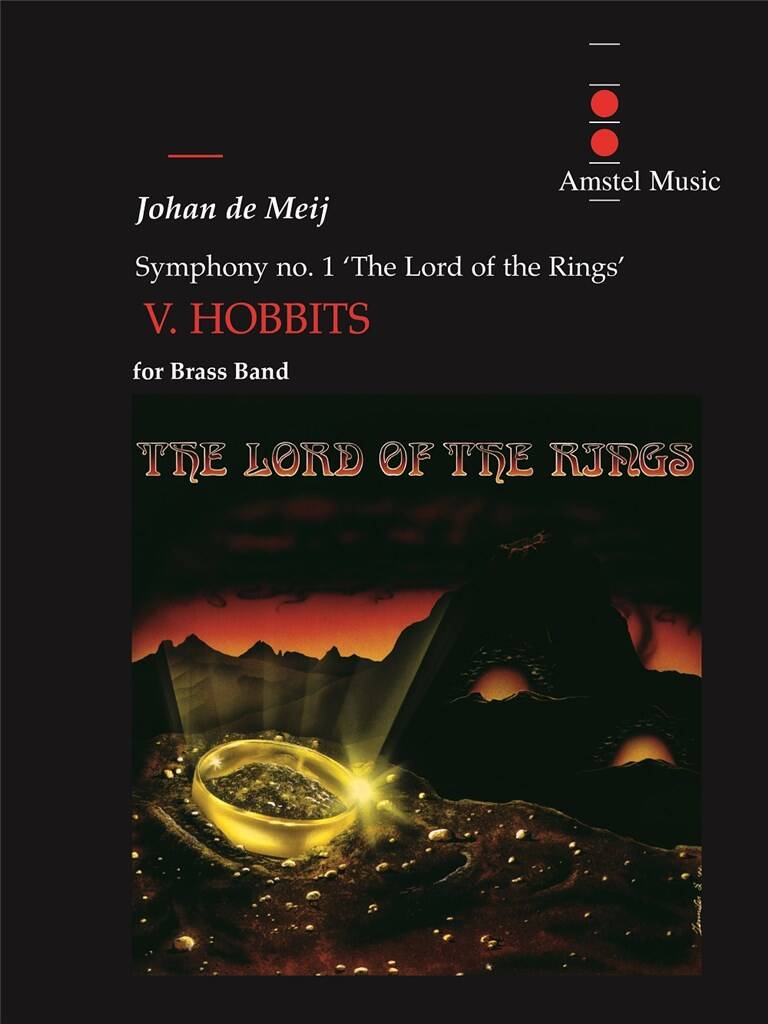
Hobbits - Johan de Meij
Johan de Meij's first symphony The Lord of the Rings is based on the trilogy of that name by J.R.R. Tolkien. This book has fascinated many millions of readers since its publication in 1955. The symphony consists of five separate movements, each illustrating a personage or an important episode from the book. This transcription for brass band, arranged by the composer has the following movements: I. GANDALF (The Wizard), IV. JOURNEY IN THE DARK (The Mines of Moria and The Bridge of Khazad-D m), V. HOBBITS. The symphony was written in the period between March 1984 and December 1987, and had its premiere in Brussels on 15th March 1988, performed by the The Royal Band ofthe Belgian Guides under the baton of Norbert Nozy. In 1989, the symphony The Lord of the Rings was awarded a first prize in the Sudler International Wind Band Composition Competition in Chicago, and a year later, the symphony was awarded a grant by the Dutch Composers Fund. In 2001, the orchestral version was premiered by the Rotterdam Philharmonic Orchestra and recorded by the London Symphony Orchestra.
Estimated dispatch 5-14 working days
 View Music