
Results
-
 £29.95
Judd: The Pilgrim Way
Attempting to recreate the atmosphere of mediaeval pilgrims, this suite comprises three separate, yet linked movements. I. Based on John Bunyan's poem 'He Who Would Valiant Be', the music reminds us of the words 'No foes shall stay his might, though he with giants fight, he will make good his right to be a pilgrim'. II. A transcription of the composer's own setting of 'God be in my head'. III. The original themes in this movement express feelings of joy and excitement of present day pilgrims journeying on the Christian path.
Estimated dispatch 7-14 working days
-
 £38.95
Unity Series Band Journal October 2017 Numbers 458-461
March Medley I Believe (Noel Jones)This potpourri of songs brings the strong assurance of faith and hope together in an attractive and enjoyable manner. The tunes featured are 'I believe we shall win', 'I believe God answers prayer', 'I believe in God the Father' and 'I believe in the word of God'.Horn Solo - Promises (Jorgen Ljserdorn)This is a brass setting of a song by Captain Matthew Spencer with the same title. The contemporary setting is simple in design and should prove to be popular amongst many who feature this journal.Suite Like a melody (Steve Forman)Major Stephen Foreman has written a short suite which will bring an easy yet attractive addition to most band's repertoire. I am praying (Jared Proellocks)A contemporary setting of the much loved chorus 'I am praying blessed Saviour' written by a young Salvationist from the Australian Southern Territory.
Estimated dispatch 7-14 working days
-
 £80.00
The Unfortunate Traveller (Brass Band - Score and Parts)
Imogen Holst (1907-1984) submitted The Unfortunate Traveller (1929) as her final work as a student portfolio at the Royal College of Music, where her composition teacher was Gordon Jacob. The title was taken from Thomas Nashe's famous 1594 picaresque novel of the same title. The Suite was first performed on 12 February 1933 at her Majesty's Theatre, Carlisle, by the St. Stephen's Band, with the composer conducting. Te concert was given in memory of Holst's uncle, Dr. H.A. Lediard. Holst had been impressed with the band's performance of his A Moorside Suite at the 1928 National Brass Band Championships (The Crystal Palace, South London) and was keen to work with them. Writing in Imogen Holst, a life in music, Christopher Grogan indicates that it was Gustav Holst's suggestion to include his daughter's work in the programme, quoting Imogen Holst's remarks made in interview to The Daily Mail as follows: "....it is the first time, so far as I know, that a woman has conducted a brass band at a public concert....It has been a delight to rehearse the St. Stephen's Band. It was their performance at the Crystal Palace Festival that inspired me to write this Suite, which I have dedicated to them."Imogen Holst accompanied her father to the Crystal Palace in 1928 to hear the performances of A Moorside Suite, and was so excited by the played and, audibly, by her father's music that she decided to write a brass band piece for her final examination. Te result was The Unfortunate Traveller (1929). However, it was not possible for her to present a brass band work for examination. She arranged it for string orchestra so that it could be played before she left the RCM in July 1930. Following the premiere of the original in 1933, the manuscripts did not resurface until 1969 Imogen found them among her late mother's effects. Although she requested score and parts be destroyed, they ended up in the possession of Manchester composer John Golland, who marked up the score presumably with the intention of creating a new performing edition. The original scoring reveals a lack of experience with what can be a tricky medium.With the agreement of the Holst Foundation, a revised edition, with additional percussion, was prepared in 2011 since when the work has been fortunate to travel round the world as a concert and contest piece. The original includes drums in the March only. The title was taken from Tomas Nashe's famous 1594 picaresque novel of the same title. Several Morris Dance tunes are introduced during the course of the four short movements, including Bonnie Green Garters, Shepherd's Hey, The Rose and The Wind Blaws Cauld. Quirky twists and turns of harmony and spirited rhythms that remind us how much Imogen Holst loved tradition English dance music.In September 2025, I made a performing edition of the composer's arrangement for string orchestra. The manuscript lacks the final movement, which I arranged in a similar style, ie. without extending the upper ranges. Making this edition raised some issues regarding the accuracy of my band version and some of the solutions I used to smooth out the voicing. I have used the composer's second thoughts to refine my performing edition and to correct a textual errors.- Paul HindmarshDuration: 10.00
Estimated dispatch 7-14 working days
-
£40.00
The Unfortunate Traveller (Brass Band - Score only)
Imogen Holst (1907-1984) submitted The Unfortunate Traveller (1929) as her final work as a student portfolio at the Royal College of Music, where her composition teacher was Gordon Jacob. The title was taken from Thomas Nashe's famous 1594 picaresque novel of the same title. The Suite was first performed on 12 February 1933 at her Majesty's Theatre, Carlisle, by the St. Stephen's Band, with the composer conducting. Te concert was given in memory of Holst's uncle, Dr. H.A. Lediard. Holst had been impressed with the band's performance of his A Moorside Suite at the 1928 National Brass Band Championships (The Crystal Palace, South London) and was keen to work with them. Writing in Imogen Holst, a life in music, Christopher Grogan indicates that it was Gustav Holst's suggestion to include his daughter's work in the programme, quoting Imogen Holst's remarks made in interview to The Daily Mail as follows: "....it is the first time, so far as I know, that a woman has conducted a brass band at a public concert....It has been a delight to rehearse the St. Stephen's Band. It was their performance at the Crystal Palace Festival that inspired me to write this Suite, which I have dedicated to them."Imogen Holst accompanied her father to the Crystal Palace in 1928 to hear the performances of A Moorside Suite, and was so excited by the played and, audibly, by her father's music that she decided to write a brass band piece for her final examination. Te result was The Unfortunate Traveller (1929). However, it was not possible for her to present a brass band work for examination. She arranged it for string orchestra so that it could be played before she left the RCM in July 1930. Following the premiere of the original in 1933, the manuscripts did not resurface until 1969 Imogen found them among her late mother's effects. Although she requested score and parts be destroyed, they ended up in the possession of Manchester composer John Golland, who marked up the score presumably with the intention of creating a new performing edition. The original scoring reveals a lack of experience with what can be a tricky medium.With the agreement of the Holst Foundation, a revised edition, with additional percussion, was prepared in 2011 since when the work has been fortunate to travel round the world as a concert and contest piece. The original includes drums in the March only. The title was taken from Tomas Nashe's famous 1594 picaresque novel of the same title. Several Morris Dance tunes are introduced during the course of the four short movements, including Bonnie Green Garters, Shepherd's Hey, The Rose and The Wind Blaws Cauld. Quirky twists and turns of harmony and spirited rhythms that remind us how much Imogen Holst loved tradition English dance music.In September 2025, I made a performing edition of the composer's arrangement for string orchestra. The manuscript lacks the final movement, which I arranged in a similar style, ie. without extending the upper ranges. Making this edition raised some issues regarding the accuracy of my band version and some of the solutions I used to smooth out the voicing. I have used the composer's second thoughts to refine my performing edition and to correct a textual errors.- Paul HindmarshDuration: 10.00
Estimated dispatch 7-14 working days
-
 £55.00
Triumph Series Brass Band Journal, Numbers 1351 - 1354, July 2023
1351: The anointed King (Marcus Venables)This piece was originally written as a massed band item for the Ontario Central-East Divisional Music Day in 2019. The updated version includes two songs, King of kings, majesty (S.A.S.B. 376) and O worship the King (S.A.S.B. 52) to a rhythmic setting of the tune Laudate Dominum (T.B. 481). Both songs present the contrasting characteristics of God; the powerful King and gentle, loving Saviour.1352: A suite of English Christmas carols (Kenneth Downie)This suite is the result of a request for a piece of music featuring exclusively English Christmas carols.The first movement features The holly and the ivy (C.C. 87). In sharp contrast, the second movement calls for a broad, sensitive, song-like approach. Using The cherry tree carol (C.C. 85), a much slower tempo than is normally applied to encourage the listener to see this beautiful tune in a new light. The rumbustious arrival of the finale is based on I saw three ships come sailing in (C.C. 44) with the festive mood prevailing until the end.1353: Nothing but thy blood (Norman Bearcroft)This two-verse setting of Richard Slater's much-loved hymn Nothing but thy blood (S.A.S.B. 769) appears straight-forward in nature, but requires a careful sense of the musical line across all parts.1354: Meditation - Reflections on Advent (Andrew Blyth)Two well-known carols, Away in a manger (C.C. 12) and Silent Night! (C.C. 77) are featured alongside original material. The piece attempts to convey a sense of reflection and meditation on the wonderful and awe-inspiring Advent story.
Estimated dispatch 7-14 working days
-
 £50.00
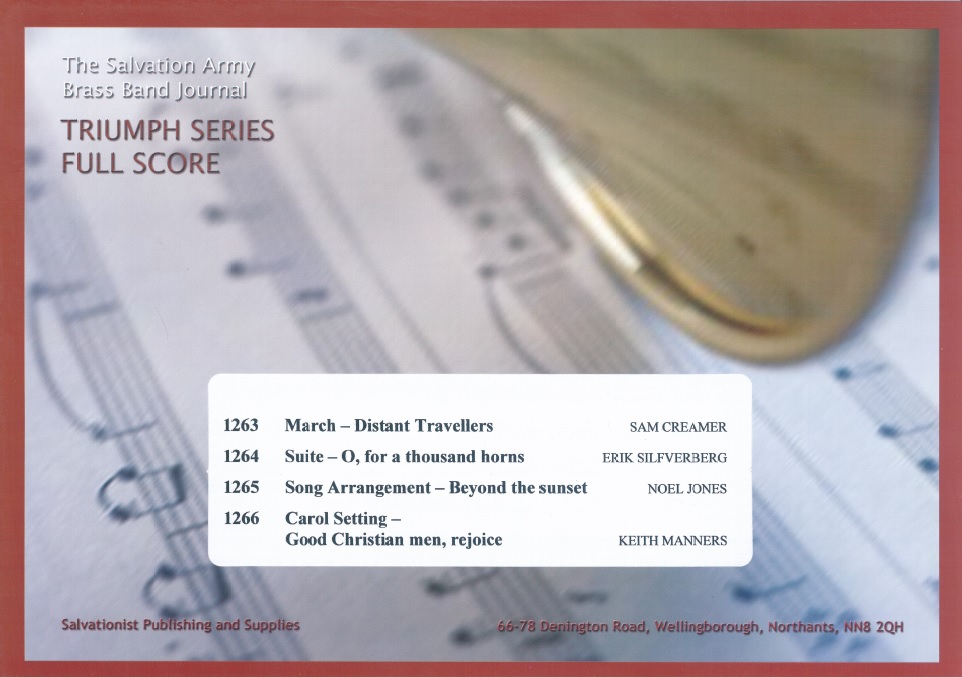
Triumph Series Band Journal July 2015 Numbers 1263 - 1266
No. 1263 March - Distant Travellers (Sam Creamer)With this Christmas march, we introduce a new contributor to our journals. Sam Creamer is a bandsman and songster at the Carindale Corps in Brisbane, Australia Eastern Territory. This march should prove a useful addition to the Christmas repertoire of many groups, as it features the well-known Christmas carols; When wise men come seeking (NCP 92) and While shepherds watched (NCP 93), as well as brief references to others.No. 1264 Suite - O, for a thousand horns (Erik Silfverberg)Bandmaster Erik Silfverberg OF has taken the song O for a thousand tongues by Charles Wesley, and has composed a suite in three movements with each of the movements exploring the sentiments of one of the verses. The tune Grimsby is heard in part throughout, but the majority of the musical material used is original.No. 1265 Song Arrangement - Beyond the sunset (Noel Jones)A three-verse setting of the song Beyond the sunset which speaks of the Christian's eternal home in Heaven.No. 1266 Carol Setting - Good Christian men, rejoice (Keith Manners)A bright setting of the well-known Christmas carol.
Estimated dispatch 7-14 working days
-
 £45.00
Triumph Series Band Journal November 2014 Numbers 1255 - 1258
No. 1255 March - Redemption (Ian Clarke)The words redemption and salvation are synonymous with each other. In theology, the word redemtion is defined as 'delivering from sin' or 'saving from evil'; sentiments that are expressed in some of the words associated with the songs that are featured in this music.No. 1256 Suite - Great Expectations! (Howard Davies)Three songs (written over a period of 25 years) are drawn together in this suite as a reminder of the great expectations rightfully held by every child of God.No. 1257 Cornet Solo - Let me be a light (arr. Mervyn Clarke)A setting for Cornet and band of Major Joy Webb's song, 'Let me be a light'.No. 1258 Meditation - Were you there? (Noel Jones)This meditation on Christ's crucifixion features the song, 'Were you there?', and the chorus, 'He died of a broken heart'.
Estimated dispatch 7-14 working days
-
 £38.95
Unity Series Band Journal February 2013 Numbers 402 - 405
No.402 Procession and praise (Andrew Mackereth)Written for an event at Belfast Citadel in November 2011, the tunes included were chosen by the youthful participants themselves!No.403 Suite - Learn, love and Live (Martin Cordner)Written for one of the bands at the 2011 Belfast Temple Music School, the three movements of this suite feature the songs 'Come Fill my cup', 'Such love' and 'Running over' respectively.No.404 Trombone Solo - You can't stop God (Kevin Larsson)Kevin Larsson has take one of his father's tunes and arranged it in the style of a Cuban bolero with the instruction that it is played at 100 beats per minute, or slower!No.405 March - The King's people (Trevor Davis)This march was written for the 125th anniversary of Loughborough Corps and is based on the song 'Come, people of the risen King' which was a particular favourite of the corps.
Estimated dispatch 7-14 working days
-
 £34.22
Finale from Leading Edge (Brass Band) Rob Wiffin
This finale from my suite Leading Edge is particularly well-suited to brass band. The drums lead into the energetic, dance-like theme that announces the Finale. Although the use of minor keys persists in this movement, the atmosphere is energetic and vivacious. A number of themes are considered before the flugelhorn introduces the theme that will go through a number of guises before emerging later in triumphant form in the whole band. The foregoing tension is banished and the music ends in a spirit of positive affirmation.Duration: Approx. 4.12 minutesDifficulty Level: DemandingThis PDF download includes the full score and parts.Sheet music available at www.brassband.co.uk (UK) or https://satradecentral.org (USA)
In Stock: Estimated dispatch 1-3 working days
-
£44.95
LORD OF THE SEA (Brass Band Set) - Ray Steadman-Allen
Each movement of this suite is linked with a quotation from the Bible; 1. Water's edge ('And Jesus went forth...by the sea-side...' Mark 2 v.13). 2. Seascapes ('His dominion shall be from sea to sea' Zechariah 9 v.10). 3. Seafarer's song ('Sing unto the Lord...ye that go down to the sea' Isaiah 42 v.10). The first two movements are based on the composer's own settings of poems by Miriam Richards. The third movement (generally lively in characater) introduces a broad hymn-like melody not associated with any words in particular but nevertheless evoking a spirit of exaltation and praise.
Estimated dispatch 7-14 working days