
Results
-
 £34.95
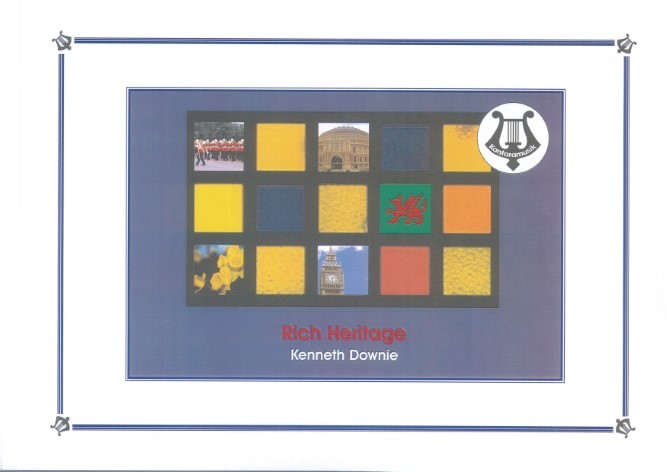
Rich Heritage (Brass Band - Score and Parts) - Downie, Kenneth
This music was written to celebrate the distinguished work done by Leighton Rich as Music Director of the Hampshire County Youth Band. Leighton's Welsh origins and his past link with the Coldtsream Guards are expressed in the music.
Estimated dispatch 7-14 working days
-
 £59.99
A Klezmer Karnival (Brass Band - Score and Parts) - Sparke, Philip
Klezmer music originated in the 'shtetl' (villages) and the ghettos of Eastern Europe, where itinerant Jewish troubadours, known as 'klezmorim', had performed at celebrations, particularly weddings, since the early Middle Ages. Since the 16th century, lyrics had been added to klezmer music, due to the 'badkhn' (the master of ceremony at weddings), to the 'Purimshpil' (the play of Esther at Purim) and to traditions of the Yiddish theatre, but the term gradually became synonymous with instrumental music, particularly featuring the violin and clarinet. In recent years it has again become very popular and in A Klezmer Karnival Philip Sparke has used three contrasting traditional tunes to form a suite that will bring a true karnival atmosphere to any concert.Duration: 4:30
Estimated dispatch 7-14 working days
-
 £54.99
Mombassa Beat (Brass Band - Score and Parts) - Martin, Peter
A contagious piece of music by Peter Martin in which he hints at the popular amusement music by Bert Kaempfert. Mombassa is a lively harbour city in Kenya which can be heard in the music. Happiness and cheeriness are the ingredients of this nice piece. Success is assured.Duration: 2:15
Estimated dispatch 7-14 working days
-
 £76.99
Free World Fantasy (Brass Band - Score and Parts) - De Haan, Jacob
This piece was commissioned by the Dutch province of Groningen for the celebrations commemorating the liberation festivities in 1987. In the composition, the dream of a world without war is symbolized. It is the first composition in a series in which Jacob de Haan combines concert music with pop music in a style, which reminds one of film music. Later compositions in which he has reaped much success with the same formula in style are Oregon, La Storia and Utopia.Duration: 8.00
Estimated dispatch 7-14 working days
-
 £100.00
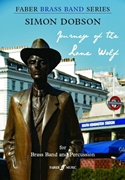
Journey of the Lone Wolf (Brass Band - Score and Parts) - Dobson, Simon
Championship Section Test Piece for the 2016 National Finals of the British Brass Band Championship.The Lone Wolf of the title is the great Hungarian composer and folklorist Bla Bartok. Bartok's journey took him from the hills of the Balkans to the heart of the new world. His singular vision may have meant a life out in the cold, a life without warmth and love, a life without true happiness, a death mourned by a few in a strange land.The first of the three linked movements is capturing the Peasants' Song and follows the young Bartok and fellow composer Zoltan Kolday as they embark on Summertime adventures through the Hungarian countryside to collect and catalogue the astonishing variety of Gypsy and folk music heard in the Balkan hills. The arrival of WW1 plunges Bartok's beloved Hungary into chaos.Bartok was at times a cold man, aloof and lonely. The occasional moments of tenderness he showed are portrayed in Night Music. His brief but intense affairs speak of a love he could only long for. Jazz is my night music and here there are hints of what Bartok may have heard in the USA later in his life.Having been forced by the world's evils to leave his homeland of Hungary for America Bartok, the anti-fascist, felt isolated and angry. In the finale, Flight and Fight, we hear his longing for a simpler time of Gypsy folk dances as well as his maturity and depth as a composer finally exploring deeper colours and darker themes.Duration: 15.00
Estimated dispatch 7-14 working days
-
 £44.95
Reflections (Flugel and Tenor Horn Duet with Brass Band - Score and Parts) - Graham, Peter
Duet for Flugel and Tenor Horn or Two Bb Cornets from War of the Worlds SuiteEach movement of War of the Worlds is available separately allowing for a variety of "mini-suite" combinations eg: Movements 1,2 and 5 or 3,4 and 5 etc. For movements 1, 4 and 5 see the BB Concert Music tab. Complete suite also available.Reflections is the second movement of the suite War of the Worlds which was commissioned by the Senzoku Gakuen College of Music Saxophone Orchestra and first performed by them in the Maeda Hall, Japan on June 29 2012, the composer conducting. The music is dedicated to Professor Shin-ichi Iwamoto. The transcription for brass band was first performed by the Brighouse & Rastrick Band, conductor David King, in the Bridgewater Hall Manchester on September 8 2012.The suite takes inspiration from the 1953 film script adaptation of the famous HG Wells novel and key scenes from the film are set as individual movements: Reflections - here mankind contemplates a life forever changed as the invaders progress their colonisation of Planet Earth.
Estimated dispatch 7-14 working days
-
 £79.95
The Plantagenets (Brass Band - Score and Parts) - Gregson, Edward
A Symphonic Study for Brass BandThe Plantagenets was Gregson's first major test piece, written specially for the 1973 National Brass Band Championships.In this ambitious symphonic study he turned his attention to music which sets out to create a mood or atmosphere, in contrast to his earlier brass band works such as Essay and Partita where the underlying concerns are technical rather than expressive. However, Gregson is at pains to emphasise that The Plantagenets is not programme music. 'Symphonic' is the optimum word here. In its textural and harmonic complexity, its rhythmic and melodic variety, this was his most ambitious brass band piece so far. His language, with its roots in Hindemith and Bartok is further enriched here with the expressive language of Holst and Rachmaninov.As he says in his notes on the work: The Plantagenets attempts to portray the mood and feelings of an age - that of the House of Plantagenet which lasted from the middle of the twelfth century to the end of the fourteenth. To many it conjures up an age of chivalry and this is represented by fanfare motifs which occur throughout the work in varied form.Characteristically, the composer then goes on to describe not the atmosphere or mood he is trying to convey, but the means by which the music has been composed: the opening fanfares, based on the interval of the third, generating the musical material for the whole work; an exposition of two themes - one fanfare-like, one lyrical (on horns); a slow episode introducing a new melody on solo horn (answered by cornet and euphonium in canon); a little scherzo, fugal in character; and a recapitulation leading to a maestoso statement of the slow movement theme with a final reference to the fanfares as a triumphant conclusion.Duration: 11.30
Estimated dispatch 7-14 working days
-
£39.95
The Plantagenets (Brass Band - Score only) - Gregson, Edward
A Symphonic Study for Brass BandThe Plantagenets was Gregson's first major test piece, written specially for the 1973 National Brass Band Championships.In this ambitious symphonic study he turned his attention to music which sets out to create a mood or atmosphere, in contrast to his earlier brass band works such as Essay and Partita where the underlying concerns are technical rather than expressive. However, Gregson is at pains to emphasise that The Plantagenets is not programme music. 'Symphonic' is the optimum word here. In its textural and harmonic complexity, its rhythmic and melodic variety, this was his most ambitious brass band piece so far. His language, with its roots in Hindemith and Bartok is further enriched here with the expressive language of Holst and Rachmaninov.As he says in his notes on the work: The Plantagenets attempts to portray the mood and feelings of an age - that of the House of Plantagenet which lasted from the middle of the twelfth century to the end of the fourteenth. To many it conjures up an age of chivalry and this is represented by fanfare motifs which occur throughout the work in varied form.Characteristically, the composer then goes on to describe not the atmosphere or mood he is trying to convey, but the means by which the music has been composed: the opening fanfares, based on the interval of the third, generating the musical material for the whole work; an exposition of two themes - one fanfare-like, one lyrical (on horns); a slow episode introducing a new melody on solo horn (answered by cornet and euphonium in canon); a little scherzo, fugal in character; and a recapitulation leading to a maestoso statement of the slow movement theme with a final reference to the fanfares as a triumphant conclusion.Duration: 11.30
Estimated dispatch 7-14 working days
-
 £69.95
Concerto for Horn (Horn Solo with Brass Band - Score and Parts) - Gregson, Edward
Horn in F with Brass BandComposed in 1971 for Ifor James, the Concerto for French Horn and Band revealed some of those elements that have made Gregson's music so popular with audiences (and not just brass band audiences) worldwide: the boldness of his melodies, with the interval of the fourth revealing his admiration for the music of Paul Hindemith; his incisive rhythms, betraying the influence of another favourite composer, Bla Bartk; an admirable economy of means; and the clarity of his scoring.Each of the Concerto's three movements displays a different facet of the French Horn's character. The first is serious, symphonic in impulse, the rising fourths of the opening gesture giving the music an almost Germanic weight. In the slow movement, the soloist becomes the first among equals, sharing with the cornet soloist some typically haunting melodies. The lyrical flow is interrupted at the mid-point by mysterious, fleet-of-foot cadenzas. A rondo finale brings the concerto to a light-hearted conclusion. The rising fourths here are the impulse for a jaunty theme which reveals another of Gregson's early influences - William Walton, and in particular that composer's Partita for orchestra.Duration: 18.00
Estimated dispatch 7-14 working days
-
 £59.95
Voices of Youth (Brass Band - Score and Parts) - Gregson, Edward
The suite Voices of Youth is one of Gregson's earliest brass band compositions, written while he was still a student at the Royal Academy of Music in London. Voices of Youth was commissioned by the National Youth Brass Band of Great Britain and was premiered by them under the baton of Geoffrey Brand.The work has three movements:Nobility of Youth (Duration: 4.00)Sadness and Tenderness (Duration: 2.30)Gaiety (Duration: 2.45)In Nobility of Youth there are the rich sonorities beloved of Salvationist composers such as Eric Ball and, particularly, Ray Steadman Allen, whose music he admired. The modal contour of the melodies here and at the climax of the slow movement Sadness and Tenderness reveal lessons well learned from Holst and Vaughan Williams. Gaiety is probably the most interesting amalgam of all. Beginning in the harmonic world of Gilbert Vinter - whose influence Gregson readily acknowledges at this time - the music is transformed into a bravura waltz of which Percy Grainger might have been proud. It then veers off via a contrapuntal episode of academic correctness, into a coda that takes us into more adventurous harmonic realms.Duration: 10.00
Estimated dispatch 7-14 working days
 View Music