
Results
-
 £54.99
Can You Feel the Love Tonight - Alan Mencken - Ron Sebregts
The Lion King was a smash-hit box office success all over the world, and is still the highest grossing 2D animated film in the US. Can You Feel The Love Tonight, is a delightful concert band arrangement of the song from this Walt Disney classic, sung and composed by Elton John. A Disney favourite for young and old alike, your musicians will look forward to playing this piece both in rehearsal and in concert!
Estimated dispatch 5-14 working days
-
£76.99
Elton John in Concert - Elton John - Don Campbell
The songs of Elton John have been in the charts for over 30 years and are still as fresh and entertaining as when he released his first record. Today he is reaching a new generation of fans with his music for many hit films. The combination of up-tempo songs and love songs makes this medley an ideal light interlude that will be adored by your entire audience.
Estimated dispatch 5-14 working days
-
 £54.99
Langstrump Samba - Jan Johansson - John Blanken
The popular Swedish children's series Pippi Langstrump (Pippi Longstocking) is about an exceedingly strong and strong-willed little girl with red braids - who is the brainchild of Astrid Lindgren. This series has been broadcasted in many countries. I arranged its cheerful theme tune in samba style. Even with the new rhythm, the original song is still very recognizable. In the exuberant samba style, the percussion plays an important role. Within the Langstrump Samba, this is especially clear in the ad libitum percussion solo halfway through the arrangement. The solo can go on as long as desired, and offers plenty of freedom because of the free choice of the instruments used.
Estimated dispatch 5-14 working days
-
£54.99
Swingin' Kilts - John Blanken
John Blanken has created a swinging arrangement of the famous Scottish traditional tune Scotland the Brave. The usual version with bagpipes is the best known and there is a similarity in Swingin' Kilts owing to its long, drone-like tones in the accompaniment. The theme has been rhythmically adapted but it is still easily recognisable. Swingin' Kilts holds a challenge for every brass band. It makes demands in terms of timing and technique which give this work the bravura feel that will keep the audience as well as the musicians swinging in their seats.
Estimated dispatch 5-14 working days
-
 £54.99
I'm So Excited - Peter Kleine Schaars
The sisters Ruth, Anita and June Pointer from West Oakland in California learned how to sing in the sixties in church where their father was a minister. At the beginning of the 1970s they entered the music business, where they proved to have a mastery of many styles - including rhythm & blues, jazz, and country. However, the Pointer Sisters acquired international fame at the beginning of the eighties with their soul-like pop music. A great hit was the up-tempo number I'm So Excited, which is still a success on every dance floor. This sparkling arrangement by Peter Kleine Schaars certainly provides the excitement that is suggested in the title.
Estimated dispatch 5-14 working days
-
 £60.99
Consolation - Jan de Haan
Wer nur den lieben Gott lasst walten was composed by Georg Neumark in about 1641 and was subtitled 'Trostlied' literally meaning consolation song. Songbooks at the time showed the popularity of this song and it is still well-known today partly due to Johann Sebastian Bach's use of the melody for one of his own chorals. In Jan de Haan's arrangement the choral is heard twice, once, alternating with the original motif from the introduction and a second time, without interruption, reflecting the composer's original intention - a song of consolation.
Estimated dispatch 5-14 working days
-
 £95.00
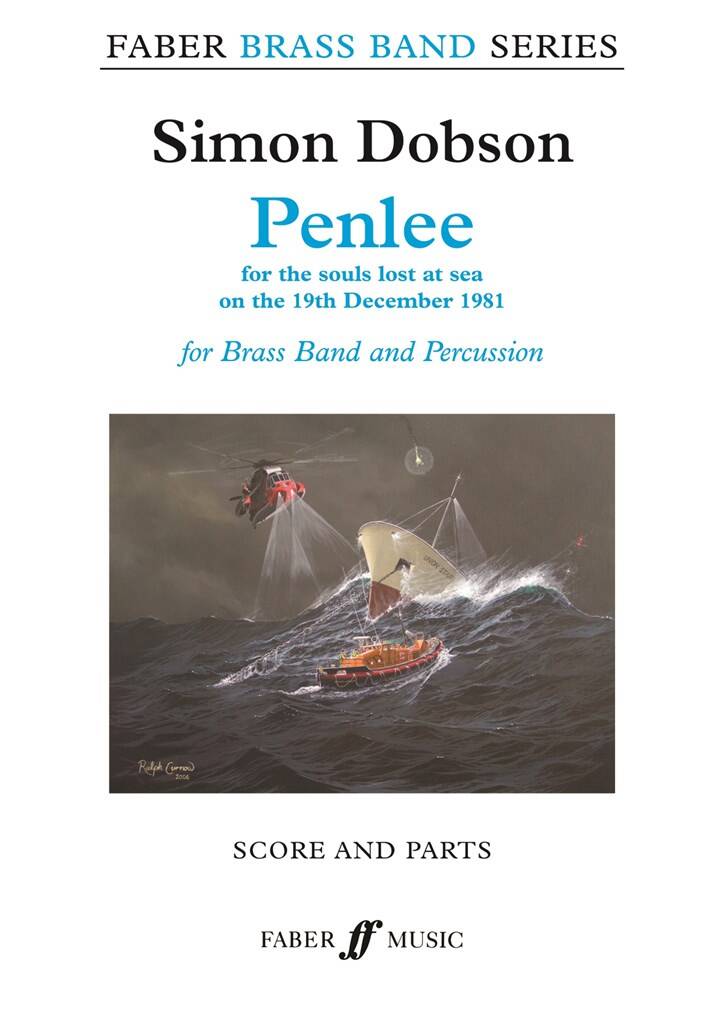
Penlee - Simon Dobson
To some, the tragic story of the Penlee lifeboat, Solomon Browne, would need no introduction, and to some the pain felt is still very much a reality. The composer, born just a few weeks before that fateful night on the19th December 1981, has created this work as a musical homage to the bravery of the souls who lost their lives and has dedicated it to their memory. Penlee was commissioned by the Cornwall Youth BrassBand using funds bequeathed by Michael Pickett. The first performance was given by the Cornish Youth Brass Band, conducted by Ian Porthouse, at St. Michael's Church, Newquay, on 30th December 2008.Penleehas been voted into the Classic FM Hall of Fame 2011 at No.106. Not only is it the first time a brass work has been featured in the Hall of Fame, but it was also thehighest new entry. The work has subsequently been recorded by the Leyland Band, conducted by Jason Katsikaris, on the CD entitled Penlee.Brass Band Grade 4: Advanced Youth and 3rd Section Duration: 13 minutes
Estimated dispatch 5-14 working days
-
 £76.99
New Waves - Torstein Aagaard-Nilsen
New Waves is a special composition. Although contemporary but still attractive to musicians and listeners. Norwegian composer Aagaard-Nilsen has failed in a special way to add new elements to the contemporary wind music. Original exciting rhythms and contrasting harmonies make this composition enjoyable and challenging together. Interrupted by a slow middle section New Waves may be seen as five minutes jazz, rock and funk optima forma! New Waves is een bijzondere compositie. Weliswaar eigentijds maar toch aantrekkelijk voor muzikanten en luisteraars. De Noorse componist Aagaard-Nilsen is er op bijzondere wijze in geslaagd nieuwe elementen toe te voegen aan dehedendaagse blaasmuziek. Oorspronkelijke ritmes en spannende contrastrijke samenklanken maken het spelen van dit werk plezierig en uitdagend tegelijk. Onderbroken door een langzaam middendeel kan New Waves beschouwd worden als vijf minuten jazz, rock en funk optima forma!
Estimated dispatch 5-14 working days
-
 £54.99
X-mas for Three - David Well
David Well composed 'X-mas for Three' for three young pupils of his, who wished to give a Christmas concert. He arranged six well-known Christmas songs for them, and their first performance was a great success. This was reason for the composer to adapt the piece for 'orchestra' by adding percussion. The title has stayed the same, and the work can still be played by as few as three musicians, but as the saying goes: "The more, the merrier"! 'X-mas for Three' consists of the following parts : 1. Oh du frohliche 2. Kling, Glockchen, kling 3. Gloria in excelsis deo 4. Joy to the world! 5. The first Noel 6. We wish you a MerryChristmas
Estimated dispatch 5-14 working days
-
 £54.99
Southern Fried Chicken - Peter Martin
Chicken is a versatile type of meat which is consumed all over the world. And it tastes differently everywhere, but in the south of the United States chicken still tastes like real chicken. The music is in the recognizable square-dance style. Can you remain seated?
Estimated dispatch 5-14 working days
 View Music