
Results
-
 £33.62
For unto us a child is born from 'Messiah'(Brass Band) Handel arr. Kevin Norbury
Ever since the first performance in April 1742 in Dublin, Ireland, Messiah has been the iconic Christian oratorio. It is a work of genius with lyrics skillfully taken from the Bible by Charles Jennens and timeless music by G. F. Handel, and has been at the top of the Western musical canon for close to 300 years. For unto us a child is born comes roughly halfway through Part One of the oratorio and is one of its most popular choruses, being the prophecy of the birth of a Messiah (Jesus) found in Isaiah chapter nine. This excellent setting for brass band is by Kevin Norbury. To view a rolling score video of the work please visit https://www.youtube.com/watch?v=G63Tzi3L07U Duration: Approx. 4.00 minutes Difficulty Level: 2nd Section + PDF download includes parts and score. Sheet music available from www.brassband.co.uk Instrumentation: Soprano Cornet Eb Solo Cornet Bb Repiano Cornet Bb 2nd Cornet Bb 3rd Cornet Bb Flugel Horn Bb Solo Horn Eb 1st Horn Eb 2nd Horn Eb 1st Baritone Bb 2nd Baritone Bb 1st Trombone Bb 2nd Trombone Bb Bass Trombone Euphonium Bb Bass Eb Bass BbTimpani Snare Glockenspiel
In Stock: Estimated dispatch 1-3 working days
-
 £33.62
God so Loved the World (Brass Band) John Stainer arr. Keith M. Wilkinson
John Stainer's stellar anthem God so Loved the World from his oratorio, The Crucifixion, has here been arranged for brass band by Keith M. Wilkinson. This enduring work is possibly the most sublime musical expression of a beloved text from the Gospel of John. Although set as a standalone item and is a semi-tone below the original pitch, it will also work well as a choral accompaniment. Sheet music available from: UK - www.brassband.co.uk USA - www.solidbrassmusic.com Difficulty Level: 4th Section + Instrumentation: Soprano Cornet Eb Solo Cornet Bb Repiano Cornet Bb 2nd Cornet Bb 3rd Cornet Bb Flugel Horn Bb Solo Horn Eb 1st Horn Eb 2nd Horn Eb 1st Baritone Bb 2nd Baritone Bb 1st Trombone Bb 2nd Trombone Bb Bass Trombone Euphonium Bb Bass Eb Bass Bb Timpani Suspended Cymbal Triangle
In Stock: Estimated dispatch 1-3 working days
-
 £37.35
Good Friday Music (Brass Band) Wagner arr. Brian Bowen
This excerpt from Parsifal, the opera Wagner completed in 1882, is a poignant meditation on the chief themes contained in the musical drama: suffering, compassion and redemption. The affirmative six-note Dresden Amen is very present. Here it has been expertly set for brass band by Brian Bowen. Difficulty Level: 3rd Section + Sheet music available from: UK - www.brassband.co.uk USA - www.solidbrassmusic.com Instrumentation: Soprano Cornet Eb Solo Cornet Bb Repiano Cornet Bb 2nd Cornet Bb 3rd Cornet Bb Flugel Horn Bb Solo Horn Eb 1st Horn Eb 2nd Horn Eb 1st Baritone Bb 2nd Baritone Bb 1st Trombone Bb 2nd Trombone Bb Bass Trombone Euphonium Bb Bass Eb Bass Bb Timpani
In Stock: Estimated dispatch 1-3 working days
-
 £33.62
Humble Hero (Tenor Horn Solo with Brass Band) Fendall Hill
This beautiful and poignant tenor horn solo was written by Fendall Hill in tribute to Ken Bradley, one of Australia's best-known, well-loved, and talented brass musicians who sadly passed away in 2022. The work was also a finalist in the BrookWright International Brass Band Composition Competition 2022. To view a video of Nicky Abkiewicz and Sydney City Brass performing the work please visit www.youtube.com/watch?v=sQfkXmMo9bs PDF download includes score and parts. Sheet music available from: UK - www.brassband.co.uk USA - www.solidbrassmusic.com Difficulty Level: 4th Section + Instrumentation: Tenor Horn Soloist Eb Soprano Cornet Eb Solo Cornet Bb Repiano Cornet Bb 2nd Cornet Bb 3rd Cornet Bb Flugel Horn Bb 1st Horn Eb 2nd Horn Eb 1st Baritone Bb 2nd Baritone Bb 1st Trombone Bb 2nd Trombone Bb Bass Trombone Euphonium Bb Bass Eb Bass Bb Timpani Drum Set Tubular Bells
In Stock: Estimated dispatch 1-3 working days
-
 £33.62
In the Bleak Midwinter (Brass Band) Holst arr. Mack Wilberg trs. Barrie Gott
A transcription for brass band of Mack Wilberg's popular setting of the much loved carol In the Bleak Midwinter, as sung by The King's Singers and The Choir of King's College, Cambridge at Carols from Kings in 2020. This is a reflective and beautiful arrangement of the classic Gustav Holst Christmas carol and remains faithful to the Wilberg choral setting. The arrangement underpins the well-loved melody with luscious, romantic harmonies, including moments of exquisite chromaticism. To view a rolling score video please visit www.youtube.com/watch?v=t2DbgNgezAQ PDF download includes score and parts. Sheet music available from: UK - www.brassband.co.uk USA - https://satradecentral.org Difficulty Level: 4th Section + Length: 5.10 minutes Instrumentation: Soprano Cornet Eb Solo Cornet Bb Repiano Cornet Bb 2nd Cornet Bb 3rd Cornet Bb Flugel Horn Bb Solo Horn Eb 1st Horn Eb 2nd Horn Eb 1st Baritone Bb 2nd Baritone Bb 1st Trombone Bb 2nd Trombone Bb Bass Trombone Euphonium Bb Bass Eb Bass Bb
In Stock: Estimated dispatch 1-3 working days
-
 £33.62
Je te veux (Brass Band) Satie arr. Rob Bushnell
Je te veux, or I Want You, is a valse chantee (sung waltz) by the French composer Erik Satie, with lyrics by Henry Pacory. It was written for Paulette Darty, who first sang it in 1903 at La Scala, Paris, with Satie accompanying. There are various versions that Satie produced, the original for piano and voice, a version for brass 'orchestra', for full orchestra (where a trio section was added), and a version for solo piano (but including the new trio section). This arrangement is for the UK-style brass band, with alternative parts for horns in F and bass-clef lower brass, and is of the longer version (with the trio section). As a result, it lends itself to being performed in a various of ways, with the ensemble has the option of selecting the part of it compound ternary form to play: (A-B-A)(C-D-C)(A-B-A). A recording of the original composition can be found here: www.youtube.com/watch?v=FA3JJdmwJU8 Difficulty Level: 4th Section + Duration: 4 or 5 minutes (depending on tempo and without any cuts) PDF download includes parts and score. Sheet music available at www.brassband.co.uk (UK) or https://satradecentral.org (USA) Instrumentation: Soprano Cornet Eb Solo Cornet Bb Repiano Cornet Bb 2nd Cornet Bb 3rd Cornet Bb Flugel Horn Bb Solo Horn Eb 1st Horn Eb 2nd Horn Eb 1st Baritone Bb 2nd Baritone Bb 1st Trombone Bb 2nd Trombone Bb Bass Trombone Euphonium Bb Bass Eb Bass Bb Timpani Drum Kit Auxiliary Percussion (Glockenspiel, Cymbal & Triangle)
In Stock: Estimated dispatch 1-3 working days
-
 £33.62
Les Chasseresses from 'Sylvia' (Brass Band) Delibes arr. Rob Bushnell
Clement Philibert Leo Delibes was a French composer, best known for his ballets and operas, including works such as Lakme (with its famous "Flower Duet"), Coppelia and Sylvia (both key works in the development of modern ballet). The latter started as a play, Aminta, by the Italian poet Torquato Tasso, which Delibes set to music. It was then adapted for the Paris Opera with rehearsals starting in August 1875. The premiere took place on 14 June 1876 and was the first ballet to be shown at the newly-built Opera Garnier. Whilst the scenery and costumes were created by top artists and designers (Cheret and Lacoste), it was Delibes's music that shown thrown, being said to have saved the production, preventing the ballet from drifting into obscurity.Sylvia is said to be one of the first modern ballets, with Tchaikovsky remarking to composer Sergei Taneyev upon its ingenuity: "... the first ballet, where the music constitutes not only the main, but the only interest. What charm, what elegance, what richness of melody, rhythm, harmony." Although Swan Lake, a contemporary to Sylvia, is considered one of the best ballets there is, Tchaikovsky preferred Sylvia to his own work, saying Swan Lake was "poor stuff in comparison". Tchaikovsky said to Taneyev, "I was ashamed. If I had known this music early then, of course, I would not have written Swan Lake". The music to Sylvia, rather than setting only the mood, also sets the action and is noted for its use of leitmotifs - Delibes was an admirer of Wagner - and more dominant use of brass and wind. The most famous piece from this ballet is the Pizzicati in the third act.Act I of the ballet takes place in sacred wood, where creatures are worshipping before Eros when Sylvia arrives with her huntresses to mock the god of love. Aminta, a lowly shepherd and infatuated with Sylvia, protects the deity and Sylvia is wounded by Eros's arrow. The hunter Orion kidnaps Sylvia, whilst Eros revives Aminta. Act II takes place in Orion's Island cave, where Sylvia tries to bribe Orion with jewels and wine. Unsuccessful, she appeals to Eros for help, who arrives and takes her to the temple of Diana (where the final act takes place). Orion and Aminta fight, Sylvia and Orion cause the goddess of the hunt, Diana, to be outraged, smiting Orion and denying the love of Aminta and Sylvia. Eros shows Diana a vision, which changes her mind and the couple finally come together.This brilliant and lively fanfare that introduces the huntresses in the first act is arranged here for the UK-style brass band, with alternative parts for horns in F and bass-clef lower brass. The piece has been lowered by a tone compared to the original. A recording of the original composition can be found here https://youtu.be/6yoGrUH38PI?si=0L0bFa1qXnYNvkR3 Duration: Approx. 3.10 minutes Difficulty Level: 1st Section + This PDF download includes the full score and parts. Includes alternative parts for soloist in Eb, horns in F and lower brass in bass clef. Sheet music available at www.brassband.co.uk (UK) or https://satradecentral.org (USA) Instrumentation: Soprano Cornet Eb Solo Cornet Bb Repiano Cornet Bb 2nd Cornet Bb 3rd Cornet Bb Flugel Horn Bb Solo Horn Eb 1st Horn Eb 2nd Horn Eb 1st Baritone Bb 2nd Baritone Bb 1st Trombone Bb 2nd Trombone Bb Bass Trombone Euphonium Bb Bass Eb Bass Bb Timpani Percussion - Triangle, Cymbal & Bass Drum
In Stock: Estimated dispatch 1-3 working days
-
 £67.24
Letters from Flanders (Brass Band) Andrew Batterham
This descriptive work by Australian composer Andrew Batterham portrays the experiences of his maternal grandfather, Corporal Reginald Littlejohns, (4th Australian Machine Gun Battalion) in the First World War. Reginald left Melbourne for Europe in May 1916 then served in Flanders through to the end of the war. He returned in April 1919, having sent hundreds of letters home during his service. His honest, articulate, and highly descriptive prose served as inspiration for this piece. Each of the 5 movements portrays a different aspect of Reginald's war, with a quote from his letters included. The first movement was premiered by the Box Hill City Band, conducted by Matt van Emmerik, in Melbourne. Daniel van Bergen conducted Booroondara Brass performing most of the work in April 2019, and Box Hill premiered the complete version in November 2019 conducted by Simon Brown. The work is comprised of the following movements: i. The World at War ii. Over the Sea iii. Passchendaele iv. Homecoming Parade v. Elegy Length: c.12.00 minutes PDF download includes score and parts. Sheet music available from www.brassband.co.uk Difficulty Level: 1st Section + Instrumentation: Soprano Cornet Eb Solo Cornet Bb Repiano Cornet Bb 2nd Cornet Bb 3rd Cornet Bb Flugel Horn Bb Solo Horn Eb 1st Horn Eb 2nd Horn Eb 1st Baritone Bb 2nd Baritone Bb 1st Trombone Bb 2nd Trombone Bb Bass Trombone Euphonium Bb Bass Eb Bass Bb Percussion 1-3
In Stock: Estimated dispatch 1-3 working days
-
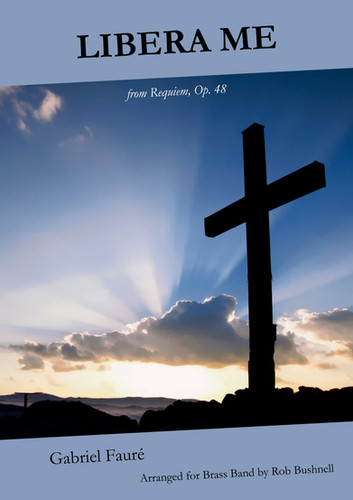 £33.62
Libera Me from 'Requiem' (Brass Band) Faure arr. Rob Bushnell
Composed between 1887 and 1890, Gabriel Faure's Requiem is not only one of his best-known works but one of the most popular piece of choral music in the Classical repertoire, coming 23rd in the Classic FM's Hall of Fame 2024. Believed to be a tribute to his father (who died in 1885), Faure himself said "My Requiem wasn't written for anything - for pleasure, if I may call it that!" It started life as a five-movement work but was later expanded to be the final seven-movement work we know today. The first version (which Faure called "un petit Requiem") was first performed on 16 January 1888, with Faure conducting, a second version premiered on 21 January 1893 before the final version (reworked for full orchestra) was played on 12 July 1900; the Requiem was performed at the composer's own funeral in 1924.The Libera Me, or Deliver Me, was actually written in 1877 and is the sixth part of the Requiem.Faure once said of the work, "Everything I managed to entertain by way of religious illusion I put into my Requiem, which moreover is dominated from beginning to end by a very human feeling of faith in eternal rest." Upon interview, he also said, "It has been said that my Requiem does not express the fear of death and someone has called it a lullaby of death. But it is thus that I see death: as a happy deliverance, an aspiration towards happiness above, rather than as a painful experience. The music of Gounod has been criticised for its inclination towards human tenderness. But his nature predisposed him to feel this way: religious emotion took this form inside him. Is it not necessary to accept the artist's nature? As to my Requiem, perhaps I have also instinctively sought to escape from what is thought right and proper, after all the years of accompanying burial services on the organ! I know it all by heart. I wanted to write something different."This arrangement is for the British-style brass band, with alternative parts for horns in F and bass-clef lower brass. The tenor solo is featured on the euphonium. A recording of the original composition can be found here: www.youtube.com/watch?v=fXwFNoBHCf0 Duration: 4.20 minutes approx. Difficulty Level: 4th Section + PDF download includes parts and score. Sheet music available from www.brassband.co.uk Instrumentation: Soprano Cornet Eb Solo Cornet Bb Repiano Cornet Bb 2nd Cornet Bb 3rd Cornet Bb Flugel Horn Bb Solo Horn Eb 1st Horn Eb 2nd Horn Eb 1st Baritone Bb 2nd Baritone Bb 1st Trombone Bb 2nd Trombone Bb Bass Trombone Euphonium Bb Bass Eb Bass BbTimpani
In Stock: Estimated dispatch 1-3 working days
-
 £37.35
March - New Jerusalem (Brass Band) Kenneth Downie
This sprightly march was the result of a request for a march in traditional style, incorporating a sacred tune that is popular in Holland. It was commissioned by Egbert Scheffer and Brass Band Valerius. The mood is distinctly chirpy and jovial, with a lightness of touch and a generous dose of good humour. This item will be ideal for bands looking for a new modern-day march to freshen up their concert programmes. Sheet music available from: UK - www.brassband.co.uk USA - www.solidbrassmusic.com Difficulty Level: 4th Section + Instrumentation: Soprano Cornet Eb Solo Cornet Bb Repiano Cornet Bb 2nd Cornet Bb 3rd Cornet Bb Flugel Horn Bb Solo Horn Eb 1st Horn Eb 2nd Horn Eb 1st Baritone Bb 2nd Baritone Bb 1st Trombone Bb 2nd Trombone Bb Bass Trombone Euphonium Bb Bass Eb Bass Bb Percussion 1-2
In Stock: Estimated dispatch 1-3 working days
 Watch video