
Results
-
 £70.00
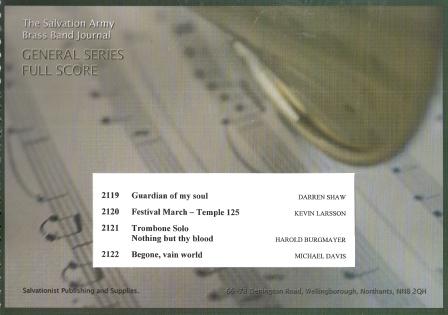
General Series Band Journal April 2013 Numbers 2119-2122
No.2119 Guardian of my soul (Darren Shaw)This arrangement combines the composer's own song 'I worship you', with the well-known hymn 'O Jesus, I have promised' (S.A.S.B. 862), both of which contain the phrase, 'Guardian of my soul', within their lyrics.No.2120 Festival March - Temple 125 (Kevin Larsson)This march was written for the 125th anniversary of Bromley Temple, which is where the composer grew up and still considers his 'home corps'. This arrangement uses two songs that are closely associated with Bromley, the first being 'Jesus is all I need' (STTL Vol.1, part 1) by Hans Knutzen, who was a soldier of the corps and a member of the 'Bill Booth Revival Machine'. The second song is 'He came to give us life (T.B. 662) from the Gowans and Larsson musical, 'Jesus Folk', which was premiered using a cast from Bromley Temple.No.2121 Trombone Solo - Nothing but thy blood (Harold Burmayer)Donna Peterson's recent melody, set to the time-honoured words of Richard Slater, provides a vehicle for solo trombone with band accompaniment.No.2122 Begone, vain world (Michael Davis)A setting of the hymn tune of the same title, with which we associate the words, 'I want, dear Lord, a heart that's true and clean'.
Estimated dispatch 7-14 working days
-
 £44.95
Judd: Golden Slippers
Written originally in the early 1970's for Deryck Diffey, of the Canadian Staff Band, this solo has now become 'the property' of the incomparable David Daws. Full of examples of the virtuosity one associates with David's playing, and requiring a real flexibility of style. Warning! - Before tackling this solo, practice your lip trills!
Estimated dispatch 7-14 working days
-
 £37.95
The Year of the Dragon (Score Only)
The highlight of Cory's centenary celebrations throughout 1984 was a concert held in St. David's Hall, Cardiff, in March. The band, with the aid of funds provided by the Welsh Arts Council, commissioned Philip Sparke to write a work for first performance at this concert. The result was "The Year of the Dragon" of which the composer writes:"At the time I wrote The Year of the Dragon, Cory had won two successive National Finals and I set out to write a virtuoso piece to display the talents of this remarkable band to the full."The work is in three movements:TOCCATA opens with an arresting side drum figure and snatches of themes from various sections of the band, which try to develop until a broad and powerful theme from the middle of the band asserts itself. A central dance-like section soon gives way to the return of this theme, which subsides until faint echoes of the opening material fade to a close.INTERLUDE takes the form of a sad and languid solo for trombone. A chorale for the whole band introduces a brief spell of optimism but the trombone solo returns to close the movement quietly.FINALE is a real tour-de-force for the band with a stream of rapid semi-quavers running throughout the movement. The main theme is heroic and march-like but this is interspersed with lighter, more playful episodes. A distant fanfare to the sound of bells is introduced and this eventually returns to bring the work to a stirring close.
Estimated dispatch 7-14 working days
-
 £34.95
Elixir of Youth - Christopher Bond
Elixir of Youth (2013) was written for the 2013 Brass for Heroes charity event where it was premiered on 19th October 2013 at St Paul's Hall in Huddersfield under the baton of Philip Harper. The title of the work reflects the nature of the band that was put together for that premiere performance; an all-star youth band comprising a selection of the country's young brass banding talent, with the term Elixir referring here to the everlasting talent seen in young brass players throughout the United Kingdom's brass bands and bands' and teachers abilities to keep producing such high quality musicians for the banding movement.The work, structured in three sections, is a showcase for band with a heroic opening where fanfare-like gestures in the cornets and trombones juxtapose rapid euphonium and baritone runs, alongside sweeping horns and percussion effects. As the piece progresses, a grove is introduced - just in the tubas at first, accompanied by a hi-hat - before spreading through the band, definitely stuff to tap your toes to! The middle, slower section of the work sees both flugel and cornet solos, with additional inputs from the euphonium and solo horn before a climax and return to the tempo and music of the opening section. A rousing close concludes the work where all of the work's themes are interweaved to create a sense of power, unity and grandeur; an Elixir of Youth.
Estimated dispatch 10-14 working days
-
 £57.00
Conspirators Overture
Composer: Andrew Duncan Conspirators Overture was written for Katrina Marzella-Wheeler and the Cooperation Band for their winning programme played at the 2025 Brass in Concert competition at the Glass House in Gateshead in England. The piece describes a meeting in a caf in Paris in 1912 between three very influential Russians. The composer Igor Stravinsky, the dancer Vaslav Nijinsk and the impresario Sergei Diaghilev. Together they conspired about how Stravinsky's new Ballet, Le Sacre du Printemps (The rite of Spring) was going to disrupt what was then a very conservative, classical music scene in Paris. Stravinsky's music would forever change the way harmonies and rhythms are used in classical and jazz music. Starvinsky's full name is Igor Fyodorovich Stravinsky. The piece uses the morse code rhythm for IFS, which is Stravinsky's initials as a pulsating 11/8 rhythm which is the foundation of the overture. The opening notes from the Rite of Spring, played by a solo bassoon, are also quoted in the piece in a jazz waltz setting and in a short fugue towards the end of the piece. Suitable for Championship or First Section Bands.
-
 £29.95
Prayer to St Michael - Jonathan Bates
DURATION: 4'00". DIFFICULTY: Moderate. 'Prayer to Saint Michael' is a solo for Euphonium, composed for the Wantage Band and inspired by the life of a young Johann Sebastian Bach, who following the death of both parents by the age of only 10 moved to live with his older brother - Johann Christoph Bach - who was the church organist at St Michael's Church in Ohrdruf. It was in this church where Bach spent many hours studying and performing, being instructed by Johann Christoff on the clavichord. Within 6 years, the young Bach had been enrolled in the prestigious St Michael's School in Luneberg. . "St. Michael the Archangel, illustrious leader of the heavenly army, . defend us in the battle against principalities and powers, . against the rulers of the world of darkness and the spirit of wickedness in high places. Come to the rescue of mankind, . whom God has made in His own image and likeness, . and purchased from Satan's tyranny at so great a price. The Holy Church venerates you as her patron and guardian. The Lord has entrusted to you the task of leading the souls of the redeemed to heavenly blessedness. Entreat the Lord of peace to cast Satan down under our feet, . so as to keep him from further holding man captive and doing harm to the Church. Carry our prayers up to God's throne, . that the mercy of the Lord may quickly come and lay hold of the beast, . the serpent of old, Satan . and his demons, casting him in chains into the abyss, . so that he can no longer seduce the nations. Amen.". .
In Stock: Estimated dispatch 1-3 working days
-
£40.00
Kiwi Dragon - Matthew Hall
'Kiwi Dragon' was commissioned by Byron 'Buzz' Newton for his Master's final performance recital at The Royal Welsh College of Music & Drama in 2012, a recital in which he was awarded an unprecedented 100%. Buzz travelled to Cardiff, Wales for his Master's degree course and became a member of Tredegar Town Band during his studies. 'Kiwi Dragon's' inception came from an initial conversation with the soloist where the thought of combining traditional Welsh folk music with that of Buzz's native New Zealand folk songs to create a virtuosic finishing piece for the recital was conceived. Originally scored for solo euphonium, 10-piece brass and percussion, 'Kiwi Dragon' includes the traditional New Zealand folk melodies Pokare Ana and Tarakihi and the Welsh folk melody Myfanwy, combined with the national anthems of both New Zealand and Wales in the pieces' culmination.
Estimated dispatch 5-7 working days
-
 £34.95
Elixir of Youth (Brass Band - Score and Parts)
Elixir of Youth (2013) was written for the 2013 Brass for Heroes charity event where it was premiered on 19th October 2013 at St Paul's Hall in Huddersfield under the baton of Philip Harper. The title of the work reflects the nature of the band that was put together for that premiere performance; an all-star youth band comprising a selection of the country's young brass banding talent, with the term Elixir referring here to the everlasting talent seen in young brass players throughout the United Kingdom's brass bands and bands' and teachers abilities to keep producing such high quality musicians for the banding movement.The work, structured in three sections, is a showcase for band with a heroic opening where fanfare-like gestures in the cornets and trombones juxtapose rapid euphonium and baritone runs, alongside sweeping horns and percussion effects. As the piece progresses, a grove is introduced - just in the tubas at first, accompanied by a hi-hat - before spreading through the band, definitely stuff to tap your toes to! The middle, slower section of the work sees both flugel and cornet solos, with additional inputs from the euphonium and solo horn before a climax and return to the tempo and music of the opening section. A rousing close concludes the work where all of the work's themes are interweaved to create a sense of power, unity and grandeur; an Elixir of Youth.
Estimated dispatch 7-14 working days
-
 £39.99
Amid the Cold Of Winter- The Rose ("Es ist ein Ros entsprungen")
ABOUT THIS PIECE: Introduce a touch of elegance to your Christmas programme with Amid the Cold of Winter - The Rose, a beautiful arrangement of the traditional carol Es ist ein Ros entsprungen (Lo, How a Rose E'er Blooming). This cherished melody dates back to the late 16th century and has been celebrated for its gentle beauty and profound sense of reverence. Its origins in German sacred music have made it a favourite across centuries, embodying the spirit of hope and renewal. This arrangement, crafted for quartet with brass band accompaniment, enhances the carol's delicate charm while providing a fresh, rhythmic and gentle take on the accompaniment and overall feel. Perfect for seasonal concerts, or gentle and reflective moments in your programme, this piece allows a quartet of soloists to shine. ENSEMBLE: Quartet (soprano cornet, repiano cornet, solo tenor horn & solo baritone) with Standard British Brass Band. For information: As only two solo cornets are required, it is suggested that remaining cornet player play additional percussion. Soprano part available in Bb to be played by Bb cornet. Solo Horn part available in Bb to be played by trombone (trombone part available in Eb to be played by tenor horn in this scenario). WHEN YOU BUY THIS PRODUCT, YOU GET: High-quality printed score and parts LEVEL: 1 LISTEN: DURATION: c. 4-minutes EXAMPLE SCORE: Click here LEVEL GUIDE: Level 1- Accessible to all Level 2 - c. UK third section and higher Level 3 - c. UK second section and higher Level 4 - c. UK first section and higher Level 5 - c. UK championship section level
Estimated dispatch 5-7 working days
-
 £50.00
Dragon Dances
DescriptionDragon Dances was commissioned by Owen Farr, who is also the work's dedicatee, gave the first performance with the Cornwall Youth Band conducted by Richard Evans on 5 April 2010 and has recorded it on his solo CD "A New Dawn" accompanied by the Cory Band conducted by Philip Harper.Being a Welsh composer, writing music for a Welsh soloist, I was naturally keen to reflect this in the music, and I drew inspiration from two particularly Welsh concepts - "hiraeth" and "hwyl". "Hiraeth" is a word that has no direct translation into English, but an approximation would be 'yearning for home'. Like the other celtic nations, Wales has a widespread diaspora of people who left to seek new lives out in the empire and "hiraeth" is a way of summing up the homesickness felt by these exiles, some of whom return each year for a special ceremony at the Royal National Eisteddfod. "Hwyl" is an even more complicated word, variously meaning ecstatic joy, fervour, equable temperament and even the characteristic sing-song oration style of the great Welsh Methodist preachers.I have attempted to make the music reflect both of these, with the melancholy first part of the work inspired by the hymns and solo songs for which Wales is famous, and the second part having a much more dance-like, joyful quality.Performance Notes:2 solo cornets, 2nd and 3rd cornets require cup mutes. 2 solo cornets require harmon mutes with tubes removed (marked 'TR' in the score).1st horn and 1st baritone require straight mutes, preferably fibre. 1st trombone requires a straight mute, 2nd and bass require cup mutes.Percussion instruments required are vibraphone, glockenspiel, timpani, snare drum, suspended cymbal and tam tamWatch/Listen to the score below:
Estimated dispatch 7-14 working days