
Results
-
 £45.00
Jurassic Park (Brass Band - Score and Parts) - Williams, John - Catherall, Alan
The two main themes from the film. The same music has been used in the sequel The Lost World.Parts of the score are quite difficult, but there is a cut to overcome many of the technical difficulties in the middle section. Six minutes of pure magic. This edition has remained a popular seller over the years.Suitable for 3rd Section bands and above
Estimated dispatch 7-14 working days
-
 £54.99
On My Way (Brass Band - Score and Parts)
The English musician Phil Collins has written six new songs for the animated Walt Disney film Brother Bear. His catchy pop rock is well known and popular with a worldwide audience. In Brother Bear, the young Kenai kills a grizzly bear to avenge his brother's death. Then he is magically transformed into a bear himself and he makes friends with the bear cub Koda. Together, they undertake a long, exciting journey in search of the mountain where Kenai can become human again. Meanwhile Kenai's remaining brother hunts them in order to avenge his family. Thus, the main themes of Brother Bear are brotherhood and friendship. On My Way gives voice to the courage and the determination that characterise Brother Bear. Peter Kleine Schaars has produced an excellent arrangement for band, which reflects the original film music very well. 03:45
Estimated dispatch 7-14 working days
-
£19.99
On My Way (Brass Band - Score only)
The English musician Phil Collins has written six new songs for the animated Walt Disney film Brother Bear. His catchy pop rock is well known and popular with a worldwide audience. In Brother Bear, the young Kenai kills a grizzly bear to avenge his brother's death. Then he is magically transformed into a bear himself and he makes friends with the bear cub Koda. Together, they undertake a long, exciting journey in search of the mountain where Kenai can become human again. Meanwhile Kenai's remaining brother hunts them in order to avenge his family. Thus, the main themes of Brother Bear are brotherhood and friendship. On My Way gives voice to the courage and the determination that characterise Brother Bear. Peter Kleine Schaars has produced an excellent arrangement for band, which reflects the original film music very well. 03:45
Estimated dispatch 7-14 working days
-
£89.95
TUBA CONCERTO (Gregson) (Tuba Solo with Brass Band - Score and Parts) - Gregson, Edward
This work was commissioned by the Besses o' th' Barn Band with funds provided by the Arts Council of Great Britain. It was written for, and is dedicated to, John Fletcher, who gave the first performance in Middleton Civic Hall, near Manchester, on 24 April, 1976, with Besses o' th' Barn Band conducted by the composer. Another interesting feature about the premire was that it was recorded by BBC Television for an Omnibus programme with Andr Previn as presenter. The concerto exists in four versions: with brass band (1976), orchestra (1978), wind band (1984) and piano reduction.The concerto is in three movements, following the usual, quick-slow-quick pattern: Allegro deciso,Lento e mesto, Allegro giocoso. The first movement has a sonata form shell with two contrasting themes, the first one being rhythmic in character, the second lyrical. There is a reference made in passing to the Vaughan Williams Tuba Concerto, but this merges into the other material in the development section.The second movement begins with a chorale, but after the entry of the tuba it leads to a cantabile theme, softly unfolded by the soloist. The opening chorale passage returns, this time briefly on muted brass, and leads to a middle section which is more chromatic in style and soon builds to a powerful climax, where the opening cantabile theme triumphantly returns. The music subsides, returning to the opening chorale and ending peacefully.The finale is light and breezy in style, and is cast in rondo form. After a brief introduction the tuba announces the main rondo theme, which is dance-like and a little jaunty. There are two episodes: the first a broad sweeping tune, the second a slowish waltz and a little jazz-like. After a virtuoso cadenza reference is made to the very opening of the concerto before the work ends with a triumphal flourish.The Tuba Concerto has established itself as one of the main works in the solo tuba repertoire. It has been performed and broadcast in over 40 countries all over the world. There are currently six commercial recordings of the concerto in its various versions.resolution in C major, pointed by a simple but expansive melody towards which the piece has been heading, and ending in a blaze of joyful colour.Duration: 18 mins
Estimated dispatch 7-14 working days
-
£44.95
TUBA CONCERTO (Gregson) (Tuba Solo with Brass Band - Score only) - Gregson, Edward
Brass Band Score onlyThis work was commissioned by the Besses o' th' Barn Band with funds provided by the Arts Council of Great Britain. It was written for, and is dedicated to, John Fletcher, who gave the first performance in Middleton Civic Hall, near Manchester, on 24 April, 1976, with Besses o' th' Barn Band conducted by the composer. Another interesting feature about the premire was that it was recorded by BBC Television for an Omnibus programme with Andr Previn as presenter. The concerto exists in three versions: with brass band (1976), orchestra (1978) and wind band (1984).The concerto is in three movements, following the usual, quick-slow-quick pattern: Allegro deciso,Lento e mesto, Allegro giocoso. The first movement has a sonata form shell with two contrasting themes, the first one being rhythmic in character, the second lyrical. There is a reference made in passing to the Vaughan Williams Tuba Concerto, but this merges into the other material in the development section.The second movement begins with a chorale, but after the entry of the tuba it leads to a cantabile theme, softly unfolded by the soloist. The opening chorale passage returns, this time briefly on muted brass, and leads to a middle section which is more chromatic in style and soon builds to a powerful climax, where the opening cantabile theme triumphantly returns. The music subsides, returning to the opening chorale and ending peacefully.The finale is light and breezy in style, and is cast in rondo form. After a brief introduction the tuba announces the main rondo theme, which is dance-like and a little jaunty. There are two episodes: the first a broad sweeping tune, the second a slowish waltz and a little jazz-like. After a virtuoso cadenza reference is made to the very opening of the concerto before the work ends with a triumphal flourish.The Tuba Concerto has established itself as one of the main works in the solo tuba repertoire. It has been performed and broadcast in over 40 countries all over the world. There are currently six commercial recordings of the concerto in its various versions.resolution in C major, pointed by a simple but expansive melody towards which the piece has been heading, and ending in a blaze of joyful colour.Duration: 18 mins
Estimated dispatch 7-14 working days
-
 £119.95
Windows of the World (Brass Band - Score and Parts) - Graham, Peter
Commissioned by YBS Band, this is a kaleidoscopic six movement sequel to Cry of the Celts. The work provides solo opportunities for several principal players. Peter Graham takes us first to Latin America, then to Japan and onwards to Saharan Africa. We get a gentle reprieve via a nostalgic hint of the British Isles before we land in the melting pot of all styles, the USA. In this final section the driving swing section is abruptly stopped and a drum cadenza leads us back into the opening Latin music. The movements are: Amazonia; Rainforest; The Rising Sun; Drums of Thunder; Celtic Dream; Earth Walk. Any of the movements can be programmed individually. Some movements are recorded on QPRL215D Master Brass (Volume Thirteen). All movements are recorded on QPRL123D Windows of the World. Total Duration: 20:30.
Estimated dispatch 7-14 working days
-
 £45.00
Carmen Suite (Brass Band - Score and Parts) - Bizet, Georges - Littlemore, Phillip
Incredible as it seems today, Bizet's opera?Carmen?was met with a lukewarm reception at its premiere at the Paris Opera-Comique in 1875; critics condemned its subject matter as lurid and its music overly Wagnerian, and it ran for a mere 37 performances. Bizet died with a few days of it opening at the tragically early age of just thirty-six. Now hailed as the composer's supreme achievement, this colourful, passionate work continues to delight listeners around the world with its emotional, atmospheric music and the originality of its conception. Two orchestral suites were created in the latter part of the 19th Century each containing six pieces. This brass band arrangement brings together three of these pieces, the?Aragonaise, the Habanera?and?Les Toreadors. Duration: 7:00
Estimated dispatch 7-14 working days
-
 £39.99
Overture for Brass (Brass Band - Score and Parts) - Franzetti, Carlos - Freeh, Mark
From symphonies to big band jazz, and from chamber works to Latin American music and film scores, the music of Argentian-born composer and arranger Carlos Franzetti (b.1948) has won many prestigious awards. This exciting six minute overture, Overture for Brass, was arranged by Mark Freeh and has been recorded by the GUS Band, conducted by Bramwell Tovey.Suitable for Advanced Youth/3rd Section Bands and aboveDuration: 6.00
Estimated dispatch 7-14 working days
-
 £95.00
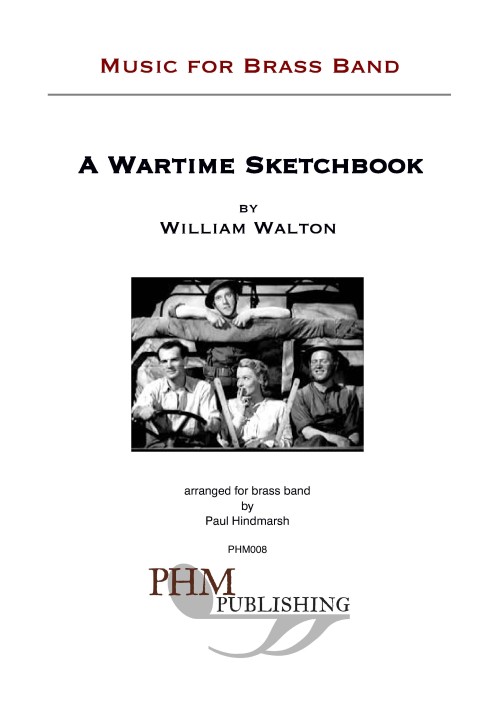
A Wartime Sketchbook (Brass Band - Score and Parts) - Walton, William - Hindmarsh, Paul
Early in 1941 William Walton, 39, received his call-up papers. He was by then one of the most eminent of British composers and was exempted from military service on condition that he provided music for films deemed to be of 'national importance'. Scoring Lawrence Olivier's Shakespeare epic Henry V in 1943 was the most substantial of these wartime projects. His role in patriotic films from 1941 and 42 like The Foreman went to France, Next of Kin, Went the day Well and The First of the Few was to provide appropriate title music and some underscoring at key moments. Walton extracted the most substantial portions of the latter as the popular Spitfire Prelude and Fugue for orchestra. The remaining music remained unpublished until 1990, when Christopher Palmer assembled the highlights into A Wartime Sketchbook. I was intrigued to hear these examples of Walton's wartime music and having discovered that they would fit naturally and idiomatically onto the brass band, I arranged six of the numbers into a suite for Besses o' th' Barn Band, which I was conducting at the time.In 1995 the brass band suite was recorded by the famous Black Dyke Mills Band as part of an all Walton album which I produced for the ASV label (ASV CD WHL 2093). This award- winning CD also included Walton's First Shoot, in the edition by Elgar Howarth, my transcription of movements from Music for Children and two substantial brass versions by Edward Watson of the suite from Henry V (with narrator) and the March and Siegfried Music from The Battle of Britain music.Prologue: This is the stirring title music from Went the day Well, a screen play by Graham Greene about a German airborne invasion of an English village. The main theme leads toBicycle Chase: Characteristic musical high-jinks for J.B.Priestley's The Foreman went to France.Refugees: From the same film, this is a poignant accompaniment to the long march of refugees. As Ernest Irving, the film's musical director, put it, "this really makes your feet sore and your knees sag."Young Siegfrieds: This lively movement comes from the music that Walton composed for The Battle of Britain in 1968, with the assistance of Malcolm Arnold, but which the film's producer rejected. It portrays first the Berliners, cheerfully ignoring the black-out and then, in the trio, the Young Siegfrieds of the Luftwaffe, courtesy of a parody of Siegfried's horn call from Wagner's opera.Romance: A soldier and a Dutch refugee snatch a few tender moments together in Next of Kin.Epilogue: At the end of The Foreman went to France, the French look forward with hope and optimism to eventual liberation.- Paul HindmarshDuration: 14.00
Estimated dispatch 7-14 working days
-
£40.00
A Wartime Sketchbook (Brass Band - Score only) - Walton, William - Hindmarsh, Paul
Early in 1941 William Walton, 39, received his call-up papers. He was by then one of the most eminent of British composers and was exempted from military service on condition that he provided music for films deemed to be of 'national importance'. Scoring Lawrence Olivier's Shakespeare epic Henry V in 1943 was the most substantial of these wartime projects. His role in patriotic films from 1941 and 42 like The Foreman went to France, Next of Kin, Went the day Well and The First of the Few was to provide appropriate title music and some underscoring at key moments. Walton extracted the most substantial portions of the latter as the popular Spitfire Prelude and Fugue for orchestra. The remaining music remained unpublished until 1990, when Christopher Palmer assembled the highlights into A Wartime Sketchbook. I was intrigued to hear these examples of Walton's wartime music and having discovered that they would fit naturally and idiomatically onto the brass band, I arranged six of the numbers into a suite for Besses o' th' Barn Band, which I was conducting at the time.In 1995 the brass band suite was recorded by the famous Black Dyke Mills Band as part of an all Walton album which I produced for the ASV label (ASV CD WHL 2093). This award- winning CD also included Walton's First Shoot, in the edition by Elgar Howarth, my transcription of movements from Music for Children and two substantial brass versions by Edward Watson of the suite from Henry V (with narrator) and the March and Siegfried Music from The Battle of Britain music.Prologue: This is the stirring title music from Went the day Well, a screen play by Graham Greene about a German airborne invasion of an English village. The main theme leads toBicycle Chase: Characteristic musical high-jinks for J.B.Priestley's The Foreman went to France.Refugees: From the same film, this is a poignant accompaniment to the long march of refugees. As Ernest Irving, the film's musical director, put it, "this really makes your feet sore and your knees sag."Young Siegfrieds: This lively movement comes from the music that Walton composed for The Battle of Britain in 1968, with the assistance of Malcolm Arnold, but which the film's producer rejected. It portrays first the Berliners, cheerfully ignoring the black-out and then, in the trio, the Young Siegfrieds of the Luftwaffe, courtesy of a parody of Siegfried's horn call from Wagner's opera.Romance: A soldier and a Dutch refugee snatch a few tender moments together in Next of Kin.Epilogue: At the end of The Foreman went to France, the French look forward with hope and optimism to eventual liberation.- Paul HindmarshDuration: 14.00
Estimated dispatch 7-14 working days
 View Music