
Results
-
 £30.00
Edward Gregson: Music of the Angels, for Symphonic Brass and Percussion
DescriptionProgramme NoteMusic of the Angels is a dramatic work of some 16 minute's duration, scored for a large symphonic brass ensemble, including seven trumpets, and percussion. The percussion section deploys 'dark' instruments such as three tam-tams, a bass drum and two sets of timpani.The title of the work is based on a quotation from the Book of Revelations:And I saw the seven angels which stood before God; and to them were given seven trumpetsThus, the idea behind the work is a dramatic one and the composer has emphasised this by the partial spatial arrangement of the ensemble, with six solo trumpets standing centre stage, but behind the main ensemble, and the seventh trumpet off-stage throughout.The work opens with a four-note motif, dominant throughout the work, announced initially by four off-stage horns and answered by fanfare figures on four solo trumpets. Then in turn each of the first four solo trumpets announce their own cadenzas before joining together, independently playing their own music. This reaches an intense climax before subsiding into slow music which might be described as a Kyrie eleison - a lament for humanity - a cantilena for flugel horn and euphonium, accompanied by trombones. The drama soon returns with the entry of trumpets 5 and 6, playing music that is fast, more urgent and foreboding, and describing in musical terms the horsemen of the Apocalypse.At the climax of this section trumpet 7 enters dramatically, representing the words of the seventh angel ... and time shall be no more. The opening four-note motif is here transformed into a cadenza of epic proportions, to the partial accompaniment of three tam-tams (representing the Holy Trinity). The ensuing scherzo, scored for the ensemble, is fast and furious, but despite the somewhat desolate mood of this music (briefly interrupted by the re-appearance of trumpet 7), it slowly moves towards a more optimistic conclusion, transforming the 'lament for humanity' music into an affirmative and triumphant climax.This work has been commercially recorded on a critically acclaimed CD from London Brass on the Chandos label, available HERE.For more information on Edward Gregson's music please visit the composer's website: www.edwardgregson.com
Estimated dispatch 7-14 working days
-
£35.00
Epitaph (for Hillsborough) - Peter Meechan
Epitaph (for Hillsborough) was written on the 20th anniversary of the Hillsborough stadium disaster, April 15 1989, in memory of the 96 victims. All of the victims were fans of Liverpool Football Club, the club I have supported since I was a young child.The disaster unfolded in front of the BBC television cameras, and due to the importance of the match (FA Cup semi final), millions, including myself, witnessed it first hand, leaving a lasting impression in the public psyche.Several features of the piece were determined by the tragedy. The length of the piece, 6 and a half minutes, represents the minutes of the game that were played that day (The match was abandoned after 6 minutes), and the final thirty seconds of the work, where the band gently applaud, is a reference to the first match played after the tragedy, a European Cup semi final between AC Milan and Real Madrid.After 6 minutes, the referee blew his whistle and all the players stood still where they were, both sets of fans applauded in memory of the perished, and the fans of AC Milan began singing You'll Never Walk Alone, the anthem of Liverpool Football Club.The work also features 96 strikes of the tubular bells, in memory of each person who lost their life.Epitaph is dedicated to the 96 people who died that day, and to their families whose fight for justice is an inspiration to all.
Estimated dispatch 12-14 working days
-
 £30.00
Broken Mantra - Lucy Pankhurst
A contemporary and stunning original work from Lucy Pankhurst, with demands on soloist and band alike.Originally showcased by Katrina Marzella, Broken Mantra marks a significant development in the style of music being written for this previously lessfeatured instrument.Broken Mantra sets the atmosphere with extended chordal progressions. Interjected with wonderful moments of unexpected rhythms and effects throughout the band. This is a challenging work but offers a new level of presentation for the baritone soloist.
In Stock: Estimated dispatch 3-5 working days
-
 £31.40
Hymn for Africa - Peter Meechan
Part of the Brass Band Aid SeriesBrass Band Aid is a Charitable Organisation formed by members of Stanhope Silver Band, based in the North of England. From an original aim to raise awareness of the Make Poverty History campaign in their local area, a brass band CD recording was planned. The initiative took on a whole new dimension when the collection of local bands performing on CD were then joined by, what is now known as, The Brass Band Aid Celebrity Band, made up of many of the top brass musicians in the country.Following the success of this initial project the Celebrity Band has come together again to record a new CD - "Into Africa". This is a compilation of pieces especially written for the recording by some of the most esteemed brass band writers of today. 'Hymn for Africa' is one such piece, generously contributed by Peter Meechan in support of the ongoing work of the charity."Hymn for Africa is inspired by the the release of Nelson Mandela in the early 1990's and the effect it had upon not only South Africa, but all over the continent of Africa, as well as the World as a whole. The fact that one man can achieve this with peace and great dignity will always be an inspiration, not only to me, but many, many millions of humans around the globe.sense of dignity and peace the composer . A simple 8 bar melody, first heard on an unaccompanied flugel horn at the beginning, is the basis of the composition. A drone is then added, before a chorale, and finally a rousing climax when the percussion and full band enter. The piece ends at it began, with a peaceful, unaccompanied, flugel solo." (Peter Meechan).All sets sold raise money for Brass Band Aid - a charity The Music Company has continued to actively support since 25.
In Stock: Estimated dispatch 3-5 working days
-
 £49.95
Variations - Andrew Lloyd Webber arr. Peter Graham
There are numerous sets of variations based on Paganinni's famous violin piece, but surely this is the only one written as the result of a wager on a football match! The composer wrote these variations for his cello-playing brother Julian in payment of a bet on a Leyton Orient match and they later formed part of the show Song and Dance. Peter Graham's arrangement of some of the best-loved sections ideally suits the euphonium.
Estimated dispatch 7-9 working days
-
 £4.95
Variations (Euphonium Solo) (Score and Parts) - Andrew Lloyd Webber arr. Peter Graham
There are numerous sets of variations based on Paganinni's famous violin piece, but surely this is the only one written as the result of a wager on a football match! The composer wrote these variations for his cello-playing brother Julian in payment of a bet on a Leyton Orient match and they later formed part of the show Song and Dance. Peter Graham's arrangement of some of the best-loved sections ideally suits the euphonium.
Estimated dispatch 7-9 working days
-
 £39.95
Swing into Christmas (Brass Band - Score and Parts)
Written during Colonel Robert Redhead's tenure as Bandmaster of The International Staff Band, this bright and good-humoured selection - originally titled Sounds of the forties - was composed for the UK Territory's annual Christmas event at the Westminster Central Hall in 1993. It features lively treatments of Good King Wenceslas, Carol of the drum, Silent Night! and Deck the hall and brings fresh sparkle to these familiar carols. With the permission of the Redhead family, the work has been readied for publication. Colonel Redhead lives in retirement in Canada, and this release stands as a welcome addition to the journals.The secret to a successful presentation of this piece (and any swing number) is for the band to have a clear grasp of basic swing principles. Players should aim for a relaxed, buoyant feel built on back'beat emphasis (2 and 4), light articulation, and a sense of forward motion without rushing. Note that, apart from the intentionally straight quavers on the drum kit in sections D and E, quavers elsewhere should be swung.A drum kit will be essential as it provides the stylistic anchor throughout, setting up the tempo, supporting the back'beat, and giving the band confidence to embrace the swing style.The Glenn Miller-inspired opening cornet feature sets the tone for the whole piece and should be played with strength, clarity, and stylistic assurance. The outer movements share this brighter, punchier swing character, with crisp rhythmic definition and confident ensemble playing.In contrast, the central setting of Silent Night! adopts a slow 'shuffle' feel. This section should feel spacious and unhurried, with warm phrasing, gentle back'beat, and a laid'back rhythmic pulse. In the melody line, think breadth, and in the accompaniment, think subtlety rather than weight.
Estimated dispatch 7-14 working days
-
 £15.00
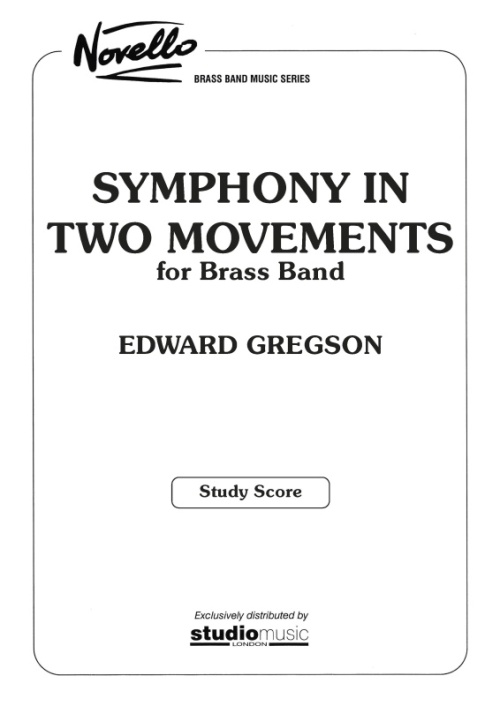
Symphony in Two Movements (Study Score Only)
Selected as the Championship Section test piece for the National Brass Band Championships of Great Britain 2025This work was jointly commissioned by the National Youth Brass Band of Great Britain (NYBBGB) and the National Youth Brass Band of Wales (NYBBW), the latter with funding from T Cerdd (Music Centre Wales), to celebrate their 60th and 30th anniversaries respectively. The first performances were given at Cadogan Hall, London, in April 2012, by the NYBBGB, conducted by Bramwell Tovey; and at the Great Hall, Aberystwyth University, in July 2012, by the NYBBW, conducted by Nicholas Childs.When I was approached about a joint commission to write a new work to celebrate the anniversaries of these two outstanding youth bands I was delighted to accept, and decided to respond by writing a work apposite for the magnitude of these special occasions, namely a 'symphony for brass'.Through a long journey of writing music for brass band, which commenced with Connotations (1977), and continued with Dances and Arias (1984), Of Men and Mountains (1991), The Trumpets of the Angels (2000) and Rococo Variations (2008), I arrived at what I regard as the most important work of the cycle to date, combining as it does serious musical intent with considerable technical demands. It is perhaps my most abstract work for brass band, avoiding any programmatic content.The symphony lasts for some 19 minutes and is structured in two linked movements. The form is based on that used by Beethoven in his final piano sonata (Op.111), which is in two movements only: a compact sonata-form allegro, followed by a more expansive theme and four variations. Prokofiev also adopted this model in his 2nd Symphony of 1925.The opening Toccata of this Symphony is highly dramatic but compact, whilst still retaining the 'traditional' structural elements of exposition, development and recapitulation; indeed, it also has the 'traditional' element of a contrasting second subject - a gentle, lyrical modal melody first heard on solo cornets.In contrast, the longer and more substantial second movement Variations is built around a theme and four variations. The slowly unfolding chorale-like theme accumulates both added note harmony and increasing instrumentation, whilst the four variations which follow are by turn mercurial (fast, starting with all the instruments muted), march-like (menacing, with short rhythmic articulations underpinning an extended atonal melody), serene (a series of 'romances' for solo instruments alongside echoes of the chorale) with an emerging theme eventually bursting into a climax of passionate intent; whilst the final variation is a dynamic scherzo (concertante-like in its series of rapid-fire solos, duets, trios and quartets) with the music gradually incorporating elements of the main ideas from the first movement, thus acting as a recapitulation for the whole work. It reaches its peroration with a return to the very opening of the symphony, now in the 'home' tonality of F, and thus creating a truly symphonic dimension to the music.Most of the melodic material of the symphony is derived from the opening eleven-note 'row', which contains various intervallic sets, and although the work is not serially conceived it does use some typical quasi-serial procedures, such as canons, inversions, and retrogrades. The symphony uses somewhat limited percussion, in line with a 'classical' approach to the sound world of the brass band, alongside a use of multi-divisi instrumentation, whereby each player has an individual part rather than the traditional doubling within certain sections of the band.- Edward GregsonDuration: 19.00
Estimated dispatch 7-14 working days
-
 £7.99
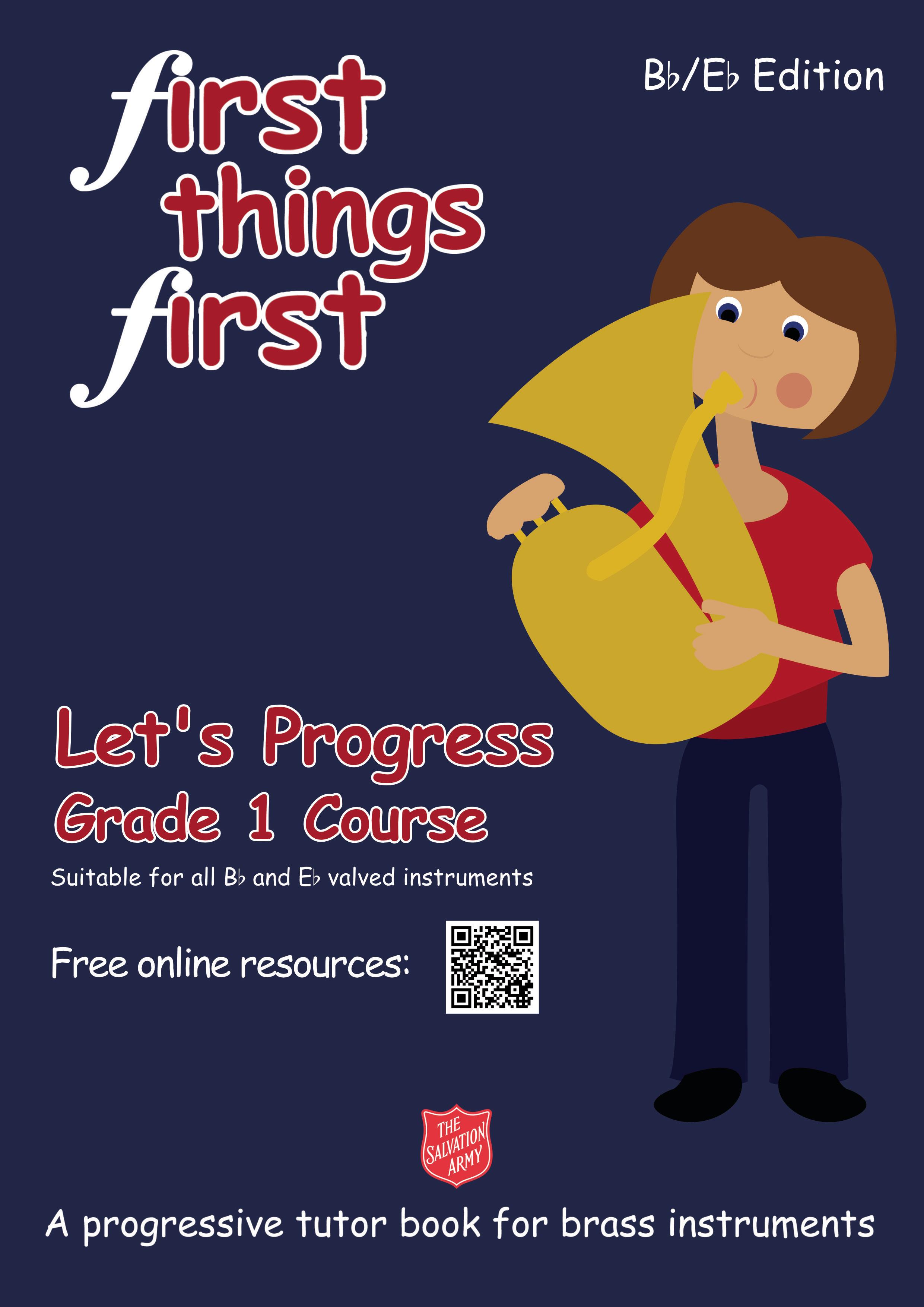
First Things First - Let's Progress (Grade 1 Course) Bb/Eb Edition
Let's Progress (Grade 1 Course) extends the range to middle C and sets out to provide beginners with the basic essentials, preparing them to tackle some of the challenges they will meet in their first experience of playing in a band.Includes link to downloadable resources including backing and demonstration tracks, online course assessment sheets and personalised course certificates.In this book you will meet:new notes, extending you rage both higher and lowernew rhythms, 3/4 timesharps, flats and key signaturesslurringquavers
Estimated dispatch 7-14 working days
-
£70.00
First Things First - Let's Progress (Grade 1 Course) Bb/Eb Edition (Pack of 10)
Let's Progress (Grade 1 Course) extends the range to middle C and sets out to provide beginners with the basic essentials, preparing them to tackle some of the challenges they will meet in their first experience of playing in a band.Includes link to downloadable resources including backing and demonstration tracks, online course assessment sheets and personalised course certificates.In this book you will meet:new notes, extending you rage both higher and lowernew rhythms, 3/4 timesharps, flats and key signaturesslurringquavers
Estimated dispatch 7-14 working days
 View Music