
Results
-
 £38.95
Unity Series Band Journal October 2017 Numbers 458-461
March Medley I Believe (Noel Jones)This potpourri of songs brings the strong assurance of faith and hope together in an attractive and enjoyable manner. The tunes featured are 'I believe we shall win', 'I believe God answers prayer', 'I believe in God the Father' and 'I believe in the word of God'.Horn Solo - Promises (Jorgen Ljserdorn)This is a brass setting of a song by Captain Matthew Spencer with the same title. The contemporary setting is simple in design and should prove to be popular amongst many who feature this journal.Suite Like a melody (Steve Forman)Major Stephen Foreman has written a short suite which will bring an easy yet attractive addition to most band's repertoire. I am praying (Jared Proellocks)A contemporary setting of the much loved chorus 'I am praying blessed Saviour' written by a young Salvationist from the Australian Southern Territory.
Estimated dispatch 7-14 working days
-
 £70.00
General Series Band Journal August 2017 Numbers 2170-2173
Praise to the Lord! (Andreas Holmund)A joyful and exuberant setting of the tune 'Lobe den Herren' which will be popular amongst many groups looking for an exciting programme item.Carol of the bells (Warren Brookes)The 'Carol of the bells' is an extremely popular and much used carol. This setting will bring a useful addition to the Christmas repertoire and is arranged by a Salvationist from Australia.Breathe on me (Paul Drury)This work is based on the 'Sing to the Lord' setting by Mark Porter which has proved popular amongst many vocal groups. It is hoped that this developed setting will enhance its popularity.March Cedarlights (Norman Bearcroft)Lt. Colonel Norman Bearcroft provides a march with all his hallmarks of energy and rhythmic and melodic interest. The march was written as a tribute to the International College for Officers and features the tunes 'Joy, joy, joy there is joy in The Salvation Army', 'They shall come from the East' and 'The World for God' reflecting the internationalism of the College.
Estimated dispatch 7-14 working days
-
 £50.00
Triumph Series Band Journal July 2017 Numbers 1287-1290
March - AFB Celebrations (Steven Ponsford)Originally written for the 15th anniversary of the Aukland Fellowship Band this march abounds in energy. It features the traditional Maori tune 'Hine e Hine' and the ever popular song 'Ill go in the strength of the Lord'.My Jesus I love thee (Kevin Downing)Having written a beautiful and thoughtful setting of this popular tune, this works introduces a new composer to our journals. Kevin Downing is a young American Salvationist and this piece was originally written for the National Capitol and Virginia Divisional Youth Band.Some day (1) (Kenneth Downie)A reflective yet lifting setting of the song as titled by Dr. Kenneth Downie.Trombone Solo Silent Night (2) (David Rowsell)This is a simple setting which should be accessible for most Trombone Soloists to feature within the Christmas season.Christmas Bells (Noel Jones)This collection of carols features 'Sweet chiming Christmas bells, sweet chiming bells' and 'Ding dong merrily on high!'
Estimated dispatch 7-14 working days
-
 £70.00
General Series Band Journal April 2017 Numbers 2166-2169
Festival March - Faith on track (Andrew Blyth)Originally written for the Peterborough Citadel Band where the composer is the Bandmaster. This march features 'This train is bound for Glory' and 'The Gospel Train' in reference to the association with the City of Peterborough and its strong links with the Railway. Also found is the song 'Share your faith' which speaks of the evangelistic nature of the Corps and its people.Flashpoint (Martin Cordner)Written for The Melbourne Staff Band and featured at the Boundless Congress in 2015, the 'John Williams type' main theme is supplemented with an exciting setting of the song 'I'll stand for Christ'.Wells (Sam Creamer)A simple hymn tune arrangement based on the title of the work.All your anxiety (Brian Hogg)The tune 'All your anxiety' has been given a developed and thoughtful setting by Australian Salvationist Brian Hogg.
Estimated dispatch 7-14 working days
-
 £50.00
Triumph Series Band Journal March 2017 Numbers 1283-1286
March - Proud to serve (Ray Steadman-Allen)One of the last works written by Lt. Colonel Ray Steadman-Allen and dedicated to the Chatham Corps, this march was featured by the International Staff Band at the composers tribute evening at the Adrian Boult Hall in Birmingham in 2015. The tunes featured are 'By the pathway of duty' and 'Marching Along'.Song Setting - His Grace! (Noel Jones)Noel Jones has for many years provided music of an attractive and accessible nature. This beautiful setting of the Herbert Booth song 'The Penitent's plea', along with touches of Major Howard Davies' song 'The wonders of his grace' will be a powerful addition to any bands repertoire.Song Arrangement - Blood of the Lamb (Ian Feltwell)Here is a bright setting of the old tune 'Are you washed?' which will provide many with a popular item for festival use.March - Makeover (Andreas Holmund)A bright and attractive work by Swedish Salvationist composer Andreas Holmund brings a traditional march with excellent harmonic and melodic interest.
Estimated dispatch 7-14 working days
-
 £38.95
Unity Series Band Journal February 2017 Numbers 450 - 453
Prelude - A promise (Ruben Schmidt)This bright energetic opener by a young German Salvationist composer features the tune 'Standing on the promises'.My Saviour (Graham Robinson)This is a lively setting of the contemporary song 'When I was lost' and the more traditional 'The Saviour sought and found me' which will give a helpful addition for bands looking for a bright number for their repertoire.Meditation - Boundless Grace (Andrew Blyth)The song 'Lord, I hear of showers of blessing' is the basis of this more traditional style meditation based around the tune 'Even Me'.March - Fired Up! (Martin Cordner)Written for the 130th anniversary of the Woodbridge Corps, this simple yet engaging march brings the tune 'Whitechapel' associated with the song 'Near the cross assembled, Master' with verse three being its focus for the work - "Fire that turns men into heroes".
Estimated dispatch 7-14 working days
-
 £70.00
General Series Band Journal December 2016 Numbers 2162 - 2165
No. 2162 Coronation Fanfare and Intrada (Kenneth Smith)Numerous Scripture verses refer to Jesus as 'King of Kings and Lord of Lords'. In addition, he is described in Revelation 5:13, 7:10 and 21:15 as 'the Lamb who sits upon the throne'. Furthermore we're told in Philippians 2:10-11 that one day 'every knee will bow...and every tongue confess that Jesus Christ is Lord'. This arrangement celebrates Jesus' heavenly coronation, bringing together two well-known hymns inviting us to crown Jesus as King.No. 2163 Telling It! (Sam Creamer)A lively, salsa setting of Sidney Cox's well-known song, 'I want to tell what God has done'.No. 2164 The Christ of Calvary (Mervyn Clarke)This arrangement of the much-loved tune 'Annie Laurie', is often associated with Nathan Atkinson Aldersley's words to 'The Christ of Calvary'.No. 2165 Festival March - The Return (Ray Steadman-Allen)The Return was written for the occasion of Chatham corps returning to its refurbished hall.
Estimated dispatch 7-14 working days
-
 £50.00
Triumph Series Band Journal November 2016 Numbers 1279-1282
No. 1279 March - In the fellowship (Stephen Bulla)This march was written at the request of Bandmaster Jamie Hood who commissioned the piece for the 125th Anniversary of his home corps band at Basel 1 Corps. Within the march are two well-loved songs from the SA's Swiss song book, both of which are still sund frequently at the corps.No. 1280 Shout and sing! (Steven Ponsford)This light-hearted, lively piece of music is based on David Fellingham's song 'Shout for joy and sing your praises to the King'.No. 1281 (1) Sweet hour of prayer (trs. Doug Engle)Prayer offers us an opportunity to communicate with the Lord. The words of this hymn invite us to bring our concerns to a God who listens. As you listen to this arrangement, take time to reflect on how God has remained faithful through times of peace and distress.No. 1281 (2) The Lord bless you and keep you (arr. Andrew Wainwright)Peter Lutkin's beloved choral benediction is well known in vocal circles. Here it is given a simple treatment that it is hoped will inspire prayer reflection and renewed confidence in God's protection and guidance.No. 1282 March - I serve a risen Saviour (Noel Jones)This Easter march features the following songs: 'Look, ye saints! the sight is glorious' and 'I serve a risen Saviour'. The motif 'I serve a risen Saviour' is used throughout the first section of this march.
Estimated dispatch 7-14 working days
-
 £38.95
Unity Series Band Journal October 2016 Number 446 - 449
Estimated dispatch 7-14 working days
-
 £45.00
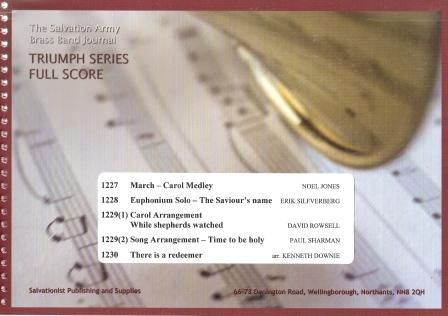
Triumph Series Band Journal July 2012 Numbers 1227 - 1230
No. 1227 March - Carol Medley (Noel Jones)This march features three carols, 'God rest ye merry, gentlemen', Hark! The herald angels sing' and 'Deck the Hall' together with brief references to others in a medley form. A couple of these references are somewhat camoflaged which provides further interest.No. 1228 Euphonium Solo - The Saviour's Name (Erik Silfverberg)A setting of Jane Clarke's lovely melody set to familiar words, 'There is a name I love to hear'.No. 1229 (1) Carol Arrangement - While shepherds watched (David Rowsell)A four-verse setting of the 16th Century tune, 'Winchester Old' commonly associated with the carol, 'While shepherds watched their flocks by night'.No. 1229 (2) Song Arrangement - Time to be holy (Paul Sharman)This arrangement of George Cole Stebbins' tune was originally made for the 2010 World Youth Convention in Sweden, the theme of which was 'Time to be holy'.No. 1230 There is a redeemer (Kenneth Downie)Melody Green-Sievright's popular song, 'There is a redeemer' was first published in 1982, 30 years before the appearance of this new setting.
Estimated dispatch 7-14 working days