
Results
-
 £15.00
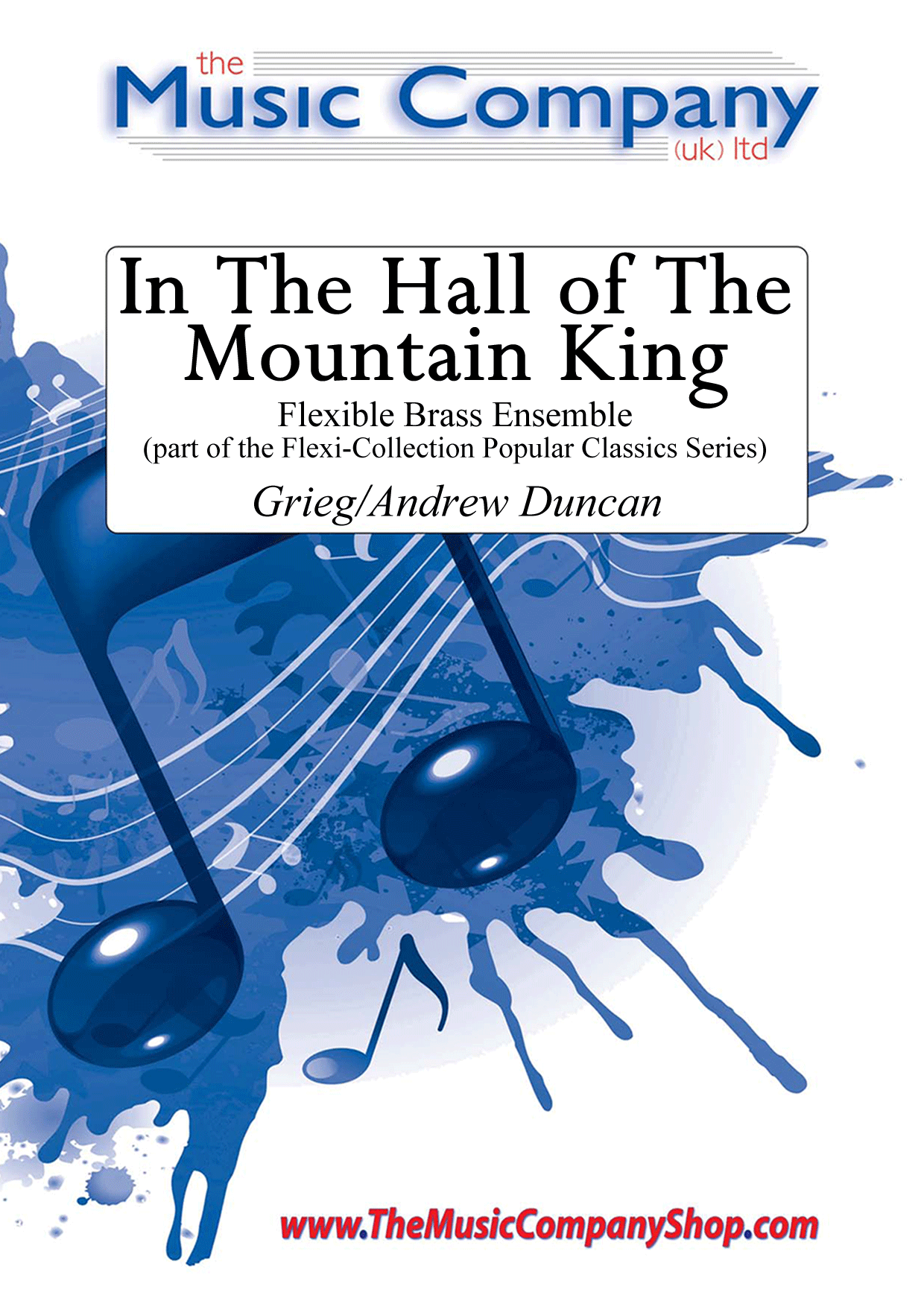
In the Hall of the Mountain King - Grieg
Performance Notes from Andrew Duncan:This arrangement is fairly difficult for inexperienced players and is without doubt one of the most difficult in the Flexi-Collection Popular Classics Series. But, as it is such a popular piece there is normally a great incentive from the players to learn the piece, despite the difficulties.The accelerando and gradual increases in tempo which are integral to this piece are in themselves very important musical ideas for new players to grasp, and these will be better understood as a result of playing and learning this arrangement.Other features found in this arrangement which may be new to some inexperienced players are the use of tin mutes in the 1st Cornet/Trumpet part, and the falling chromatic notes (accidentals) found in the melody line. Also, the wide range of dynamics, pp - ff , may be new to some players.I have deliberately not suggested any specific metronome markings as this is very much up to the conductor and is dependant on the players' abilities. However, as the arrangement becomes more familiar, the tempo could no doubt be speeded up adding to the excitement of future performances.The Flexi-Collection ApproachFlexible scoring tailored to your needs - A perfect solution for expanding the repertoire of training and junior brass bands. The Flexi-Collection currently offers two series - Popular Classics and World Tour. Based on four-part harmony, these collections provide groups with the advantage of complete flexibility when they may not be balanced. If players or instruments are missing, the show can still go on!The Flexi-Collection - Popular Classics Series, encapsulates all that is great about the wonderful range of musical styles produced by Holst, Elgar, Handel, Verdi, Tchaikovsky, Grieg, Bizet and Parry.The thoughtful scoring and arranging by Andrew Duncan now means that groups of all abilities have access to a truly flexible set of music for their needs. With world parts, rudimentary theory, terminology translations and large format typesetting, The Flexi-Collection ticks all the boxes when it comes to bringing interesting music to the training and junior band/brass group environment.Available individually or as part of the money-saving Flexi-Collection Popular ClassicsAlbum.Scored for Brass Band and supplied with additional Easy Bb, Easy Eb and world parts - The Flexi-Collection offers flexibility in every sense of the word.
In Stock: Estimated dispatch 3-5 working days
-
 £49.95
Variations - Andrew Lloyd Webber arr. Peter Graham
There are numerous sets of variations based on Paganinni's famous violin piece, but surely this is the only one written as the result of a wager on a football match! The composer wrote these variations for his cello-playing brother Julian in payment of a bet on a Leyton Orient match and they later formed part of the show Song and Dance. Peter Graham's arrangement of some of the best-loved sections ideally suits the euphonium.
Estimated dispatch 7-9 working days
-
 £4.95
£4.95Variations (Euphonium Solo) (Score and Parts) - Andrew Lloyd Webber arr. Peter Graham
There are numerous sets of variations based on Paganinni's famous violin piece, but surely this is the only one written as the result of a wager on a football match! The composer wrote these variations for his cello-playing brother Julian in payment of a bet on a Leyton Orient match and they later formed part of the show Song and Dance. Peter Graham's arrangement of some of the best-loved sections ideally suits the euphonium.
Estimated dispatch 7-9 working days
-
 £55.00
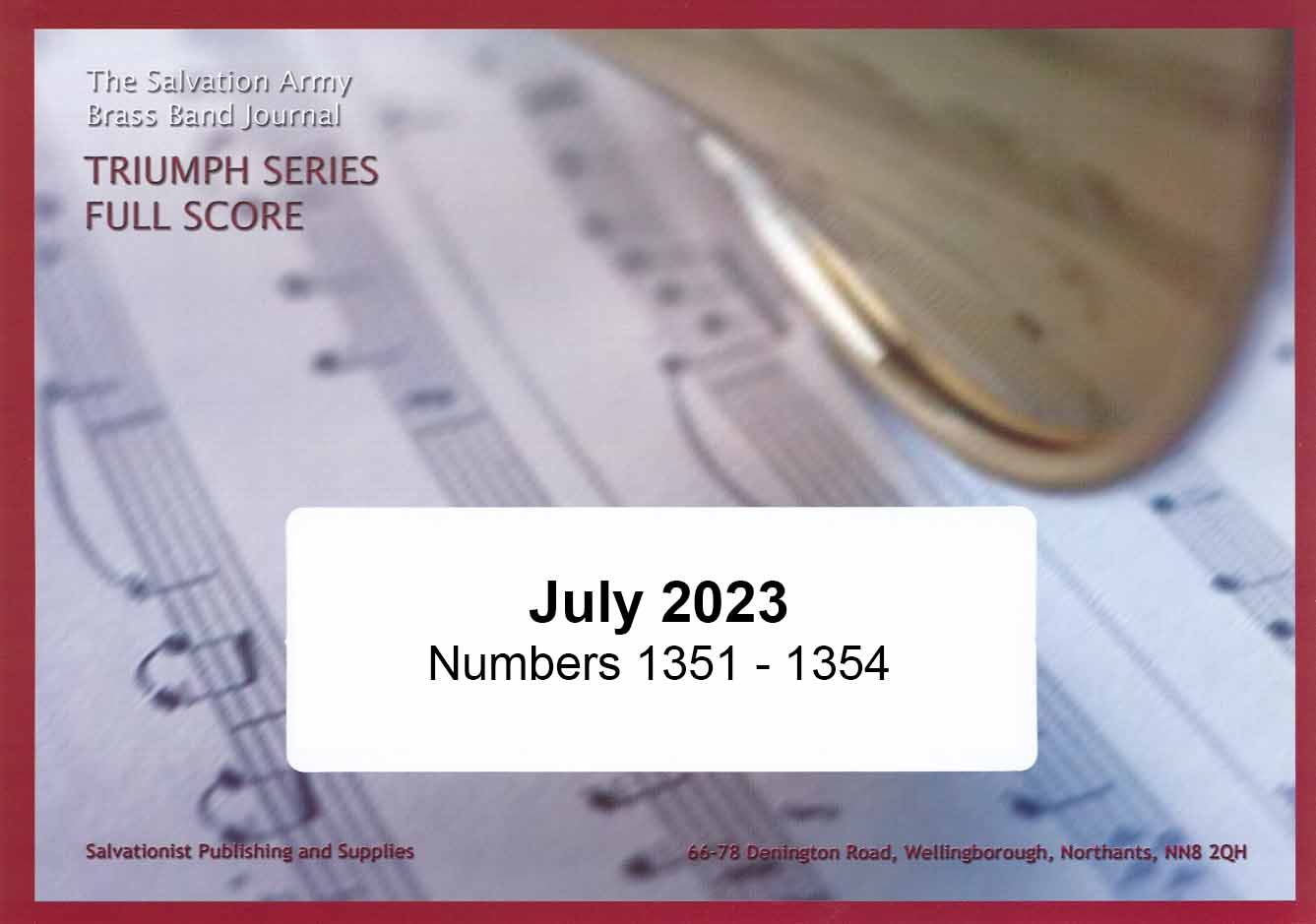
Triumph Series Brass Band Journal, Numbers 1351 - 1354, July 2023
1351: The anointed King (Marcus Venables)This piece was originally written as a massed band item for the Ontario Central-East Divisional Music Day in 2019. The updated version includes two songs, King of kings, majesty (S.A.S.B. 376) and O worship the King (S.A.S.B. 52) to a rhythmic setting of the tune Laudate Dominum (T.B. 481). Both songs present the contrasting characteristics of God; the powerful King and gentle, loving Saviour.1352: A suite of English Christmas carols (Kenneth Downie)This suite is the result of a request for a piece of music featuring exclusively English Christmas carols.The first movement features The holly and the ivy (C.C. 87). In sharp contrast, the second movement calls for a broad, sensitive, song-like approach. Using The cherry tree carol (C.C. 85), a much slower tempo than is normally applied to encourage the listener to see this beautiful tune in a new light. The rumbustious arrival of the finale is based on I saw three ships come sailing in (C.C. 44) with the festive mood prevailing until the end.1353: Nothing but thy blood (Norman Bearcroft)This two-verse setting of Richard Slater's much-loved hymn Nothing but thy blood (S.A.S.B. 769) appears straight-forward in nature, but requires a careful sense of the musical line across all parts.1354: Meditation - Reflections on Advent (Andrew Blyth)Two well-known carols, Away in a manger (C.C. 12) and Silent Night! (C.C. 77) are featured alongside original material. The piece attempts to convey a sense of reflection and meditation on the wonderful and awe-inspiring Advent story.
Estimated dispatch 7-14 working days
-
£74.95
Second Suite in F (Score and Parts)
During Holst's earlier years as a composer, he took interest, as did many other English composers at the time, in writing pieces based on folk music. His contemporary Ralph Vaughan Williams had written his English Folk Song Suite, all based on English folk tunes. Holst followed suit and composed the Second Suite as a result. Six tunes are compressed into the four movements of the suite, each with their own character.The Second Suite consists of movements based on specific English folk songs
Estimated dispatch 7-14 working days
-
£32.95
Second Suite in F (Score Only)
During Holst's earlier years as a composer, he took interest, as did many other English composers at the time, in writing pieces based on folk music. His contemporary Ralph Vaughan Williams had written his English Folk Song Suite, all based on English folk tunes. Holst followed suit and composed the Second Suite as a result. Six tunes are compressed into the four movements of the suite, each with their own character.The Second Suite consists of movements based on specific English folk songs
Estimated dispatch 7-14 working days
-
 £33.62
My Bonnie - Brass Band (Kenneth Downie)
VIEW SCORE PDF This three-minute fantasy waltz was commissioned by John Ward, conductor of Fulham Brass Band, to celebrate the first birthday of his daughter, Bonnie. The result is a work that is full of Kenneth Downie's customary imagination and musical signatures. Based on the Scottish folk song My Bonnie lies over the ocean, there is also a subtle reference to Away in a Manger to signify Bonnie's Christmas Day arrival. For a follow-the-score video based on a performance by Brass Band Willebroek, please visit: https://www.youtube.com/watch?v=SKNd_ocryZY PDF download includes score and full set of parts. Sheet music available from: UK - www.brassband.co.uk USA - www.solidbrassmusic.com Difficulty Level: 2nd Section + Instrumentation: Soprano Cornet Eb Solo Cornet Bb Repiano Cornet Bb 2nd Cornet Bb 3rd Cornet Bb Flugel Horn Bb Solo Horn Eb 1st Horn Eb 2nd Horn Eb 1st Baritone Bb 2nd Baritone Bb 1st Trombone Bb 2nd Trombone Bb Bass Trombone Euphonium Bb Bass Eb Bass Bb Timpani Glockenspiel Percussion
In Stock: Estimated dispatch 1-3 working days
-
 £55.00
Mary Did You Know?
ABOUT THIS PIECE: Upon being asked to write a Christmas musical for his church, Mark Lowry penned a series of monologues based on Christmas Songs including a conversation with Mary about the birth and life of her Son, Jesus. Lowry worked on the lyrics for years until he approached southern gospel singer-songwriter and harmonica player, Buddy Greene. Greene agreed to pen music for his words, completing the instrumentation within a few days. The result is this new-age Christmas classic: 'Mary Did You Know". ENSEMBLE: Standard British Brass Band WHEN YOU BUY THIS PRODUCT, YOU GET: High-quality printed score and parts LEVEL: 2 LISTEN: Listen here DURATION: 4-minutes 30-secondsEXAMPLE SCORE: Click here LEVEL GUIDE: Level 1- Accessible to all Level 2 - c. UK third section and higher Level 3 - c. UK second section and higher Level 4 - c. UK first section and higher Level 5 - c. UK championship section level .
Estimated dispatch 5-7 working days
-
The Wombles Song - Mike Batt - Len Jenkins
The Wombles are fictional pointy-nosed, furry creatures that live in burrows, where they aim to help the environment by collecting and recycling rubbish in creative ways. They were created by author Elisabeth Beresford, and originally appeared in a series of children's novels from 1968 that featured the inhabitants of a burrow on Wimbledon Common in London, England.The characters gained a higher national profile in the UK in the mid-1970s as a result of a BBC commissioned children's television show, and a number of spin-off novelty songs also became hits in the British music charts. The Wombles pop group was the idea of British singer and composer Mike Batt who wrote the series' theme tune, and who went on to perform and produce a number of successful albums and singles with 'The Wombles'.This is a brass band arrangement of that well-known theme tune. Caution! This may provoke a sing-along.
-
 £44.95
Triumphant (Brass Band - Score and Parts)
Triumphant was written as the opening work for the 2024 Future All-Stars final concert. Based on the well-known hymn Victory in Jesus (S.A.S.B. 464), the piece reimagines the familiar melody and words with energetic drumline-inspired rhythms and driving Bass groove.O victory in Jesus, my Saviour, for ever!He sought me and bought me with his redeeming blood;He loved me ere I knew him, and all my love is due him -He plunged me to victory beneath the cleansing flood.Musically speaking, the rhythmic pulse should remain confident and consistent throughout, with the percussion establishing the groove and the band locking in with precision. Take time to find a tempo that allows the Bass and Percussion parts to remain clear and accurate. A slightly steadier pace will produce a stronger, more convincing groove. However, a slower tempo can result in the band's playing becoming too heavy. Melodic lines should be played on the longer side, allowing phrases to sing over the rhythmic accompaniment that can be more defined and articulated. As the work builds, be patient and disciplined with dynamics, saving the band's fullest sound for the climactic moments, maximising their impact.
Estimated dispatch 7-14 working days