
Results
-
£35.00
Lament (from Macbeth) - Peter Meechan
Macbeth was commissioned by the Scottish Brass Band Association for the 2007 Scottish Open Championship, and takes its' inspiration from the Shakespeare play of the same name.The Lament is the central, emotional core to the work. Although the play tells of Macbeth not feeling the pain of his wife's death, this lament ponders not only her death, but the tale as a whole.
Estimated dispatch 12-14 working days
-
 £29.72
Coventry Carol (Brass Band) Traditional arr. Stephen Tighe
VIEW SCORE PDFThe Coventry Carol is an English Christmas carol dating from the 16th century. The carol was traditionally performed in Coventry as part of a mystery play called The Pageant of the Shear Men and Tailors.The play depicts the Christmas story from chapter two in the Gospel of Matthew: the carol itself refers to the Massacre of the Innocents, in which Herod ordered all male infants under the age of two in Bethlehem to be killed, and takes the form of a lullaby sung by mothers of the doomed children.Stephen Tighe has here given this well loved tune an update to allow it to appeal to a broad audience.Sheet music available from:UK - www.brassband.co.ukUSA - www.solidbrassmusic.comDifficulty Level: 4th Section +Instrumentation:Soprano Cornet EbSolo Cornet BbRepiano Cornet Bb2nd Cornet Bb3rd Cornet BbFlugel Horn BbSolo Horn Eb1st Horn Eb2nd Horn Eb1st Baritone Bb2nd Baritone Bb1st Trombone Bb2nd Trombone BbBass TromboneEuphonium BbBass EbBass BbPercussion 1-3
In Stock: Estimated dispatch 1-3 working days
-
 £35.00
A Suffolk Prelude - Andrew Duncan
Written for the Ipswich & Norwich Co-Op Band, A Suffolk Prelude is based around five traditional tunes from Suffolk:'Nutting Time','Blackberry Fold','Cupid's Garden','A Seaman's Life''The Bold Richard'The piece begins on the percussion and timpani alone leading through a crescendo into the first statement of the fanfare which is derived from a motif from the tune 'Nutting Time'. This leads into a playing of the 'Nutting Time' tune which is then developed as the tune is passed around the band.'Nutting Time' is a jolly lighthearted tune about a 'fair maid' who meets a handsome young farmer called 'Johnny' when out gathering nuts in the wood. After a pause on the tubular bells the slow tune 'Blackberry Fold' is presented as a solo for Flugel Horn, then as a full band version.'Blackberry Fold' is a touching song about a Suffolk squire who gets married well below his station to a beautiful milkmaid, simply because he loves her! They live happily ever after.The next tune to be heard is the juanty 'Cupid's Garden' played firstly as a solo on the Euphonium, and again this is about the subject of love. This song is sung from a sailors prospective and he tells how he met a lovely maiden and has promised to marry her when he returns from duty at sea.The trombones then play the noble tune 'A Seaman's Life'. This tune seems to serve as a warning to young girls about the fickle nature and the total unsuitability of marrying a sailor! 'Oh a seaman's life is a merry merry life, they'll rob young girls of their heart's delight, they will leave them behind for to sail one morn, but they never know when they'll return'. Despite this it is a fine tune!The last tune featured is 'The Bold Richard' which is played by all the bass instruments in the band. This is a song telling how the Royal Navy friggate 'The Bold Richard' went to battle against a French friggate destroying her and taking her crew as prisoners.Suffolk Prelude goes on to feature a slow version of the tune 'A Seaman's Life' played alongside a fast version of the tune 'Cupid's Garden'. The opening fanfare then returns leading into a final coda section.
In Stock: Estimated dispatch 3-5 working days
-
 £29.72
Fanfare from La Peri (Brass Band) Dukas arr. Rob Bushnell
La Peri is a one-act ballet by the French composer Paul Dukas, best known for The Sorcerer's Apprentice (L'apprenti sorcier) as in the 1940 Disney film Fantasia. Dukas was commissioned to write La Peri by the Ballets Russes, producing a Poeme danse en un tableau ('dance poem in one scene') in 1911; this become his last published work.With Natalia Trouhanova due to play the Peri and Vaslav Nijinsky to play Iskender (the name of Alexander the Great in Persian, who is scouting around Iran in search of the Flower of Immortality), the production was ultimately cancelled because Serge Diaghilev feel Trouhanova was not a skilled enough dancer to be partnered to Nijinsky. Trouhanova later hired Ivan Clustine to choreograph the music, with the ballet premiering at the Theatre du Chatelet in Paris on 22 April 1912.The brilliant fanfare that precedes the ballet is often performed separately and is the arrangement available here. Arranged for British-style brass band, it has optional percussion parts as well as alternative parts for horns in F and bass-clef lower brass. The piece has been lowered by a tone compared to the original.A recording of the original composition can be found here: www.youtube.com/watch?v=7EDekMos1ok.Duration: Approx. 2 minutesDifficulty Level: 2nd Section +Duration: 4 or 5 minutes (depending on tempo and without any cuts)PDF download includes parts and score.Sheet music available at www.brassband.co.uk (UK) or https://satradecentral.org (USA)Instrumentation:Soprano Cornet EbSolo Cornet BbRepiano Cornet Bb2nd Cornet Bb3rd Cornet BbFlugel Horn BbSolo Horn Eb1st Horn Eb2nd Horn Eb1st Baritone Bb2nd Baritone Bb1st Trombone Bb2nd Trombone BbBass TromboneEuphonium BbBass EbBass BbTimpaniPercussion 1 - Snare DrumPercussion 2 - Bass Drum & Cymbal
In Stock: Estimated dispatch 1-3 working days
-
 £29.72
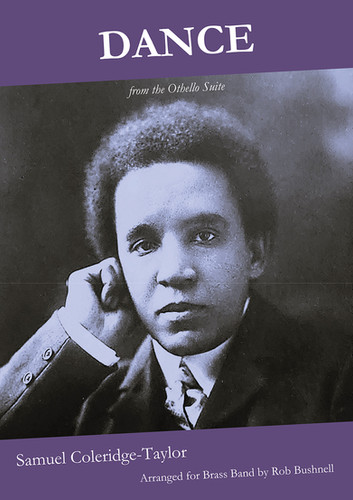
Dance from the Othello Suite (Brass Band) Coleridge-Taylor arr. Bushnell
Samuel Coleridge-Taylor is a British composer, who, from a young age, showed talent on the violin and entered the Royal College of Music, studying with Charles Villers Standford. His music become so popular that his Hiawatha trilogy was the second most performed choral piece (joint with Mendelssohn's Elijah, and only beaten by Handel's Messiah) with choral societies up and down the British Isles. In fact, Hiawatha was arranged by Charles Godfrey as a test-piece for the 1902 National Brass Band Championship of Great Britain, held at Crystal Palace.Commissioned by the theatre impresario Herbert Beerbohm, Coleridge-Taylor composed incidental music for His Majesty's Theatre London production of the Shakespeare play, Othello, in the West End, in 1909. In 1912, the play opened to the public, with a suite of five movements put together soon afterwards. The Dance, arranged here by Rob Bushnell, makes a great concert opener.This arrangement is for the British-style brass band, with alternative parts for horns in F and bass-clef lower brass.A recording of the original composition can be found at www.youtube.com/watch?v=OQeO_Ij9CV8Duration: approx. 2.30 minutesDifficulty Level: 3rd Section +PDF download includes parts and score.Sheet music available at www.brassband.co.uk (UK) or https://satradecentral.org (USA)Instrumentation:Soprano Cornet EbSolo Cornet BbRepiano Cornet Bb2nd Cornet Bb3rd Cornet BbFlugel Horn BbSolo Horn Eb1st Horn Eb2nd Horn Eb1st Baritone Bb2nd Baritone Bb1st Trombone Bb2nd Trombone BbBass TromboneEuphonium BbBass EbBass BbTimpaniPercussion - Triangle, Cymbal & Bass Drum
In Stock: Estimated dispatch 1-3 working days
-
 £15.00
Pomp and Circumstance No. 1 (Land of Hope and Glory) - Elgar
Performance Notes by Andrew Duncan:This fine march theme is arranged in two distinct parts.From the beginning up to two bars before letter C the melody is played quietly with the Horns carrying the tune - the Horns have to play up to a high F in this section. If this is not something that your band can manage then you have two options of where you can start playing the arrangement from.If your band can manage the chromatic notes, then begin playing from two bars before letter C. Alternatively, simply start playing directly from letter C .The musical concepts of Rallentando and A tempo are encountered in this arrangement. These can be difficult concepts for inexperienced players to grasp, so playing this arrangement should help to establish this technique.The Flexi-Collection ApproachFlexible scoring tailored to your needs - A perfect solution for expanding the repertoire of training and junior brass bands. The Flexi-Collection currently offers two series - Popular Classics and World Tour. Based on four-part harmony, these collections provide groups with the advantage of complete flexibility when they may not be balanced. If players or instruments are missing, the show can still go on!The Flexi-Collection - Popular Classics Series, encapsulates all that is great about the wonderful range of musical styles produced by Holst, Elgar, Handel, Verdi, Tchaikovsky, Grieg, Bizet and Parry.The thoughtful scoring and arranging by Andrew Duncan now means that groups of all abilities have access to a truly flexible set of music for their needs. With world parts, rudimentary theory, terminology translations and large format typesetting, The Flexi-Collection ticks all the boxes when it comes to bringing interesting music to the training and junior band/brass group environment.Available individually or as part of the money-saving Flexi-Collection Popular ClassicsAlbum.Scored for Brass Band and supplied with additional Easy Bb, Easy Eb and world parts - The Flexi-Collection offers flexibility in every sense of the word.
In Stock: Estimated dispatch 3-5 working days
-
 £66.88
Pyrenean Carol Suite (Brass Band) David Taylor
This attractive suite for brass band by David Taylor features five traditional carols from the Pyrenees region of Spain, as follows:i. Nadal Tindaire (Jingling Christmas) - Occitan traditionalThis Occitan Christmas song tells of musical instruments used to celebrate the Nativity - 'fifes and trumpets, timpani and pipes, or you, clear little bells, along with the angels' choir.'ii. Gabriel's Message (Birjina Gaztetto Bat Zegoen) - Basque traditionalThe most widely-known of the chosen carols, honouring Jesus's mother Mary, this is often sung in its English version, but the melody came from the Basque country. The Basque words were adapted from the Mediaeval song Angelus ad Virginem. Here, we feature the flugel horn. This movement was originally written on its own, with organ accompaniment, for the composer's wife, Diane Scott.iii. El Noi de la Mare (The Child of the Mother) - Catalan traditionalA beautiful Catalan carol celebrating the birth of Jesus, telling of the tasty gifts that the singer would bring - 'Raisins and figs and nuts and olives; Raisins and figs and honey and mato [a Catalan dessert cheese traditionally served with honey.]' Here we feature the euphonium. The tune was made famous by guitarist Andres Segovia, who used it as a favourite encore, and by John Rutter, who made a widely-used setting for choir.iv. Paure Satan (Poor Satan) - Occitan traditionalThis rather unusual carol tells of the pain that Satan is put to by the arrival of the infant Jesus. Its mocking and sarcastic tone is reflected here, where the tuba soloist (as Satan) is given musical trouble throughout by the other parts. At first they conflict with the soloist, then the soloist makes overtures of friendship, which are treated with suspicion followed by contempt. The soloist finally gives in to their accompaniment (or do they?). There are plenty of opportunities for little theatrical touches here, if the tuba player is so inclined! The tuba part in this movement is notably more difficult than the rest of the music, and a number of optional changes have been marked to make the part easier to play, if so desired. The player is also welcome to add suitable extra embellishments to taste if they wish, within the character of the music.v. Fum, Fum, Fum! - Catalan traditionalA favourite Catalan Christmas song for centuries, this rousing melody provides a fitting way to round off the suite, with its repeated rhythmic refrain of the nonsense title phrase. It tells of the Nativity, and then it tells of the celebratory feasting and good times that the singers look forward to to honour it.Although the suite is intended to be performed whole, it is also intended for usage with a selection of movements on occasions where a shorter piece is wanted. Suggested formats include a single movement alone (2, 3, and 5 are likely most appropriate), a pair of movements (any of the first four, plus 5), and a suite of three or four movements (1 and 5, plus one or two of 2, 3, or 4 in the middle). It is suggested that a good way to design a 'pick-your-own-suite' from the movements is to think of the earlier movements as introductory to the final movement.To view a rolling score video featuring Kidlington Concert Brass please visit www.youtube.com/watch?v=QIGdul-yxxgPDF download includes score and parts.Sheet music available from:UK - www.brassband.co.ukUSA - https://satradecentral.orgDifficulty Level: 3rd Section +Length: 9.45 minutesInstrumentation:Soprano Cornet EbSolo Cornet BbRepiano Cornet Bb2nd Cornet Bb3rd Cornet BbFlugel Horn BbSolo Horn Eb1st Horn Eb2nd Horn Eb1st Baritone Bb2nd Baritone Bb1st Trombone Bb2nd Trombone BbBass TromboneEuphonium BbBass EbBass BbTimpaniPercussion 1-2
In Stock: Estimated dispatch 1-3 working days
-
 £30.00
A Rachmaninoff Prelude - Rachmaninoff
An arrangement by Tim Paton of this Rachmaninoff favourite for brass band.Comments from Tim:I first heard the Rachmaninoff Prelude in G minor when my brother, (Dr) Rod Paton, used to play it on the piano. The martial sound of the opening theme caught my imagination, and I knew then that this piece would sound magnificent if played by a brass band - if you like the music of Rachmaninoff, then you will love this piece! That spectacular sound that we all know, with busy, melodic bass lines, and a middle section in his well known 'romantic' style - I could already hear the euphonium playing those rippling arpeggios. In response to the enthusiasm for this magnificent piece, I have lightheartedly commented that maybe he wrote it for brass band, but there wasn't one available, so he did it for piano instead!Look and Listen (Score-reading digital sound sample):
In Stock: Estimated dispatch 3-5 working days
-
 £25.00
BA-Rock - Steve Robson
This can definitely be described as a fun piece from Steve Robson, with a bit of clever styling thrown in for good measure!With an initial, melodious theme written in the style of a 'Baroque' composition, it is then recreated in a modern 'Rock' idiom, joining the two extremes and presenting a great little number to brighten your concert programme.Whilst this already demonstrates one instance of its play on words, it's also worth noting that this composition also formed part of the writer's portfolio for his BA degree!Whilst written withfour percussion parts of Timpani, Kit, Tambourine, Glockenspiel & Cow Bell, the tambourine part can be omitted if necessary.
In Stock: Estimated dispatch 3-5 working days
-
Off Duty - John Dankworth - Len Jenkins
The late John Dankworth (1927-2010) made a string of recordings in the 1960s that have since come to be regarded as some of the finest British jazz of their time. Amongst these is his composition 'Off Duty' which was recorded in the 1960s when the influence of pop and rock on jazz was at its height and instruments such as the bass guitar were beginning to be incorporated into jazz's vocabulary. At this time and almost subconsciously, a Dankworth 'pop' style also evolved. This was a balanced marriage between jazz and pop which is here demonstrated in 'Off Duty' thanks to the ingenious and original orchestration by John Dankworth, and the faithful arrangement for Brass Band by one of his fans, Len Jenkins. The title is interesting as John loved to play with words. 'Off Duty' could mean relaxing away from work, but could also carry the implication of something not attracting taxation.... a sort of 'duty-free'. About the same time, the Dave Brubeck Quartet produced the seminal 'Take Five'... so could this be John's take on that title, suggesting a short break? Which meaning fits best for you? The piece would best suit the capabilities of a brass band playing at the standard of Third Section or above.
 View Music
 Watch video