
Results
-
 £33.62
A Christmas Canon (Brass Band) Traditional arr. William Gordon
Seamlessly merging the traditional English carol The First Nowell with Johann Pachelbel's beloved Canon in D, A Christmas Canon is a captivating arrangement designed to bring rich texture and emotional depth to your band's winter concert repertoire. Suitable for intermediate to advanced bands, the piece opens Adagio sostenuto with a gently rolling, scalic ostinato in the euphonium and lower brass, establishing the unmistakable harmonic ground bass of Pachelbel's masterpiece. Over this foundation, expressive solo lines in the flugel and horns gracefully weave the familiar melody of The First Nowell into the texture. As the arrangement unfolds, the scoring gradually builds density and counterpoint. Intricate muted cornet passages give way to flowing arpeggios, bell-like glockenspiel accents, and cascading lines across the band, driving a gradual crescendo into a rich, full-ensemble statement of the carol theme. The work reaches its dramatic climax at an expanded Allargando section, where the full band, supported by percussion, delivers a majestic, fortissimo declaration of the melody before resolving into a warm, lingering final chord. To view a rolling score video of the Amsterdam Staff Band performing this piece please visit: www.youtube.com/watch?v=dr9hMLhAvRM Difficulty Level: 3rd Section + Duration: 3.30 minutes This PDF download includes the full score and parts. Sheet music available at www.brassband.co.uk (UK) or https://satradecentral.org (USA) Instrumentation: Soprano Cornet Eb Solo Cornet Bb 1st Cornet Bb 2nd Cornet Bb Flugel Horn Bb Solo Horn Eb 1st Horn Eb 2nd Horn Eb 1st Baritone Bb 2nd Baritone Bb 1st Trombone Bb 2nd Trombone Bb Bass Trombone Euphonium Bb Bass Eb Bass Bb Timpani Percussion 1-2
In Stock: Estimated dispatch 1-3 working days
-
 £37.35
A Fugal Overture (Brass Band) Gustav Holst arr. Rob Bushnell
A Fugal Overture was written in 1922 by Gustav Holst. It was first performed at the Royal Opera House, Covent Garden on 14 May 1923 and was used as an opening work to Holst's one-act opera The Perfect Fool. It received its concert premiere on 11 October 1923 at one of Henry Wood's Queen's Hall Promenade Concerts. It is an early example of neoclassicism and was influenced by the counterpoint of J. S. Bach, despite its unconventional use of the fugal process. Holst began writing the piece in the summer of 1922, having hoped to develop it into a ballet. It is divided into three sections, the fugal subject with its distinct 3+3+2 pattern, a slower section with solos at the end, and a third section where the subject returns. Although reviews of the piece were mixed at the time of its premiere, the likes of Adrian Boult have said it was "an invigorating work that could effectively start any [...] concert". In more recent years, it has been compared to John Adam's A Short Ride in a Fast Machine. This arrangement is for the British-style brass band, with alternative parts for horns in F and bass-clef lower brass. A recording of the original composition can be found here: www.youtube.com/watch?v=a8xfwJyFq2E. Duration: Approx. 5.40 minutes Difficulty Level: 1st Section + PDF download includes parts and score. Sheet music available from www.brassband.co.uk Instrumentation: Soprano Cornet Eb Solo Cornet Bb Repiano Cornet Bb 2nd Cornet Bb 3rd Cornet Bb Flugel Horn Bb Solo Horn Eb 1st Horn Eb 2nd Horn Eb 1st Baritone Bb 2nd Baritone Bb 1st Trombone Bb 2nd Trombone Bb Bass Trombone Euphonium Bb Bass Eb Bass BbTimpani Percussion 1-2
In Stock: Estimated dispatch 1-3 working days
-
 £52.30
A Renaissance Christmas (Brass Band) Kevin Norbury
VIEW SCORE PDF This magnificent festive suite was written by Kevin Norbury for the Pierre Elliott Trudeau High School Wind Symphony and features several well known carols set in a Renaissance style. Here it has been set for brass band. Three contrasting movements comprise the work: i. Processional (Personent hodie - On this day earth shall ring) This is a short piece imagining a torchlight Yuletide procession (perhaps bearing the traditional roasted wild boar), using a well-known Christmas melody from the large collection of music compiled in the 16th century called Piae Cantiones (1582). The tune is presented twice with accompanying, related melodic material. ii. Pastorale (Quem pastores laudavere - Shepherds sang their praises o'er him) This is a 14th-century melody which was originally collected by Michael Praetorius at the end of the 16th-century. The treatment throughout is very lyrical without overly complex harmonies. The melody is heard three times with brief linking episodes and a short coda. iii. Celebration! (In dulci jubilo - In sweet celebration - Ding-dong merrily on high)) This magnificent 13th-century melody was also a part of Michael Praetorius's collection. It is traditional associated with the words 'Good Christian men, rejoice!' The opening is a straight transcription of the great chorale prelude for organ by J.S.Bach. After the grandeur of the opening, the tune is heard in more of a 'folky' style. A lot of related melodic material is then presented before the tune Ding-dong merrily on high is heard. After another episode of previously used music In dulci jubilo reappears in a joyful conclusion to the piece. Sheet music available from: UK - www.brassband.co.uk USA - www.solidbrassmusic.com Difficulty Level: 3rd Section + Instrumentation: Soprano Cornet Eb Solo Cornet Bb Repiano Cornet Bb 2nd Cornet Bb 3rd Cornet Bb Flugel Horn Bb Solo Horn Eb 1st Horn Eb 2nd Horn Eb 1st Baritone Bb 2nd Baritone Bb 1st Trombone Bb 2nd Trombone Bb Bass Trombone Euphonium Bb Bass Eb Bass Bb Percussion 1-4
In Stock: Estimated dispatch 1-3 working days
-
 £44.83
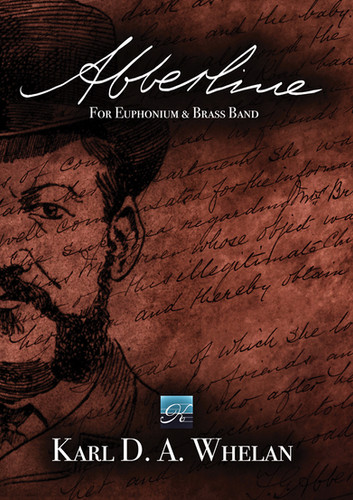
Abberline (Euphonium Solo with Brass Band) Karl Whelan
Inspired by the infamous investigation into Jack the Ripper, Abberline follows Detective Inspector Frederick Abberline through the mist-shrouded streets of Victorian London in his desperate pursuit of a killer who remains forever just out of reach. Scored for brass band and solo euphonium, the piece blends atmospheric textures, shifting musical identities, and virtuosic demands to capture a narrative that is as haunting as it is unresolved. The piece opens in a world of shadows - the foggy alleys of Whitechapel - where tension simmers beneath the surface. The euphonium enters cautiously, as if stalking unseen figures, echoing the danger and uncertainty that cloaked the city in fear. This eerie calm is broken suddenly: the Ripper strikes. The moment is brief but brutal, leaving only silence and horror in its wake. From here, the music shifts into an uneasy, angular waltz: the figure of Abberline takes center stage, portrayed by the soloist as he investigates the aftermath. The waltz is melodically off-kilter and harmonically unstable, capturing both the grotesque nature of the crime and the detective's mental burden. The scene then returns to the streets - but this time, the musical material is more intricate, fragmented, and tense. The threat has deepened, and again the silence is shattered by violence. A second, slightly altered waltz follows, further reflecting Abberline's obsessive descent into the case. In the final section, the chase begins in earnest. Themes from earlier return in quick succession, intensified and overlapping as time runs out. The ancient Dies Irae chant is woven into the texture, evoking fate and judgment. In a final, erratic surge, the euphonium and band race toward an ending that is breathless and unresolved - a reflection of history's unanswered questions and the ghost that always stayed one step ahead. To view a rolling score video of the work please visit https://www.youtube.com/watch?v=i59xYzJRMaI Duration: approx. 7.30 minutes This PDF download includes parts and score. Sheet music available at www.brassband.co.uk (UK) or https://satradecentral.org (USA) Instrumentation: Euphonium Soloist Bb Soprano Cornet Eb Solo Cornet 1-2 & 3-4 Bb Repiano Cornet Bb 2nd Cornet Bb 3rd Cornet Bb Flugel Horn Bb Solo Horn Eb 1st Horn Eb 2nd Horn Eb 1st Baritone Bb 2nd Baritone Bb 1st Trombone Bb 2nd Trombone Bb Bass Trombone Euphonium (tutti) Bb Bass Eb Bass Bb Timpani Percussion 1-3
In Stock: Estimated dispatch 1-3 working days
-
 £41.09
Allegro Spirito from Symphony No.2 (Brass Band) Borodin arr. Harold Burgmayer
Alexander Borodin's Second Symphony in B minor dates from the years 1869-76, a time when he was also working on his enduring opera Prince Igor. Flavors of the exotic and outdoor celebration seemed to have spilled over from the opera in this brilliant sonata movement. Borodin seldom quotes Russian folk tunes, but his graceful melodic lines are permeated with the spirit of his native song, supported by iridescent harmonies and bright colors. This arrangement for brass band was premiered by The Salvation Army's New York Staff Band, with Ronald Waiksnoris conducting, at Alice Tully Hall in New York City on 11 April 2001. This complete transcription of the Finale movement of Borodin's Second Symphony has an approximate duration of 6.40 minutes. To alternatively utilize the piece as an opener, a cut from bar 173 to 272 is indicated with Coda signs, reducing the piece to 4.30 seconds. To view a rolling score video of the work please visit www.youtube.com/watch?v=x4SqSXLopRo Difficulty Level: 2nd Section + PDF download includes parts and score. Sheet music available at www.brassband.co.uk (UK) or https://satradecentral.org (USA) Instrumentation: Soprano Cornet Eb Solo Cornet Bb Repiano Cornet Bb 2nd Cornet Bb 3rd Cornet Bb Flugel Horn Bb Solo Horn Eb 1st Horn Eb 2nd Horn Eb 1st Baritone Bb 2nd Baritone Bb 1st Trombone Bb 2nd Trombone Bb Bass Trombone Euphonium Bb Bass Eb Bass Bb Timpani Percussion 1-3
In Stock: Estimated dispatch 1-3 working days
-
 £29.88
Breathe on me, breath of God (Brass Band) Robert Jackson arr. Andrew Wainwright
Andrew Wainwright's sensitive setting of Breathe on Me, Breath of God was commissioned by Sione Malekamu Manu Jr for the 2026 Tonga Secondary School Music Festival, in memory of the late Sione Malekamu Manu. The piece offers a reflective yet powerful treatment of Edwin Hatch's beloved 1878 hymn. Set across two contrasting verses, the arrangement traces a spiritual journey from quiet contemplation to triumphant exaltation. The first verse opens with delicate textures and warm, blended tone, allowing the familiar melody - traditionally set to Robert Jackson's tune Trentham - to emerge with serene simplicity. Building seamlessly through a transitional passage, the setting broadens into a majestic second verse, celebrating the transformative power and majesty of the divine spirit. Concise yet profoundly moving, this arrangement showcases both the lyrical sensitivity and majestic power inherent to the traditional brass band. To view a rolling score video of this piece please visit www.youtube.com/watch?v=Oh7WRTwhpqM Duration: approx. 2.40 minutes Difficulty Level: 4th Section + This PDF download includes the full score and parts. Sheet music available at www.brassband.co.uk (UK) or https://satradecentral.org (USA) Instrumentation: Soprano Cornet Eb Solo Cornet Bb Repiano Cornet Bb 2nd Cornet Bb 3rd Cornet Bb Flugel Horn Bb Solo Horn Eb 1st Horn Eb 2nd Horn Eb 1st Baritone Bb 2nd Baritone Bb 1st Trombone Bb 2nd Trombone Bb Bass Trombone Euphonium Bb Bass Eb Bass Bb Timpani Percussion 1-2
In Stock: Estimated dispatch 1-3 working days
-
 £37.35
Capriccio for Brass Band (Robbert Vos)
VIEW SCORE PDF Capriccio for Brass Band (Robbert Vos) was the winner of both the overall prize decided by the judges and Public Commendation prize for the 2020 International Brass Band Composer Competition, a contest that included some 92 entries from around the world. The composer writes: 'My Capriccio for Brass Band is a lively, intense and virtuosic piece based on several thematic, rhythmical and harmonic ideas which are developed during the piece. It is non-programmatic and not based on a storyline. The middle section, in contrary, is in more of a minimalistic style, where there is room to create a mysterious and open atmosphere. Rhythmical elements are quoted from the opening movement, whilst clashing chords are used to build up tension. The last movement builds to a big climax, where several of the compositorial ideas used before come together for the finale.' PDF download includes score and full set of parts. Sheet music available from: UK - www.brassband.co.uk USA - www.solidbrassmusic.com Difficulty Level: Championship Section Instrumentation: Soprano Cornet Eb Solo Cornet Bb Repiano Cornet Bb 2nd Cornet Bb 3rd Cornet Bb Flugel Horn Bb Solo Horn Eb 1st Horn Eb 2nd Horn Eb 1st Baritone Bb 2nd Baritone Bb 1st Trombone Bb 2nd Trombone Bb Bass Trombone 1st Euphonium Bb 2nd Euphonium Bb Bass Eb Bass Bb Timpani Percussion 1-3
In Stock: Estimated dispatch 1-3 working days
-
 £33.62
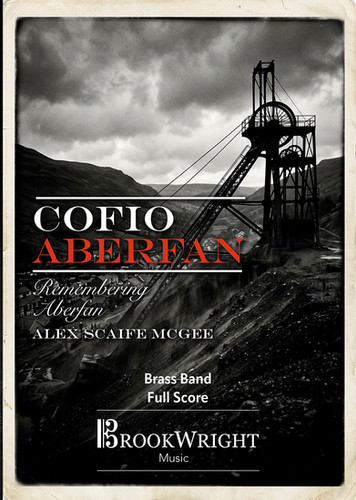
Cofio Aberfan (Brass Band) Alex Scaife McGee
Cofio Aberfan (Remembering Aberfan) is a deeply moving musical work composed to mark the 60th anniversary of the 1966 Aberfan disaster. On that tragic day, a collapsing coal tip devastated a close-knit Welsh village, claiming 144 lives - including 116 children attending their final day of term at Pant Glas Primary School. Designed for commemorative programs, civic events, and concert performances, this piece serves as both a solemn homage to those who perished and an inspiring tribute to the survivors. Moving fluidly between deep reflection and powerful affirmation, the composition captures the poignant sense of a childhood cut short while honoring the extraordinary tenacity of a community that refused to let tragedy define its destiny. Duration: 4.30 minutes Difficulty Level: 4th Section + To view a rolling score video of this piece please visit https://www.youtube.com/watch?v=X4XB5HCV6RY This PDF download includes the full score and parts. Sheet music available at www.brassband.co.uk (UK) or https://satradecentral.org (USA) Instrumentation: Soprano Cornet Eb Solo Cornet Bb Repiano Cornet Bb 2nd Cornet Bb 3rd Cornet Bb Flugel Horn Bb Solo Horn Eb 1st Horn Eb 2nd Horn Eb 1st Baritone Bb 2nd Baritone Bb 1st Trombone Bb 2nd Trombone Bb Bass Trombone Euphonium Bb Bass Eb Bass Bb Timpani Percussion 1-2
In Stock: Estimated dispatch 1-3 working days
-
 £33.62
E lucevan le stelle (Cornet/Euphonium Duet with Brass Band) Puccini arr.Bushnell
Tosca is an opera in three acts by the Italian composer Giacomo Puccini. The opera is set in June 1800 in Rome, and tells the story of the Kingdom of Naples and the threat to its control of Rome by Napoleon's invasion of Italy. Some of Puccini's best-known arias can be found in Tosca. The opera is based on Victorien Sardou's dramatic play of the same name (La Tosca). Puccini saw the play at least twice in 1889 and begged his publisher, Giulio Ricordi, to obtain the rights to turn it into an opera, which were secured in 1891 - although Puccini relinquished the rights to Alberto Franchetti before being recommissioned in 1895. Puccini wrote "I see in this Tosca the opera I need, with no overblown proportions, no elaborate spectacle, nor will it call for the usual excessive amount of music." It took four years to write, with Puccini arguing with his librettists (Luigi Illica and Giuseppe Giacosa) and his publisher. Although the first performance was delayed by a day due to the unrest in Rome at the time, the opera was premiered on 14 January 1900 at the Teatro Costanzi in Rome. The critics reviews were indifferent, but it was an immediate success with the public. The opera is through-composed, with the different musical elements weaved from piece to piece. Puccini used the Wagner's leitmotif concept to identity different parts of the opera. Taken from Act 3, E lucevan le stelle is sung by Cavaradossi, a painter, who has fallen for the singer Tosca. The corrupt Chief of Police, Baron Scarpia, longs for Tosca himself and, upon suspecting Cavaradossi of helping a political prisoner escape, he takes the opportunity to get rid of Cavaradossi and blackmail Tosca into being with him. The guards lead Cavaradossi to the roof of Castel Sant'Angelo, where he is told he has 1 hour to live before being executed. He asks to write a letter to Tosca, overcome by memories, he sings E lucevan le stelle (And the stars shone). It was selected by the tenor Wynne Evans as one of the most romantic songs for his top ten arias for Classic FM. He described it as "another tenor classic, both tragic and beautiful." This arrangement (for cornet and euphonium duet with brass band) includes alternative parts for horns in F and lower brass in bass clef. A recording of the original song can be found here: www.youtube.com/watch?v=EAqHQMX7GHY
In Stock: Estimated dispatch 1-3 working days
" frameborder="0" allowfullscreen> -
 £33.62
Eternity (Brass Band) Michael Bojesen arr. David Robb
In Eternity, Danish composer and conductor Michael Bojesen sets a text by the Danish poet Ellen Heiberg as a choral fantasy piece. In this effective arrangement by Scottish composer/arranger David Robb, after a simple, pure opening melody, lilting unison lines evoke the roll of the ocean's waves and the smoothness of the stone which represents a piece of "all eternity." Following the opening hymn, layered melodies overlap and circle each other, representing the cycle of time. Each melody repeats and builds until it dies away, and the band returns to unison to end on a single note. PDF download includes score and parts. To view a video of Victoria Brass performing the work please visit www.youtube.com/watch?v=-b2jfywsSz4 Sheet music available from: UK - www.brassband.co.uk USA - www.solidbrassmusic.com Difficulty Level: 3rd Section + Instrumentation: Soprano Cornet Eb Solo Cornet Bb Repiano Cornet Bb 2nd Cornet Bb 3rd Cornet Bb Flugel Horn Bb Solo Horn Eb 1st Horn Eb 2nd Horn Eb 1st Baritone Bb 2nd Baritone Bb 1st Trombone Bb 2nd Trombone Bb Bass Trombone Euphonium Bb Bass Eb Bass Bb Timpani Suspended Cymbal Glockenspiel
In Stock: Estimated dispatch 1-3 working days
 Watch video