
Results
-
 £60.99
Jubilus! - Jan Van der Roost
Jan van der Roost's new work Jubilus will make an ideal opening piece for any event. It is in a classical ABA form, beginning with a rising brass fanfare which is quickly replaced by a contrasting expressive lyrical theme. The two themes alternate for a few seconds until an exciting new atmosphere is created with the lively allegro. This eventful piece lets you show off many aspects of your player's style and technique without losing overall unity
Estimated dispatch 5-14 working days
-
 £104.99
Parnassus - Jan Van der Roost
Since most of the bands competing in the 4th Section of the Dutch National Championships have many young players, this piece is stylistically youthful-- especially in the opening and closing sections. An arpeggio pattern appears numerous times in all registers and is the basic musical element of the main melody, alternating with a second theme that has a slightly different melodic character. The middle section is conceived like a chorale, introduced and developed stepwise: firstly with short patterns and gradually in increasingly long snippets, until it's played in its glorious entirety at measure 216. No real solo passages are included but rather small chambercombinations, thus offering the opportunity to various players to display their technical and performance skills. The finale recaptures musical material from the first section of the piece and provides a majestic conclusion.
Estimated dispatch 5-14 working days
-
 £94.99
Chorale Variations - Jan de Haan
Chorale Variations comprises six variations on an original theme in Renaissance style. Written as a test piece for the renowned contest 'Gouden Spiker Festival' in Friesland (The Netherlands), it is a challenging concert or contest piece, presenting attractive and demanding parts for all sections.
Estimated dispatch 5-14 working days
-
 £125.00
Titan's Progress - Hermann Pallhuber
Commissioned by Austria's leading brass band, Brass Band Oberoesterreich, Titan's Progress is a series of descriptive, virtuoso episodes based on the principal character of the novel by Jean Paul. This was also theoriginal subject of Mahler's Symphony No. 1, from which Hermann Pallhuber derives much of his material. The work has proved an exceptionally popular test piece all over the world. Titan's Progress wasthe selected test piece for the British Open Brass Band Championship, held at Symphony Hall, Birmingham on Saturday 12th September 2009. Brass Band Grade 6: Championship Duration: 17 minutes Thescoreprovided with this set is a larger format, B4 size.
Estimated dispatch 5-14 working days
-
 £104.99
High Flyers - Andrew R. Mackereth
From the composer: High Flyers are regarded as people with promise and potential.They are winners. This is music for winners.The title, as well as being a play-on-words, implies the nature of the work. It is a bright, optimistic, and upbeat piece attempting to depict an exhilarating ride on flying carpet. The opening rising chords immediately suggest the gentle elevation of the carpets' ascent towards unknown heights, leading to a hint of a first theme in the horns at Fig. B. The first four notes provide the thematic material for the whole work: C F G A.A perpetual sense of movement is achieved through accented quaver chords punctuating the melodicmaterial of the first main theme. Fig. E sees the music of the opening bars fully realised, with flourishes from the euphonium and baritones representing swirling clouds, shooting stars, or passing birds in flight.The same subject is developed into a lyrical second theme with a new lush harmonic treatment, evocative of gliding over an expanse of sparse countryside.This section ends with a note of serenity but is shattered by the urgent insistence of the percussion rhythms.The third section introduces a new idea with a slightly distorted fanfare in the cornets and trombones. This figure suggests for the first time that there may be trouble ahead. In fact, there is no need to fear and the journey can continue without aggravation. This fanfare returns near the end to signal a final note of triumph.A new rhythmic variant of the cell motif emerges as the third theme now transformed by the addition of a triplet figure. The music steadily gains momentum before moving inexorably towards the climactic return of the music and tonality of the opening bars of the piece.
Estimated dispatch 5-14 working days
-
 £54.99
Mombassa Beat - Peter Martin
A contagious piece of music by Peter Martin in which he hints at the popular amusement music by Bert Kaempfert. Mombassa is a lively harbour city in Kenya which can be heard in the music. Happiness and cheeriness are the ingredients of this nice piece. Success is assured.
Estimated dispatch 5-14 working days
-
 £76.99
Praise to the Lord - Carl Wittrock
This composition, based on the hymn Praise to the Lord, is comprised of eight separate parts that can be played together as a concert piece or opening work. The A and B sections are different openings, C is four-part arrangement of the hymn, D is a solo for four saxophones, or two trumpets and two trombones, E is a calm intermezzo, F a solo for trumpet or cornet, and G and F finally are a majestic or peaceful closing section. How will you choose to present this piece on stage?
Estimated dispatch 5-14 working days
-
 £74.99
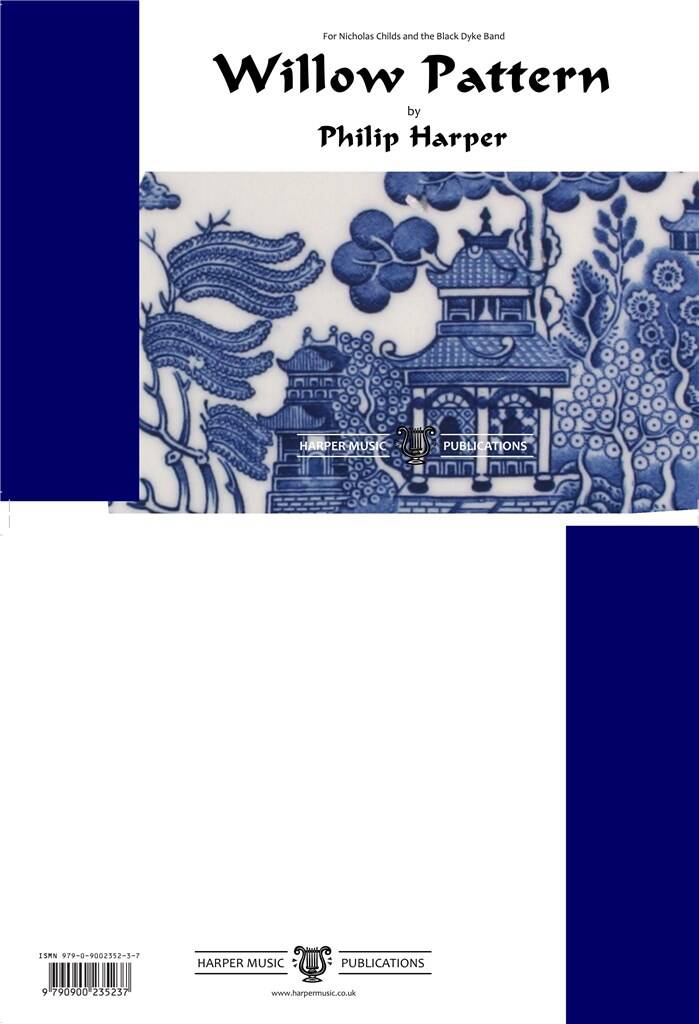
Willow Pattern - Philip Harper
Composed in 2009 for Nicholas Childs and the Black Dyke BandThis piece tells the Willow Pattern legend through music. Several leitmotifs are used both for the different characters and also for some of the important emotions in the tale. Additionally, Knoon-se's part is mainly played by the flugel horn, Changby the euphonium, the Mandarin by the Eb Bass and the Duke Ta-jin by the trombone. The Willow Pattern LegendOnce, in ancient China, there lived a wealthy and powerful Mandarin who had a beautiful daughter, Knoon-se. She had fallen in love with Chang, a humble accountant, which angered her father who imprisoned her in the Pavilion by the river with only theexotic birds for company. She learnt that the Mandarin planned to marry her to the pompous Duke Ta-jin and that the wedding would take place on the day the blossom fell from the willow tree, so she sent Chang a message: "Gather thy blossom, ere it bestolen". The Duke arrived by sea amid great fanfare when the tree was heavy with bud, and nights of magnificent banquets followed. After one such occasion when the Mandarin slept, Chang crept over the crooked fence and tiptoed into the Pavilion to rescueKnoon-se, but as they escaped the alarm was raised. They fled over the bridge with the Mandarin close on their heels brandishing his whip.They managed to escape by boat to a secluded island where they lived happily for a time. Meanwhile, the Mandarin learned of their refuge and, intent on revenge, he ordered his soldiers to kill them. As Knoon-se and Chang slept at night, the men setfire to the pagoda in which they lived and the lovers perished in the flames. However, the Gods, moved by the lovers' plight, transformed their souls into two turtle-doves which rose from the charred remains, soaring above the Earth, symbolising eternal happiness. Willow Pattern is dedicated to the memory of Jean Harper who passed away as I was completing the piece and who was a great collector of porcelain and china-ware. NOTES ON PERFORMANCEMute Requirements:Metal mutes soprano cornet, repiano cornet, 2nd cornets, 3rd cornets (6 in total) Cup mutes all cornets and trombones (10 + 3) Harmon mutes soprano cornet, solo cornets, repiano cornet (6) Percussion Requirements:There are two parts for percussion on the score. The minimum requirements are as follows: 2 players - Timpani, 2 Large tom toms, 2 Wood Blocks, Triangle, Sleigh Bells, Whip, Clash Cymbals, Suspended Cymbal, Hi-hat, Glockenspiel, Xylophone, Tam tam (or susp. cym.) For performances with extra resources, and to achieve closer authenticity, the full requirements are as follows: 3 players - Timpani, 3 Taiko Drums played with thick wooden sticks (or Large tom toms), 2 Wood Blocks, Triangle, Chinese Bells (or Sleigh Bells), Whip, Clash Cymbals, Chinese Cymbals (small clash cymbals approx 12"), Suspended Cymbal, Glockenspiel,Xylophone, Tam tam
Estimated dispatch 5-14 working days
-
 £56.50
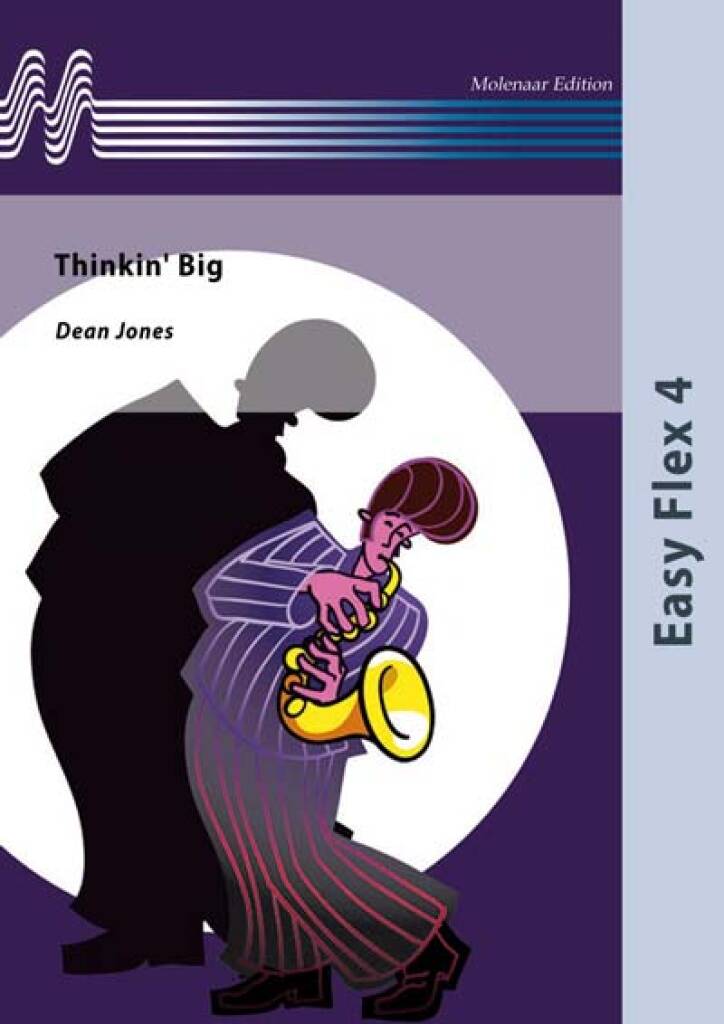
Thinkin' Big - Dean Jones
This is a piece for the bold and young dreamer! Growing up, we all have our wild ideas about what we can become as adults...and here are 3 such hero-like figures portrayed in this piece. The first is that of a 'Rock n roll star' in something of a 60s throwback idiom. The middle movement is gentle in approach and depicts the life of a Ballerina. Finally, the music reaches its conclusion with a trip to the 'Big Screen' with a few touches of Hollywood and the Red Carpet!
Estimated dispatch 5-14 working days
-
 £139.00
The Jazz Police - Gordon Goodwin - Reid Gilje
This is really a powerhouse of a piece! Hard-driving rock'n roll at a high tempo with the Jazz Police at the heels... Please note the dynamics. Tempo and good articulation is a very big part of the energy of this piece. Fortissimo first appears at bar 113. A useful tip: It's possible to practice this one also at lower dynamic levels.
Estimated dispatch 5-14 working days
 View Music