
Results
-
 £15.00
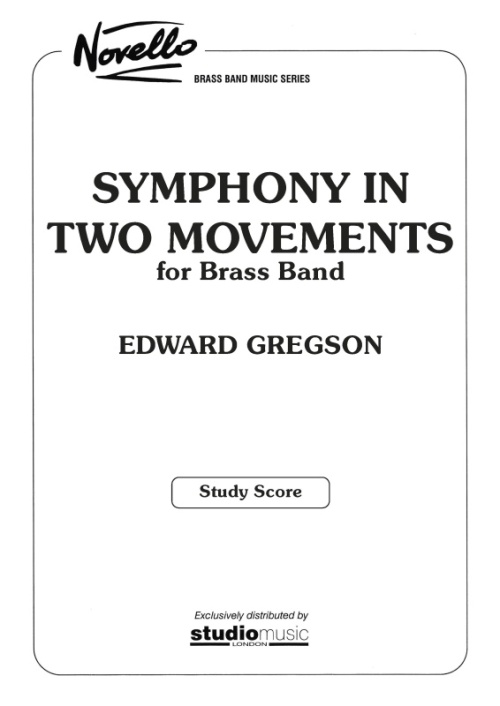
Symphony in Two Movements (Study Score Only)
Selected as the Championship Section test piece for the National Brass Band Championships of Great Britain 2025This work was jointly commissioned by the National Youth Brass Band of Great Britain (NYBBGB) and the National Youth Brass Band of Wales (NYBBW), the latter with funding from T Cerdd (Music Centre Wales), to celebrate their 60th and 30th anniversaries respectively. The first performances were given at Cadogan Hall, London, in April 2012, by the NYBBGB, conducted by Bramwell Tovey; and at the Great Hall, Aberystwyth University, in July 2012, by the NYBBW, conducted by Nicholas Childs.When I was approached about a joint commission to write a new work to celebrate the anniversaries of these two outstanding youth bands I was delighted to accept, and decided to respond by writing a work apposite for the magnitude of these special occasions, namely a 'symphony for brass'.Through a long journey of writing music for brass band, which commenced with Connotations (1977), and continued with Dances and Arias (1984), Of Men and Mountains (1991), The Trumpets of the Angels (2000) and Rococo Variations (2008), I arrived at what I regard as the most important work of the cycle to date, combining as it does serious musical intent with considerable technical demands. It is perhaps my most abstract work for brass band, avoiding any programmatic content.The symphony lasts for some 19 minutes and is structured in two linked movements. The form is based on that used by Beethoven in his final piano sonata (Op.111), which is in two movements only: a compact sonata-form allegro, followed by a more expansive theme and four variations. Prokofiev also adopted this model in his 2nd Symphony of 1925.The opening Toccata of this Symphony is highly dramatic but compact, whilst still retaining the 'traditional' structural elements of exposition, development and recapitulation; indeed, it also has the 'traditional' element of a contrasting second subject - a gentle, lyrical modal melody first heard on solo cornets.In contrast, the longer and more substantial second movement Variations is built around a theme and four variations. The slowly unfolding chorale-like theme accumulates both added note harmony and increasing instrumentation, whilst the four variations which follow are by turn mercurial (fast, starting with all the instruments muted), march-like (menacing, with short rhythmic articulations underpinning an extended atonal melody), serene (a series of 'romances' for solo instruments alongside echoes of the chorale) with an emerging theme eventually bursting into a climax of passionate intent; whilst the final variation is a dynamic scherzo (concertante-like in its series of rapid-fire solos, duets, trios and quartets) with the music gradually incorporating elements of the main ideas from the first movement, thus acting as a recapitulation for the whole work. It reaches its peroration with a return to the very opening of the symphony, now in the 'home' tonality of F, and thus creating a truly symphonic dimension to the music.Most of the melodic material of the symphony is derived from the opening eleven-note 'row', which contains various intervallic sets, and although the work is not serially conceived it does use some typical quasi-serial procedures, such as canons, inversions, and retrogrades. The symphony uses somewhat limited percussion, in line with a 'classical' approach to the sound world of the brass band, alongside a use of multi-divisi instrumentation, whereby each player has an individual part rather than the traditional doubling within certain sections of the band.- Edward GregsonDuration: 19.00
Estimated dispatch 7-14 working days
-
 £34.95
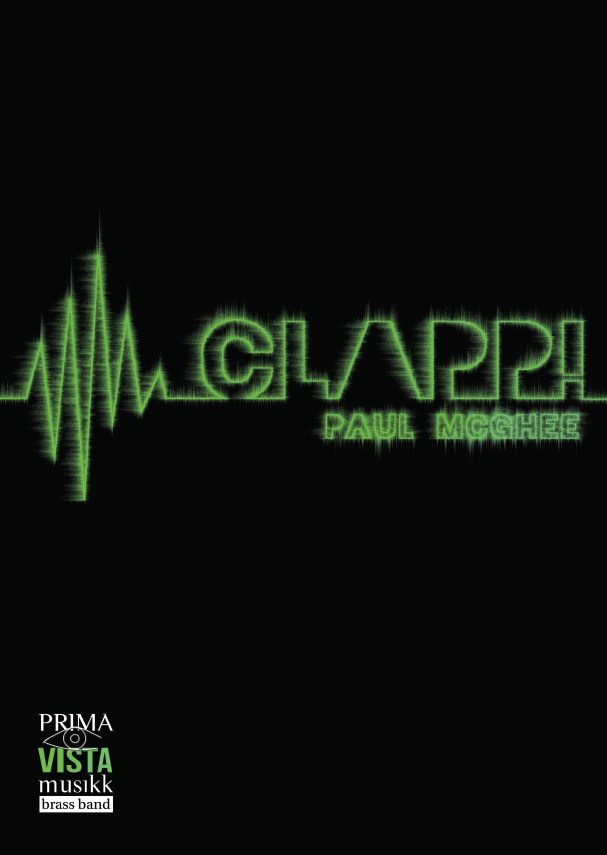
Clapp!!! (Score and Parts)
'Clapp!!!!' was originally written in 2006 whilst studying at the Royal Welsh College of Music and Drama and was written for two players at one piano. The music uses rhythmic phasing with each rhythm assigned it's own tone cluster - as each shift in rhythm occurs the harmonic structure is altered too. Melodic passages are created through the shifts in rhythm and harmony, but these only occur within the given rhythmic parameters. The music can very much be viewed as a study in momentum, with its unrelenting pulse driving us through the music.The Brass Band version of 'Clapp!!!!' was written for Manger Musikklag and Torstein Aagaard-Nilsen, receiving its premiere at the 2010 BrassWind Festival in Bergen, Norway. The Whitburn Band featured Clapp!!!! at their 2012 Brass in Concert programme and the piece was featured by the Grimethorpe Colliery Brass Band on their 'Grimethorpe Entertain' CD.
Estimated dispatch 7-14 working days
-
£14.95
Clapp!!! (Score Only)
'Clapp!!!!' was originally written in 2006 whilst studying at the Royal Welsh College of Music and Drama and was written for two players at one piano. The music uses rhythmic phasing with each rhythm assigned it's own tone cluster - as each shift in rhythm occurs the harmonic structure is altered too. Melodic passages are created through the shifts in rhythm and harmony, but these only occur within the given rhythmic parameters. The music can very much be viewed as a study in momentum, with its unrelenting pulse driving us through the music.The Brass Band version of 'Clapp!!!!' was written for Manger Musikklag and Torstein Aagaard-Nilsen, receiving its premiere at the 2010 BrassWind Festival in Bergen, Norway. The Whitburn Band featured Clapp!!!! at their 2012 Brass in Concert programme and the piece was featured by the Grimethorpe Colliery Brass Band on their 'Grimethorpe Entertain' CD.
Estimated dispatch 7-14 working days
-
 £1.95
£1.95SCHNEEWALZER (The Snow-Waltz) (SATB) - Richards, Goff
SATB & Piano. Compatible with Brass Band edition. Also available TTBB with Piano) Words in German and English
Estimated dispatch 7-14 working days
-
£1.95
SCHNEEWALZER (The Snow-Waltz) (TTBB) - Richards, Goff
TTBB & Piano. Compatible with Brass Band edition. Also available SATB with Piano) Words in German and English
Estimated dispatch 7-14 working days
-
 £61.00
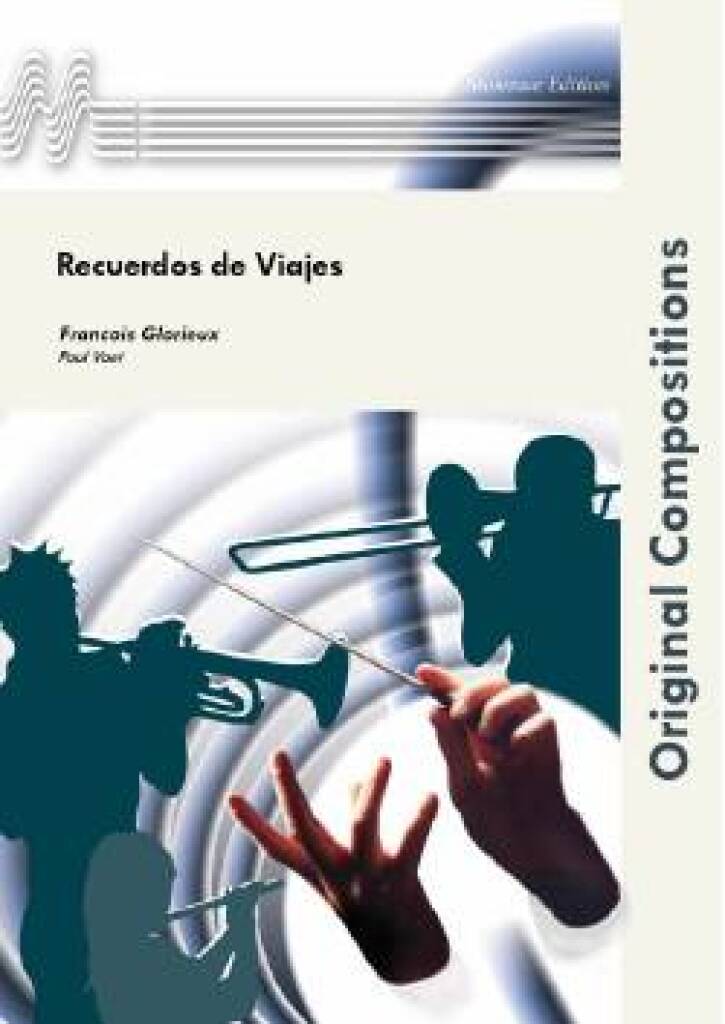
Recuerdos De Viajes - François Glorieux - Paul Voet
The Belgian piano virtuoso and composer Francois Glorieux (Kortrijk, 1932) has had a long international career as a concert pianist and conductor. As composer and arranger he worked, among others, with Stan Kenton and with the famous London brass ensemble 'Locke Brass Consort'. With that ensemble as well as with his own orchestra 'The Francois Glorieux Brass and Percussion Orchestra', he recorded many of his own compositions. His pupil trumpeter Paul Voet wrote an arrangement for brass band of these 'travel memories'. This is really a most fine original concert piece for brass band.
Estimated dispatch 5-14 working days
-
 £39.95
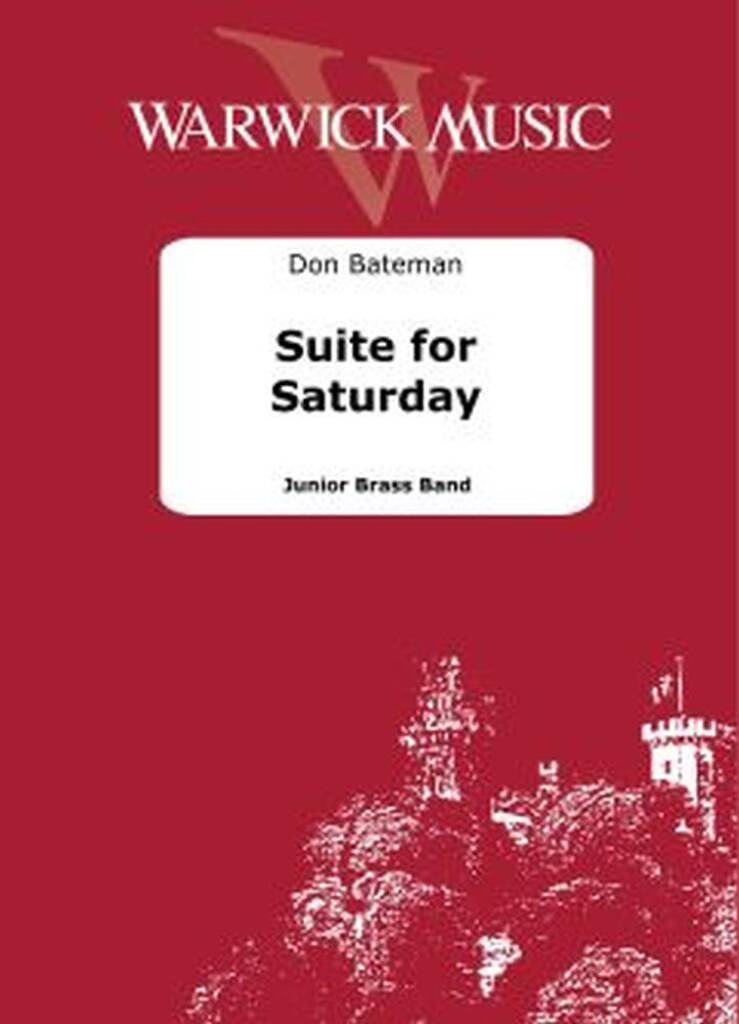
Suite for Saturday - Don Bateman
This work was originally written for a Junior Brass Band with the title Suite for Saturday and was road-tested at a Band Day organized by West Sussex Music Service. It became a piece for 2 clarinets with a version for clarinet and piano. Its title then was Suite for Chloe. As you can see, the original title has been restored as being more appropriate for a full junior brass band and, inevitably, with regard to an Educational project, there is a strong didactic thread running through the sections of the Suite.For Openersrequires a decisive attack, fanfare style. Metro Gnomesdemands articulative skill and metronomic precision.Smooth Operatorsencourages an efficient legato style.Best Foot Forwardstresses rhythmic drive (alla militare).
Estimated dispatch 5-14 working days
-
 £127.30
Rendezvous - Torstein Aagaard-Nilsen
Rendezvous was commissioned by Krohnengen Brass Band for their 50th Anniversary in 2019.Rendezvous is devided into three sections. Each section are referring to Edvard Grieg's own titles. but twisted, to make sure that everybody understand that this music is a mash-up of themes Edvard Grieg used in opus 54 (for piano) and opus 61 (songs for children).1. Trolltog med avsporing (March of the Trolls derailment)March of the Trolls is a famous part of Edvard Grieg lyric pieces, opus 54.2. Klokkeklang i feil sang (Bell ringing in wrong tune).Bell ringing show that Grieg was one of the first composers to write the way impressionists did. What happens if this beatiful piece is combined with several other themes from the same book? It somehow works in its own way.3. Pep talk til Blakken (Pep talk to Blakken)The riff used in the first part becomes an important part of the third part: a funky treat of the childrens song "Kveldssang for Blakken" (Evening song for Blakken).I felt that a rather tired old horse needed a pep talk more than a slow tune. So that is why you get this music(!) - and this is how my rendezvous with Grieg ends.Not sure what maestro Grieg would have thougt... But, I have read that the fiddlers that played the tunes Grieg used was not happy with the way Grieg used them.So there you go...Torstein Aagaard-Nilsen
Estimated dispatch 5-14 working days
-
 £127.30
Stealing Apples - Fats Waller - Reid Gilje
Stealing Apples is an old swing-tune written by Fats Waller. Performances by Benny Goodman and his big band made the song very popular. In this arrangement for brass band, the mallet percussion is very essential. Mallet Percussion presents the melody from letter A and is also featured as soli-instruments from letter L to P. These parts can alternatively be played as vibraphone solo. Please be aware of the balance at letter A. Horn and Trombones must play piano but well articulated. Letter D must sound sparkling and fresh with articulated and powerful trombones and cornets (using straight-mute). Make shue that the 8th-notes are not played too dotted two bars before letterG. Almost even 8th-notes accentuated on the start of the slur is a good tip. Watch the balance at letter H. This part have to sound homogeniously. The soloistic Soprano Cornet at letter Q must be played in the style of Benny Goodan. The accompaniment must not be too powerful from letter R to S. Best of luck with the performance!
Estimated dispatch 5-14 working days
-
 £159.99
Omaggio - Philip Sparke
Omaggio was commissioned by Steven Mead in celebration of his 60th birthday and in memory of his father, Rex. He gave the premiere of the brass band version in Rome in March 2022, accompanied by the Italian Brass Band conducted by Filippo Cangiamilla. The concert band premiere took place on 6th July that year as part of the 2022 Spanish International Tuba Euphonium Conference, accompanied by the Banda municipal de musica de Malaga. The concerto is set in 3 continuous movements, which are united by a recurring syncopated interval of a fifth. The first movement, FANTASIA, opens with this motive accompanying an extended monologue for the soloist. This is followed by a lengthy bridge passage by the band (piano), which is eventually joined by the soloist, who guides the music back to the opening soliloquy, leading to an energetic central section. This develops until the opening material again returns to introduce the second movement, BALLAD, which revolves around an expressive melody for the soloist, interspersed by accompanied cadenzas. The third movement, THE KING TRIUMPHANT, pays homage to Steven's late father, Rex, and its title alludes both to Rex's name ('Rex' being Latin for 'king') as well as his love of Eric Ball's Salvationist masterpiece, The Kingdom Triumphant. The finale is an energetic tour-de-force featuring an acrobatic 6/8 melody, which is interrupted twice by the magnificent hymn tune, Helmsley, which Ball uses so effectively in The Kingdom Triumphant. A galloping coda brings the work to a close.
Estimated dispatch 5-14 working days
 View Music