
Results
-
 £154.60
Variations for Brass Band - John Brakstad
"Variations for Brass Band" consists of a chorale and 5 variations of brilliant, lyric and humorous character. The piece also contains several soloparts and elements of ensemble.Each variation has its own title, but the piece should be played in its entirity.The chorale is based on a minor pentachord, and each variation begins with these five notes, with different rhythmical treatment.There is also a little secondary "theme", consisting of five notes which are heard throughout the work (eg. as sixteens/semiquavers in cornets in bar 1).When the beams sweep across the Earth, they can be heard as regular pulses. We call them pulsars.In this piece there are three percussion parts. In addition there is an "optional part" to replace the marimba and vibraphone written in the three original percussion parts if desired. This fourth part is shown in the full score.
Estimated dispatch 5-14 working days
-
£76.99
Haexdonck - Guido De Ranter
This work was commissioned by the municipality of Kapelle-op-den-Bos on the occasion of the 150th anniversary of canon Jaak Muyldermans. Haexdonck is the old spelling of the present day region of "Oxdonk" where Jaak Muyldermans lived. In this three-part work the composer describes the different human aspects of canon Muyldermans' rich life. The first part, slow and dreamy, describes the writer/poet. The second dissonant part with much percussion describes his time as an army chaplain during the Great War. The third hymn-like part depicts his time as a priest. This work by Guido De Ranter, a newcomer to composition,is suitable for competitions or concerts.
Estimated dispatch 5-14 working days
-
 £104.99
Cambridgeshire Impressions - Rieks van der Velde
In a four-part composition Rieks van der Velde takes us to the richly varied area surrounding the university city of Cambridge. The Dutch composer was especially inspired by the atmosphere of Cambridgeshire, the county which lies north ofLondon. 1. The Journey. Although on arrival the area looks peaceful and friendly, the ruggedness of its inhabitants and landscape have an unmistakable influence on the music. In the course of the tour, which starts with an Allegromovement, we are shown the vitality, energy and freshness of the Cambridgeshire countryside. Short themes, swift and sudden motifs and rhythmical patterns supported by the drive of percussion instruments give expression to this image. Thefirst part is concluded by two Calmo movements in which the music expresses how the cathedral in the city of Ely comes into sight and is gradually approached. 2. Visit to Ely Cathedral. The famous Norman cathedral church of Ely, whichwas built in 1109, has attracted tourists from all over the world apart from being a place of worship and heritage site. A cornet solo introduces the contemplative mood of the composition at this point. The mystical atmosphere of thecathedral runs through this lyrical part like a continuous thread. 3. The Pub. The thirst caused by this intensive journey makes a visit to the local pub a definite must. These "public houses", which may be open until the earlyhours of the morning, offer all kinds of entertainment. Drinks are served liberally and the atmosphere is lively. 4. The Journey Back. Time has flown: In other words, the moment of departure has come sooner than one would havewished. In a flashback which recaptures elements of the first part of the composition we say goodbye to Cambridgeshire in a fitting manner. Two scintillating final measures bring us abruptly back to the present.
Estimated dispatch 5-14 working days
-
 £127.30
Stealing Apples - Fats Waller - Reid Gilje
Stealing Apples is an old swing-tune written by Fats Waller. Performances by Benny Goodman and his big band made the song very popular. In this arrangement for brass band, the mallet percussion is very essential. Mallet Percussion presents the melody from letter A and is also featured as soli-instruments from letter L to P. These parts can alternatively be played as vibraphone solo. Please be aware of the balance at letter A. Horn and Trombones must play piano but well articulated. Letter D must sound sparkling and fresh with articulated and powerful trombones and cornets (using straight-mute). Make shue that the 8th-notes are not played too dotted two bars before letterG. Almost even 8th-notes accentuated on the start of the slur is a good tip. Watch the balance at letter H. This part have to sound homogeniously. The soloistic Soprano Cornet at letter Q must be played in the style of Benny Goodan. The accompaniment must not be too powerful from letter R to S. Best of luck with the performance!
Estimated dispatch 5-14 working days
-
 £74.99
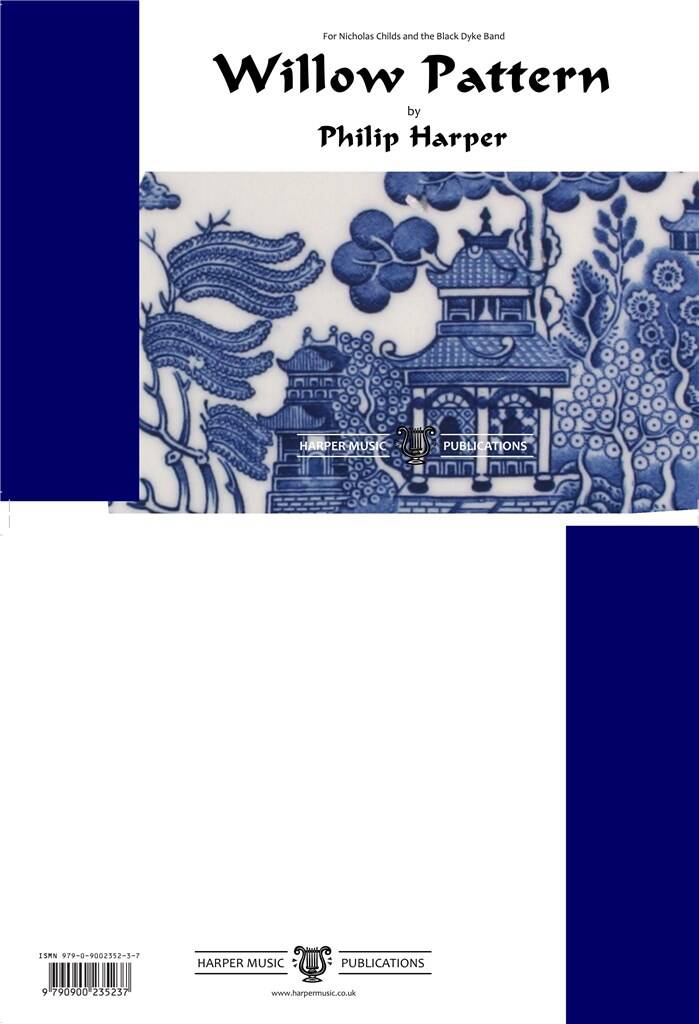
Willow Pattern - Philip Harper
Composed in 2009 for Nicholas Childs and the Black Dyke BandThis piece tells the Willow Pattern legend through music. Several leitmotifs are used both for the different characters and also for some of the important emotions in the tale. Additionally, Knoon-se's part is mainly played by the flugel horn, Changby the euphonium, the Mandarin by the Eb Bass and the Duke Ta-jin by the trombone. The Willow Pattern LegendOnce, in ancient China, there lived a wealthy and powerful Mandarin who had a beautiful daughter, Knoon-se. She had fallen in love with Chang, a humble accountant, which angered her father who imprisoned her in the Pavilion by the river with only theexotic birds for company. She learnt that the Mandarin planned to marry her to the pompous Duke Ta-jin and that the wedding would take place on the day the blossom fell from the willow tree, so she sent Chang a message: "Gather thy blossom, ere it bestolen". The Duke arrived by sea amid great fanfare when the tree was heavy with bud, and nights of magnificent banquets followed. After one such occasion when the Mandarin slept, Chang crept over the crooked fence and tiptoed into the Pavilion to rescueKnoon-se, but as they escaped the alarm was raised. They fled over the bridge with the Mandarin close on their heels brandishing his whip.They managed to escape by boat to a secluded island where they lived happily for a time. Meanwhile, the Mandarin learned of their refuge and, intent on revenge, he ordered his soldiers to kill them. As Knoon-se and Chang slept at night, the men setfire to the pagoda in which they lived and the lovers perished in the flames. However, the Gods, moved by the lovers' plight, transformed their souls into two turtle-doves which rose from the charred remains, soaring above the Earth, symbolising eternal happiness. Willow Pattern is dedicated to the memory of Jean Harper who passed away as I was completing the piece and who was a great collector of porcelain and china-ware. NOTES ON PERFORMANCEMute Requirements:Metal mutes soprano cornet, repiano cornet, 2nd cornets, 3rd cornets (6 in total) Cup mutes all cornets and trombones (10 + 3) Harmon mutes soprano cornet, solo cornets, repiano cornet (6) Percussion Requirements:There are two parts for percussion on the score. The minimum requirements are as follows: 2 players - Timpani, 2 Large tom toms, 2 Wood Blocks, Triangle, Sleigh Bells, Whip, Clash Cymbals, Suspended Cymbal, Hi-hat, Glockenspiel, Xylophone, Tam tam (or susp. cym.) For performances with extra resources, and to achieve closer authenticity, the full requirements are as follows: 3 players - Timpani, 3 Taiko Drums played with thick wooden sticks (or Large tom toms), 2 Wood Blocks, Triangle, Chinese Bells (or Sleigh Bells), Whip, Clash Cymbals, Chinese Cymbals (small clash cymbals approx 12"), Suspended Cymbal, Glockenspiel,Xylophone, Tam tam
Estimated dispatch 5-14 working days
-
 £102.99
Introduction & Punk - Torstein Aagaard-Nilsen
Torstein Aagaard-Nilsen's (1964) way of composing can be described as: uncompromising, wilful and contemporary. It is not surprising, therefore, that this occasionally causes a stir. In the middle of the Seventies a trend arose in youth culture, which was characterized by provocation, distrust of the great ideologies, and the autonomy of the individual. Punk is playful, aggressive, often humorous, and anti-everything, which inevitably leads to self-irony. The first part of Aagaard-Nielsen's composition (Introduction) is a texture based mainly on one short theme. This pompous theme breathes a spirit of cold empty plains, where icy winds sigh around yourhead. In the vehement Punk (Presto barbaro!) there is no longer any question of a theme. The basis for this part is formed by a repetitive motif (a descending minor third). This motif is alternated with very powerful percussion beats and later on shrill harmonies. De wijze van componeren van Torstein Aagaard-Nilsen (1964) laat zich omschrijven als: compromisloos, eigenzinnig en eigentijds. Niet verwonderlijk dat dit af en toe wat stof doet opwaaien. Midden zeventiger jaren ontstaat er een stroming binnen de jongerencultuur, die provocatie, wantrouwen tegen de grote ideologieen en de autonomie van het individu centraal stelt. Punk is speels, agressief, veelal humoristisch en anti-alles, wat onvermijdelijk leidt tot zelfspot. Het eerste deel (Introduction) is een weefsel, gebaseerd op voornamelijk een kort thema. Het pompeuze thema ademt de sfeer van kille lege vlakten, waar de ijzige wind je om de oren suist. Tijdens de 'heftige' Punk (Presto barbaro!) is van een thema geen sprake meer. De basis voor dit deel is een steeds herhalend motief (dalende kleine terts). Dit motief wordt afgewisseld met zeer krachtige percussie slagen en later schrille samenklanken. Dit alles zorgt voor een bombastisch geheel. Aan het slot van de Punk horen we het intoductie-thema tussen het punkgeweld door terugkomen.
Estimated dispatch 5-14 working days
-
 £76.99
Let's Celebrate - Dagmar Kildevann
Is there something to be celebrated? Then let's play 'Let's Celebrate'! This four-part suite has been based on two birthday songs: the world-famous 'Happy Birthday to you' (which is also sung in many other languages), and the Dutch song 'Lang zal hij/zij leven'. The Fanfare opens in grand style with the motif of 'Lang zal hij leven' and is followed by a cheerful March in which the motifs of both songs can be heard. The third part, Song, forms a moment of contemplation, and the birthday presents are unwrapped by the percussion section in the fourth part, Surprise Party. The yell may be adapted to the occasion. (the sleigh bells caused the composer to note down this somewhat peculiar yell). Of course everybody is expected to join in.
Estimated dispatch 5-14 working days
-
£60.99
Ave Maria - Giulio Caccini - John Blanken
Giulio Caccini (ca. 1550 - 1618), also known as Giulio Romano, was an Italian composer, singer, and lute player and is regarded as the founder of opera. Today, Caccini's music is receiving attention again being performed by world stars such as Andrea Bocelli and Inessa Galante. In this arrangement Ave Maria the solo part can be taken by several instruments or even a vocal soloist. The percussion, of course, is ad libitum.
Estimated dispatch 5-14 working days
-
£76.99
American Dances - Bertrand Moren
This entertaining work highlights the cornet and trombone sections. Several dances of American origin are presented by the soloists, supported by band accompaniment. Following a short introduction a country and western passage takes us to the far West and the home of the cowboys. The second part, a blues section, opens with a terrific trombone cadenza. The final jazz based passage is rather acrobatic in style and ends with a fantastic percussion improvisation.
Estimated dispatch 5-14 working days
-
£60.99
King Arthur - Kees Schoonenbeek
King Arthur is a five-movement suite based on the famous Arthur ledged. It forms part of the 'Easy Band 4' series in which all pieces have ten-part instrumentation (+ percussion) so can be performed by bands who do not have a full compliment of players. Bring a little Arthurian magic to your concert with this easy and exciting suite.
Estimated dispatch 5-14 working days
 View Music