
Results
-
 £29.50
Empty Chairs at Empty Tables - Schonberg, Boublil & Kretzmer - Cathryn Rogers
Les Miserables has been entertaining thousands of people the world over since its premiere in Paris in 1980. With a hit soundtrack of memorable songs, Empty Chairs at Empty tables is one of the more reflective works from the musical. As Marius' returns to the caf alone, the solo survivor following the battle (other than Jean Valjean), he regrets and reminisces over the loss of his friends in this moving work that, like many other titles from the musical, works extremely well for Brass Band. A great addition to any concert programme and a sure hit with audiences across the globe.
In Stock: Estimated dispatch 1-3 working days
-
 £54.99
It Started with a Kiss - Timothy Travis
This delightful ballad, in which the solo horn plays a leading role, will remind many people of a very special moment in their lives. A lot could be said about it, but perhaps it is better to let the music speak for itself. While listening to this romantic ballad, unforgettable moments are sure to be relived by many people. Daydreaming is allowed, but don't forget to pay some attention to the soloist's performance it will be worth your while.
Estimated dispatch 5-14 working days
-
 £69.99
Auld Lang Syne - Menno Haantjes
Whereas 'Auld Lang Syne' may be considered the best-known Scottish song ever, yet at the same time it is an obscure one, for there are but few people who know the complete text by heart. After the familiar 'Should auld acquaintance be forgot .....' many people take their refuge to lyrics like 'rum tee dum ta dee ..... lah, lah, lah ........... for auld lang syne'. Even in Scotland only a handful of persons know the entire text and are able to give a correct rendering of it. The current lyrics have been attributed to the Scottish poet Robert Burns. Burns, however, he did not write the whole poem : after he had heard an old man sing the centuries-old Scotchballad, he wrote it down and added a number of stanzas (1788). Historical research teaches us that the ballad served many purposes, both political and religious. Nowadays, 'Auld Lang Syne' is sung as a Christmas Carol and it is also sung on New Year's Eve at the turning of the year. Apart from that, though, the song is also sung on many other occasions sometimes with different lyrics, which usually have Love, Friendship and/or Parting as their themes, as these go well with the fascinating melody. In this arrangement a low-sounding solo instrument is central. The harmonization in the accompaniment fits in perfectly with the sentiments this song will evoke. Should auld acquaintance be forgot And never brought to mind? Should auld acquintance be forgot. And days of auld lang syne? For auld lang syne, my dear, For auld lang syne, We'll take a cup of kindness yet, For auld lang syne.
Estimated dispatch 5-14 working days
-
 £80.00
St. Magnus - Kenneth Downie
Dedicated to Alastair Massey, an inspirational music teacher. Commissioned by the Scottish Brass Band Association for the 2004 European Brass Band Championships in Glasgow. This music is a set of variations on the tune known as St Magnus, which is attributed to Jeremiah Clarke. Most people will associate it with Thomas Kelly's hymn which begins: "The Head that once was crowned with thorns is crowned with glory now". The tune is very simple, consisting of just two, four-bar phrases. Neither is there much in the way of rhythmic variety, every note being a crotchet with the exception of two quavers, and the last note in each phrase. Within such a simple structure, however, lies considerable strength. THEME The listener is given the opportunity of hearing it twice, in full, at the beginning, starting with one player but soon taken up by the full ensemble. It returns in the middle of the music and is stated again near the end. This has been done quite deliberately in the hope that there will be an appreciation of what material is being developed, by the listener as well as by those with access to the score, who are able to see the visual connections. VARIATION 1 This takes the rhythm of the last part of the theme and also uses the shape of the opening as a recurring figure. The mood is whimsical and skittish, with short, teasing rhythmic figures tossed around the band, and quick interplay with percussion, at a fast tempo. An energetic flourish finishes this variation before the Andante espress. VARIATION 2 This commences with chords related to the opening of Variation 1. The cantabile on solo comets establishes a new, lyrical mood and there is scope for expressive playing in a series of short solo passages. The theme works its way unobtrusively into the texture before a reprise of the solo cornet melody and some more lyrical interchanges between Eb bass, euphonium, flugel horn and comets. The variation ends serenely with clear references to the last phrase of the theme. VARIATION 3 The first idea to dominate is clearly linked to the shape of the theme's first phrase. There is a frenetic feel to much of this variation, with considerable energy and instability created by extensive use of cross-rhythms. A thinning-out of the score marks a clear change to development of the start of the second phrase of the theme. This proves to be short-lived however, and the opening material returns leading to a restatement of the theme, "Maestoso," after which a euphonium cadenza links to Variation 4. VARIATION 4 Here we have some solos for euphonium, cornet, trombone and Eb bass set against a background of horns and baritones presenting a pensive statement of the theme's opening. VARIATION 5 This commences Allegro, with lively work for cornet and euphonium spreading to the whole band before attention focuses on the beginning of the second phrase of the theme which is initially presented in diminution, then in regular rhythm, then in inversion. An increase in tempo coupled with a decrease in volume, requires dexterity and control, with several metrical challenges thrown in for good measure. The same fragment of phrase becomes an ostinato which generates a frenzied climax, punctuated by short, dramatic silence, before the opening figure returns and the music gradually winds down. The tubular bells herald the final return of the theme, in augmentation, marking the start of the Finale. FINALE This features the running semiquavers of the previous variation sounding in counterpoint. A fast, furious coda speeds the work to a conclusion while references to the opening of the theme are still trying to break into the texture of the music. Kenneth Downie
Estimated dispatch 5-14 working days
-
 £33.62
Metamorphosis on 'Finlandia' (Brass Band - Full Score Print) Andrew Wainwright
This major work was commissioned by Five Lakes Silver Band and its Musical Director Christopher Ward in February 2024, and is featured on the band's CD Resurget Cineribus. The music is based on the hymn tune by Katharina von Schlegel, Be Still, My Soul, found in Sibelius' famous tone poem Finlandia (Op. 26). While the only source material used in Metamorphosis on 'Finlandia' is the hymn itself as opposed to any of the developmental music found in the tone poem, it does also seek to depict the strife of the Finnish people against the censorship of the Russian Empire. It is therefore both rousing and turbulent at various times. Metamorphosis on 'Finlandia' commences with a quartet playing a full statement of the hymn in its simplest form, featuring a solo flugel. This leads into a sprightly 6/8 section where a fanfare-like figure proclaims the theme. The music in this section is at times unstable and off-kilter as references to the hymn come and go, often in a very chromatic or dissonant form - a reflection of the struggles that the Finnish people went through. Despite this, there is still a sense of optimism. A somewhat reflective slower section follows, featuring another full rendition of the hymn, with a number of solo voices taking up the tune. This is followed by several cadenzas - for cornet, trombone, Eb bass, and Bb bass, which represent different voices speaking out against the oppression of the Finnish people. This leads into an energetic final movement before a resounding proclamation of the hymn in its full glory. A return to the fanfare heard earlier in the work brings the piece to a glorious conclusion. To listen to a recording of Five Lakes Silver Band performing the work please visit www.youtube.com/watch?v=GeJJF6asD2k Duration: Approx. 13.15 minutes Difficulty Level: 1st Section + This product includes a print copy of the full score. PDF parts and score available here. Sheet music available here (UK) or https://satradecentral.org (USA) Instrumentation: Soprano Cornet Eb Solo Cornet Bb Repiano Cornet Bb 2nd Cornet Bb 3rd Cornet Bb Flugel Horn Bb Solo Horn Eb 1st Horn Eb 2nd Horn Eb 1st Baritone Bb 2nd Baritone Bb 1st Trombone Bb 2nd Trombone Bb Bass Trombone Euphonium Bb Bass Eb Bass Bb Timpani Percussion 1-3
In Stock: Estimated dispatch 1-3 working days
-
£67.24
Metamorphosis on 'Finlandia' (Brass Band) Andrew Wainwright
This major work was commissioned by Five Lakes Silver Band and its Musical Director Christopher Ward in February 2024, and is featured on the band's CD Resurget Cineribus. The music is based on the hymn tune by Katharina von Schlegel, Be Still, My Soul, found in Sibelius' famous tone poem Finlandia (Op. 26). While the only source material used in Metamorphosis on 'Finlandia' is the hymn itself as opposed to any of the developmental music found in the tone poem, it does also seek to depict the strife of the Finnish people against the censorship of the Russian Empire. It is therefore both rousing and turbulent at various times. Metamorphosis on 'Finlandia' commences with a quartet playing a full statement of the hymn in its simplest form, featuring a solo flugel. This leads into a sprightly 6/8 section where a fanfare-like figure proclaims the theme. The music in this section is at times unstable and off-kilter as references to the hymn come and go, often in a very chromatic or dissonant form - a reflection of the struggles that the Finnish people went through. Despite this, there is still a sense of optimism. A somewhat reflective slower section follows, featuring another full rendition of the hymn, with a number of solo voices taking up the tune. This is followed by several cadenzas - for cornet, trombone, Eb bass, and Bb bass, which represent different voices speaking out against the oppression of the Finnish people. This leads into an energetic final movement before a resounding proclamation of the hymn in its full glory. A return to the fanfare heard earlier in the work brings the piece to a glorious conclusion. To listen to a recording of Five Lakes Silver Band performing the work please visit www.youtube.com/watch?v=GeJJF6asD2k Duration: Approx. 13.15 minutes Difficulty Level: 1st Section + PDF download includes parts and score. Sheet music available here (UK) or https://satradecentral.org (USA) Instrumentation: Soprano Cornet Eb Solo Cornet Bb Repiano Cornet Bb 2nd Cornet Bb 3rd Cornet Bb Flugel Horn Bb Solo Horn Eb 1st Horn Eb 2nd Horn Eb 1st Baritone Bb 2nd Baritone Bb 1st Trombone Bb 2nd Trombone Bb Bass Trombone Euphonium Bb Bass Eb Bass Bb Timpani Percussion 1-3
In Stock: Estimated dispatch 1-3 working days
-
£33.62
Metamorphosis on 'Finlandia' (Brass Band - Full Score PDF) Andrew Wainwright
This major work was commissioned by Five Lakes Silver Band and its Musical Director Christopher Ward in February 2024, and is featured on the band's CD Resurget Cineribus. The music is based on the hymn tune by Katharina von Schlegel, Be Still, My Soul, found in Sibelius' famous tone poem Finlandia (Op. 26). While the only source material used in Metamorphosis on 'Finlandia' is the hymn itself as opposed to any of the developmental music found in the tone poem, it does also seek to depict the strife of the Finnish people against the censorship of the Russian Empire. It is therefore both rousing and turbulent at various times. Metamorphosis on 'Finlandia' commences with a quartet playing a full statement of the hymn in its simplest form, featuring a solo flugel. This leads into a sprightly 6/8 section where a fanfare-like figure proclaims the theme. The music in this section is at times unstable and off-kilter as references to the hymn come and go, often in a very chromatic or dissonant form - a reflection of the struggles that the Finnish people went through. Despite this, there is still a sense of optimism. A somewhat reflective slower section follows, featuring another full rendition of the hymn, with a number of solo voices taking up the tune. This is followed by several cadenzas - for cornet, trombone, Eb bass, and Bb bass, which represent different voices speaking out against the oppression of the Finnish people. This leads into an energetic final movement before a resounding proclamation of the hymn in its full glory. A return to the fanfare heard earlier in the work brings the piece to a glorious conclusion. To listen to a recording of Five Lakes Silver Band performing the work please visit www.youtube.com/watch?v=GeJJF6asD2k Duration: Approx. 13.15 minutes Difficulty Level: 1st Section + This PDF download includes the full score. Parts and score available here. Sheet music available here (UK) or https://satradecentral.org (USA) Instrumentation: Soprano Cornet Eb Solo Cornet Bb Repiano Cornet Bb 2nd Cornet Bb 3rd Cornet Bb Flugel Horn Bb Solo Horn Eb 1st Horn Eb 2nd Horn Eb 1st Baritone Bb 2nd Baritone Bb 1st Trombone Bb 2nd Trombone Bb Bass Trombone Euphonium Bb Bass Eb Bass Bb Timpani Percussion 1-3
In Stock: Estimated dispatch 1-3 working days
-
 £59.77
Horizon: The Promise of the Lord (Brass Band) Andrew Wainwright
Horizon: The Promise of the Lord was written at the request of Bandmaster Stephen Cobb for The International Staff Band. It is based on the much loved hymn of the church, Cwm Rhondda (Guide me O thou great Jehovah). The work was recorded on the ISB's CD Manuscripts II (released 2023). This highly descriptive piece will be an excellent addition to concert programs, as well as being appropriate as a test piece. The inspiration for the work comes from the book of Exodus. Whilst the music is not intended to be directly programmatic, like the hymn Cwm Rhondda, the work takes the listener through the Exodus from Egypt to the promised land of Israel as a metaphor of the spiritual pilgrimage of the individual Christian through his or her earthly life. The music aims to evoke a sense of God's guidance through strife and affirm the reality that God provides for us and redeems all the wrong in the world. This God who provided for the Hebrew people wandering amidst 'barren lands' with 'bread of heaven' is still and ever will be a God of provisional grace. Through listening to the music, it is the composer's intention that we are reminded of God's promise of Deliverance as set out in Exodus 6 v7-8: 'I will take you as my own people, and I will be your God. Then you will know that I am the Lord your God, who brought you out from under the yoke of the Egyptians. And I will bring you to the land I swore with uplifted hand to give to Abraham, to Isaac and to Jacob. I will give it to you as a possession. I am the Lord.' Like the hymn, Horizon: The Promise of the Lord is intended as a prayer for guidance. The Christian is a pilgrim through 'this barren land'. The music is often chromatic and in large parts verging on atonality, as a reflection of the strife that the Israelites endured in their 40 years in the wilderness. However, it ends in climactic fashion with the Hebrew people finally reaching their destination after many years of wandering in the desert - as they approach the 'Horizon' promised by the Lord. To view a performance of the work by the National Youth Brass Band of Great Britain please visit www.youtube.com/watch?v=LjOHf7QEw1g PDF download includes score and parts. Sheet music available from: UK - www.brassband.co.uk USA - https://satradecentral.org Difficulty Level: 1st Section + Length: c11.00 minutes Instrumentation: Soprano Cornet Eb Solo Cornet Bb Repiano Cornet Bb 2nd Cornet Bb 3rd Cornet Bb Flugel Horn Bb Solo Horn Eb 1st Horn Eb 2nd Horn Eb 1st Baritone Bb 2nd Baritone Bb 1st Trombone Bb 2nd Trombone Bb Bass Trombone Euphonium Bb Bass Eb Bass Bb Percussion 1-4
In Stock: Estimated dispatch 1-3 working days
-
 £33.62
Disinformation! (Brass Band) Joe Galuszka
This atmospheric work by English composer Joe Galuszka is set in three movements: I. Fear II. Hope III. Solidarity (March for Truth) The composer writes: 'All around us is mistrust in the information we receive. Chinese misinformation. Russian disinformation. 'Fake News' in the United States. At every turn we doubt what we hear, what we see. Disinformation was composed in response to the ever-growing and all powerful misinformation campaigns worldwide that reached dizzying levels of influence, coming from some of the most eminent heads of states, during the turn of the 21st century. With division and disillusionment now rife and engrained in Western democracies, the unravelling of the social order is reflected in this short work for brass band. Opening with Fear, Disinformation starts with vast amounts of noise taking over the establishment and paints a world with people coming to terms with the cacophony of sound that is 'false information'. With a retreat to a brief moment of solace, Hope conjures up a calm escapism where on the outside, the brave and the wise look on to what is becoming of our new world. Maybe there is chance to pull together? Ending with a frenzied, brazen climax, the piece concludes with Solidarity - where people and the politicians come to loggerheads in a battle - where those who seek division are called out and the lies are laid bare for all to see, as we enter, once more, the unknown.' To listen to a recording of Solna Brassperforming the work please visit https://open.spotify.com/track/2gvPdCsvmykdWpm2yjz3Uk?si=68cc33805d16449c To view a rolling score video of this work please visit www.youtube.com/watch?v=z-0I47yfvM0 PDF download includes score and parts. Sheet music available from www.brassband.co.uk Difficulty Level: 1st Section + Length: 4.35 minutes Instrumentation: Soprano Cornet Eb Solo Cornet Bb Repiano Cornet Bb 2nd Cornet Bb 3rd Cornet Bb Flugel Horn Bb Solo Horn Eb 1st Horn Eb 2nd Horn Eb 1st Baritone Bb 2nd Baritone Bb 1st Trombone Bb 2nd Trombone Bb Bass Trombone Euphonium Bb Bass Eb Bass Bb Timpani Percussion 1-4 (Part 2 optional)
In Stock: Estimated dispatch 1-3 working days
-
 £38.95
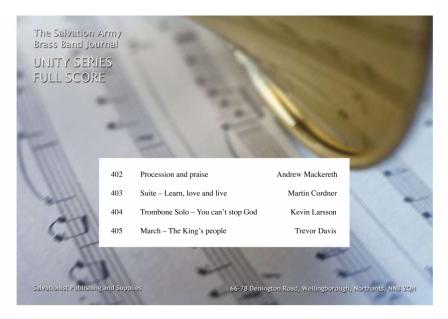
Unity Series Band Journal February 2013 Numbers 402 - 405
No.402 Procession and praise (Andrew Mackereth)Written for an event at Belfast Citadel in November 2011, the tunes included were chosen by the youthful participants themselves!No.403 Suite - Learn, love and Live (Martin Cordner)Written for one of the bands at the 2011 Belfast Temple Music School, the three movements of this suite feature the songs 'Come Fill my cup', 'Such love' and 'Running over' respectively.No.404 Trombone Solo - You can't stop God (Kevin Larsson)Kevin Larsson has take one of his father's tunes and arranged it in the style of a Cuban bolero with the instruction that it is played at 100 beats per minute, or slower!No.405 March - The King's people (Trevor Davis)This march was written for the 125th anniversary of Loughborough Corps and is based on the song 'Come, people of the risen King' which was a particular favourite of the corps.
Estimated dispatch 7-14 working days
 View Music