
Results
-
 £54.99
A Spanish Christmas Carol (Brass Band - Score and Parts) - Millstone, Patrick
Rondeau of the Shepherds is the historical title associated with the well'known Dutch Christmas carol "Midden in de winternacht." The modern Dutch text was written in 1948 by the poet and writer Harry Prenen. The melody, however, has a much older heritage. It appears in the works of 17th' and 18th'century French organ composers such as Louis-Claude Daquin, Claude Balbastre, and Jean-Franois Dandrieu, who often included it in their Christmas suites and nols.The tune itself is believed to originate from a late'medieval Spanish (likely Catalan) Christmas song, traditionally identified as "El Desembre Congelat." Its imagery--shepherds, flutes, and drums--reflects a deep familiarity with biblical narratives while offering a vivid glimpse into the festive, folk-influenced Christmas celebrations of the Middle Ages.Energetic and joyful, this carol works beautifully as an uplifting, up-tempo intermezzo within a church service or seasonal concert program.Duration: 3.00
Estimated dispatch 7-14 working days
-
 £60.99
Ave Verum Corpus (Brass Band - Score and Parts)
Edward Elgar (1857-1934) originally composed this work in 1887, as a Pie Jesu, when he was an organist in the St George's Church in Worcester. Years later, in 1902, he transformed the Pie Jesu into an Ave Verum for soprano and tenor solo, mixed choir and organ. This excellent arrangement was created by Robert van Beringen and skilfully retains the wonderful atmosphere of the original composition. 03:30
Estimated dispatch 7-14 working days
-
 £154.99
Spiriti (Brass Band - Score and Parts)
A Bach chorale stands at the centre of this work (F?r deinen Thron tret? ich hiermit).Anton Bruckner was one of Johann Sebastian Bach's great admirers. His work is full of the spirit of that musical genius. For Thomas Doss, it was Bruckner's spirit that always seemed to be with him while working on Spiriti. Bruckner's spirit is captured in this composition by a quote from the chorale of his Fifth Symphony at the end of the piece.The introduction, written in the style of a funeral march, already displays the first fragments of the chorale. Like splinters they are strewn throughout the first Allegro, combining and recombining in turbulent, powerful tutti passages. As the music becomes more rambunctious, the Bach-like fragments begin to swirl around each other, only to be scattered once more.The middle-section is of a more pensive nature. The Religioso character gives the audience time to reflect. The music is meditative and the quarter-note (or crotchet) elements mimic a soul that is yearning and crying out.The third part of the piece finally leads, by way of minimalist elements and the fragments mentioned earlier, to a magnificent presentation of the Bach chorale. As the church bells ring out, one can almost hear the great masters presiding at the organ. 17:00
Estimated dispatch 7-14 working days
-
£95.00
CINEMA ( for Organ and Brass Band)??" Philip Wilby
In Stock: Estimated dispatch 3-5 working days
-
 £24.50
Praise My Soul - John Goss - Andi Cook
This special arrangement of the well-known hymn tune was crafted by arranger Andi Cook for his recent wedding, to be played by an all-star group of players made up of instrumentalists from Grimethorpe, Black Dyke, Hepworth, Faireys & EYMS. Whilst originally scored for a congregation to sing along to, with optional organ part (included in this publication), Andi had in mind that no one really likes to sing at weddings, and so the final verse was written to wow the congregation and show his wife's family the awe-inspiring sound a brass band can generate. Since then, this arrangement has been used several times and has found favor with adjudicators, winning best hymn tune at the Morley Contest and the Brighouse Contest this year. The work is a perfect addition to any bands repertoire, working perfectly in all manners of occasions.
In Stock: Estimated dispatch 1-3 working days
-
 £50.90
HIGHLAND CATHEDRAL (Brass Band with Organ ad.lib.) - Korb & Roever - Gygli, Andre
Medium
Estimated dispatch 7-14 working days
-
 £60.99
Canterbury Chorale - Jan Van der Roost
This quiet piece with its broad tones was originally written for brass band on request of Robert Leveugle, chairman of the composer's own band: Brass Band Midden Brabant (Belgium). The direct cause was a visit to the beautiful cathedral of the English city Canterbury, in which so many fine compositions sounded throughout the centuries. Later on, Jan Van der Roost rescored this piece for symphonic wind band, exploring the full richness of colours of this formation. Besides solo phrases for several instruments, there are some massive tutti passages making the wind orchestra sound like a majestic organ. By the way: an "ad libitum" organ part adds an extra richness, colour and powerto this piece, making it sound even more broad and grand.
Estimated dispatch 5-14 working days
-
 £40.00
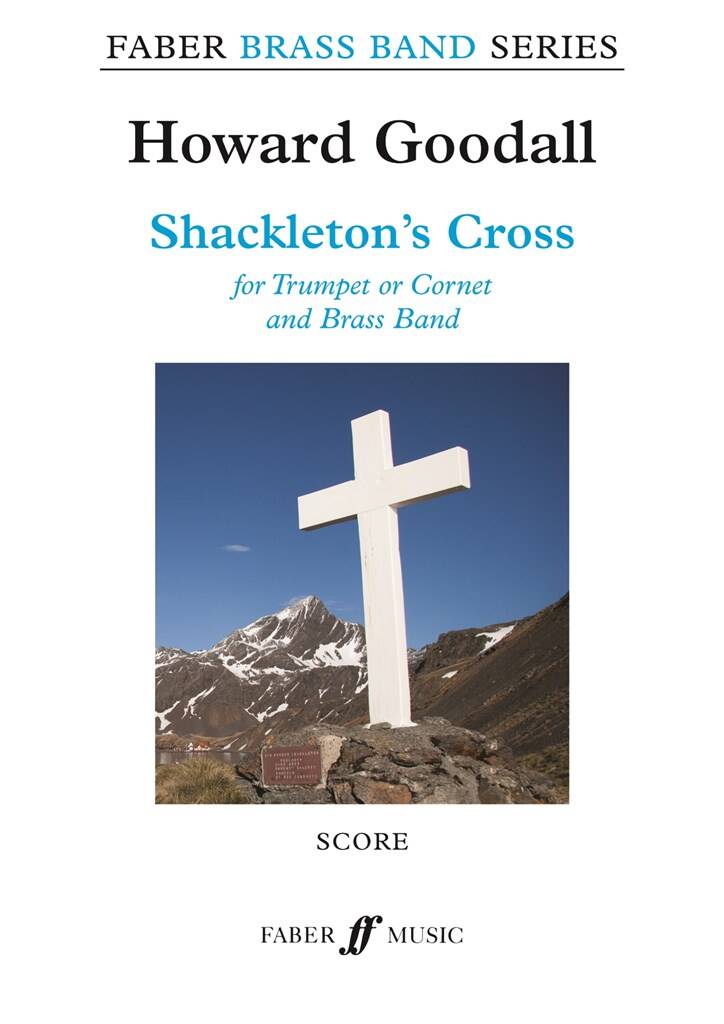
Shackleton's Cross - Howard Goodall
Shackleton s Cross was inspired by a painting created in 1957 by the English artist Edward Seago (1910 1974). The title refers to a cross which was erected to the memory of Sir Ernest Shackleton, who led a number of explorations to the Antarctic. Shackleton died in 1922 whilst on a Polar expedition, and the cross can be found on a promontory at the entrance to the bay at Grytviken Whaling Station in South Georgia. The painting is owned by HRH The Duke of Edinburgh, and was part of an exhibition at Buckingham Palace from October 2011 to April 2012. Originally scored for oboe, trumpet and small orchestra, Daniel Hall s sensitive arrangement fortrumpet or cornet and brass band follows the composer s alternative version for solo trumpet and organ, created for Crispian Steele-Perkins (trumpet) and David Goode (organ).
Estimated dispatch 5-14 working days
-
 £149.99
A Tribute to Henk Badings - Rob Goorhuis
The motivation for composing this test piece for the Concert Division Brassband of the 2001 WMC was Rob Goorhuis's deep respect for one of the greatest Dutch composers of the 20-th century who also enlarged the wind band repertoire in a most valuable way. Goorhuis wanted to light up the "soft and kind" side of the brassband and wrote about this composition : "The basis is a theme of twelve tones wich Badings once played at an International Organ Improvisation Contest in Haarlem.My organ teacher participated in that contest and so the theme remained somehow in the back of my mind." The composer worked out a series of variations and clustered them into bundles ofthree and so the melody kept its diversity while remaining easy to recognise.
Estimated dispatch 5-14 working days
-
 £115.60
Generalstabens Honnormarsj - Oscar Borg - Svein H. Giske
This march was written in 1919 by Norways own March King Oscar Borg (1851-1930).He was born in the town of Halden in the southeast of Norway and received his education at the Royal Academy in Stockholm, Sweden.Upon his return to Halden he became a driving force in the towns musical life in several respects. He conducted choirs, amateur bands and played the organ in church.Borg was also the conductor of 1. Brigades Musikkorps (today The Norwegian Wind Ensemble) from 1881 to 1918.His significance for the Norwegian military bands and their repertoire is unquestionable.He wrote over 60 marches and he played several instruments; the violin, flute, cornet and the organ.This arrangement was written for Askoy Brass Band in 2021.Svein H. Giske
Estimated dispatch 5-14 working days
 View Music