
Results
-
 £31.95
A Tale of Hope (Brass Band - Score only)
The piece tells the story of Chicago lawyer and Presbyterian church elder Horatio Gates Spafford. In 1873, the Spafford family planned a vacation to England, but last-minute business demands prevented Horatio from sailing with them. Tragedy struck when the ship collided with an iron sailing vessel while crossing the Atlantic, killing 226 people, including all four of Spafford's daughters. His wife, Anna, survived the tragedy, and upon arriving in Cardiff, Wales, she sent a telegram to Spafford that simply read "Saved alone." Shortly afterwards, as Spafford travelled to meet his grieving wife, he was inspired to write the hymn It Is Well with My Soul as his ship passed near where his daughters had died. The hymn was subsequently set to music by fellow American Philip Bliss, with the tune named after the ship on which Spafford's daughters died, Ville du Havre.Composer Steven Ponsford has chosen to portray this story in a substantial composition for brass band. Much of the early music is turbulent, reflecting the long voyage, and then the disaster that claimed Spafford's daughters. After a darker 'Grave' section, the hymn It Is Well With My Soul softly emerges, with the piece ending on a note of optimism and hope.Duration: 11.30
Estimated dispatch 7-14 working days
-
 £14.95
Funk Engine (Score Only)
'Funk Engine' was commissioned by Brass Bands England for the 2016 National Youth Brass Band Championships of Great Britain. What Ryan says about the piece:"When I was commissioned to write a piece for the Championships I decided that I wanted to create something a bit different to standard brass band repertoire. I decided that the best way to do this was to go a bit out of my comfort zone and explore some styles of music that I have yet to experiment with. I have always been a great lover of jazz, funk and big band music and the sounds associated with them. In 'Funk Engine' I have tried to capture some of these sounds, however I am a brass-bander at heart and as such I've tried to create a fusion of styles that hopefully combines the best of brass band and jazz into one piece.'Funk Engine' runs continuously, but is divided into three broad sections - fast, slow, fast. The opening is in driving big band style, which segues into a smoother lyrical section; the pace then picks up into a jazz inspired scherzo. After a delicate transition from the basses and trombones the euphonium plays a soaring scale - bringing us into the central movement - which begins with a series of languid solos before descending into a darker interlude. A flugel solo lightens the mood and the music gains momentum leading into a brief cornet chorale before a euphonium solo leads into a percussive climactic passage for full band. As this section winds down to settle on an open fifth, the Hi-hat and Bass section punctuate the texture with the first notes of the final section."The final section of the piece is in similar big band style to the opening and develops material from the first two movements. The percussion feature heavily at this stage and the tension builds towards a final statement, with the piece concluding with a bang!"
Estimated dispatch 7-14 working days
-
 £14.95
Marching to Glory (Score Only)
This energetic piece focusses on the Christian's life goal of 'marching home to Glory' which is described in the first verse of William James Pearson's song.We are marching home to Glory, Marching up to mansions bright,Where bright golden harps are playing,Where the saints are robed in white.There's a golden harp in Glory,There's a spotless robe for you;March with us to the hallelujah city,To the land beyond the blue.
Estimated dispatch 7-14 working days
-
£32.95
Moor of Venice (Dramatic Overture) (Score Only)
Shakespeare, in his tragedy ' Othello, the Moor of Venice,'? tells a tale of treachery and deceit which culminates in the murder of the chaste Desdemona by her demented husband. The Overture re-tells the story in the form of a character study of the Mo
Estimated dispatch 7-14 working days
-
 £24.95
Music from Kantara (Score Only)
4th Section Test Piece 2016 National Finals of the British Brass Band Championship. Music from Kantara was written in 1994 and was first performed by Watership Brass, a band based near Newbury. The title comes from the name of the former home of the composer, in Winchester, a name which was inherited from the previous owners, and which presumably comes from the ruined castle of that name on the Northern coast of Cyprus. The music is not programmatic: it does not tell a story. It is a three-movement suite of absolute music, in a tuneful and straightforward idiom. The slow, central movement calls for playing of a sensitive, vocal nature.
Estimated dispatch 7-14 working days
-
 £37.35
Drink to me only (Flugel Solo with Brass Band) Trad. English Melody arr. Bowen
Enhance your solo repertoire with this evocative and timeless setting for flugel horn. Originally arranged for the New York Staff Band in 1991, this piece offers a lyrical and deeply expressive showcase for the soloist. This arrangement draws from a rich heritage, blending secular and sacred traditions. The melody, famously attributed to Colonel R. Mellish (1777-1817), is inspired by the classic 17th-century poem by Ben Johnson. Within The Salvation Army tradition, this beloved tune is paired with the sacred lyrics of William Drake Pennick, "There is a holy hill of God, its heights by faith I see" (The Salvation Army Song Book, No. 627), making it a versatile choice for both concert and worship settings. This setting is celebrated for its warm, melodic lines, perfectly suited to the mellow tonal qualities of the flugel horn. For those interested in studying the interpretation of this work, the New York Staff Band featured this arrangement on their 1992 recording, Under Three Flags (Triumphonic TRCD 1050). To view a rolling score video featuring Donald Spencer (Flugel Horn Soloist) with the New York Staff Band please visit: www.youtube.com/watch?v=ZRocgjTrli4 Sheet music available from: UK - www.brassband.co.uk USA - www.solidbrassmusic.com Difficulty Level: 4th Section + Instrumentation: Flugel Horn Soloist Bb Soprano Cornet Eb Solo Cornet Bb Repiano Cornet Bb 2nd Cornet Bb 3rd Cornet Bb Solo Horn Eb 1st Horn Eb 2nd Horn Eb 1st Baritone Bb 2nd Baritone Bb 1st Trombone Bb 2nd Trombone Bb Bass Trombone Euphonium Bb Bass Eb Bass Bb Timpani Glockenspiel
In Stock: Estimated dispatch 1-3 working days
-
 £76.00
Concerto for Euphonium (Parts only) - Philip Wilby
Completed on New Year's Eve 1995, Philip Wilby's concerto has already established itself as one of, if not the, greatest concerto for the instrument written so far. Its extended length seeks to explore that fine combination of sustained lyricism and explosive virtuosity which typifies the modern euphonium in the most expert hands. There are two parts which divide into four movements. Part One opens with a sonata structure movement which alternates between a melodic style and some rapid passage work. The intention of the music is a firm and cerebral development of the opening fourth-based motifs. At the tranquil conclusion of this music the second movement bursts in - Zeibekikos - a rapid and extrovert Greek Island dance complete with plate smashing! Part Two re-examines some of the opening material surrounded by cadenzas, and centred upon a short and sustained adagio. The final movement opens with a rapid fugal section which moves inexorably towards a climactic return of the music and tonality of the open
Estimated dispatch 7-9 working days
-
 £64.00
Stories for Saroyan (Parts only) - Elgar Howarth
Stories for Saroyan was written for Robert Childs and has also been performed to great acclaim by his son David Childs. A concerto of stature, graced with the composer's hallmark scoring, intense passion, and enigma! The Saroyan of the title is the American author William Saroyan whose tales inspired the composition. Saroyan, who one the Pulitzer Prize and turned it down, became known for loosly structured, impressionistic plays and stories stressing his belief in people's basic innocence. Elgar Howarth has set the standard of modern brass arranging, and his original works feature largely in the Winwood Music catalogue
Estimated dispatch 7-9 working days
-
 £60.00
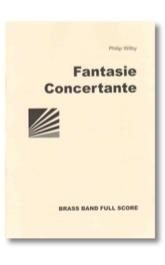
Fantasie Concertante (Score only) - Philip Wilby
This exciting new concerto is a welcome addition to the repertoire of french and tenor horn players alike. Like the 18th-Century Serenade form there are five movements, arranged symmetrically around a slow movement - Soliloquy - which separates movements entitled Burlesque (two) and Valse Caprice (three) respectively. The first and last movements share common material of a more symphonic stature, and the concerto ends with a brisk fugato. The solo horn is (in the band version) accompanied by a quintet of solo players (two cornets, euphonium, trombone, and tuba) who provide the lion's share of the counterpoint and contrast with the main body of musicians who provide musical punctuation in the more sonorous tutti sections. The first movement, Don Quixote's Dream, contains references to Cervantes' famous hero, the Spanish nature of his stories, and the ambling gait of his horseback adventures.
Estimated dispatch 7-9 working days
-
 £74.00
Fantasie Concertante (Parts only) - Philip Wilby
This exciting new concerto is a welcome addition to the repertoire of french and tenor horn players alike. Like the 18th-Century Serenade form there are five movements, arranged symmetrically around a slow movement - Soliloquy - which separates movements entitled Burlesque (two) and Valse Caprice (three) respectively. The first and last movements share common material of a more symphonic stature, and the concerto ends with a brisk fugato. The solo horn is (in the band version) accompanied by a quintet of solo players (two cornets, euphonium, trombone, and tuba) who provide the lion's share of the counterpoint and contrast with the main body of musicians who provide musical punctuation in the more sonorous tutti sections. The first movement, Don Quixote's Dream, contains references to Cervantes' famous hero, the Spanish nature of his stories, and the ambling gait of his horseback adventures.
Estimated dispatch 7-9 working days