
Results
-
 £60.00
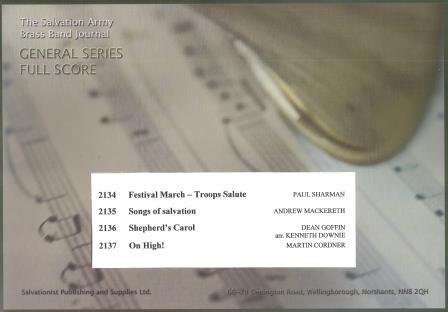
General Series Band Journal August 2014 Numbers 2134-2137
No. 2134 Festival March - Troops Salute (Paul Sharman)Written to mark the retirement of Major John Mott as Bandmaster of the Household Troops Band in 2010, this march features the tunes 'Are you washed?' and 'There's only one flag for me'. No. 2135 Songs of Salvation (Andrew Mackereth)This piece was written for Haaglanden Band in the Netherlands and contains some old Salvation Army Songs; 'Ring the bell, watchman' (T.B. 776), 'Make no delay' (T.B.730), 'Room for Jesus' (T.B. 395), 'Tell me the old, old story' (T.B. 265) and 'Praise God, I'm saved' (T.B. 770).No. 2136 Shepherd's Carol (Dean Jones arr. Kenneth Downie)Originally published in November 1955, this lovely carol was written by father and son, Dean and Henry Goffin, both of whom were Salvation Army officers. Commissioner Sir Dean Goffin was awarded his kinghthood in the Queen's Honours list of 1983No. 2137 On High! (Martin Cordner)Taking its inspiration from the world of rock music, this piece features the song, 'Lord, I lift your name on high'.
Estimated dispatch 7-14 working days
-
 £69.95
Judd: Isaiah 40
Commissioned for the final of the 1996 National Brass Band Championships of Great Britain, Isaiah 40 represents Robert Redhead's only 'test piece' composition to date. The timeless truths contained in Isaiah 40 were written to encourage a people facing very intimidating circumstances. The Jewish people of the 5th Century BC were preparing to make an arduous journey though the desert to return to their ravaged homeland after a lengthy exile in the sophisticated society of Babylon. Both Scripture and music sound out a message of hope, as they view life from an eternal perspective, thus placing change in its proper context. Because 'the Lord is the everlasting God' his word 'stands forever' and 'those who hope in the Lord will renew their strength'. They will not merely get through somehow but 'they will soar on wings like eagles'.
Estimated dispatch 7-14 working days
-
 £7.46
£7.46Euphonium Concerto with Brass Band (Karl Whelan) Soloist Copy
*Karl Whelan's Euphonium Concerto with Brass Band is written in three linked movements: I: Prelude II: Aria III: Scherzo The first movement, Prelude, is in a mirror image sonata form and with its menacing ostinato sets the tone for the entire concerto and also introduces material on which the concerto is based. During this movement, the soloist has the opportunity to display their technical ability as well as the extremes of the instruments range. A chord based on the notes of the ostinato signal the beginning of the second movement, Aria. Here, material from the first movement has been weaved together and moves through a multitude of keys, the soloist is able to show the expressive side of the instrument to create an almost yearning, operatic aria. A reiteration of the 1st subject takes us into an almost march like figure at the beginning of the third movement, Scherzo. This is then interrupted both times by dance-like scherzo which, as with the rest of the concerto navigates itself through different keys leading to the cadenza that even the temple blocks have the the chance of participating in! The concerto concludes with almost a battle between the band (playing fragments of the first and second subjects from the first movement), and soloist who is attempting to have the last word! To view a follow-the-score video of the work please visit: www.youtube.com/watch?v=aEnou67XHqA To purchase the full band set please visit www.brookwrightmusic.com/product-page/euphonium-concerto-with-brass-band-karl-whelan *Please note this download only includes the soloist copy. Sheet music available from: UK - www.brassband.co.uk USA - www.solidbrassmusic.com Instrumentation: Euphonium Soloist Bb Soprano Cornet Eb Solo Cornet Bb 2nd Cornet Bb 3rd Cornet Bb Flugel Horn Bb Solo Horn Eb 1st Horn Eb 2nd Horn Eb 1st Baritone Bb 2nd Baritone Bb 1st Trombone Bb 2nd Trombone Bb Bass Trombone Euphonium Bb Bass Eb Bass Bb Timpani Percussion 1-3
In Stock: Estimated dispatch 1-3 working days
-
 £14.94
Jingle Boogie-Woogie Bells (Brass Band - Ukraine Charity Release) Ovcharenko
This piece was arranged by Halyna Ovcharenko, a Ukrainian composer who was born in Lugansk, a Ukrainian city that is currently under occupation by the Russian Federation. All the proceeds from this sale will go towards the 'A family for every orphan' appeal, which is providing emergency relief services to thousands of children and families in Ukraine. For more information about the charity please visit https://afamilyforeveryorphan.org/ukraine/ Halyna Ovcharenko has been composing music since she was 11. Many of her compositions of various genres have received international awards, but she discovered the world of brass band music with its specific timbre and huge range of musical colors only recently, in 2022, while composing her Vyshyvanka for Grimethorpe Colliery Band. Halyna comments: "I enjoyed my experience. Since then I have had an appetite to write more for brass bands, and here we are - an arrangement of a traditional English Christmas song which I have done especially to raise money for Ukrainian orphans. Their heroic parents stood for my Lugansk, for our Ukraine and for the whole World. I hope that the World will make these children feel that they are not left alone, giving them love, care and joy." The picture on the front cover was drawn by Victoria Lebed, a Ukrainian girl. This PDF download includes parts and score. Sheet music available from www.brassband.co.uk Instrumentation: Soprano Cornet Eb Solo Cornet Bb Repiano Cornet Bb 2nd Cornet Bb 3rd Cornet Bb Flugel Horn Bb Solo Horn Eb 1st Horn Eb 2nd Horn Eb 1st Baritone Bb 2nd Baritone Bb 1st Trombone Bb 2nd Trombone Bb Bass Trombone Euphonium Bb Bass Eb Bass Bb Percussion 1-2
In Stock: Estimated dispatch 1-3 working days
-
 £67.24
King (Concertino for Solo Trombone & Brass Band) Brenton Broadstock
King is a major new addition to the trombone repertoire, commissioned in 2024 by Brett Baker as a deeply personal homage to his mentor, the legendary David King. This compelling Concertino for Solo Trombone and Brass Band seeks to capture the multifaceted personality of its namesake through three distinct movements: i. Rhapsodic: A movement defined by fluid tempo shifts and evocative mood changes. ii. Introspective: A generous, lyrical section that highlights the expressive capabilities of the soloist. iii. Fast & Passionate: A high-energy finale characterized by determination, optimism, and rhythmic drive. The work is masterfully constructed with pitch material derived directly from the name 'David,' establishing a thematic core introduced by the soloist in the opening bars and woven throughout the entire ensemble texture. It is an essential work for soloists looking for a piece that combines technical brilliance with profound musical narrative. To listen to an excerpt featuring Brett Baker and Flowers Band please visit: https://youtu.be/i-px4OmjplQ Duration: Approx. 12.00 minutes Difficulty Level: 1st Section + This PDF download includes the full score and parts. Sheet music available at www.brassband.co.uk (UK) or https://satradecentral.org (USA) Instrumentation:Trombone Soloist* Soprano Cornet Eb Solo Cornet Bb Repiano Cornet Bb 2nd Cornet Bb 3rd Cornet Bb Flugel Horn Bb Solo Horn Eb 1st Horn Eb 2nd Horn Eb 1st Baritone Bb 2nd Baritone Bb 1st Trombone Bb 2nd Trombone Bb Bass Trombone Euphonium Bb Bass Eb Bass Bb Timpani Percussion 1-3 *For bands with only 3 trombones where one is the soloist, the 1st trombone part is covered in other parts throughout the piece.
In Stock: Estimated dispatch 1-3 working days
-
 £38.00
Monteverdi Three Miniatures
ABOUT THIS PIECE: Monteverdi - Three Miniatures, is an engaging and educational brass band arrangement by Adam Taylor, originally composed for the British Open Youth Brass Band Contest at the Guild 2015. This piece masterfully reimagines themes from the works of Claudio Monteverdi, presenting them in a contemporary style that's both accessible and inspiring for modern brass ensembles. Ideal for youth bands and ensembles looking to explore early music in a fresh format, Monteverdi - Three Miniatures offers flexibility and creativity. The arrangement includes adaptable tempos to match your interpretation, a featured duet with parts available in both Bb and Eb, and written percussion parts that can be expanded with additional instruments or streamlined for smaller sections. Players are encouraged to add their own ornamentation, allowing for personal expression and an authentic touch to the music. With its nod to the grandeur of the late Renaissance and early Baroque periods, this piece serves not only as an excellent concert addition but also as a valuable educational tool, introducing young musicians to Monteverdi's timeless work. Dive into this vibrant arrangement and bring the essence of Monteverdi's genius to your next performance. ENSEMBLE: Standard British Brass Band (with adaptations) WHEN YOU BUY THIS PRODUCT, YOU GET: High-quality printed score and parts LEVEL: 1 LISTEN: Click here DURATION: 5-minutes, 30-secondsEXAMPLE SCORE: Click here LEVEL GUIDE: Level 1- Accessible to all Level 2 - c. UK third section and higher Level 3 - c. UK second section and higher Level 4 - c. UK first section and higher Level 5 - c. UK championship section level
Estimated dispatch 5-7 working days
-
 £19.95
As The World Falls Apart... - Jonathan Bates
DURATION: 4 minutes. DIFFICULTY: Moderate. 'As The World Falls Apart' was composed for David Maxted as part of the programme for his BMus Final Recital at the RNCM in May 2017. The work was composed in a time of real political and social divide, with chaos only ever seeming minutes away, and the base of the piece is one of serenity and traniquility amongst the bedlam which is occurring around us all. Originally, the work was planned to be a totally free unaccompanied work for solo horn, however I wanted to make use of the vast space the RNCM concert hall can offer with the surround-sound speakers and decided to utilise a short sound effect track to enhance the feeling of chaos as the music reaches it's peak in dynamic and intensity. AUDIO FILE AVAILABLE FROM COMPOSER - [email protected]. . . .
In Stock: Estimated dispatch 1-3 working days
-
 £188.00
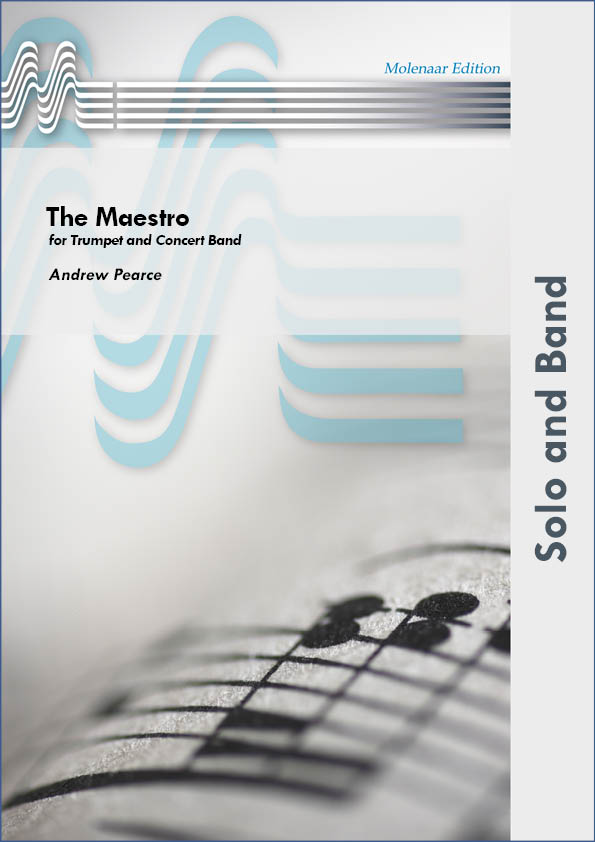
The Maestro - Andrew Pearce
The Maestro, a concertino voor trompet en band, was commissioned by Philip Cobb, principal trumpet of the London Symphony Orchestra. I spent most of Summer 2011 in Prague and London composing this demanding piece, for this was a wonderful opportunity to write a large scale work for one of the world's finest Trumpet virtuosos and I accepted the assignment with great enthusiasm. I also felt a great responsibility to deliver a tour de force for this world class player that was both challenging and enjoyable. Phil was seeking melodies and themes in the piece and had enjoyed my album 'Cinema Symphony', and the dramatic vistas it conjured up. Before writing began, I listened to his beautiful album 'Life Abundant' many times, ensuring I had his sound in my head while writing. The piece represents the many aspects of a contemporary trumpeter's musical life from; brass band chorale (a homage to Phil's musical roots), to the symphonic concert hall to the film recording studio. I am delighted to have had Phil and the International Staff Band record this work under the baton of Dr Stephen Cobb. Its a tour de force not only for the soloist but also for the band and should be an exciting challenge for the very best bands out there.
Estimated dispatch 10-14 working days
-
 £18.00
Scarborough Fair
DescriptionScarborough Fair is a traditional English ballad about the Yorkshire town of Scarborough. The song relates the tale of a young man who instructs the listener to tell his former love to perform for him a series of impossible tasks, such as making him a shirt without a seam and then washing it in a dry well, adding that if she completes these tasks he will take her back. Often the song is sung as a duet, with the woman then giving her lover a series of equally impossible tasks, promising to give him his seamless shirt once he has finished.As the versions of the ballad known under the title Scarborough Fair are usually limited to the exchange of these impossible tasks, many suggestions concerning the plot have been proposed, including the theory that it is about the Great Plague of the late Middle Ages. The lyrics of "Scarborough Fair" appear to have something in common with an obscure Scottish ballad, The Elfin Knight which has been traced at least as far back as 1670 and may well be earlier. In this ballad, an elf threatens to abduct a young woman to be his lover unless she can perform an impossible task.As the song spread, it was adapted, modified, and rewritten to the point that dozens of versions existed by the end of the 18th century, although only a few are typically sung nowadays. The references to the traditional English fair, "Scarborough Fair" and the refrain "parsley, sage, rosemary, and thyme" date to 19th century versions. A number of older versions refer to locations other than Scarborough Fair, including Wittingham Fair, Cape Ann, "twixt Berwik and Lyne", etc.The earliest notable recording of it was by Ewan MacColl and Peggy Seeger, a version which heavily influenced Simon and Garfunkel's later more famous version. Amongst many other recordings, the tune was used by the Stone Roses as the basis of their song "Elizabeth my Dear".
Estimated dispatch 7-14 working days
-
 £10.00
Land Under Wave
DescriptionLand Under Wavewas inspired by the character Tiffany Aching, in the "Wee Free Men" series of books by Terry Pratchett. In the books, Tiffany discovers not only that she is a witch, but that her name in the language of the Wee Free Men means "land under wave". This name signifies her ties to the land of her birth, the chalk downlands of Pratchett's Discworld, because chalk is formed from the beds of prehistoric seas.Listen to an audio preview while following the music below:
Estimated dispatch 7-14 working days
 View Music