
Results
-
 £36.50
A Road Less Travelled By (Brass Band - Score only) - Sparke, Philip
A Road Less Travelled By was commissioned by Palangos Orkestras for the Championship Section of the 2020 European Brass Band Championships held in Palanga, Lithuania.The following was written by the composer, Philip Sparke:The title alludes to a poem by American author, Robert Frost, which appeared in his 1916 collection, Mountain Intervals: The Road Not Taken.In common with most of my larger works, this piece in not programmatic, but purely abstract; there is no extrinsic musical story. The choice of title shares my view of how composers can often develop. There can be no 'destination' in a composer's career, but rather a continuing journey to an unknown place. From piece to piece a composer needs to decide his or her next steps, never really knowing where they might lead. As Frost so eloquently describes, these sorts of instinctive decisions guide all our lives.Set in three movements, which play without a break, A Road Less Travelled By opens with a Moto Perpetuo firmly rooted in classical language, form and syntax. A continuous river of semiquavers, veering from melody to accompaniment and back again, adds drive, every and motion. The second movement, Nocturne, is in the form of a free fantasia; solos for vibraphone, flugel horn and euphonium set the stage for a central cornet solo, quietly echoed by the full band. A triumphal climax is reached before the movement dissolves into a Scherzo Finale. Mercurial and quixotic in nature, this third movement starts jovially until trios for trombones and horns darken the atmosphere. A change of mood and meter leads to a reprise of the opening and a return of the cornet melody, this time accompanied by figures derived from the scherzo theme. A brief coda based on earlier material drives the piece to a close.Duration: 15.30
Estimated dispatch 7-14 working days
-
 £0.99
£0.99Christmas Collection - Words only
Christmas Collection is a newly revised carol book with original, additional and rearranged carols from New Christmas Praise as well as 10 extended pieces. Parts are now also available in large print A4 size!Titles:A child this day is bornA Christmas lullabyA great and mighty wonderAll my heart this night rejoicesAngels, from the realms of Glory (Come and worship)Angels, from the realms of Glory (Iris)Angels we have heard on highA starry nightAs with gladness men of oldA virgin most pureAway in a manger (The manger scene)Away in a manger (Traditional)BethlehemBrightest and best (Spean)Brightest and best (Traditional)Calypso CarolCarol for the NativityCarol of the drumChild of MaryChristians AwakeChrist is born (Il est n)Christ was born on Christmas DayCome and join the celebrationCome, children, come quicklyCoventry CarolDing dong! merrily on highDo you hear what I hear?Gabriel's MessageGaudeteGlory in the highestGlory in the highest HeavenGod of God, the uncreatedGod rest you merry, gentlemenGood Christian men, rejoiceGood King WenceslasGo, tell it on the mountain!Hark the glad sound!Hark! the herald angels singHow far is it to Bethlehem?Huron CarolInfant HolyIn the bleak midwinter (Cranham)In the bleak midwinter (Darke)I saw three ships come sailing inIt came upon the midnight clear (Traditional)It came upon the midnight clear (Willis)I wonder as I wanderJesus, good above all otherJoy to the world!Little baby JesusLittle children, wake and listenLittle DonkeyLittle Jesus, sweetly sleepLo! he comes with clouds descendingLong, long agoLove came down at ChristmasMary's boy childMary's ChildMasters in this hallNoelO come, all ye faithfulO come, ImmanuelO Heaven-sent KingO holy night!O little town of Bethlehem (Christmas Carol)O little town of Bethlehem (Forest Green)O little town of Bethlehem (St Louis)Once in royal David's cityPast three o'clockPersonent HodiePraise ye the LordRing the bellsRise up, shepherd!Sans day carolSaviour's DaySee, amid the winter's snowSilent Night!Softly the night is sleepingStars are shiningStill, still, stillSussex CarolSweet chiming bellsSweet chiming Christmas bellsThe candle songThe cherry tree carolThe first NowellThe holly and the ivyThe infant KingThe light has comeThe shepherds' farewellThe stable doorThe star in the eastThe virgin Mary had a baby boyThey all were looking for a kingThou didst leave thy throneThree kings' marchUnto us a boy is bornWe gather round the manger-bedWe three kings of Orient areWhat child is this?Whence is that goodly fragrance flowing?When wise men came seekingWhile shepherds watched (Cranbrook)While shepherds watched (Handel)While shepherds watched (Winchester Old)Who is he?Zither Carol
Estimated dispatch 7-14 working days
-
£0.99
Christmas Collection - Words only - Large Print
Christmas Collection is a newly revised carol book with original, additional and rearranged carols from New Christmas Praise as well as 10 extended pieces. Parts are now also available in large print A4 size!Titles:A child this day is bornA Christmas lullabyA great and mighty wonderAll my heart this night rejoicesAngels, from the realms of Glory (Come and worship)Angels, from the realms of Glory (Iris)Angels we have heard on highA starry nightAs with gladness men of oldA virgin most pureAway in a manger (The manger scene)Away in a manger (Traditional)BethlehemBrightest and best (Spean)Brightest and best (Traditional)Calypso CarolCarol for the NativityCarol of the drumChild of MaryChristians AwakeChrist is born (Il est n)Christ was born on Christmas DayCome and join the celebrationCome, children, come quicklyCoventry CarolDing dong! merrily on highDo you hear what I hear?Gabriel's MessageGaudeteGlory in the highestGlory in the highest HeavenGod of God, the uncreatedGod rest you merry, gentlemenGood Christian men, rejoiceGood King WenceslasGo, tell it on the mountain!Hark the glad sound!Hark! the herald angels singHow far is it to Bethlehem?Huron CarolInfant HolyIn the bleak midwinter (Cranham)In the bleak midwinter (Darke)I saw three ships come sailing inIt came upon the midnight clear (Traditional)It came upon the midnight clear (Willis)I wonder as I wanderJesus, good above all otherJoy to the world!Little baby JesusLittle children, wake and listenLittle DonkeyLittle Jesus, sweetly sleepLo! he comes with clouds descendingLong, long agoLove came down at ChristmasMary's boy childMary's ChildMasters in this hallNoelO come, all ye faithfulO come, ImmanuelO Heaven-sent KingO holy night!O little town of Bethlehem (Christmas Carol)O little town of Bethlehem (Forest Green)O little town of Bethlehem (St Louis)Once in royal David's cityPast three o'clockPersonent HodiePraise ye the LordRing the bellsRise up, shepherd!Sans day carolSaviour's DaySee, amid the winter's snowSilent Night!Softly the night is sleepingStars are shiningStill, still, stillSussex CarolSweet chiming bellsSweet chiming Christmas bellsThe candle songThe cherry tree carolThe first NowellThe holly and the ivyThe infant KingThe light has comeThe shepherds' farewellThe stable doorThe star in the eastThe virgin Mary had a baby boyThey all were looking for a kingThou didst leave thy throneThree kings' marchUnto us a boy is bornWe gather round the manger-bedWe three kings of Orient areWhat child is this?Whence is that goodly fragrance flowing?When wise men came seekingWhile shepherds watched (Cranbrook)While shepherds watched (Handel)While shepherds watched (Winchester Old)Who is he?Zither Carol
Estimated dispatch 7-14 working days
-
 £49.95
Cornet Concerto (Brass Band - Score only) - Gregson, Edward
The Cornet Concerto was commissioned by Black Dyke Band for their principal cornet, Richard Marshall, and was premiered at the European Brass Band Festival's Gala Concert in Lille, France, on 30 April 2016 by the same performers, conducted by Nicholas Childs.It is challenging work, both musically and technically, and one that exploits the wide range of the instrument's capabilities. Lasting for some 17 minutes, it is in the usual three movements: Sonata, Intermezzo (subtitled 'Of More Distant Memories') and Rondo.The first movement presents four main ideas:Cadenzas (which recur throughout the movement, and indeed appear at the end of the work); a fast and rhythmically energetic motive; Bugle calls (echoing the ancestor of the cornet), and a lyrical and expressive melody, full of yearning. These four ideas are juxtaposed within the broad shape of a Sonata form structure, although here the word 'Sonata' is used in its original meaning of 'sounding together'.The second movement is music in search of a theme, which eventually comes at the end of the movement. In the middle section there are brief quotations, albeit mostly hidden, from three cornet solos written by the Swedish/American composer Erik Leidzen for the Salvation Army in the 1940s and 50s; these are solos I loved as a teenager, and my use of them is by way of tribute, not imitation - a sort of memory bank, just as the main theme of the movement, when it eventually comes, is reminiscent of the tune from my earlier work for brass band, 'Of Distant Memories'.The final Rondo, the shortest of the three movements, is a lively and 'fleet-of foot' Scherzo, its main theme full of cascading arpeggios, but with a contrasting lyrical second theme intertwined in the structure. There is much interplay between soloist and band in the development of the music, but eventually a brief reprise of the opening cadenzas leads to an exciting and climactic coda.Duration: 17.00
Estimated dispatch 7-14 working days
-
 £17.50
Almighty (Brass Band - Score only) - Trigg, Roger
'Almighty' was written for Bandmaster Ross Johnson and Camberwell Citadel Band (Australia) for use on the band's 2009 tour of New Zealand. This energetic work takes its title from the opening line of the well-loved hymn, 'Praise to the Lord, the Almighty, the King of creation' (S.A.S.B. 19). It is based on the hymn tune 'Lobe den Herren' (T.B. 721) and whilst the tune is only heard in its entirety once, fragments of the tune can be heard throughout the music. The music is a shout of acclamation to the King of Kings.
Estimated dispatch 7-14 working days
-
 £40.00
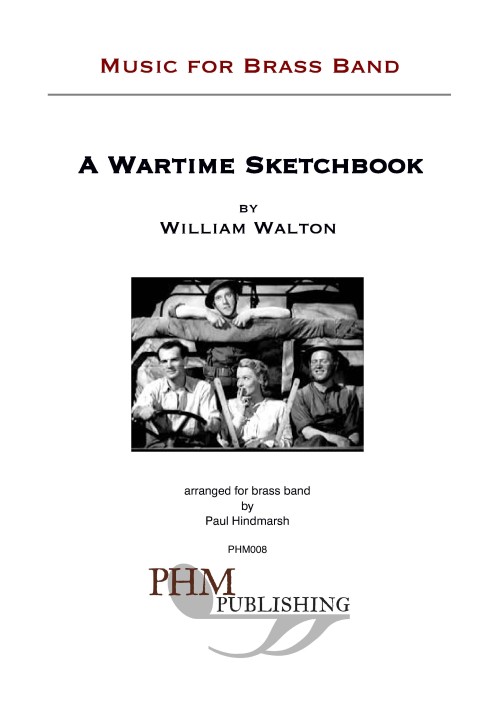
A Wartime Sketchbook (Brass Band - Score only) - Walton, William - Hindmarsh, Paul
Early in 1941 William Walton, 39, received his call-up papers. He was by then one of the most eminent of British composers and was exempted from military service on condition that he provided music for films deemed to be of 'national importance'. Scoring Lawrence Olivier's Shakespeare epic Henry V in 1943 was the most substantial of these wartime projects. His role in patriotic films from 1941 and 42 like The Foreman went to France, Next of Kin, Went the day Well and The First of the Few was to provide appropriate title music and some underscoring at key moments. Walton extracted the most substantial portions of the latter as the popular Spitfire Prelude and Fugue for orchestra. The remaining music remained unpublished until 1990, when Christopher Palmer assembled the highlights into A Wartime Sketchbook. I was intrigued to hear these examples of Walton's wartime music and having discovered that they would fit naturally and idiomatically onto the brass band, I arranged six of the numbers into a suite for Besses o' th' Barn Band, which I was conducting at the time.In 1995 the brass band suite was recorded by the famous Black Dyke Mills Band as part of an all Walton album which I produced for the ASV label (ASV CD WHL 2093). This award- winning CD also included Walton's First Shoot, in the edition by Elgar Howarth, my transcription of movements from Music for Children and two substantial brass versions by Edward Watson of the suite from Henry V (with narrator) and the March and Siegfried Music from The Battle of Britain music.Prologue: This is the stirring title music from Went the day Well, a screen play by Graham Greene about a German airborne invasion of an English village. The main theme leads toBicycle Chase: Characteristic musical high-jinks for J.B.Priestley's The Foreman went to France.Refugees: From the same film, this is a poignant accompaniment to the long march of refugees. As Ernest Irving, the film's musical director, put it, "this really makes your feet sore and your knees sag."Young Siegfrieds: This lively movement comes from the music that Walton composed for The Battle of Britain in 1968, with the assistance of Malcolm Arnold, but which the film's producer rejected. It portrays first the Berliners, cheerfully ignoring the black-out and then, in the trio, the Young Siegfrieds of the Luftwaffe, courtesy of a parody of Siegfried's horn call from Wagner's opera.Romance: A soldier and a Dutch refugee snatch a few tender moments together in Next of Kin.Epilogue: At the end of The Foreman went to France, the French look forward with hope and optimism to eventual liberation.- Paul HindmarshDuration: 14.00
Estimated dispatch 7-14 working days
-
£17.50
The Southern Cross (Brass Band - Score only) - Bowen, Brian
The Southern Cross is one of several excellent marches by Brian Bowen in which he carried on the more sophisticated pattern of British marches by Wilfred Heaton, Leslie Condon and Ray Steadman-Allen. It was written for the Box Hill (Australia) Corps jubilee celebrations in 1970 and formed part of the band's repertoire when it toured Great Britain in the same year. The first half of the march features part of the song, 'March on!' by Klaus Ostby, an early pioneer of Salvation Army music in Scandinavia. The contrapuntal layering of melodies in the trio, especially in the finale where 'March on!' sounds one more triumphant time, is notable, as is the shift to a slower, more stately tempo. The harmonic and rhythmic style also represents the more modern sounds of Salvation Army brass band music in the late 1960s and early 1970s. Right from the opening gestures, listeners at early performances knew that a page had turned in the evolution of the Salvation Army march.
Estimated dispatch 7-14 working days
-
 £45.00
Diversions after Benjamin Britten (Brass Band - Score only)
Suite by Lucy Pankhurst, Simon Dobson, Paul McGhee and Gavin HigginsHaving devised a collective centenary tribute for Michael Tippett at the 2006 RNCM Festival of Brass (Variations on a Theme of Michael Tippett by five eminent composers of brass band music, PHM002), I commissioned this companion piece as a Benjamin Britten tribute for the 2013 festival. In the late 1970s, while researching a book about the English composer, and Britten's first teacher, Frank Bridge (1879 - 1941), I came across a copy of the printed score of Benjamin Britten's Variations on a Theme of Frank Bridge (Op.10) for string orchestra, in which Britten had written descriptive titles for each of the variations suggesting appropriate character traits of his much loved mentor and guide. The character variations are cast in march, song and dance forms.Taking inspiration from Britten's youthful tribute, I invited four award-winning composers, who have all made significant contributions to the brass band medium, to create their own personal reflections on four aspects of Britten's character and music, designed to form a suite of Diversions after Benjamin Britten, but which can also be played separately.Lucy Pankhurst's hauntingly lyrical Prelude: His Depth refers to the emotional and symbolic subtexts that underpin Britten's operas, taking its musical cue from Britten's many arrangements of folk songs. The flugel horn takes a prominent role throughout.Simon Dobson's breathless Scherzo: His Vitality reminds us with its rapid passage work and leaping bass 'groove' that Britten loved tennis and fast cars in his younger days.Paul McGhee's evocative interpretation of the March: His Sympathy represents Benjamin Britten's pacifism, as the composer writes: 'We view the music through the eyes of a pacifist. Whilst war and violence surround us, we do not engage in it and though it continues to happen around us. With the use of muted effects in most of the band throughout the piece, the flugel horn is the lone voice of reason, standing firm against the mechanical and destructive society in which it is forced to live. As the machine of war continues around the lone voice, the voice is gradually dismissed and mocked as the war machine rumbles on into the distance.'In an extended finale, entitled Toccata: His Skill, Gavin Higgins celebrates Benjamin Britten's consummate creativity. For the RNCM Festival of Brass premiere, the four contrasting movements were framed and connected by Britten's Fanfare for St. Edmundsbury for three trumpets, with the trumpet soloists spaced round the hall. I am grateful to the Britten Estate and publishers Boosey & Hawkes for giving permission for the elements of Britten's fanfare to be incorporated in the collective work.- Paul HindmarshDuration: 19.30
Estimated dispatch 7-14 working days
-
 £74.99
Drink to Me Only With Thine Eyes (Cornet Solo with Brass Band - Score and Parts) - Callcott, J. W. - Sparke, Philip
The lyrics to Drink to Me Only with Thine Eyes can be traced to English poet Ben Jonson, a contemporary of Shakespeare. The melody's origin, on the other hand, is not certain. In this three-movement arrangement, Philip Sparke provides the soloist with plenty of substance while respecting the beautiful simplicity of the original tune.Duration: 5:45
Estimated dispatch 7-14 working days
-
 £37.50
Arkansas (Brass Band - Score only) - De Haan, Jacob
This concert work, one of Jacob de Haan works based on American states, is a suite in three movements, based on a well-known folk tune from Arkansas. In the course of this varied work the folk song appears in its complete form and in fragments, in major and in minor, as a ballad in a lyrical orchestration, as a blues, accompanied by a jazzy rhythm and at the end again in its pure form. In the process, all instrumental groups of the brass band get their chance to shine!Duration: 9:30
Estimated dispatch 7-14 working days
 View Music