
Results
-
 £74.99
Olympus (Brass Band - Score and Parts) - Harper, Philip
Selected as the test-piece for the 3rd Section Regional contests of the National Brass Band Championships 2012The music begins with a depiction of the exciting Opening Ceremony where noisy fanfares and sudden swells add to the cosmopolitan flag-waving clamour. Without a break the music leads to The Chariot Race, a fast compound-time gallop with thundering hooves in the basses and percussion, and a heroic melody introduced by the tenor horns. Chariot racing was the main equestrian event in the Ancient Greek Games, which were founded in memory of King Oenomaus. In the Greek legend he suffered defeat in a chariot race to his son-in-law and Zeus' grandson, Pelops, but much of the music is bitter-sweet to symbolise the fact that Pelops had to cheat to win - drawing parallels with some of the issues still facing modern-day athletics.A slow, mystical passage follows, describing The Temple of Zeus at Olympia. The statue of Zeus, who was honoured throughout the Ancient Games' history, was housed inside the temple and was one of the Seven Wonders of the Ancient World. The music depicts this period of the dawn of one of mankind's most ancient civilisations and there is a series of solo passages above a drone.The next section is called The Olympic Flame and a broad and lyrical anthem-like melody develops slowly in the euphoniums, which gradually ascends until the horns can take it over before passing upwards again to the cornets (Higher). The music bursts into bright life at the lighting of the flame and the regular rhythmic pattern which has been established goes through an accelerando (Faster).The final section is called The Olympic Truce and aims to capture the cooperative spirit of the ancient practice of ending wars for the duration of the games. The anthem-like melody makes an affirmatory return (Stronger) and the work ends as it began - with a blaze of colour and a real sense of optimism and global celebration.Citius, Altius, Fortius (Faster, Higher, Stonger)Duration: 11:30
Estimated dispatch 7-14 working days
-
 £29.95
Cairo Red Shield (Brass Band - Score and Parts) - Raikes, Albert Stanley
During World War Two, Salvation Army servicemen serving in Cairo formed a 'Red Shield Club', of which one of the elements was a band. Albert Stanley Raikes (more often known affectionately by his middle name, Stan) was for some time in charge of this band and wrote this march in memory of this wartime combination and the enthusiasts who were, at one time or another, members of it.
Estimated dispatch 7-14 working days
-
£14.95
Cairo Red Shield (Brass Band - Score only) - Raikes, Albert Stanley
During World War Two, Salvation Army servicemen serving in Cairo formed a 'Red Shield Club', of which one of the elements was a band. Albert Stanley Raikes (more often known affectionately by his middle name, Stan) was for some time in charge of this band and wrote this march in memory of this wartime combination and the enthusiasts who were, at one time or another, members of it.
Estimated dispatch 7-14 working days
-
 £60.99
Simply the Best (Brass Band - Score and Parts) - Chapman & Knight - Sebregts, Ron
Simply the Best was first performed by the little known Bonnie Tyler in 1988, but did not gain wide-spread popularity until Tina Turner recorded it barely one year later. The song has become one of Tina Turner's all time greatest hits and is a favourite around the world when something needs celebrating. Ron Sebregts' arrangement really rocks and will make sure your next concert is Simply the Best!Duration: 3.00
Estimated dispatch 7-14 working days
-
 £119.99
Bellum et Pax (Brass Band - Score and Parts) - Roels, Stijn
Bellum et Pax is a composition describing the two ancient concepts of 'war' and 'peace.' While this piece appears to be one single movement, it consists of four sections that flow into one another. Mysterious and threatening tones lead the way into an epic battle between the chaos of war and enlightenment of peace. Peace triumphs, but menacing bass notes at the end symbolise the constant presence and threat of war and violence in the world.Duration: 11:45
Estimated dispatch 7-14 working days
-
£89.95
TUBA CONCERTO (Gregson) (Tuba Solo with Brass Band - Score and Parts) - Gregson, Edward
This work was commissioned by the Besses o' th' Barn Band with funds provided by the Arts Council of Great Britain. It was written for, and is dedicated to, John Fletcher, who gave the first performance in Middleton Civic Hall, near Manchester, on 24 April, 1976, with Besses o' th' Barn Band conducted by the composer. Another interesting feature about the premire was that it was recorded by BBC Television for an Omnibus programme with Andr Previn as presenter. The concerto exists in four versions: with brass band (1976), orchestra (1978), wind band (1984) and piano reduction.The concerto is in three movements, following the usual, quick-slow-quick pattern: Allegro deciso,Lento e mesto, Allegro giocoso. The first movement has a sonata form shell with two contrasting themes, the first one being rhythmic in character, the second lyrical. There is a reference made in passing to the Vaughan Williams Tuba Concerto, but this merges into the other material in the development section.The second movement begins with a chorale, but after the entry of the tuba it leads to a cantabile theme, softly unfolded by the soloist. The opening chorale passage returns, this time briefly on muted brass, and leads to a middle section which is more chromatic in style and soon builds to a powerful climax, where the opening cantabile theme triumphantly returns. The music subsides, returning to the opening chorale and ending peacefully.The finale is light and breezy in style, and is cast in rondo form. After a brief introduction the tuba announces the main rondo theme, which is dance-like and a little jaunty. There are two episodes: the first a broad sweeping tune, the second a slowish waltz and a little jazz-like. After a virtuoso cadenza reference is made to the very opening of the concerto before the work ends with a triumphal flourish.The Tuba Concerto has established itself as one of the main works in the solo tuba repertoire. It has been performed and broadcast in over 40 countries all over the world. There are currently six commercial recordings of the concerto in its various versions.resolution in C major, pointed by a simple but expansive melody towards which the piece has been heading, and ending in a blaze of joyful colour.Duration: 18 mins
Estimated dispatch 7-14 working days
-
£44.95
TUBA CONCERTO (Gregson) (Tuba Solo with Brass Band - Score only) - Gregson, Edward
Brass Band Score onlyThis work was commissioned by the Besses o' th' Barn Band with funds provided by the Arts Council of Great Britain. It was written for, and is dedicated to, John Fletcher, who gave the first performance in Middleton Civic Hall, near Manchester, on 24 April, 1976, with Besses o' th' Barn Band conducted by the composer. Another interesting feature about the premire was that it was recorded by BBC Television for an Omnibus programme with Andr Previn as presenter. The concerto exists in three versions: with brass band (1976), orchestra (1978) and wind band (1984).The concerto is in three movements, following the usual, quick-slow-quick pattern: Allegro deciso,Lento e mesto, Allegro giocoso. The first movement has a sonata form shell with two contrasting themes, the first one being rhythmic in character, the second lyrical. There is a reference made in passing to the Vaughan Williams Tuba Concerto, but this merges into the other material in the development section.The second movement begins with a chorale, but after the entry of the tuba it leads to a cantabile theme, softly unfolded by the soloist. The opening chorale passage returns, this time briefly on muted brass, and leads to a middle section which is more chromatic in style and soon builds to a powerful climax, where the opening cantabile theme triumphantly returns. The music subsides, returning to the opening chorale and ending peacefully.The finale is light and breezy in style, and is cast in rondo form. After a brief introduction the tuba announces the main rondo theme, which is dance-like and a little jaunty. There are two episodes: the first a broad sweeping tune, the second a slowish waltz and a little jazz-like. After a virtuoso cadenza reference is made to the very opening of the concerto before the work ends with a triumphal flourish.The Tuba Concerto has established itself as one of the main works in the solo tuba repertoire. It has been performed and broadcast in over 40 countries all over the world. There are currently six commercial recordings of the concerto in its various versions.resolution in C major, pointed by a simple but expansive melody towards which the piece has been heading, and ending in a blaze of joyful colour.Duration: 18 mins
Estimated dispatch 7-14 working days
-
 £37.95
Connotations (Brass Band - Score only) - Gregson, Edward
Connotations was commissioned for the 1977 National Brass Band Championship finals, held in the Royal Albert Hall, London (the winner, incidentally, of that particular competition was the famous Black Dyke Mills Band).At the age of 32 Gregson was the youngest composer to have received the honour of such a commission. It came at the end of a productive five years writing for the brass band publisher R Smith. Some of those works - The Plantagenets, Essay and Patterns for example, with their direct and tuneful style, have remained popular with brass bands the world over.For Gregson, these were the means by which he sharpened the tools of his trade, preparing the ground, as it were, for his finest work to date - Connotations. He thought of calling the piece Variations on a Fourth, but with due deference to Gilbert Vinter perhaps (Variations on a Ninth), he chose a more appropriate one. As Gregson has written, 'Connotations suggests more than one way of looking at something, an idea, and this is exactly what the piece is about'.Writing a competition piece brought its own problems. 'It has to be technically difficult and yet musically satisfying. I didn't like being kept to an eleven-minute maximum. The inclusion of short cadenzas for less usual solo instruments seems to signify a certain test-piece mentality'.Gregson solved the problems admirably by adopting a symphonic approach to variation form: Introduction - fanfares, a call to attention, in effect Variation 1; Theme - a six-note motif, given a lyrical and restrained first statement; Variation 2 - a delicate toccata; Variation 3 - typically robust in melody and rhythm; Variation 4 - lyrical solos; Variation 5 - a scherzo; Variation 6 - cadenzas; Variations 7-9 - an introduction, fugato and resounding restatement of the theme.Duration: 10.30
Estimated dispatch 7-14 working days
-
£74.95
Connotations (Brass Band - Score and Parts) - Gregson, Edward
Connotations was commissioned for the 1977 National Brass Band Championship finals, held in the Royal Albert Hall, London (the winner, incidentally, of that particular competition was the famous Black Dyke Mills Band).At the age of 32 Gregson was the youngest composer to have received the honour of such a commission. It came at the end of a productive five years writing for the brass band publisher R Smith. Some of those works - The Plantagenets, Essay and Patterns for example, with their direct and tuneful style, have remained popular with brass bands the world over.For Gregson, these were the means by which he sharpened the tools of his trade, preparing the ground, as it were, for his finest work to date - Connotations. He thought of calling the piece Variations on a Fourth, but with due deference to Gilbert Vinter perhaps (Variations on a Ninth), he chose a more appropriate one. As Gregson has written, 'Connotations suggests more than one way of looking at something, an idea, and this is exactly what the piece is about'.Writing a competition piece brought its own problems. 'It has to be technically difficult and yet musically satisfying. I didn't like being kept to an eleven-minute maximum. The inclusion of short cadenzas for less usual solo instruments seems to signify a certain test-piece mentality'.Gregson solved the problems admirably by adopting a symphonic approach to variation form: Introduction - fanfares, a call to attention, in effect Variation 1; Theme - a six-note motif, given a lyrical and restrained first statement; Variation 2 - a delicate toccata; Variation 3 - typically robust in melody and rhythm; Variation 4 - lyrical solos; Variation 5 - a scherzo; Variation 6 - cadenzas; Variations 7-9 - an introduction, fugato and resounding restatement of the theme.Duration: 10.30
Estimated dispatch 7-14 working days
-
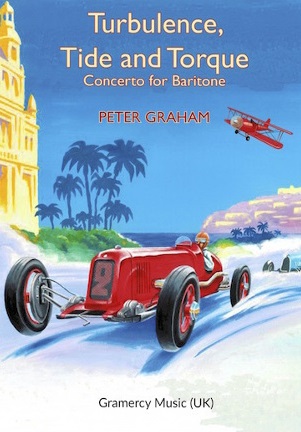 £84.95
Turbulence, Tide and Torque (Baritone Solo with Brass Band - Score and Parts) - Graham, Peter
Concerto for BaritoneTurbulence, Tide and Torque can be considered to be a companion piece to my 2008 Euphonium Concerto In League with Extraordinary Gentlemen, and indeed can be performed on Euphonium (vintage or medium bore instrument preferred). Whereas the gentlemen in question in the latter work were fictional (e.g. Sherlock Holmes and Phileas Fogg), the former pays tribute to three real life women who were very much true pioneers and heroines of their age.Turbulence: Harriet Quimby (b. 1875) was one of the world's best woman aviators, her significant and historic achievement being the first woman to fly across the English Channel. Sadly, in her lifetime very few people were aware of her 1912 accomplishment; potential press coverage was dominated by the sinking of The Titanic only two days before.Grace Darling (b. 1815) is a name much more familiar to the public today, and in her lifetime she was lauded as a national heroine. A humble lighthouse keeper's daughter from Northumberland, her participation in the rescue of survivors from the wrecked paddle-steamer Forfarshire is well documented (a museum dedicated to her achievements located in Bamburgh, the town of her birth). This movement, Tide, develops a main theme from my large scale work Harrison's Dream, reflecting on the souls lost in the disaster.The final movement Torque, opens with a sudden gear change such as might have been undertaken by Dorothy Levitt (b. 1882), the woman's world land speed record holder, in her Napier racing car. Levitt, who following her 1906 record-breaking achievement was described as the Fastest Girl on Earth, went on to write extensively about her experiences, encouraging females to take up motoring through her articles in The Graphic newpaper.Turbulence, Tide and Torque was commissioned by and is dedicated to Katrina Marzella as part of an Arts Council of England funded residency I was awarded with the Black Dyke Band in 2018.- Peter GrahamDuration: 15.00
Estimated dispatch 7-14 working days
 View Music