
Results
-
 £38.00
Is That the Time? (Brass Band - Score and Parts) - Mottram, Paul
'Is That The Time' was written in 2014 for UK national award winning band 'Youth Brass 2000'. It's a showpiece in a jazzy fusion idiom with a full and central role for the kit drummer and percussionists. The temptation must be resisted to play the piece too quickly and in so doing losing the 16th note syncopations inherent within the rhythmic groove. The challenge is not so much one of getting the notes, although there are a few harmonic surprises along the way, as one of playing as a cohesive rhythmic unit. Duration: 4.30. Suitable for 1st Section Bands and above.
Estimated dispatch 7-14 working days
-
 £137.99
Metamorphosis (Brass Band - Score and Parts) - De Haan, Jan
The opening of this three-movement work features an initial appearance of the thematic material that returns in various guises later on in the work. The leitmotiv centres on a minor second.A range of thematic variations is heard in the lively and energetic Metamorphosis One. This movement is interrupted by an atmospheric meno mosso, containing melodic passages that return to the opening theme.Metamorhosis Two is characterised by various changes in tempo and musical character. Seven different soloists transform the thematic material - each in their own way. This eventually culminates in a passionate tutti passage.The source of inspiration for Metamorphosis Three is the so-called BACH-motif, a musical autograph consisting of the notes B flat, A, C and B. This distinctive motif arises from the leitmotiv (here a descending minor second), which continues to evolve through various transpositions and transformations. For the composer, this spectacular last movement is an homage to one of the greatest and most influential composers in the history of music: Johann Sebastian Bach.Duration: 17:00
Estimated dispatch 7-14 working days
-
 £119.99
Bellum et Pax (Brass Band - Score and Parts) - Roels, Stijn
Bellum et Pax is a composition describing the two ancient concepts of 'war' and 'peace.' While this piece appears to be one single movement, it consists of four sections that flow into one another. Mysterious and threatening tones lead the way into an epic battle between the chaos of war and enlightenment of peace. Peace triumphs, but menacing bass notes at the end symbolise the constant presence and threat of war and violence in the world.Duration: 11:45
Estimated dispatch 7-14 working days
-
 £154.99
Spiriti (Brass Band - Score and Parts)
A Bach chorale stands at the centre of this work (F?r deinen Thron tret? ich hiermit).Anton Bruckner was one of Johann Sebastian Bach's great admirers. His work is full of the spirit of that musical genius. For Thomas Doss, it was Bruckner's spirit that always seemed to be with him while working on Spiriti. Bruckner's spirit is captured in this composition by a quote from the chorale of his Fifth Symphony at the end of the piece.The introduction, written in the style of a funeral march, already displays the first fragments of the chorale. Like splinters they are strewn throughout the first Allegro, combining and recombining in turbulent, powerful tutti passages. As the music becomes more rambunctious, the Bach-like fragments begin to swirl around each other, only to be scattered once more.The middle-section is of a more pensive nature. The Religioso character gives the audience time to reflect. The music is meditative and the quarter-note (or crotchet) elements mimic a soul that is yearning and crying out.The third part of the piece finally leads, by way of minimalist elements and the fragments mentioned earlier, to a magnificent presentation of the Bach chorale. As the church bells ring out, one can almost hear the great masters presiding at the organ. 17:00
Estimated dispatch 7-14 working days
-
 £95.00
Tenor Horn Concerto 'Three Gods' (Tenor Horn Solo with Brass Band - Score and Parts) - Gregson, Edward
Edward Gregson's Tenor Horn Concerto (Three Gods) was commissioned by the Belgian tenor horn soloist Tim de Maeseneer for a recording of commissioned works he made in 2024 with his own band, Brass Band Willebroek.The subtitle of 'Three Gods' refers to three mythological Greek Gods: Zeus, Hermes and Apollo. The idea for this came from Gregson's Viola Concerto, which he composed in 2023 and which was similarly subtitled 'Three Goddesses'. Indeed, the first movement of the horn concerto shares some common material with the viola concerto, although the other movements are newly composed.The concerto exploits the noble character of the horn, but the writing is also virtuosic in character as well as lyrical and melodic, demanding an extended playing range of nearly four octaves with a variety of colouration in its sonorities. The unifying motif of the whole concerto is the interval of a rising 5th, heard at the outset. The opening also has some other surprises (both seen and heard).The musical ideas, cast in three separate movements, take their starting point from the characters of the Three Gods in the title:Zeus, ruled as King of the Gods on Mount Olympus, and was the God of Thunder and Lightning and of War. His music is often threatening and violent, but also has a more tender side as portrayed in the lyrical second subject. However, the dominant mood is one of foreboding.Hermes was the great messenger to the Gods who could travel between realms on his winged sandals. Thus, his music is fast, fleet of foot, and mercurial - a dashing scherzo, but with lyrical and expressive moments.Apollo, the God of Music and Dance (and the Sun), symbolises virtue and beauty. This final movement, 'Hymn to Apollo', is mainly slow and hymn-like and cast in a continuous stream of melody passed between soloist and band. Brief fanfares herald a triumphant march, before the music returns to its quiet opening, gradually rising to a triumphant climax with glittering melodic percussion leading the way. The music ends in a blaze of glory!Duration: 17.00
Estimated dispatch 7-14 working days
-
£40.00
Tenor Horn Concerto 'Three Gods' (Tenor Horn Solo with Brass Band - Score only) - Gregson, Edward
Edward Gregson's Tenor Horn Concerto (Three Gods) was commissioned by the Belgian tenor horn soloist Tim de Maeseneer for a recording of commissioned works he made in 2024 with his own band, Brass Band Willebroek.The subtitle of 'Three Gods' refers to three mythological Greek Gods: Zeus, Hermes and Apollo. The idea for this came from Gregson's Viola Concerto, which he composed in 2023 and which was similarly subtitled 'Three Goddesses'. Indeed, the first movement of the horn concerto shares some common material with the viola concerto, although the other movements are newly composed.The concerto exploits the noble character of the horn, but the writing is also virtuosic in character as well as lyrical and melodic, demanding an extended playing range of nearly four octaves with a variety of colouration in its sonorities. The unifying motif of the whole concerto is the interval of a rising 5th, heard at the outset. The opening also has some other surprises (both seen and heard).The musical ideas, cast in three separate movements, take their starting point from the characters of the Three Gods in the title:Zeus, ruled as King of the Gods on Mount Olympus, and was the God of Thunder and Lightning and of War. His music is often threatening and violent, but also has a more tender side as portrayed in the lyrical second subject. However, the dominant mood is one of foreboding.Hermes was the great messenger to the Gods who could travel between realms on his winged sandals. Thus, his music is fast, fleet of foot, and mercurial - a dashing scherzo, but with lyrical and expressive moments.Apollo, the God of Music and Dance (and the Sun), symbolises virtue and beauty. This final movement, 'Hymn to Apollo', is mainly slow and hymn-like and cast in a continuous stream of melody passed between soloist and band. Brief fanfares herald a triumphant march, before the music returns to its quiet opening, gradually rising to a triumphant climax with glittering melodic percussion leading the way. The music ends in a blaze of glory!Duration: 17.00
Estimated dispatch 7-14 working days
-
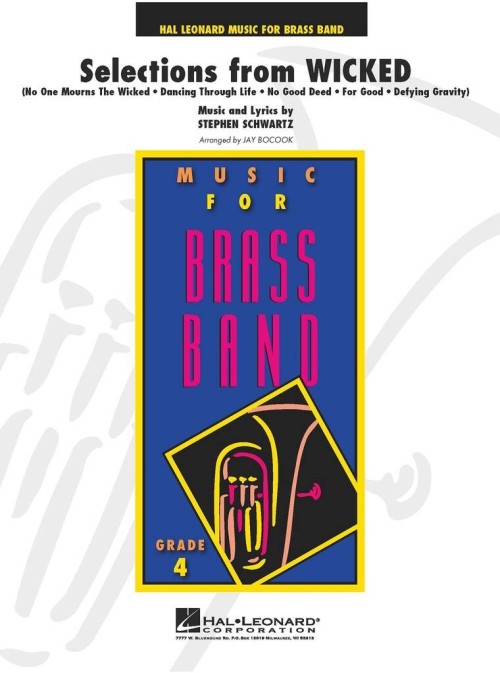 £68.99
Wicked, Selections from (Brass Band - Score and Parts) - Schwartz, Stephen - Bocook & Jeanbourquin
Rarely has a musical in modern times taken Broadway by storm the way this huge hit from Stephen Schwartz has done. The story line of the Wicked Witch of the West is intriguing and the music is filled with depth and beauty. This powerful medley includes:No One Mourns The WickedDancing Through LifeNo Good DeedFor GoodDefying GravityDuration: 8.30
Estimated dispatch 7-14 working days
-
 £23.95
The Red Kite (Euphonium Solo with Brass Band - Score and Parts) - Wiffin, Rob
At one time the Red Kite was close to national extinction in the UK but now it is possible to admire this distinctive bird of prey with its red colouring and forked tail. I love watching it soaring so gracefully through the sky. I attempted to catch that feeling in this solo composed for Martin Smith. In writing it I had in mind making the euphonium glide solitary and effortlessly, occasionally swooping down then reclaiming its high altitude.To create the desired atmosphere, I avoided too many root position chords and enhanced the feeling of floating by adding notes to a lot of the harmony, giving it subtle colour. The harmonic rhythm is slow but the movement switches in the way that the Red Kite can make slight changes of direction by minor adjustments of its tail. On top of this accompaniment the soloist is left to sing with a sense of grace and freedom.- Rob WiffinDuration: 3.45
Estimated dispatch 7-14 working days
-
 £159.99
Other Lives (Brass Band - Score and Parts) - Waespi, Oliver
Other Lives is works perfectly for a competition but can also be programmed as concert work. The dark chords at the beginning of the piece are derived from Der Doppelganger, one of Franz Schubert's late songs. After a short development the music begins to accelerate and find its own shape, gradually moving away from the introduction. The entire first part, Rage, has an intensely agitated character. The ensuing Reflection turns back to the initial chord progression, before a series of interspersing solos explore time and space at a slower pace. After another musical surge, the music is brought close to silence and then gives way to the third part, Redemption. Here, a widely spaced sound field contains a remote allusion to another work by Schubert, Ruckblick. After this farewell, an abstract musical transformation triggers an emotional change, as the initial motifs are now presented in their inversed form in order to create a much brighter harmonic landscape. Moreover, in the last part of the piece, Renewal, the grim, tense atmosphere of the first part is transformed into a great energy.Duration: 18.00
Estimated dispatch 7-14 working days
-
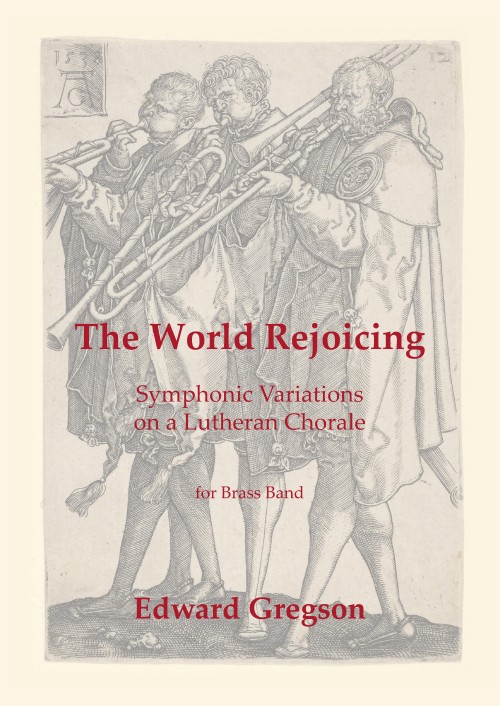 £125.00
The World Rejoicing (Brass Band - Score and Parts) - Gregson, Edward
The World Rejoicing was commissioned by the National Brass Band Associations of Belgium, Netherlands, Norway, Switzerland, and the British Open, as the test piece for their competitions in 2020/21. Although the work was completed in 2019, the pandemic of 2020 meant that these competitions were postponed until 2021/22. The premiere took place in September 2021 at Symphony Hall, Birmingham, UK.In searching for a common link between the brass band traditions of the various European countries that commissioned this work, I considered the fact that hymns have always played an important role in the relationship that brass bands have with their particular communities; and thus I turned to a well- known Lutheran chorale, Nun danket alle Gott (Now thank we all our God), written around 1636 by Martin Rinkart, with the melody attributed to Johann Cruger. A number of composers have incorporated this chorale into their music, most famously J.S. Bach in his Cantatas no. 79 and 192, and Mendelssohn in the Lobsegang movement of his 2nd Symphony (the harmonisation of which is usually used when this hymn is sung).It seemed fitting therefore for me to return to a compositional form I have used many times before (Variations) and to write a work based on this hymn. I have used it in a similar way to that which I employed in my Variations on Laudate Dominum of 1976 - that is, rather than writing a set of variations using elaborations of the complete tune, I have taken various phrases from the chorale and used them within the context of other musical material, applying an overall symphonic process of continuous variation and development. The structure, or sub-divisions of the work, which is through composed and plays without a break, is as follows:Prelude, Capriccio, La Danza 1, Processional, La Danza 2, Arias and Duets, Fuga Burlesca, Chorale, and Postlude.The work, which is around 16 minutes in length, is also partly autobiographical - in the manner say of Strauss's Ein Heldenleben - in that I have incorporated into the score brief quotations from many of my other major works for brass band. In that respect, The World Rejoicing sums up a particular facet of my life as a composer, and reflects the admiration I have always had for what is surely one of the great amateur music-making traditions in the world.Duration: 16.00
Estimated dispatch 7-14 working days
 View Music